







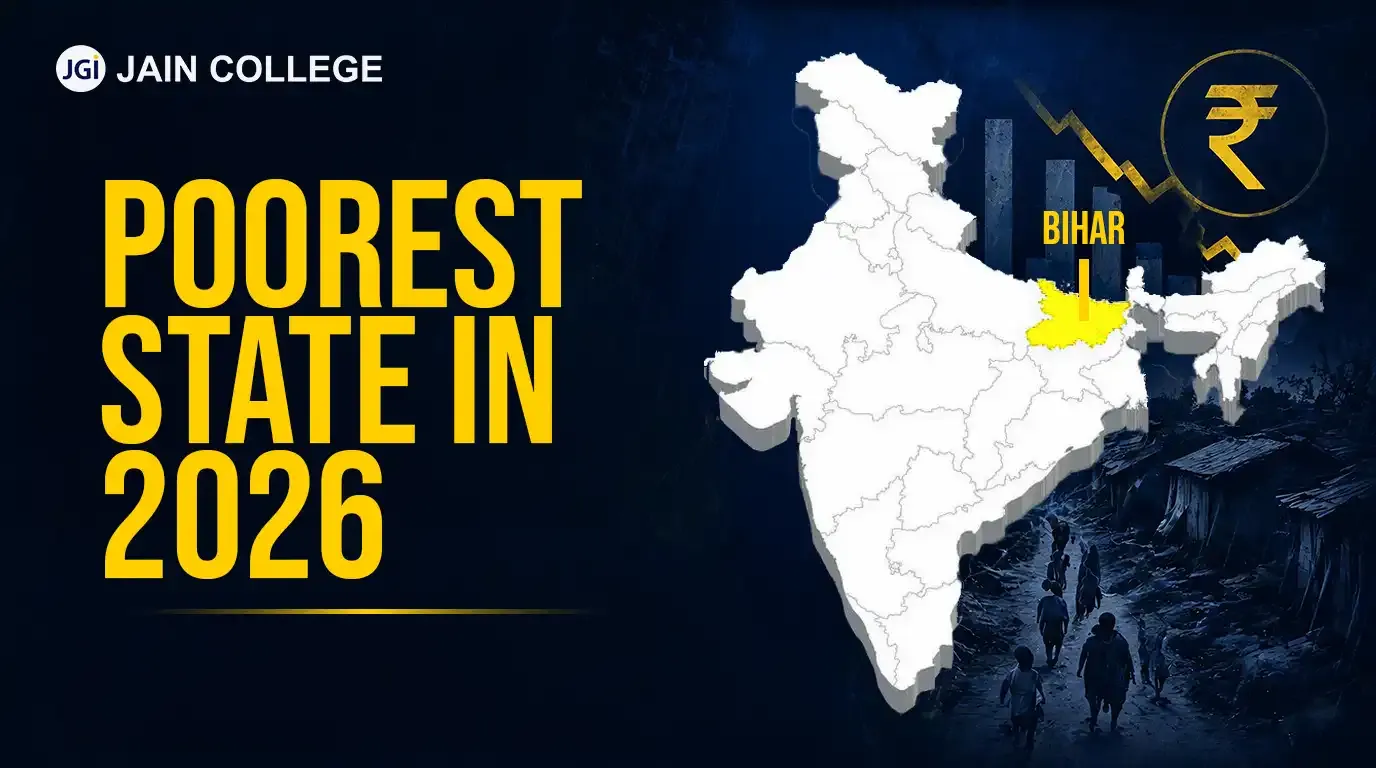
As reported in the NITI Aayog’s National Multidimensional Poverty Index (MPI) edition, Bihar remains the poorest state in India, followed by Jharkhand and Meghalaya.
In 2026, Bihar ranks as the poorest state in India. However, improvements in infrastructure, welfare programmes, and economic reforms are gradually reducing poverty levels across several states.
Bihar remains the poorest state in India, facing difficulties such as limited industrialisation, climate vulnerability, high population pressure and low industrial diversification.
Bihar, the country's second most populous state, is also considered one of the most economically backward regions.
Bihar accounts for nearly 9%–10% of India’s total population, making it one of the most populous states in the country.
As per the Periodic Labour Force Survey (PLFS) 2023–24, Bihar continues to face economic and developmental challenges, including a high poverty rate and the lowest per capita income among Indian states.
The state also records comparatively slow industrial investment growth, which affects employment opportunities and overall economic progress.
These factors highlight the need for sustained development policies and increased investment to improve Bihar’s socio-economic conditions.
More than one-third of Bihar’s population is classified as multidimensionally poor. This is due to a combination of key driving factors, which include the following:
These factors create a cycle of poverty that slows economic growth.
Bihar is the poorest state in India in 2026, based on the NITI Aayog Multidimensional Poverty Index (MPI). This is primarily because the Bihar state has the highest poverty rate and lowest per capita income, followed by Jharkhand and Meghalaya.
States such as Uttar Pradesh, which historically recorded high poverty levels, have achieved significant reductions, lifting millions of people above the poverty line. Jharkhand, Meghalaya, and Madhya Pradesh continue to report high multidimensional poverty levels.
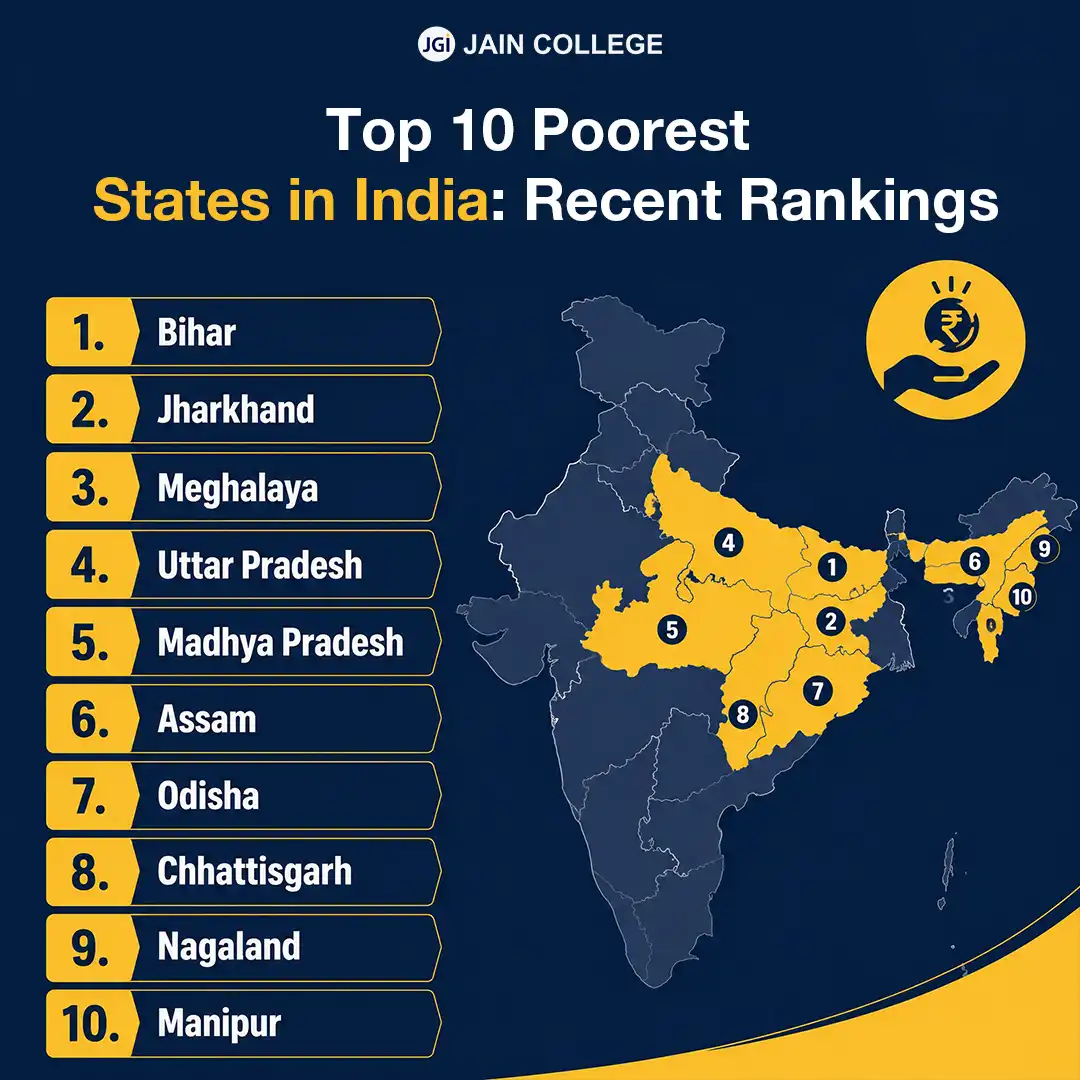
Bihar is consistently ranked as the lowest-income state in India. This state has the highest percentage of its population (approximately 33.76%) living below the poverty line and the lowest per capita income, which is roughly 39% of the national average.
The ranking is determined according to the percentage of people living below the poverty line.
This list of the top 10 poorest states in India summarises poverty percentages, key causes, and where each state faces the most challenges in terms of basic needs, health, education, jobs, and connectivity.
| State | Population in Poverty (%) | Key Issues |
| Bihar | Approx. 33-34% | Low industrialization, floods, unemployment |
| Jharkhand | Approx. 28-29% | Tribal poverty, limited development |
| Meghalaya | Approx. 27-28% | Connectivity challenges |
| Uttar Pradesh | Approx. 22-23% | Large population pressure |
| Madhya Pradesh | Approx. 20-21% | Rural inequality |
| Assam | Approx. 19-20% | Flood impacts |
| Odisha | Approx. 15-16% | Historical underdevelopment |
| Chhattisgarh | Approx. 15-17% | Agriculture dependence |
| Nagaland | Approx. 15-17% | Remote terrain |
| Manipur | Approx. 9-10% | Connectivity challenges |
*Note:
Rankings are primarily based on the Multi-dimensional Poverty Index (MPI)
The above table presents a fact-checked 2025 overview of some of the Indian states with the highest levels of multidimensional poverty and developmental challenges.
Despite rapid economic growth, poverty remains a major developmental challenge in India.
Millions of Indians still struggle to access adequate nutrition.
Multidimensional poverty in India has declined significantly over the past decade, though disparities remain across states.
According to the Press Information Bureau reports, the five most populous states, i.e., Uttar Pradesh, Maharashtra, Bihar, West Bengal, and Madhya Pradesh, represented 65 per cent of India’s extreme poor in 2011-12. By 2022-23, these states contributed to two-thirds of the overall decline in extreme poverty.
According to recent GSDP growth data, fiscal health assessments, and state economic surveys, several Indian states continue to experience slower economic expansion and structural development challenges entering 2026. Factors such as weak industrial growth, infrastructure limitations, fiscal stress, and regional disparities continue to affect their long-term economic performance.
Key issues of poverty in Bihar include the following:
Key issues of poverty in Jharkhand include the following:
Several economic and social factors contribute to poverty in Jharkhand, which are as follows:
Key issues of poverty in Meghalaya include the following:
In Meghalaya, wide regional disparities contribute to a higher incidence of multidimensional poverty. The key issues include:
The poverty level in Uttar Pradesh is approximately 22.93 per cent, which surpasses the national average. Uttar Pradesh is one of India’s largest, poorest and most populous states.
Uttar Pradesh faces significant developmental challenges due to its large population and regional disparities. The state encounters challenges related to:
Addressing poverty and improving nutritional outcomes are crucial for the overall development of the state. Despite being one of the most populous states in India, UP struggles with a lack of adequate infrastructure and social services, contributing to its high poverty level.
Key issues of poverty in Uttar Pradesh include the following:
The poverty level in Madhya Pradesh is approximately 20.63 per cent.
Key issues of poverty in Madhya Pradesh include the following:
Assam remains an economically underdeveloped state compared to national averages in India and is home to 31 million people.
Key issues of poverty in Assam include the following:
Certain districts in Assam exhibit significant regional variations, recording a higher percentage of multidimensional poverty. The key issues include the following:
Odisha continues to be the poorest of the major states in the country.
According to recent multidimensional poverty reports, the percentage of the population in
Odisha is below the poverty line, followed by Bihar and Madhya Pradesh.
Key issues of poverty in Odisha include the following:
According to NSS data, the following characteristics constitute the core poverty group in Odisha:
Chhattisgarh is one of the Indian states with high poverty levels, with 10 million people living in poverty.
Key issues of poverty in Chhattisgarh include the following:
Nagaland, a state nestled in the northeastern hills of India, faces unique challenges in its pursuit of poverty alleviation and rural development.
Key issues of poverty in Nagaland include the following:
In Nagaland, variations across districts result in relatively higher levels of multidimensional poverty in some areas. The key issues include:
Manipur, the north-eastern state with one of India’s highest poverty rates, high youth unemployment, and low growth.
Key issues of poverty in Manipur include the following:
Bihar’s per capita income remains far below India’s national average.
Here is the list of the per capita income of the top ten poorest states in India:
| State | Estimated PMI ($) | Key Economic Challenges |
| Bihar | $69,000 – $76,000 | High population density, low industrialisation, unemployment |
| Uttar Pradesh | $1.0 – $1.1 lakh | Regional inequality, rural poverty, population pressure |
| Jharkhand | $1.1 – $1.3 lakh | Tribal poverty, uneven mining-led development |
| Madhya Pradesh | $1.3 – $1.5 lakh | Rural deprivation, agriculture dependence |
| Assam | $1.4 – $1.6 lakh | Flood-related disruptions, infrastructure gaps |
| Chhattisgarh | $1.5 – $1.7 lakh | Rural inequality, conflict-affected regions |
| Odisha | $1.6 – $1.8 lakh | Cyclone vulnerability, tribal underdevelopment |
| Meghalaya | $1.6 – $1.8 lakh | Connectivity challenges, limited industrial growth |
| Manipur | $1.7 – $1.9 lakh | Geographic isolation, infrastructure limitations |
| Nagaland | $1.7 – $2.0 lakh | Difficult terrain, limited economic diversification |
*Source
Poverty reduction has been fastest in states with improved rural infrastructure and welfare delivery systems.
According to recent multidimensional poverty reports released by NITI Aayog, Bihar has recorded improvements in several social development indicators, including sanitation, housing, electricity access, and school attendance.
Recent government and multidimensional poverty reports indicate that Bihar has shown improvement in housing, sanitation, electricity access, education, and other basic living standards over the past decade.”
In India, poverty is commonly measured using monetary poverty indicators such as the Headcount Ratio and Poverty Gap Index, along with multidimensional measures in recent years.
This indicator is widely used to measure the following:
The poverty gap index measures the average shortfall of the poor’s income or consumption from the poverty line. It indicates the depth or intensity of poverty by estimating how far the poor are from escaping it.
India has used different methods to estimate poverty over time, including:
Many Indian states are experiencing rapid economic expansion; however, some continue to record slower economic growth rates due to structural challenges such as limited industrialisation, fiscal stress, geographic constraints, and weaker investment inflows.
Poor-performing states are identified based on comparatively lower GSDP growth rates rather than overall economic size.
According to NITI Aayog's first Multidimensional Poverty Index (MPI) report, three Indian states: Bihar, Uttar Pradesh, and Madhya Pradesh, account for nearly half of India’s multidimensionally poor population.
The poorest states in India indicate the country’s regional development imbalance.
While Bihar currently ranks as India’s poorest state based on multidimensional poverty indicators, sustained investments in education, infrastructure, and industrial growth are gradually reshaping economic outcomes across several states.
Bihar, Jharkhand, and Meghalaya continue to have high levels of poverty.
However, sustained policy efforts, infrastructure investment, better education, and climate-resilient development strategies can gradually reduce poverty in these states.
Inclusive growth remains essential for India’s long-term economic and social progress.
Poverty is a national issue that requires urgent action. The government has implemented several steps to mitigate poverty. Eradication of poverty would ensure sustainable and inclusive growth of the economy and society.
Stay tuned with JAIN PU College to learn more about the poorest states in India, the richest district in India and other related topics.
What steps should governments prioritise to reduce poverty in India?
Share your thoughts in the comments below.
Poverty refers to a situation when people are deprived of basic necessities of life.
Yes. Climate change plays a major role in increasing poverty across many Indian states.
BPL refers to "Below the Poverty Line". It is a benchmark or a standard measurement set by the Indian government to classify individuals and households in need of government assistance.
The most important factors that lead to poverty in Indian states are poor agriculture, lack of education and technical skills, unemployment and underemployment, rapid population growth, poor infrastructure, natural disasters, and climate vulnerability.
Jharkhand ranks as the second poorest state in India, with approximately 28–29% of its population below the poverty line.
According to recent economic surveys in 2025–26, Bihar’s per capita income is estimated at ?1.3–1.4 lakh, still the lowest among Indian states despite steady economic growth.
As per the most recent available data (FY 2025–26) estimates, the per capita income of Meghalaya is approximately ?74,489 per year.
Yes. Uttar Pradesh is still a poor state. However, Uttar Pradesh has recognised significant reductions in poverty in recent years.
Some of the primary effects of poverty are illiteracy, poor health, poor living conditions, unemployment, malnutrition and hunger, reduced life expectancy and housing problems.

JAIN PU College, a part of the renowned JGI Group, is committed to empowering students with quality education.
Beyond academics, the college ensures its online content reflects the same standard of excellence. Every blog and article is meticulously vetted and proofread by subject matter experts to ensure accuracy, relevance, and clarity. From insightful educational topics to engaging discussions, JAIN PU College's content is crafted to inform, inspire, and add value to its readers, reflecting the institution's commitment to intellectual growth and innovation.
View all Blogs