






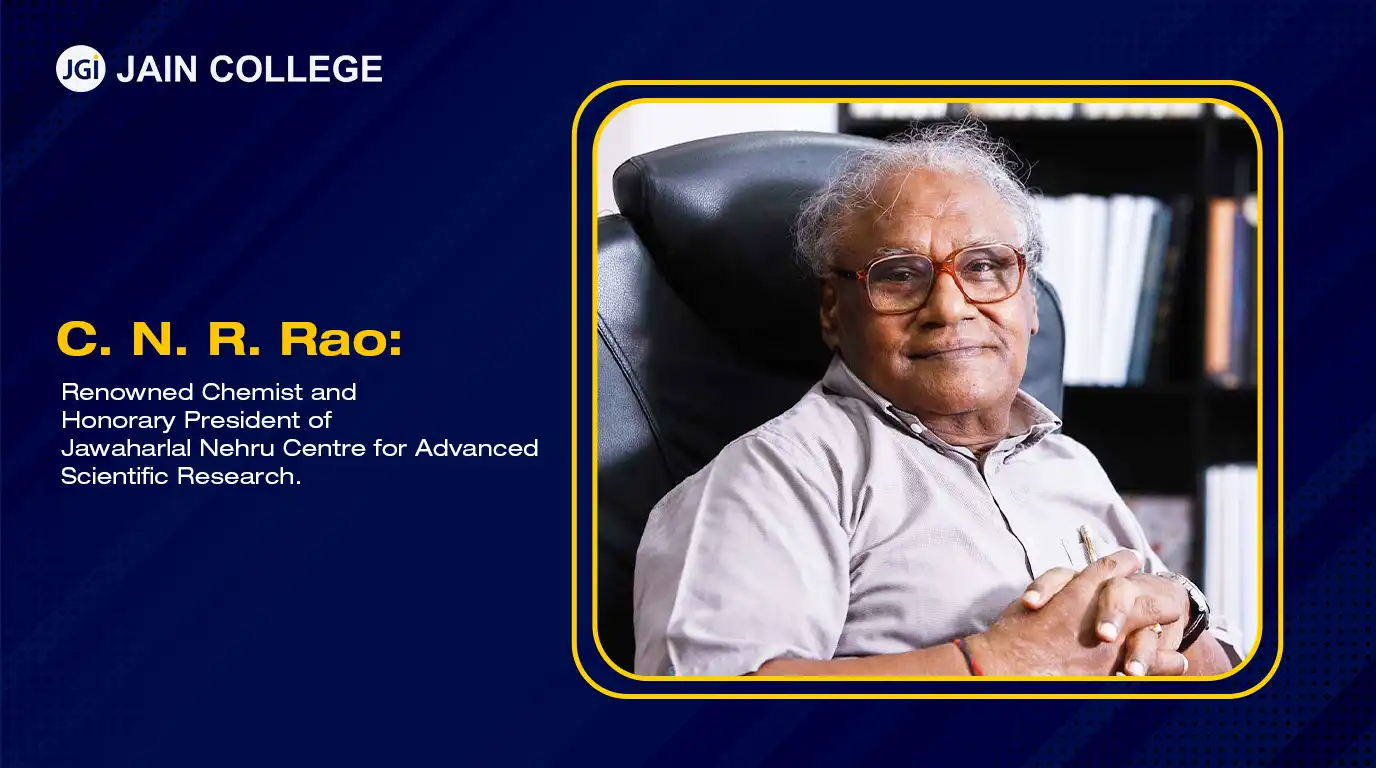
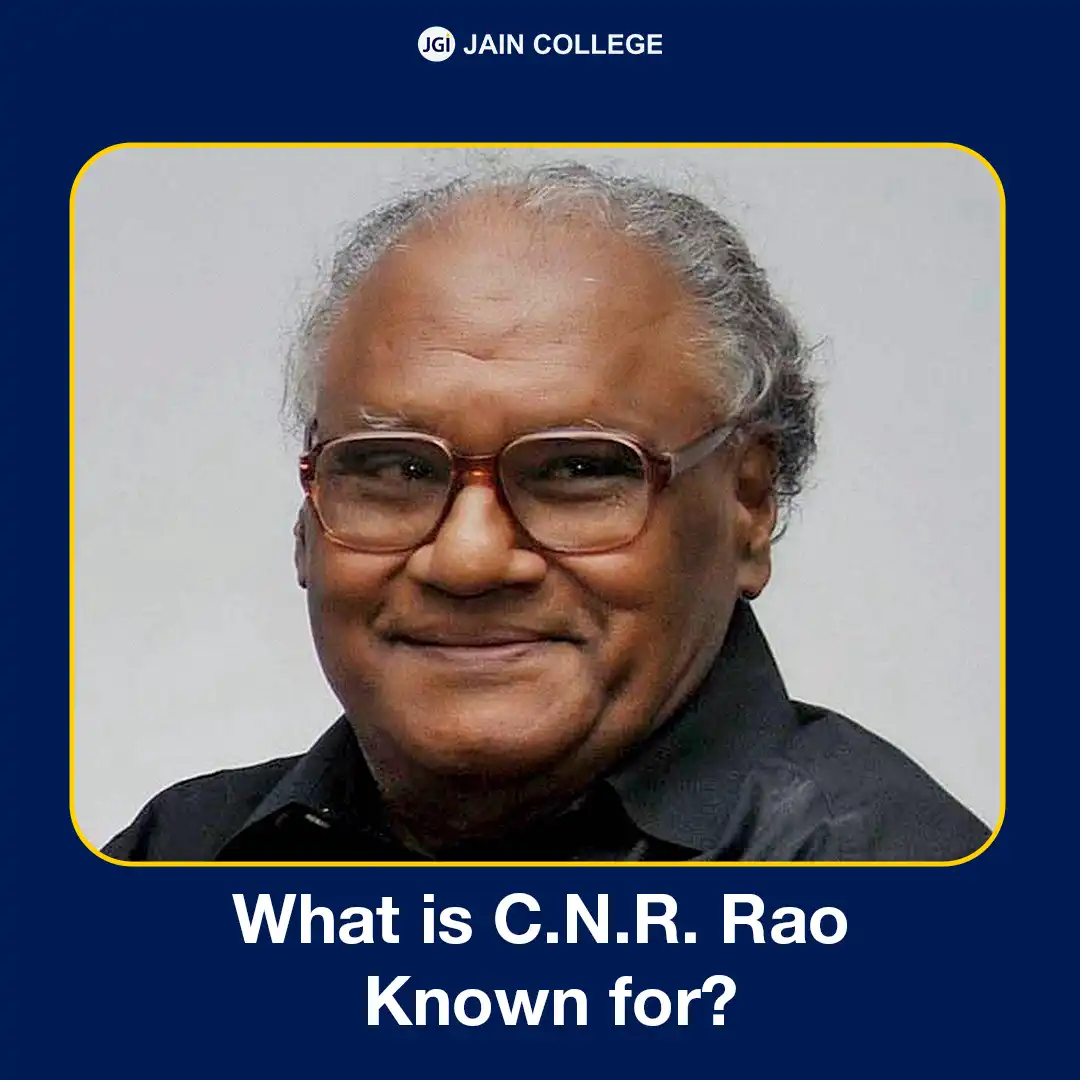
Chintamani Nagesa Ramachandra Rao, popularly known as CNR Rao, is a world-renowned Indian chemist and structural scientist. He is often referred to as the "Father of Indian Nanotechnology". He has dedicated over five decades to the study of solid-state and materials chemistry.
In the field of chemical science, Prof. CNR. Rao (Chintamani Nagesa Ramchandra Rao) holds a prominent position in Chemistry Science. His deep passion for Chemistry inspired his lifelong dedication to scientific research. He is one of the pioneering figures and architects of chemical science who worked in India and internationally with lifelong commitment.
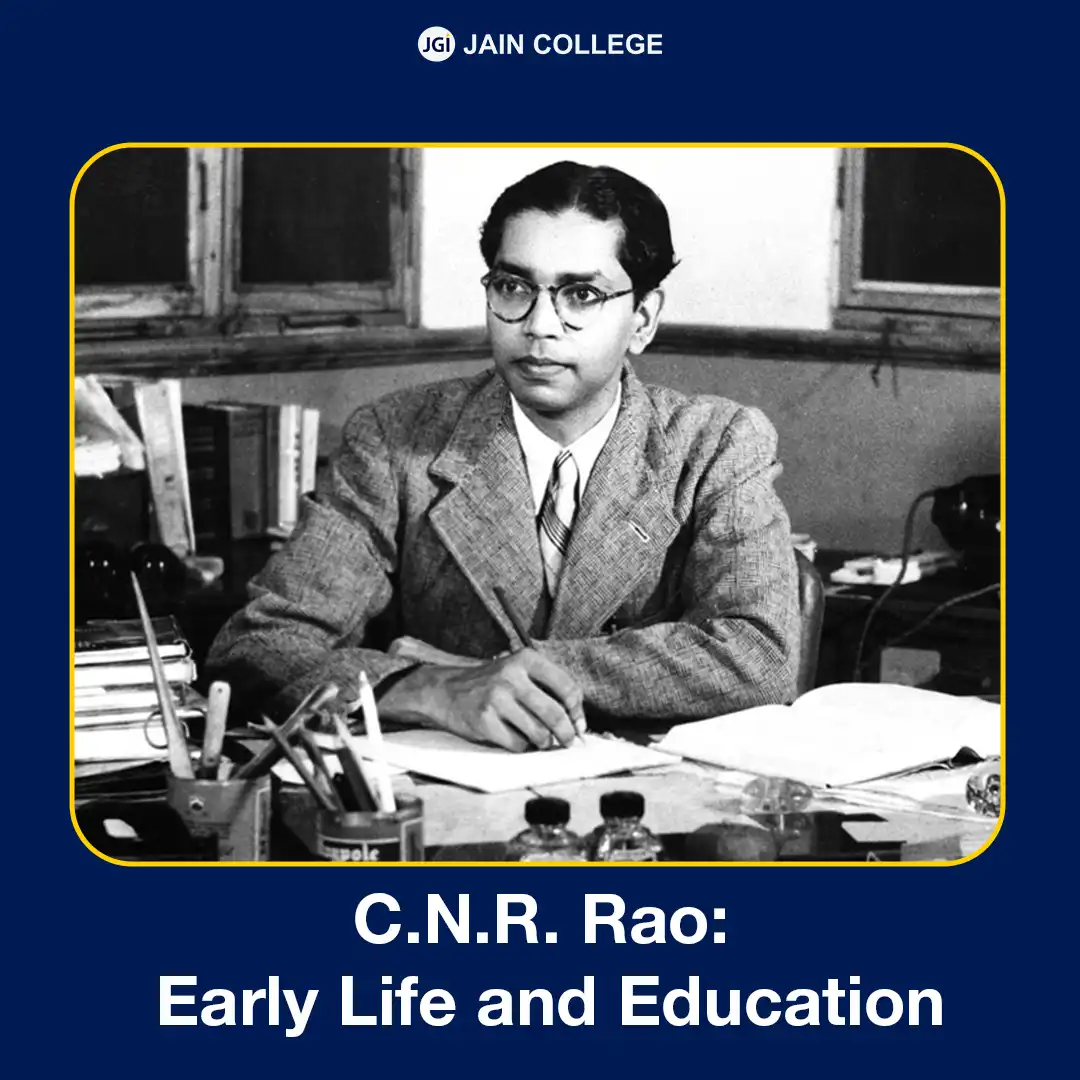
CNR Rao, also known as Chintamani Nagesa Ramachandra Rao. He is one of the world’s leading solid-state and materials chemist.
CNR. Rao, born in Bangalore, was the only child of his parents. From childhood, his mother introduced him to Hindu literature, while his father helped him develop proficiency in English. He is an Indian chemist who has worked mainly in solid-state and structure chemistry.
CNR. Rao did not attend formal elementary school, and he was home-tutored by his mother, who was particularly skilled in arithmetic and Hindu literature. In 1940, at the age of six, CNR. Rao entered a middle school. He was the youngest in his class and helped his peers with English and Mathematics.
In 1944, he successfully completed his secondary examination in first class, for which he received a small amount as a token of appreciation from his father as a reward. Later, he joined Acharya Patashala High School in Basavanagudi, Bangalore. his school played a significant role in shaping his academic career.
After completing his schooling in 1947, CNR. Rao continued his higher education at Central College, Bangalore. Here he developed his communication skills in English and learned Sanskrit.
In 1951, at the age of only seventeen, CNR. Rao obtained his bachelor's degree from Mysore University with first class, and after two years he obtained a master's degree in Chemistry from BHU (Banaras Hindu University).
After completing his master's degree, CNR. Rao was granted a scholarship for his PhD from both IIT Kharagpur and four other foreign universities. In 1958, at the age of twenty-four, he completed his PhD from Purdue University, USA and published his first research papers in the Agra University Journal of Research.
CNR. Rao earned the title “Father of Indian Nanotechnology” because of his pioneering research in nanoscience and nanomaterials. His work laid the foundation for modern nanotechnology research in India.
He was among the earliest scientists to study nanoscale materials and their applications in electronics, energy systems, and advanced technologies.
His research helped India emerge as a global contributor in the field of materials chemistry and nanotechnology.
The field most strongly associated with CNR. Rao is solid-state chemistry. This branch of chemistry studies the structure and properties of solid materials. At first glance, it may sound highly technical, but its applications shape everyday technology. Smartphones, batteries, computer chips, solar panels, and electronic devices all depend on materials science and solid-state chemistry.
Rao’s research explored how atoms arrange themselves inside solid materials and how those arrangements influence physical behaviour. His discoveries improved understanding of metal oxides, superconductors, and advanced materials. Scientists worldwide respected his work because it combined theoretical insight with experimental precision.
What made his contribution extraordinary was consistency. Rao published more than 1,400 research papers and dozens of books during his career. That level of scientific productivity is incredibly rare. Each publication added knowledge to fields connected with materials chemistry and nanoscience. His research output also increased India’s visibility within global scientific communities.
As science evolved, Rao expanded into nanotechnology and advanced materials research. Nanotechnology involves studying matter at extremely tiny scales, often at atomic or molecular levels. This field is revolutionising industries ranging from medicine to electronics and renewable energy.
Rao recognised the importance of nanoscience long before it became globally fashionable. He explored how nanomaterials behaved differently from ordinary materials and how those unique properties could create technological innovation. His research influenced the development of high-performance materials with applications in energy systems, sensors, and electronic devices.
Nanomaterials are often described as the “building blocks of future technology.” Imagine constructing an entire city using microscopic Lego pieces that possess extraordinary strength, conductivity, or flexibility. That is essentially what nanotechnology aims to achieve. Rao’s work contributed significantly to understanding these possibilities.
His contributions helped establish India as an important player in nanoscience research. Instead of remaining dependent entirely on foreign innovation, Indian scientists gained confidence and capability in advanced materials research. Rao’s mentorship also produced numerous scientists who continued expanding this field globally.
| Achievement | Approximate Figures |
|---|---|
| Research Papers | 1,700+ |
| Books Authored | 45+ |
| Citation Count | 58,000+ |
| Scientific Career Span | 60+ Years |
These numbers are not merely statistics. They represent decades of experimentation, mentorship, innovation, and academic discipline. Many scientists produce a handful of impactful papers during their careers. Rao built an entire scientific legacy across multiple generations of researchers.
His publications also enhanced India’s scientific reputation internationally. Academic journals and universities worldwide recognised his contributions. Young Indian researchers began feeling that they too could compete at global levels. That psychological transformation may be one of his greatest invisible achievements.
Scientific publications are one of the clearest indicators of research impact, and Rao’s numbers are astonishing. Reports indicate that he authored over 1,400 research papers and more than 45 books, while some later estimates place his publications even higher. His work received tens of thousands of citations, reflecting enormous influence within the scientific community.
The following timeline highlights key milestones in CNR Rao’s life and career.
CNR Rao’s Life and Scientific Career (1934–Present) |
|
| Early Life | |
| Full Name | Chintamani Nagesa Ramachandra Rao |
| Birth Date | 30 June 1934 |
| Birthplace | Bangalore |
| Nationality | Indian |
| Occupation | Indian chemist, materials scientist, educator, and researcher. |
| Family Details | |
| Parents | Hanumantha Nagesa Rao and Nagamma Nagesa Rao |
| Siblings | None |
| Spouse | Indumati Rao |
| Children | Two children |
| Education & Career | |
| 1951 | Completed a B.Sc. from Mysore University. |
| 1953 | Earned M.Sc. degree from Banaras Hindu University |
| 1958 | Obtained Ph.D. in Chemistry from Purdue University, USA |
| Academic and Research Career | |
| 1959 | Began academic career at the Indian Institute of Science (IISc) |
| 1963 | Joined Indian Institute of Technology Kanpur (IIT Kanpur) as a faculty member |
| 1976 | Returned to IISc to help build the Solid State and Structural Chemistry Unit (SSCU) |
| 1984-1994 | Served as Director of the Indian Institute of Science (IISc) |
| 1984 | Returned to IISc in 1976 to establish and strengthen the Solid State and Structural Chemistry Unit (SSCU) |
| 1989 | Established the Jawaharlal Nehru Centre for Advanced Scientific Research (JNCASR) in Bangalore and became its founding president |
| Scientific Contributions | |
| Pioneered research in: | NanomaterialsMaterials scienceSolid-state chemistryTransition metal oxides |
| Published around 1,800 research papers and over 50 books | |
| Widely recognised as one of the world’s most influential materials chemists | |
| CNR. Rao Recognition and Awards | |
| 1967 | Shanti Swarup Bhatnagar Prize. |
| 1985 | Padma Vibhushan (India’s second-highest civilian award). |
| Early 2000 | Received the Karnataka Ratna |
| 2014 | Awarded the Bharat Ratna, India’s highest civilian honour. |
| CNR Rao is regarded as one of India’s greatest scientists and a global leader in materials chemistry, significantly contributing to India’s rise in advanced scientific research. | |
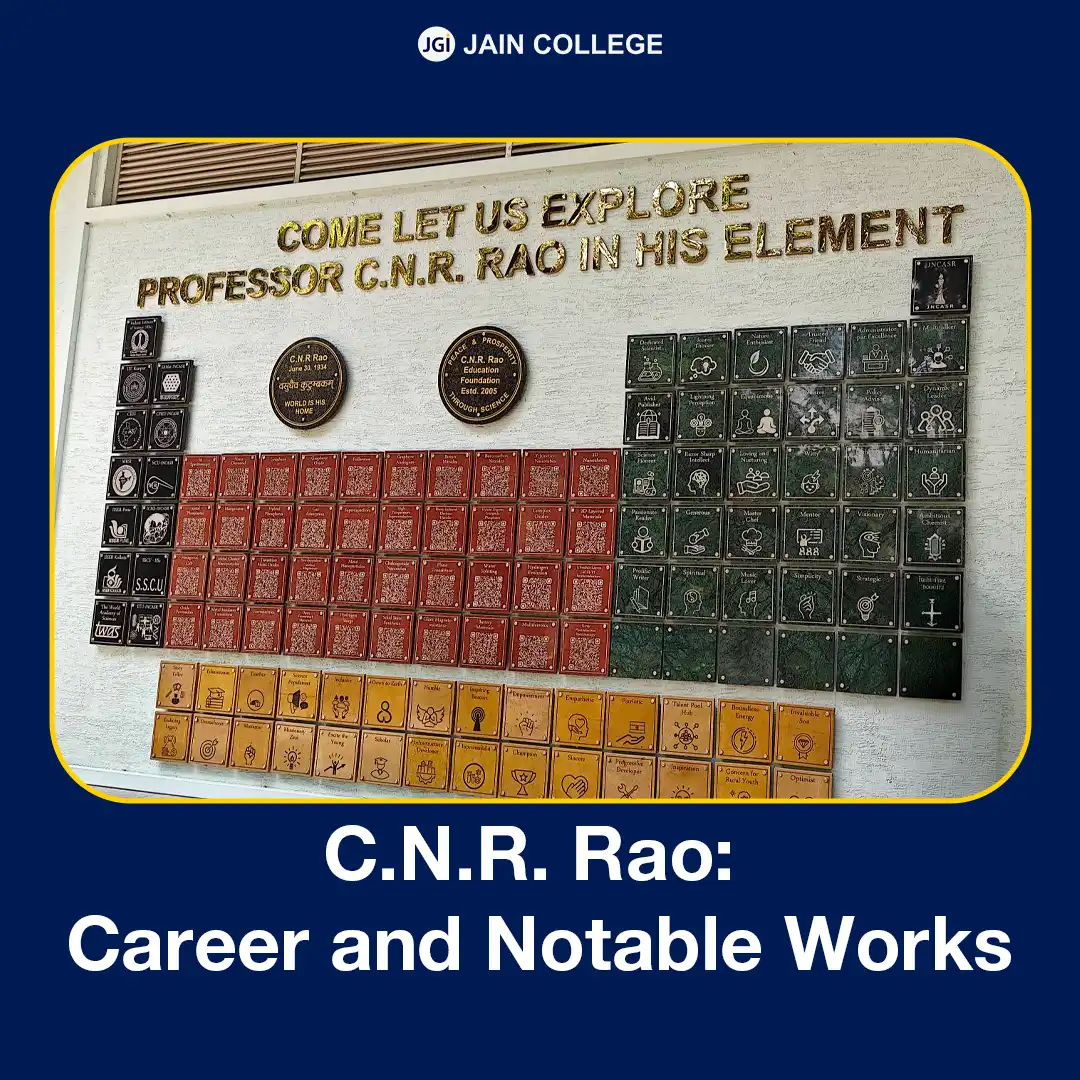
Over a career spanning more than five decades, CNR Rao has made significant contributions to solid-state and materials chemistry, particularly in the study of transition metal oxides and nanomaterials.
CNR Rao is one of the world’s foremost solid-state and materials chemists.
CNR. Rao is one of the earliest to synthesise two-dimensional oxide materials such as La₂CuO₄. His work has led to a systematic study of compositionally controlled metal-insulator transitions. His work on transition metal oxides has led to the relationship between materials' properties and the structural Chemistry of the materials.
| Year / Period | Position / Role | Institution / Organisation | Notable Work / Contribution |
| 1959 | Began Academic Career | Indian Institute of Science (IISc), Bangalore | Started independent research in solid-state chemistry and materials science |
| 1963–1976 | Faculty Member, , Department of Chemistry | Indian Institute of Technology (IIT) Kanpur | Developed advanced research programmes in materials chemistry and trained young scientists |
| 1964 | Fellow | Indian Academy of Sciences (IAS) | Recognised for early scientific contributions |
| 1984–1994 | Director | Indian Institute of Science (IISc), Bangalore | Strengthened interdisciplinary scientific research and modernised research infrastructure |
| 1984 | Founder | Solid State and Structural Chemistry Unit (SSCU), IISc | Established a major research centre focused on materials chemistry |
| 1989 | Founding President | Jawaharlal Nehru Centre for Advanced Scientific Research (JNCASR), Bangalore | Promoted advanced scientific research and interdisciplinary collaboration |
| 1990s–Present | Research Scientist & Mentor | JNCASR | Continued pioneering work in nanomaterials and advanced materials research |
Quick Summary:
CNR. Rao Throughout Career – Visiting Professor
CNR Rao served as a visiting professor at leading international universities such as:
Through these roles, he collaborated with global scientists, shared knowledge, and strengthened international scientific partnerships.
CNR. Rao Research Contributions – Scientist & Author
Some of his major scientific research areas include:
These research contributions have significantly advanced modern materials science and nanotechnology.
CNR. Rao Publications – Author & Editor
CNR Rao has made a significant impact on global scientific literature. He has published more than 1,700 research papers and has written and edited over 50 scientific books.
CNR. Rao Recent Research – Senior Scientist
In recent years, CNR Rao has continued his active research at the Jawaharlal Nehru Centre for Advanced Scientific Research (JNCASR), focusing on the following areas:
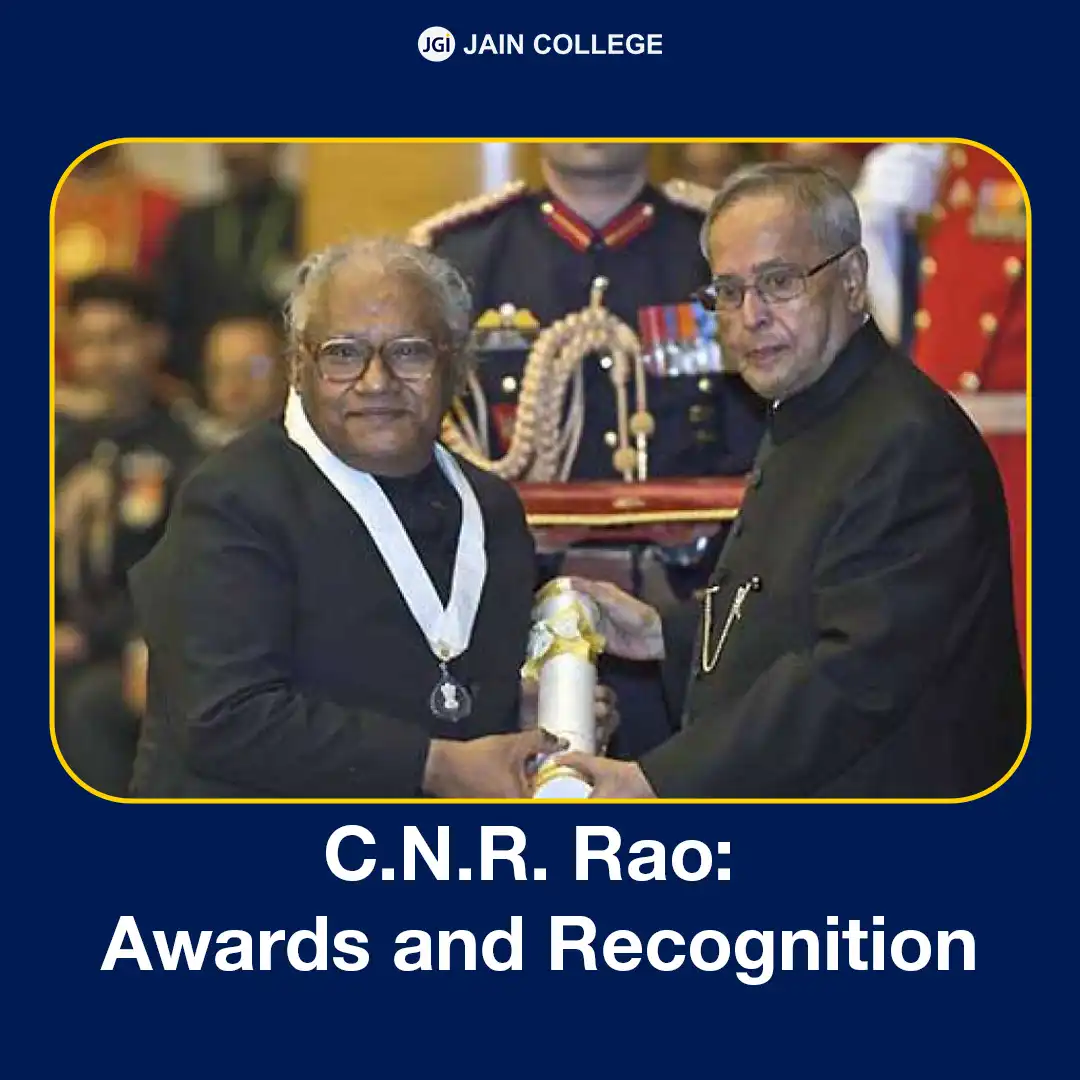
Throughout his life, CNR Rao has received numerous honours, including India's highest civilian award, the Bharat Ratna.
Today, CNR. Rao ranks among the world’s most cited chemists.
CNR. Rao's pioneering research in solid-state and materials Chemistry has earned him global recognition in his career achievement recognition. He has published more than 1,700 research papers and numerous scientific books.
Here is a detailed list of all awards and recognition won by CNR. Rao during his lifetime
| Year | Award | Achievements |
| 1967 | Shanti Swarup Bhatnagar Prize | One of India’s most prestigious science awards. |
| 1974 | Padma Shri | For his contributions to scientific research. |
| 1985 | Padma Vibhushan | India’s second-highest civilian award. |
| 2000 | Hughes Medal | Awarded by the Royal Society, London. |
| 2005 | Dan David Prize | For contributions to materials science. |
| 2005 | Chevalier de la Légion d'Honneur | This is one of France’s highest honours. |
| 2008 | Nikkei Asia Prize | For scientific advancement in Asia. |
| 2014 | Bharat Ratna | For stellar contributions to solid-state and structural chemistry |
| 2017 | Von Hippel Award | For his Advanced Scientific Research |
Young scientists often search for role models who combine intelligence with purpose. Rao represents exactly that combination. His career proves that scientific success is not built overnight. It requires patience, discipline, intellectual curiosity, and resilience.
He also demonstrates why science matters beyond personal achievement. Research influences healthcare, technology, climate solutions, energy systems, and economic growth. Scientists shape the future just as much as politicians or business leaders. Rao understood this deeply and dedicated his life to strengthening scientific culture in India.
Students can also learn from his consistency. Even after receiving global recognition, Rao continued researching, writing, mentoring, and advocating for science. That lifelong commitment distinguishes truly great scientists from temporary achievers.
CNR Rao's contributions to science have not only advanced material Chemistry but also inspired generations of students and researchers. His legacy continues to shape the future of scientific innovation in India and beyond.
Even today, Professor CNR. Rao is active, inspiring, and deeply involved in research and teaching.
His present research interests are focused on graphene, the new wonder material, and artificial photosynthesis. He is continuing his daily schedule of work enthusiastically with full interest and devotion, contributing to scientific research and education through his extensive experience.
Prof. CNR. Rao’s life represents a new era in chemical science, inspiring generations through innovation and knowledge. He keeps motivating students and researchers through his contributions to science and education. His motivating message to the younger generation will help them as a guide for their success.
Visit the blogs on our website at JAIN PU College and learn more about Karnataka's famous personalities, literary authors, poets, and Kannada Jnanapeetha/Jnanpith winners.
What lessons can students learn from CNR Rao’s dedication to science and education?
Share your thoughts in the comments below.
Museums are institutions that collect, preserve, study, and display objects of historical, cultural, artistic, or scientific significance.
The different types of museums are
'Treasures' are the objects of great aesthetic quality and historic value. In some instances an object is considered a ‘treasure’ in a particular museum.
The Treasures of Indian museums is a series that reflects the aesthetic sensibility of Indian artists and their patrons through the ages.
The anthropology collection of the National museum of India includes the following:
The National museum houses an extensive numismatic collection, including:

JAIN PU College, a part of the renowned JGI Group, is committed to empowering students with quality education.
Beyond academics, the college ensures its online content reflects the same standard of excellence. Every blog and article is meticulously vetted and proofread by subject matter experts to ensure accuracy, relevance, and clarity. From insightful educational topics to engaging discussions, JAIN PU College's content is crafted to inform, inspire, and add value to its readers, reflecting the institution's commitment to intellectual growth and innovation.
View all Blogs






.jpg)