





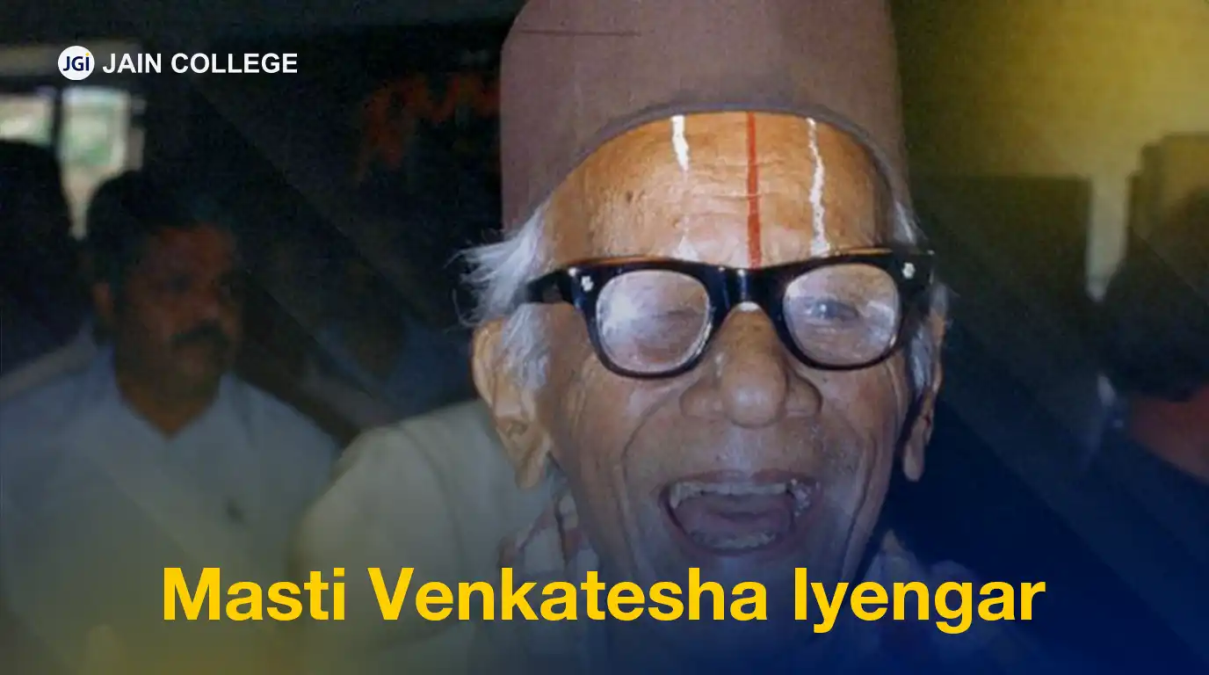
Masti Venkatesha Iyengar was a renowned Indian writer and one of the most respected figures in Kannada literature. He was born in 1891 in Hosahalli village, Karnataka, and is widely known as the “Father of the Modern Kannada Short Story.” Masti wrote novels, short stories, poems, and essays that deeply reflected Indian culture, values, and human emotions. He was awarded the Jnanpith Award in 1983 for his contribution to Indian literature.
Masti was born in 1891 at Hosahalli in the Kolar district of Karnataka to a Tamil-language-speaking Sri Vaishnavite family. He spent his early childhood in Maasti village.
His early days were spent in acute poverty, so much so that after the demise of his father, he had to support his mother on the stipend he received as a merit student.
Masti excelled academically. He obtained a master's degree in English literature (Arts) in 1914 from Madras University and won a gold medal by getting the first rank in the M.A. English examination. In the examination for the Mysore Civil Services, he also placed first.
Starting his career as an assistant commissioner, he rose to occupy the position of excise commissioner. During the days of the Maharaja of Mysore, he held various positions of responsibility in different parts of Karnataka.
After 26 years of service, he resigned in 1943 to protest the denial of the ministerial post he aspired to, especially after a junior was promoted ahead of him. He wrote some pieces in English and then switched to writing in the Kannada language.
As mentioned earlier, Masti was born to a Tamil-language-speaking family, yet he chose Kannada for his literary voice despite his mother tongue. He was popularly referred to as "Maasti Kannada Aasti", which means "Maasti is Kannada's Treasure". He is most renowned for his short stories. The then Maharaja of Mysore, Nalvadi Krishnaraja Wadeyar, also honoured him with the title Rajasevasakta.
Here is an overview of Masti Venkatesha Iyengar and a detailed timeline of his history.
| Masti Venkatesha Iyengar’s Chronology (June 6, 1891 – June 6, 1986) | |
| Early Life | |
| Full Name | Masti Venkatesha Iyengar |
| Pen name | Srinivasa, Masti |
| Birth Date | June 6, 1891 |
| Birthplace | Hosahalli, Malur taluk, Kolar district, Karnataka |
| Nationality | Indian |
| Occupation | Civil Servant (Mysore Civil Service), Professor, Writer, Author |
| Genre | Fiction (Short stories, novels) |
| Literary movement | Navodaya |
| Died on | June 6, 1986 (aged 95), Bengaluru, Karnataka, India |
| Family Details | |
| Parents | Ramaswamy Iyengar and Tirumalamma |
| Spouse | Masti Subbamma |
| Children | Six daughters |
| Education & Career | |
| Early Education | Maasti village School |
| 1914 | Master's degree in English literature (Arts) from Madras University |
| Literary Contributions | |
| Epics | Shri Rama Pattabhisheka (Coronation of Lord Rama) |
| Autobiography | Bhaava (Three Volumes) |
| Novels |
|
| Stories and Anthologies |
|
| Plays |
|
| Recognition and Awards | |
| 1929 | He was the youngest person to preside over the annual conference of the Kannada Sahitya Parishad held at Belgaum. |
| The Maharaja of Mysore honoured Masti Venkatesha Iyengar with the title Rajasevasakta. | |
| The Universities of Karnataka and Mysore conferred on him the honorary D.Litt degree. | |
| 1943 | Elected as the Vice-President of the Kannada Sahitya Parishad. |
| 1968 | Received the Sahitya Akademi award for his short stories. |
| 1974 | Fellow of the Sahitya Akademi |
| 1983 | He received the Jnanpith award for his historical novel, Chikaveera Rajendra. |
Masti Venkatesha Iyengar has the nickname "Masti," named after the village where he spent most of his childhood.
Masti Venkatesha Iyengar is one of the famous icons in Kannada literature.
Right from a young age, he wrote both in English and in Kannada: more than 123 books in Kannada and 17 in English.
In those days when Masti was providing service to Kannada literature, it was an era when English was particularly strong. The Kannada literary field, like other languages, received little respect.
In the late 1920s, Masti Venkatesha Iyengar and his friends decided to work to promote Kannada culture and literature and to improve the scarcity of works in the Kannada language. This scheme led to the publication of several books associated with the Karnataka Navodaya literary movement.
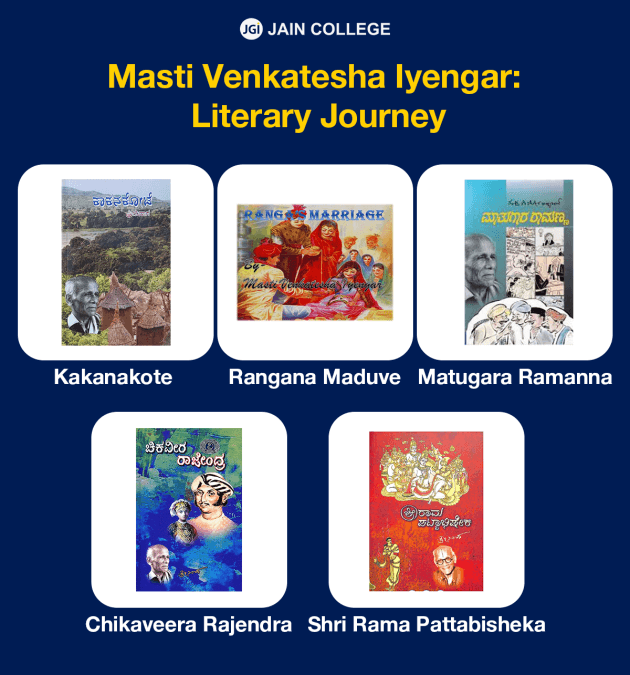
Masti Venkatesha Iyengar's literary works included novels, poetry, drama, criticism, journalism, and largely short stories. His first work was Rangana Maduve (meaning marriage to Ranga) in 1910, and his last work was Matugara Ramanna (meaning talkative Ramanna) in 1985, both in Kannada.
*Note: (Matugara Ramanna is also referred to as Maatugara Ramanna or Mathugara Ramanna.)
For his contribution to Kannada literature, he was given the epithet Maasti Kannada Aasti. This refers to the Kannada’s Treasure”.
Here is the detailed literary contribution of Masti Venkatesha Iyengar.
Over a span of 70 years, Masti Venkatesha Iyengar wrote:
Masti Venkatesha Iyengar was a bold writer whose award-winning novels, such as Chikaveera Rajendra, reflected his aggression. His literary contributions earned him the following accolades:
Masti Venkatesha Iyengar was a pioneering Kannada writer and civil servant. He is also referred to as the "Bheeshma Pitamaha" of modern Kannada fiction.
In addition to shedding light on human emotions, social norms, morality, and culture, Masti's work offers profound conclusions about human behaviour.
Masti Venkatesha Iyengar has had a profound impact on Kannada literary traditions, particularly as a foundational figure whose realistic prose inspired subsequent generations. He played a pivotal role in standardising modern Kannada prose through his innovative short stories, which elevated the genre.
In the literary world, Masti Venkatesha Iyengar is known by his pen name, ‘Srinivasa’. The collections of his short stories are regarded as the fathers of modern Kannada literature. He began his literary career as a short story writer. His first short story, Rangana Maduve, was published in 1910. His last work was Matugara Ramanna, written a year before his death in 1986. In all he has written more than 100 stories, through which he is famously known as the father of modern Kannada short stories.
Why is Masti Venkatesha Iyengar called the father of Kannada short stories?
Masti Venkatesha Iyengar is famously known as the father of modern Kannada short stories. This honour primarily stems from his numerous enduring contributions.
Masti Venkatesha Iyengar, a highly regarded Kannada writer known as ‘Masti’, has produced an extensive body of work that includes short stories, novels, plays, poetry, philosophical meditations, essays, biographies, and an autobiography. There was a kaleidoscopic view of life in Masti's stories. He was of a humane and empathic nature. His writings were an attempt to understand life and its unending mysteries.
Masti Venkatesha Iyengar has gained appreciation for his service to various governmental departments with the utmost diligence and professionalism. Masti’s influence and imprint on Kannada literature have endured for generations. In his writing, he displayed these characteristics, maintaining a dispassionate distance from both the public and people.
Masti has received many awards and honours for his versatile service. Here are some of them:
The historical novel Chikaveera Rajendra is a powerful and tragic tale of the last Raja of Kodagu (Coorg). This novel received the Jnanpith Award.
Masti Venkatesha Iyengar was one of the brave Indians who served the British government without servitude. He resisted servitude not through open rebellion but through quiet intellectual independence and ethical firmness. For the sake of 'his Kannada people', he shifted his primary literary expression to Kannada. Even today, Masti's books, written in simple Kannada, are accessible to everybody.
Today, Masti Venkatesha Iyengar is known as a producer of Kannada literary heritage and as a writer who redefined the Kannada language and literature in a way that is beautiful, meaningful, and beyond the norm.
With the Jnanpith Award in 1983, one of India’s highest literary honours, his recognition and legacy expanded both within Karnataka and across India’s literary community. Several factors contributed to his growing influence as a writer, thinker, and cultural icon.
Some of his legacy includes:
Masti Venkatesha Iyengar is a renowned figure in Kannada literature, having played a significant role in the Navodaya literary movement that revolutionised Kannada literature.
Masti Venkatesha Iyengar died on his 95th birthday in 1986. Generations of fans continue to read his works, even years after his demise. Masti's writings, whether poetry, novels, or stories, shaped the intellectual and emotional landscape of an entire generation. He used literature to highlight India's culture and values.
Discover Karnataka's famous literary authors, poets, and other related articles on JAIN PU College's blogs.
The Kannada novel Chikaveera Rajendra was written by Masti Venkatesha Iyengar. This historical novel won the author's prestigious literary honour, the Jnanpith Award, in 1983.
Chikka Veerarajendra was the last king of Kodagu (Coorg) before it fell into British hands.
Masti Venkatesha Iyengar's first work was a short story, Rangana Maduve. It was published in 1910.
The pen name of Masti Venkatesha Iyengar is Srinivasa/Masti.
Over a course of seventy years, Masti wrote more than 123 books in Kannada and 17 books in English.
?r?r?ma pa???bhi??ka was the famous Kannada epic written by Masti Venkatesha Iyengar. It is based on the coronation of Lord Rama.
Bhaava, a set of three volumes, is an autobiography written by Masti Venkatesha Iyengar. This book includes Bhaava Samagra, which refers to the works of Masti Venkatesha Iyengar.
To keep Masti’s legacy alive, members of the Masti family run a trust called the Masti Venkatesha Iyengar Jeevana Karyalaya Trust at the 102-year-old house of the litterateur.
Masti Venkatesha Iyengar's last work was Matugara Ramanna. He wrote this short story a year before his death in 1986.

JAIN PU College, a part of the renowned JGI Group, is committed to empowering students with quality education.
Beyond academics, the college ensures its online content reflects the same standard of excellence. Every blog and article is meticulously vetted and proofread by subject matter experts to ensure accuracy, relevance, and clarity. From insightful educational topics to engaging discussions, JAIN PU College's content is crafted to inform, inspire, and add value to its readers, reflecting the institution's commitment to intellectual growth and innovation.
View all Blogs