






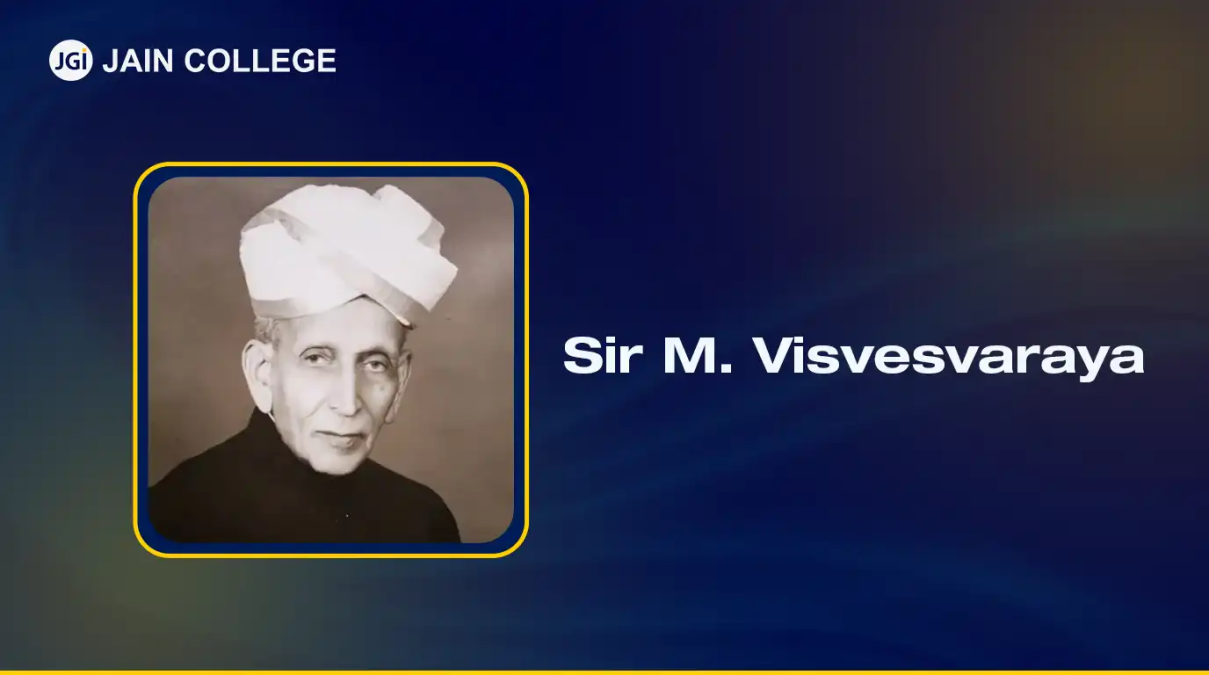
Here is an overview of Sir M.Visvesvaraya achievements, life and career.
| Sir M. Visvesvaraya (Sept. 15, 1861 – April 14, 1962) | |
| Early Life and Family Background of Sir M. Visvesvaraya | |
| Full Name | Sir Mokshagundam Visvesvaraya |
| Birth Date | Sept. 15, 1861 |
| Birthplace | Muddenahalli, Chikkaballapura district, Karnataka |
| Nationality | Indian |
| Profession | Civil Engineer and Statesman |
| Education | Engineering |
| Died on | April 14, 1962 (aged 100) |
| Parents | Father Mokshagundam Srinivasa Sastry and Mother Venkatalakshmiamma |
| Education and Career | |
| Education | B.A. (Bachelor of Arts) from the University of MadrasPursued civil engineering from the College of Science in Pune |
| Contributions | |
| 1899 | Block Irrigation System |
| 1903 | Automatic Water Floodgates |
| 1917 | Founder of Bengaluru Engineering College |
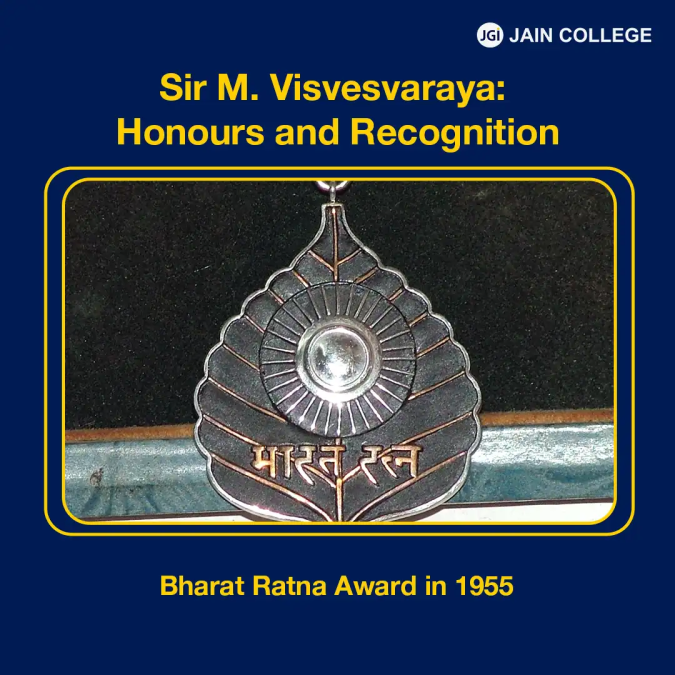
| Recognition and Awards | Bharat Ratna, in 1955 |
Let us discover the legacy of M. Visvesvaraya, India's leading engineer, whose innovative contributions transformed infrastructure and inspired generations.
Sir Mokshagundam Visvesvaraya is called the man with values because he lived by discipline, integrity, punctuality, and uncompromising professional ethics, which he practised consistently in his personal life and public service.
M. Visvesvaraya was known for his enormous contributions to the infrastructure and development of irrigation in the Indian state of Karnataka.
M. Visvesvaraya is widely regarded as a man with values. This is mainly because of his:
Impeccable appearance: M. Visvesvaraya was known for impeccable dressing, which was admired by all who met him
Punctuality: He was always on time and never late, not even by a minute, and he expected his people to realise the importance of time.
Perfectionist: Numerous examples demonstrate that he consistently completed even the smallest tasks to perfection. Even when tasked with delivering a speech, he would think ahead, write, and rehearse multiple times.
Courage: His will and conviction were essential for many projects completed by him that India stands proud of today.
Fitness: Even at the age of 92, Visvesvaraya remained physically independent. He would always walk by himself and participate fully in any proceedings he was involved in.
M. Visvesvaraya was one of those rare individuals who practiced in their personal lives what they preached in public.
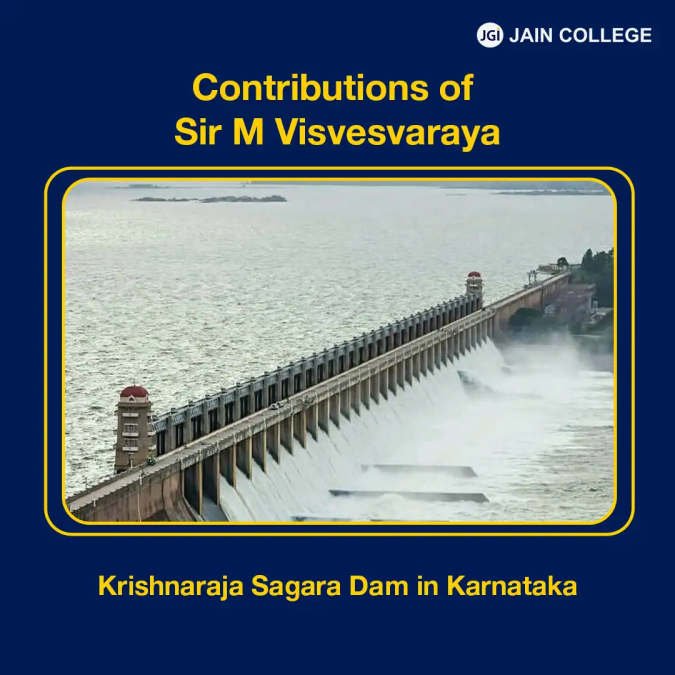
Sir M.Visvesvaraya was a pioneering Indian Civil Engineer, statesman, and innovative thinker. He is also known as the "Father of Modern Mysore". He is best remembered for the instrumental role he played in the construction of the Krishna Raja Sagara Lake and dam, which was completed in the year 1924.
The Krishna Raja Sagara dam not only became the main source of water for irrigation in the nearby areas, but it was also the main source of drinking water for several cities.
He also introduced innovative flood control with automatic sluice gates and championed industrialisation, education (founding the University of Mysore), and economic planning.
Mokshagundam Visvesvaraya, commonly referred to as Sir M. Visvesvaraya, was a notable Indian engineer, scholar, and statesman. He was the diwan of Mysore during the period of Krishna Raja Wadiyar IV (1912 to 1918).
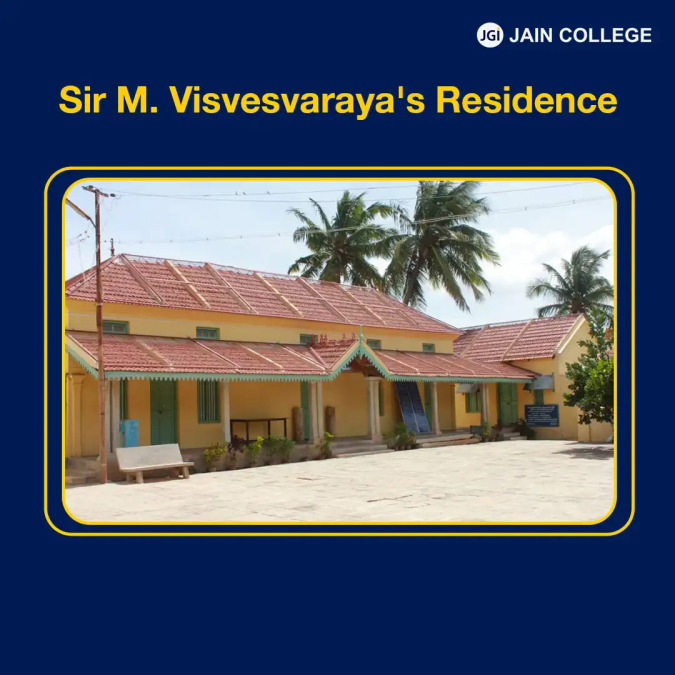
M.Visvesvaraya was born on Sept. 15, 1861, at Muddenahalli, Chikkaballapura district, Karnataka, into a Telugu-speaking family of Venkatalakshmi and Mokshagundam Srinivasa Shastry. He completed his primary schooling in his hometown and continued his higher studies in Bangalore.
Sir M.Visvesvaraya received his Bachelor of Arts from Central College, Bangalore, in 1881. He later pursued civil engineering at the prestigious College of Engineering, Pune, also known as COEP.
Since childhood, M.Visvesvaraya lived a simple life. After his father’s death, the young M.Visvesvaraya supported both his studies and his family financially by providing tuition for young children in his hometown.
He was a brilliant student from childhood. Despite his struggles, Visvesvaraya ranked first in his matriculation exams, L.C.E. (Licentiate in Civil Engineering) and F.C.E. (Fellow of the College of Engineering) examinations (equivalent to the B.E. Examination today).
After graduating as an engineer, Visvesvaraya took up his first job with the PWD (Public Works Department) in Mumbai. Later, he was invited to join the Indian Irrigation Commission.
During this period:
Later, in 1906–07, the Government of India sent him to Aden, Yemen, to study the water supply and drainage system. He successfully implemented the project he prepared in Aden.
Mokshagundam Visvesvaraya designed a flood protection system for the city of Hyderabad, for which he gained national recognition. He was also responsible for developing a system to protect Visakhapatnam port from coastal erosion.
Mokshagundam Visvesvaraya was one of the key personnel overseeing operations and construction of the Krishna Raja Sagara (KRS) Dam across the Kaveri River, among the largest reservoirs in Asia at the time. Due to his transformative contributions as a diwan, people referred to Visvesvaraya as the "Father of Modern Mysore."
He was responsible for the following during his tenure with the Mysore government:
Some of the job positions he held were:
Sir M. Visvesvaraya firmly believed that nation-building requires character as much as technical knowledge. His values were not theoretical but reflected in his decisions as an engineer and as the Diwan of Mysore.
Discipline and Punctuality
Sir M. Visvesvaraya was known for strict discipline and punctuality. He followed a fixed daily routine and expected the same level of time management from officials working under him. For him, respect for time meant respect for public resources.
Integrity and Professional Ethics
As a civil engineer and administrator, he never compromised on quality or ethical standards. He rejected projects and proposals that did not meet technical or safety requirements, even under political pressure. This made him a role model for ethical governance.
Simplicity and Personal Integrity
Despite holding high offices and receiving national honours, Sir M. Visvesvaraya lived a simple and disciplined life. He believed that public servants should lead by example and avoid luxury.
Courage and Sense of Responsibility
He displayed moral courage while executing large infrastructure projects such as flood-control systems and dams, often taking responsibility for decisions that involved risk but served long-term public interest.
Commitment to National Development
Mokshagundam Visvesvaraya strongly believed that education, industrialisation, and scientific planning were essential for India’s progress. His values shaped policies that focused on self-reliance and sustainable development.
M. Visvesvaraya has received recognition in various fields, most notably the education sector and the engineering sector. Some of them include:
Some of the memorials and institutions in his honour include:
Sir M.Visvesvaraya was an extraordinary engineer, a statesman, a visionary, and a staunch supporter of industrialisation. Visvesvaraya's extraordinary work in accelerating industrialisation and education in India is the driving force behind his engineering achievements.
Here are some of the major achievements of Visvesvaraya:
In Bihar & Orissa States:
In Hyderabad City:
Krishna Raja Sagara Dam:
Bhadravati's iron and steel works
As chairman of Bhadravati Iron and Steel works, he played a key role in reviving the industry.
He was also a founder of:
In addition to the achievements listed above, there are also many other industries and public works that owe their inception or active nurturing to him.
In 1917, he was crucial in the founding of the Government Engineering College at Bangalore. This is one of the first engineering institutes in India and was later named the University Visvesvaraya College of Engineering after its founder. He also commissioned several new railway lines in Mysore.
Sir M. Visvesvaraya was a highly innovative engineer and creative administrator whose work laid the foundation for modern infrastructure in India. As diwan of Mysore from 1912 to 1918, he promoted industrial development, education, and scientific planning.
M.Visvesvaraya received many honours, including being knighted by Britain, and he was later awarded India's highest civilian honour, the Bharat Ratna.
In recognition of his contributions, India observes Engineers Day on Sept. 15, his birth anniversary. His legacy continues to inspire generations of engineers and policymakers.
For more details about the contributions of Sir M Visvesvaraya and Karnataka's famous literary authors, poets, and other related articles, read our blogs at JAIN PU College.
Which of Sir M. Visvesvaraya’s values do you think is most relevant in today’s world? Share your thoughts with us.
The block system is an automatic irrigation and flood-control mechanism invented by Sir M. Visvesvaraya The block system regulates water flow by using self-operating gates during overflow conditions.
Yes. The Krishna Raja Sagara (KRS) Dam has 177 arch-type iron sluice gates, some of which are equipped with automatic doors.
Sir M. Visvesvaraya is called the Father of Modern Mysore for his role in industrialisation, infrastructure development, and administrative reforms during his tenure as Diwan of Mysore.
The Krishna Raja Sagara dam was constructed primarily to help the people of the kingdom during a severe drought.
The Krishna Raja Sagara Dam was constructed on the river Kaveri at Kannambadi, which was initially called ‘Kannambadi Katte’ and was later renamed Krishnaraja Sagara.
The Krishna Raja Sagara Dam is 8600 feet in length and 130 feet in height.
Sir M. Visvesvaraya was awarded the Bharat Ratna in 1955, India’s highest civilian honour.
Sir M. Visvesvaraya served as a civil engineer, Chief Engineer, Diwan of Mysore, and advisor to various national institutions.
Sir M. Visvesvaraya is relevant to GS-IV Ethics for his examples of integrity, discipline, professional ethics, and value-based governance.
Engineer’s Day is celebrated on 15 September to mark the birth anniversary of Sir M. Visvesvaraya in recognition of his contributions to engineering and nation-building.

JAIN PU College, a part of the renowned JGI Group, is committed to empowering students with quality education.
Beyond academics, the college ensures its online content reflects the same standard of excellence. Every blog and article is meticulously vetted and proofread by subject matter experts to ensure accuracy, relevance, and clarity. From insightful educational topics to engaging discussions, JAIN PU College's content is crafted to inform, inspire, and add value to its readers, reflecting the institution's commitment to intellectual growth and innovation.
View all Blogs







.jpg)


