









| District | Indicator 1 | Rank | Indicator 2 | Rank | Indicator 3 | Rank | Composite Score | Overall Rank |
|---|---|---|---|---|---|---|---|---|
| Bengaluru Urban | 1.7 | 5 | 15.8 | 1 | 82.4 | 1 | 859154 | 1 |
| Dakshina Kannada | 9.6 | 10 | 38.9 | 2 | 51.5 | 2 | 125140 | 2 |
| Belagavi | 22.6 | 1 | 23.3 | 4 | 54.1 | 4 | 91449 | 3 |
| Tumakuru | 19.6 | 4 | 30.1 | 3 | 50.3 | 5 | 82626 | 4 |
| Mysuru | 20.2 | 3 | 16.9 | 9 | 62.9 | 3 | 80676 | 5 |
| Shivamogga | 23.3 | 6 | 22.9 | 8 | 53.7 | 7 | 63028 | 6 |
| Udupi | 15.1 | 15 | 27.9 | 5 | 57.0 | 8 | 59236 | 7 |
| Mandya | 15.9 | 16 | 22.6 | 12 | 61.5 | 10 | 53318 | 8 |
| Bagalkote | 19.2 | 14 | 27.7 | 7 | 53.1 | 11 | 53094 | 9 |
| Dharwad | 8.3 | 30 | 25.0 | 11 | 66.7 | 6 | 52941 | 10 |
| Chikkamagaluru | 23.8 | 8 | 28.9 | 6 | 47.3 | 14 | 52893 | 11 |
| Hassan | 21.3 | 13 | 16.3 | 17 | 62.4 | 9 | 52632 | 12 |
| Vijayapura | 35.0 | 2 | 16.5 | 20 | 48.5 | 16 | 46483 | 13 |
| Kalaburagi | 25.9 | 12 | 19.1 | 16 | 55.0 | 13 | 45868 | 14 |
| Ballari | 12.6 | 28 | 29.3 | 10 | 58.1 | 12 | 45536 | 15 |
| Davanagere | 31.9 | 7 | 20.5 | 18 | 47.6 | 22 | 40352 | 16 |
| Raichur | 30.7 | 9 | 16.5 | 23 | 52.8 | 17 | 40226 | 17 |
| Uttara Kannada | 21.0 | 17 | 20.4 | 19 | 58.7 | 15 | 39783 | 18 |
| Chitradurga | 32.1 | 11 | 15.4 | 24 | 52.5 | 21 | 37293 | 19 |
| Kolar | 19.6 | 21 | 25.6 | 15 | 54.8 | 19 | 36492 | 20 |
| Bengaluru Rural | 18.1 | 25 | 29.9 | 14 | 52.0 | 23 | 35599 | 21 |
| Ramanagara | 16.2 | 29 | 32.0 | 13 | 51.8 | 24 | 33799 | 22 |
| Bidar | 21.3 | 22 | 16.8 | 26 | 61.9 | 18 | 32777 | 23 |
| Haveri | 21.2 | 24 | 17.4 | 25 | 61.4 | 20 | 31989 | 24 |
| Chikkaballapur | 26.2 | 18 | 21.0 | 22 | 52.8 | 25 | 31671 | 25 |
| Vijayanagar | 21.1 | 26 | 25.3 | 21 | 53.6 | 26 | 29433 | 26 |
| Koppal | 30.2 | 20 | 18.7 | 28 | 51.0 | 29 | 26804 | 27 |
| Chamarajanagar | 23.2 | 27 | 20.1 | 27 | 56.7 | 27 | 26064 | 28 |
| Gadag | 15.7 | 31 | 20.0 | 29 | 64.2 | 28 | 22891 | 29 |
| Yadgir | 29.9 | 23 | 16.8 | 30 | 53.2 | 30 | 22754 | 30 |
| Kodagu | 45.2 | 19 | 13.1 | 31 | 41.7 | 31 | 17995 | 31 |
Indicator 1: Reflects the district’s economic structure and dependency, such as reliance on low-productivity sectors. Lower values generally indicate stronger economies.
Indicator 2: Represents economic activity and urbanisation, including industrial and service-sector employment. Higher values indicate better economic diversification.
Indicator 3: Shows human development and social infrastructure, such as education and access to services. Higher values reflect better quality of life.
Composite Score: A combined weighted score of all three indicators showing overall economic and social strength.
Overall Rank: Final ranking of districts based on the composite score (Rank 1 = most developed).
Karnataka is one of the most prosperous Indian states. Located in the southwestern region of India, it is the 6th largest state by area, with 31 districts being home to around 62 million residents. With Bangalore as its capital and major city, it is the fourth largest state economy in the country. Apart from IT, it is also known for its rich fauna, flora, scenic beauty, and heritage
Karnataka is divided into 31 districts, 240 taluks, and about four administrative divisions.
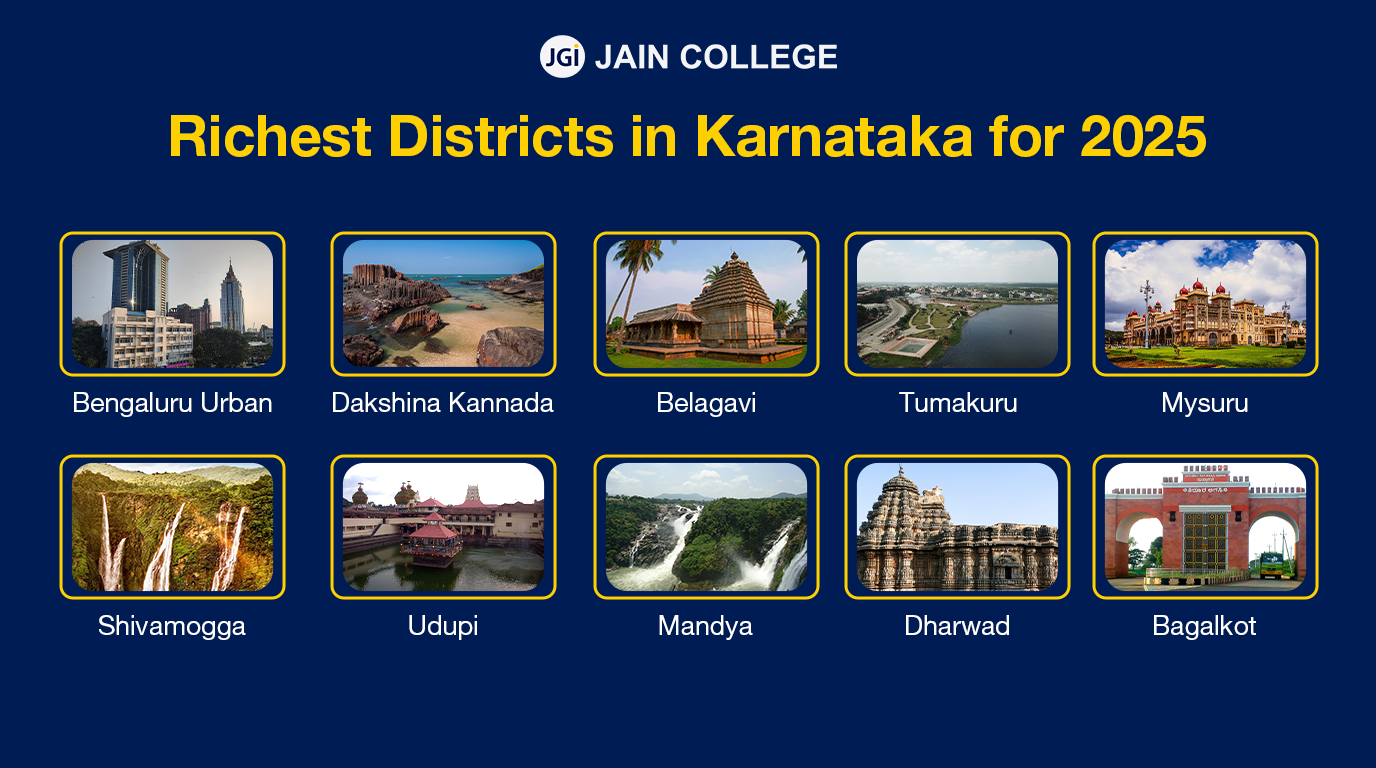
Among these 31 districts, here are the top ten districts and their importance.
Bengaluru Urban
Dakshina Kannada
Belagavi
Tumakuru
Mysuru
Shivamogga
Udupi
Mandya
Dharwad
Bagalkote
The following factors primarily characterise emerging districts in Karnataka:
Here are the emerging districts in Karnataka that have shown rapid improvements in development, economy, infrastructure, and social indicators in 2025:
| Emerging Districts | Improvements |
| Koppal | Growth in small-scale industriesImproved social and economic indicatorsAdvancements in irrigation and agriculture |
| Yadgir | Emerging from earlier development challengesIncreased government focus and welfare schemesRapid progress in health, education, and basic infrastructure |
| Raichur | Improved literacy and healthcare facilitiesStrategic importance in energy and farming sectorsGrowth in power generation, agriculture, and irrigation |
| Ballari | Increasing employment opportunitiesBetter transport and logistics facilitiesExpansion in manufacturing and mining-related industries |
| Kalaburagi | Development of road and rail connectivityExpansion of agriculture and service sectorsEducational growth with universities and colleges |
| Ramanagara | Improved education, health, and infrastructureLargest silk producer and agro-based industriesGrowing industrial activity and proximity to Bengaluru |
| Chitradurga | Improved tourism potentialEconomic development and infrastructureGrowth in renewable energy (wind & solar) |
| Chikkaballapur | Benefits from Bengaluru’s expansionImproved irrigation projects and horticultureGetting the most out of Bengaluru's expansion |
Overall, the development of these districts is moving steadily in the direction of balanced regional development.
While 2025 district-wise per capita income data is not fully available yet, the preliminary data for the year 2023–2024 shows the 10 richest districts in Karnataka.
According to the Economic Survey of 2024-25, the rapid growth of services shows how rich and economically stable each district is. These services include:
Let's find the Top 10 Richest Districts in Karnataka by GDP and Per Capita Income:
| Rank | District | District GDP (₹ crore) | Per Capita Income (₹) |
| 1 | Bengaluru Urban | 9.98 lakh | 7.38 lakh |
| 2 | Dakshina Kannada | 1.37 lakh | 5.56 lakh |
| 3 | Belagavi | 9.90 lakh | 1.62 lakh |
| 4 | Tumakuru | 9.20 lakh | 3.02 lakh |
| 5 | Mysuru | 8.80 lakh | 2.39 lakh |
| 6 | Shivamogga | 7.00 lakh | 3.49 lakh |
| 7 | Udupi | 6.70 lakh | 5.33 lakh |
| 8 | Mandya | 6.00 lakh | 3.06 lakh |
| 9 | Dharwad | 5.90 lakh | 2.61 lakh |
| 10 | Bagalkot | 5.80 lakh | 2.49 lakh |
Agriculture is an important part of Karnataka's economy. Key crops grown in the state include rice, maize, pulses, oilseeds, sugarcane, cashews, cardamom, and chillies. Karnataka is the largest producer of coarse cereals, coffee, and silk in India.
Major Agricultural Regions of Karnataka:
| Northern Karnataka | The region is predominantly dry, with a focus on drought-resistant crops. |
| Southern Karnataka | The region is suitable for paddy, sugarcane, and horticulture. |
| Coastal and Malnad Regions | The region is known for its horticultural crops, which include coconut, areca nut, and spices. |
The table below shows the district-wise and season-wise area, yield, and production of agricultural crops in Karnataka.
| Crops | Seasons | High Yields and Productivity |
| Food Grains | ||
| Rice | Kharif and summer | Mandya, Mysuru, Raichur and Ballari |
| Ragi | Kharif and Rabi | Kolar, Tumkur, Chikkaballapur and Bengaluru |
| Jowar | Kharif and Rabi | Dharwad, Belgaum and Bijapur/Vijayapura |
| Maize | Kharif and summer | Haveri, Davangere and Chitradurga |
| Pulses | ||
| Green Gram | Kharif and Rabi | Bidar and Raichur |
| Bengal Gram | Rabi | Gulbarga and Bijapur/Vijayapura |
| Red Gram | Kharif | Gulbarga Bidar and Raichur |
| Commercial Crops | ||
| Sugarcane | Perennial crop | Mandya Mysuru and Belgaum |
| Cotton | Kharif | Raichur, Dharwad and Haveri |
| Tobacco | Kharif | Mysuru, Hassan and Chikkamagaluru |
| Oilseeds | ||
| Groundnut | Kharif and Rabi | Dharwad, Gulbarga and Bijapur/Vijayapura |
| Sunflower | Kharif and Rabi | Kolar, Tumkur, Chitradurga and Davangere |
| Sesame | Kharif | Bagalkot and Belagavi |
| Horticulture Crops | ||
| Coconut | Tropical Crop | Udupi and Dakshina Kannada |
| Areca Nut | Tropical Crop | Shimoga Chikmagalur and Dakshina Kannada |
| Spices | ||
| Ginger | Tropical Crop | Kodagu and Hassan |
| Pepper | Tropical Crop | Coorg (Kodagu) and Chikmagalur |
| Cardamom | Tropical Crop | Kodagu and Hassan |
| Fruits | ||
| Grapes | January to MarchJune to December | Kolar and Bijapur/Vijayapura |
| Bananas | Year-Long | Mysuru and Bengaluru |
| Mangoes | March to June | Ramanagara, Bengaluru and Kolar |
| Plantation Crops | ||
| Tea | March to May | Western Ghats of Chikmagalur and Kodagu |
| Coffee | November to March | Chikmagalur, Kodagu (Coorg) and Hassan |
Karnataka districts have achieved high rankings due to steady progress in the following sectors:
Health
Education
Economy
Economy plays a key role in district development. Karnataka state has a mixed economy that includes:
In Karnataka state, rural districts generate high income and employment from agriculture, horticulture, and allied activities. Urban districts benefit from various business sectors, including innovation and technology.
Governance
Governance leads to high rankings in districts by ensuring:
Infrastructure
In addition, better infrastructure, such as roads, electricity, drinking water, and sanitation, improves the quality of life
Social development indicators, such as women's participation, self-help groups, and community involvement, further facilitate development.
The high ranking of Karnataka districts is due to a combination of good governance, education, healthcare, job opportunities, and infrastructure.
In accordance with the Economic Survey of 2024-25, the rapid growth of services, tourism, industries, and technology indicates the wealth and economic status of the respective districts in Karnataka.
The top 10 districts reflect a mix of industries, agriculture, and cultural significance. Consequently, these rankings offer beneficial perspectives on future development strategies and shape the economic landscape of each district.
. .
For more information about the total number of districts in India and about the country's economy and other related articles, read our blogs.
Bengaluru is considered the richest city in Karnataka.
Mysuru is considered the cleanest heritage city in Karnataka. This is due to its excellent sanitation, extensive green cover and strong implementation of waste management.
Hubli-Dharwad is a pair of twin cities located in the Indian state of Karnataka. It is considered a smart city in Karnataka because of its:
Thus, the success of Hubli-Dharwad’s Smart City initiatives lies in infrastructure development.
The top six elements of district development in Karnataka are:
The main reasons these districts rank so high in Karnataka are:

JAIN PU College, a part of the renowned JGI Group, is committed to empowering students with quality education.
Beyond academics, the college ensures its online content reflects the same standard of excellence. Every blog and article is meticulously vetted and proofread by subject matter experts to ensure accuracy, relevance, and clarity. From insightful educational topics to engaging discussions, JAIN PU College's content is crafted to inform, inspire, and add value to its readers, reflecting the institution's commitment to intellectual growth and innovation.
View all Blogs













_(1).webp)