








Indian mathematicians have made lasting contributions to mathematics through early work in topics like algebra, trigonometry, geometry, statistics, number theory, and calculus. These contributions led to the foundation of modern mathematics. From Aryabhata and Brahmagupta to Ramanujan and C.R. Rao and Shakuntala Devi, India has produced scholars whose ideas influenced mathematics across centuries.
In this blog, let us discover the impactful contributions of renowned Indian mathematicians, from ancient times to modern day.
Table of Contents
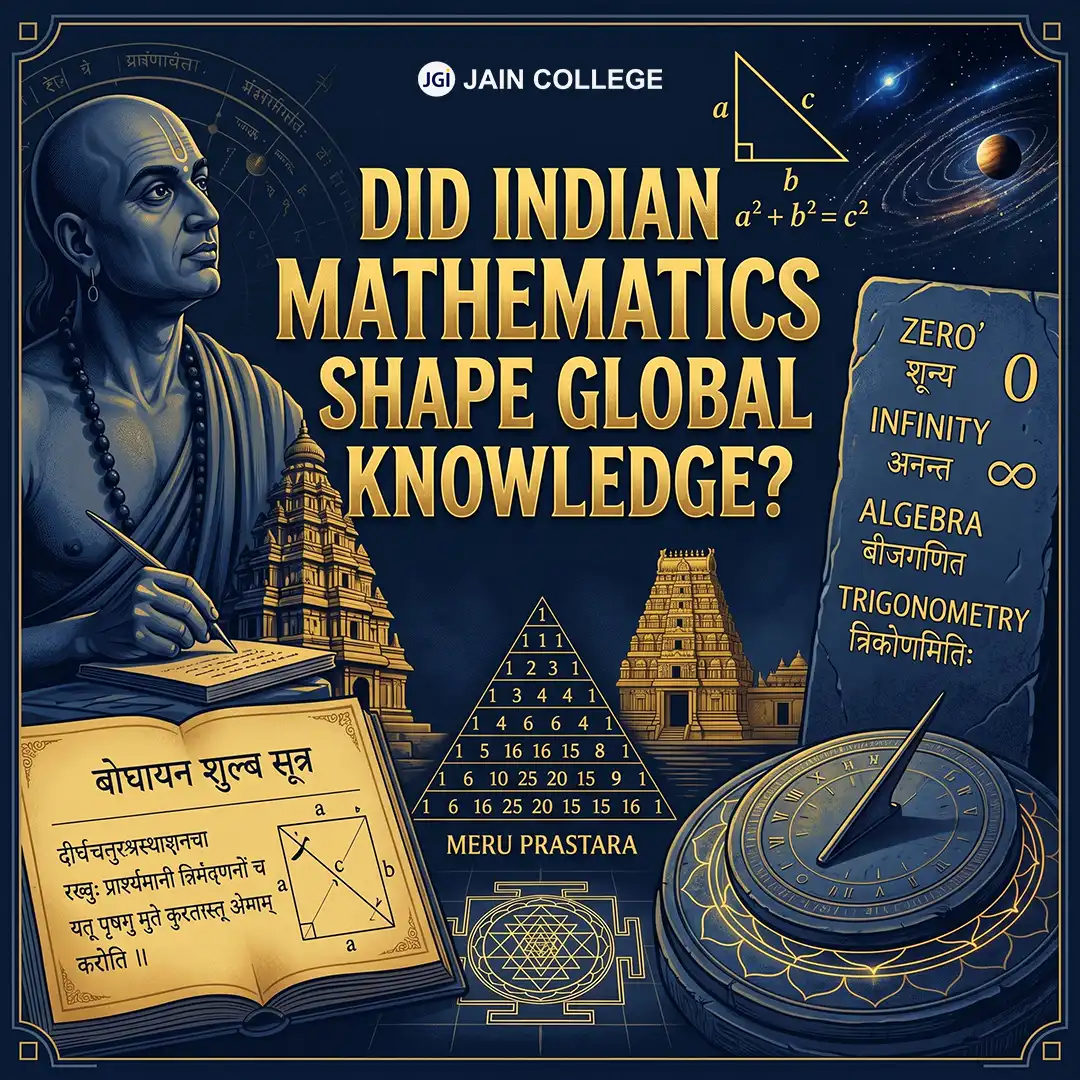
The roots of Indian mathematics lie in Vedic literature. Vedic literature is believed to have emerged several thousand years and forms one of the oldest literary traditions in the world.
In India, mathematical ideas developed gradually over several centuries through the contributions of scholars from different periods.
This period includes the concept of zero, the techniques of algebra and algorithms, geometry, and the decimal system.
The Vedic period was a period of history that occurred roughly from 1700 BCE to 150 BCE.
The Sulba sutras, which are known to be the appendices of the Vedas, are the only sources of knowledge of Indian mathematics from this period.
They are guides or handbooks for the construction of sacrificial altars used in Vedic worship. This included geometrical rules related to figures, such as triangles and circles.
India has a rich mathematical legacy that spans thousands of years.
Indian mathematicians have contributed significantly across different historical periods, from ancient scholars who laid the foundations of number systems to modern researchers and pioneers who transformed mathematical research.
Indian mathematicians made early contributions to number systems, algebra, geometry, and trigonometry, primarily in the areas of Mathematics and Science. The origin and inspiration for Indian mathematics is geometry. It originated in India in the construction of the altars meant for Vedic sacrifices.
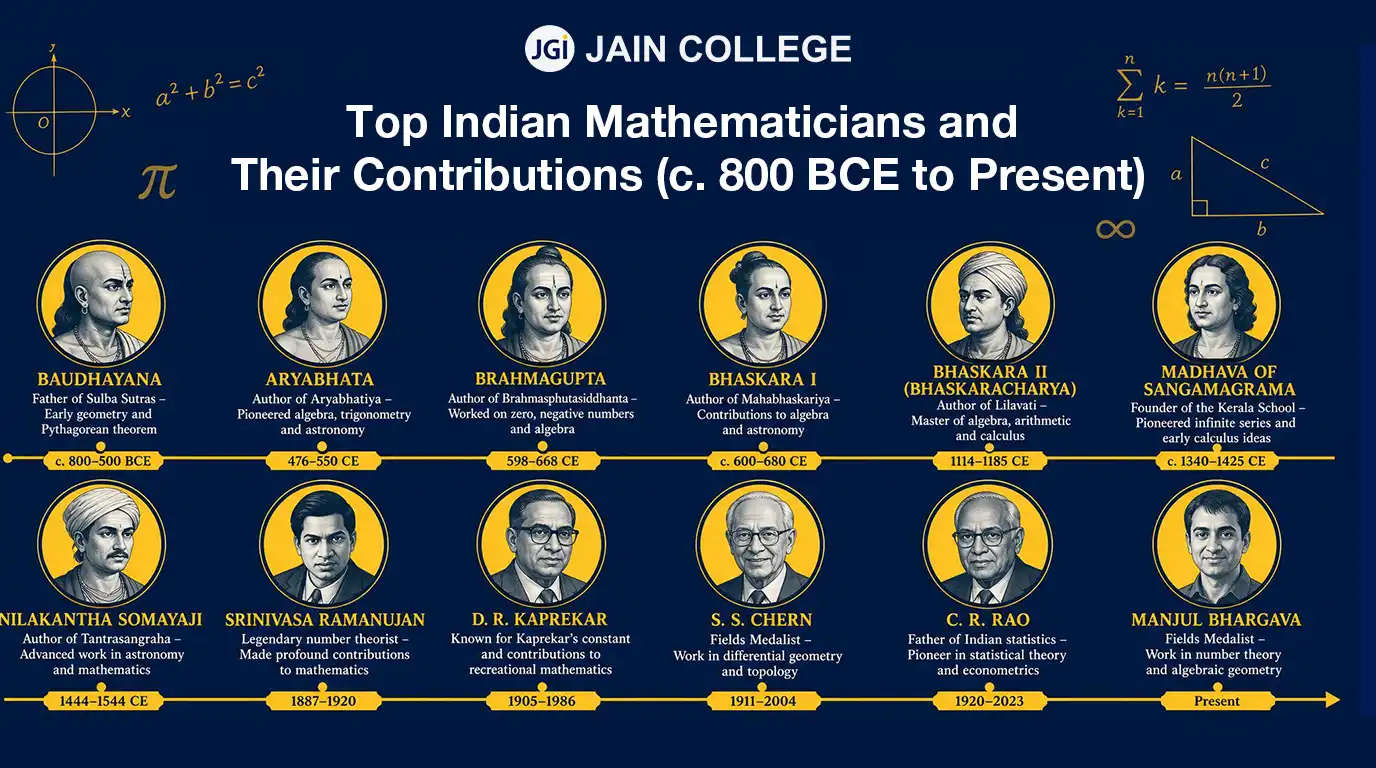
The following section highlights the major contributions of these mathematicians and their lasting impact on global mathematics
.webp)
| Ancient Period (Before 1200 CE) | |
| Baudhayana (c. 800 BCE) | Known for the Baudhayana Sulba Sutra, which contains an early version of the Pythagorean theorem. |
| Aryabhata (476–550 CE) | Developed concepts of place value, calculated the value of pi (π)and advanced trigonometry. |
| Brahmagupta (598–668 CE) | Developed rules for arithmetic with zero and negative numbers. |
| Bhaskara I(c. 600–680 CE) | Known for contributions to trigonometry and early calculus ideas. |
| Medieval Period (1200–1800 CE) | |
| Bhaskara II (1114–1185 CE) | Wrote Lilavati and contributed to algebra, calculus, and number theory. |
| Madhava of Sangamagrama (c. 1340–1425 CE) | Founder of the Kerala School of Mathematics, known for infinite series expansions. |
| Modern Period (1800–Present) | |
| Srinivasa Ramanujan (1887–1920) | One of the greatest mathematicians, known for work in number theory, partitions, and infinite series. |
| Shakuntala Devi (1929–2013) | Known as the “Human Computer” for her extraordinary mental calculation abilities. |
| Harish-Chandra (1923–1983) | Made significant contributions to representation theory and harmonic analysis. |
| C. R. Rao (1920–2023) | Renowned for contributions to statistics and probability theory. |
India has a rich tradition of Mathematics dating back to ancient times. From the development of the numeral system to the concept of zero (0) and pi (π)
Here are the significant contributions of renowned Indian mathematicians, who have shaped mathematics through innovations like the decimal number system, the concept of zero, and advancements in algebra and trigonometry.
Baudhayana was an ancient Indian scholar associated with the Baudhayana Sulba Sutra, one of the earliest Indian texts on geometry. He is known for mathematical ideas related to geometric constructions used in Vedic altar design.
The Baudhayana Sulba Sutra contains an early statement related to what is now known as the Pythagorean theorem. It is more accurate to say that the text presents an early form of this geometric principle rather than claiming that Baudhayana was the original mathematician behind the theorem.
Baudhayana is also associated with early geometric methods, including shape transformations, approximations related to square roots, and geometric constructions.
Main contributions associated with Baudhayana
Aryabhatta was born in 476 CE in Kusumpur (present-day Patna), India. He was the first in the line of outstanding mathematicians from the classical age of Indian Mathematics and Astronomy.
His famous works are the "Aryabhatiya" and the "Arya‐siddhanta".
The Mathematical part of the Aryabhatiya covers arithmetic, algebra, plane trigonometry, and spherical trigonometry. The Arya-siddhanta deals largely with astronomical computation.
He discussed algebraic identities such as
| (a+b)² = a² + b² + 2ab |
He taught the method of solving the following problems:
| 1+2+3+…………+n = n(n+1)/2 1²+2²+3²+……+n² = n(n+1)(2n+1)/6 1³+2³+3³+……+n³ = (n(n+1)/2)² 2 |
Aryabhata was the first of the major mathematician-astronomers from the classical age of Indian mathematics and Indian astronomy. His work includes the Aryabhatiya and the Aryasiddhanta.
Numerical values:
He invented a notation system in which digits are denoted with the help of alphabetic numerals.
Notation system:
He invented a notation system consisting of alphanumeric numerals. Digits were denoted by alphabet numerals. Place value: He was familiar with the place value system. He knew numerical symbols and the sign for zero.
Square root and cube root:
His calculations on square roots and cube roots would not have been possible without the knowledge of the place value system and zero. He has given methods of extracting square roots and cube roots along with their explanation.
Algebra:
In Aryabhatiya, he provided elegant results for the summation of a series of squares and cubes.
| 1 + 2 + 3 + 4 + 5 + ......... + n = n(n+1)2 12 + 22 + 32 + 42 + 52 + ......... + n2= n(n+1) (2n+1)6 13 + 23 + 33 + 43 + 53 + ......... + n3= [n(n+1) 2]2 14 + 24 + 34 + 44 + 54 + ......... + n4= n(n+1) (2n+1)(3n2+ 3n - 1)30 |
Interest:
He developed the different methods and a formula for solving questions related to rates, interest and time.
Trigonometry:
Brahmagupta was born in 598 A.D. in Bhinmal city in the state of Rajasthan. He was a mathematician and astronomer who wrote many important works on mathematics and astronomy. His best-known work is the "Brahmasphuta-siddhanta", written in 628 AD in Bhinmal.
| a + ar + ar² + ar³ + …… + arⁿ⁻¹ = a(rⁿ ‐ 1)(r ‐ 1) for r ≠ 1 |
| a, b, c, d = 9 (s‐a) (s‐b) (s‐c) (s‐d), where 2s = a + b + c + d. |
Brahmagupta’s formula should be written clearly as
| Area = [(s-a) (s-b) (s-c) (s - d)] |
Bhaskara II, also known as Bhaskaracharya
He was born in Bijapur, present-day Karnataka. His work made a significant contribution to mathematical and astronomical knowledge in India
Bhaskara II was one of the most important Indian mathematicians and astronomers of the 12th century.
Siddhānta Śiromaṇi ("Crest-Jewel of Astronomical Systems"). This is a seminal 12th-century Sanskrit treatise on mathematics and astronomy. It divided into four parts called
These four sections deal with arithmetic, algebra, and the mathematics of planets and spheres, respectively.
Bhaskaracharya made important contributions to several areas of mathematics. Some of his best contributions to the field of mathematics are the following:
| 61x² + 1 = y². |
| sin(A ± B) = sin A cos B ± cos A sin B. |
Mahāvīra, also known as Mahaviracharya, was the first, 9th-century Jain mathematician who made important contributions to Indian mathematics, especially in algebra and geometry. He is known for stating that the square root of a negative number does not exist within the realm of real numbers.
Mahāvīra was born around 815 CE in the city of Gulbarga, Karnataka, in southern India. Mahāvīra worked under the patronage of the Rashtrakuta king Amoghavarsha and was associated with the mathematical scholarship of his time.
Mahāvīra made significant contributions to mathematics. He also gave rules for the area of certain geometric figures and discussed methods related to the perimeter of an ellipse.
Mahaviracharya mastered a wide range of subjects, from basic to complex topics. Some of his contributions include:
Also Read: Jnanapeeta Award Winners in Kannada Language
India has a rich history in the area of mathematics. Many brilliant Indian mathematicians have made remarkable contributions and gained many recognitions across the globe.
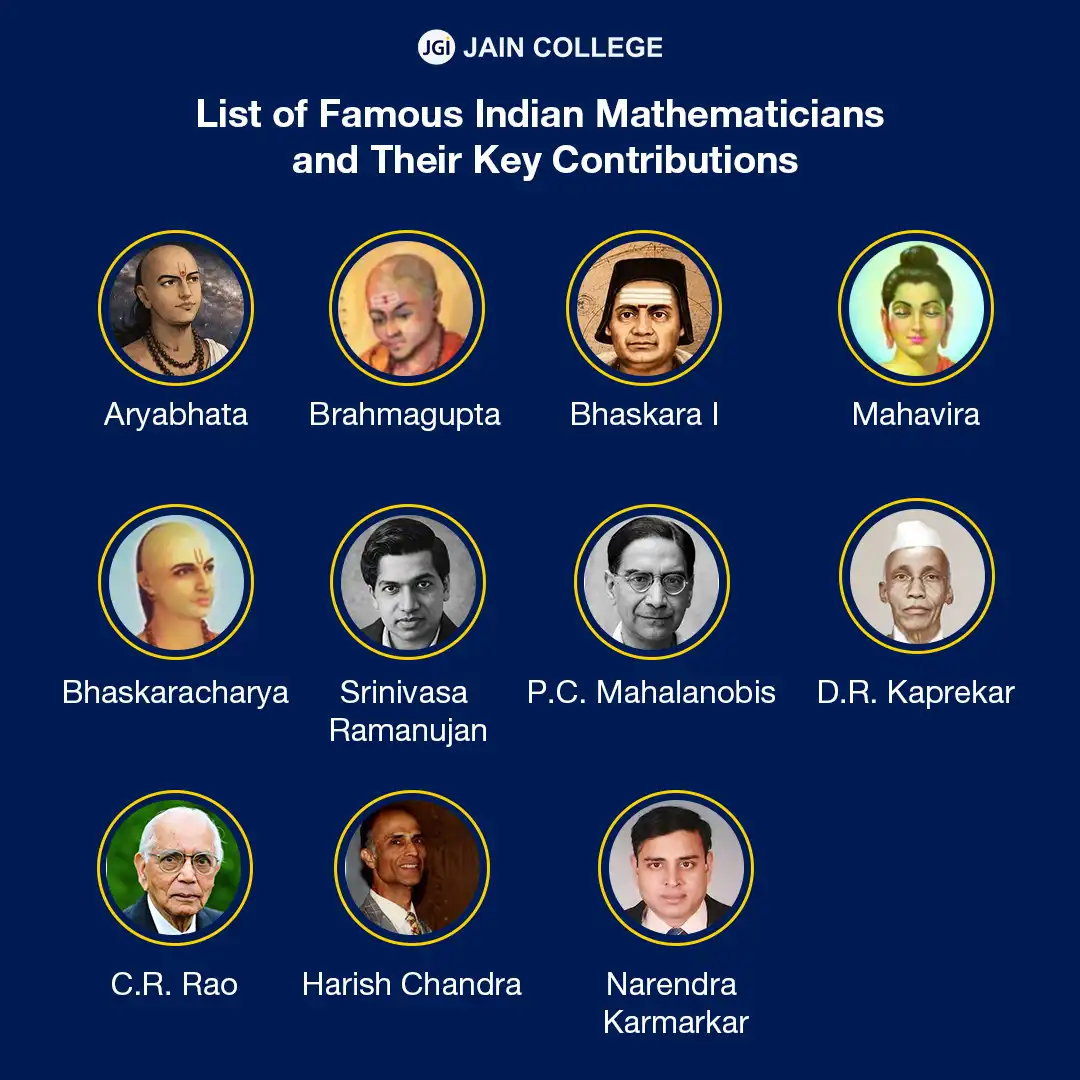
| Time Line | Names | Renowned Works and Inventions |
| 476–550 CE | Aryabhata | Approximation of πTrigonometry (sine tables) |
| 598–668 CE | Brahmagupta | Quadratic equationsRules for zero and negative numbers |
| 7th Century | Bhaskara I | An early Indian mathematician known for his work in trigonometry |
| 9th Century | Mahavira | The concepts being named are a semicircle, circle, isosceles triangle, rhombus, and equilateral triangle. |
| 1114–1185 CE | Bhaskara II (or)Bhaskaracharya | Known for his major contributions to algebra and calculus-like concepts. |
| 1887–1920 | Srinivasa Ramanujan | Properties of the Partition Function |
| 1893–1972 | P.C. Mahalanobis | Mahalanobis Distance |
| 1905–1986 | D.R. Kaprekar | Devlali numbers, Kaprekar numbers, the Harshad numbers and Demlo numbers. |
| 1920–2023 | C.R. Rao | Theory of Estimation |
| 1923–1983 | Harish Chandra | Representation theory, Harmonic analysis on semisimple Lie groups. |
| Born 1957 | Narendra Karmarkar | Karmarkar’s algorithm |
Mathematics is the divine language of the Universe. Today, more women are becoming proficient in technology and digital skills, as well as in other leadership roles. Indian women are breaking barriers and shattering glass ceilings in mathematics, paving the way for future generations.
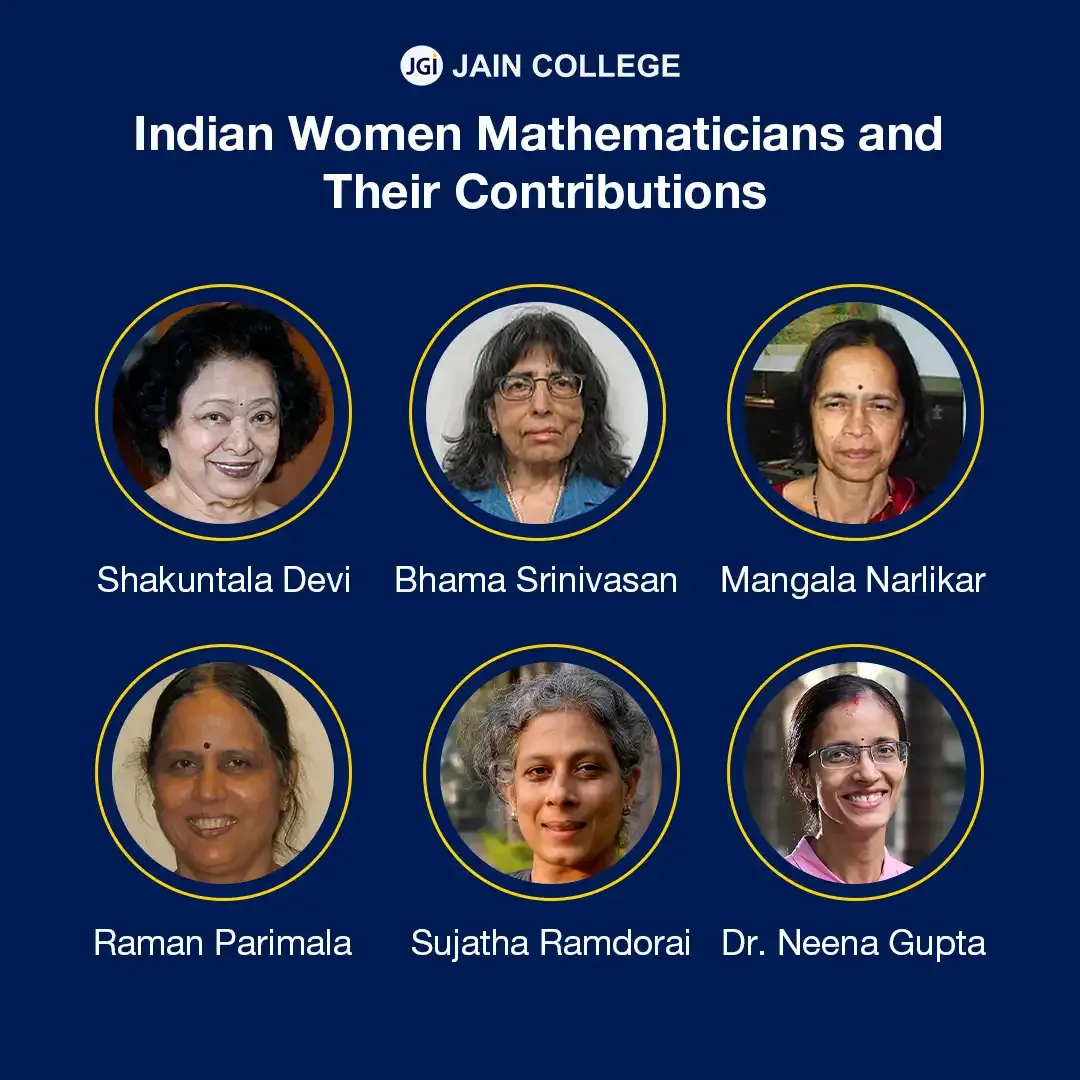
As per an estimate, there might be about 2,000 women working in maths in India today, including PhD students, postdocs, and faculty.
Here are the achievements of some of the remarkable Indian women mathematicians.
| Timeline | Name | Field / Area | Major Contributions |
| 1929–2013 | Shakuntala Devi | Mental mathematics& Popular mathematics | Famous worldwide as the “Human Computer". She amazed audiences with extremely fast mental calculations and helped popularise mathematics through books and public demonstrations. |
| 1935-2025*Source | Bhama Srinivasan | Representation theory of finite groups | Known for major work in the representation theory of finite groups. She became an internationally respected mathematician, and she was honoured with the 1990 Noether Lecture. |
| 1943–2023 | Mangala Narlikar | Pure mathematics, mathematics education | Contributed to mathematics as a teacher, writer, and scholar. She also helped make mathematics easier for general readers through popular writing in India. |
| Born 1948 | Raman Parimala | Algebra | Known for important work in quadratic forms, Galois cohomology and algebraic groups. She is one of India’s leading algebraists and has had major international academic influence. |
| Born 1962 | Sujatha Ramdorai | Algebraic number theory & Iwasawa theory | Known for major contributions to algebraic number theory and Iwasawa theory. She received important honours, including the Shanti Swarup Bhatnagar Award and the ICTP Ramanujan Prize. |
| Born 1984 | Neena Gupta | Commutative algebra & affine algebraic geometry | Known for solving a major case of the Zariski Cancellation Problem, a landmark achievement in modern algebra. She is one of the most important contemporary Indian women mathematicians. |
In ancient India, mathematics developed as an important field of knowledge and contributed significantly to:
Among all these achievements, concepts such as zero, place value notation, arithmetic rules, and trigonometric methods played an important role in shaping later mathematical thought.
Some of the major achievements associated with Indian mathematics include
The global influence of Indian mathematicians was far-reaching.
The legacy of Indian mathematics remains important today because it helped shape many foundational ideas that continue to be used in modern mathematics.
Indian mathematicians have made significant contributions that the world today owes a debt to. Some of the most important contributions made by Indian mathematicians were the introduction of the decimal system as well as the invention of zero.
Here are some important facts about Indian mathematicians and their contributions to mathematics:
Also Read: Bharat Ratna Award Winners in Karnataka
The contributions of Indian mathematicians to the field are monumental and diverse, spanning centuries of inquiry and innovation.
Indian mathematicians have made significant contributions to the field of mathematics, ranging from the foundational concepts of zero and decimal notation to groundbreaking discoveries in algebra, trigonometry, and calculus. Their contributions still continue to reverberate throughout modern mathematics, influencing fields such as number theory, geometry, and computer science.
The legacy of Indian mathematicians continues to influence modern mathematics and inspires new generations of learners.
Stay tuned to JAIN PU College blogs and learn more about the famous Indian Mathematicians, their work on pi and series, as well as its lasting legacy in the world of Mathematics.
Do you know any other famous Indian mathematicians?
Share your thoughts in the comments below.
Aryabhata, also known as Aryabhata I, is the earliest Indian mathematician whose work and history are available to modern scholars.
Brahmagupta is known for formalising arithmetic rules involving zero in his work Brahmasphutasiddhanta in 628 CE.
Shakuntala Devi was popularly known as the 'Human Computer' because of her extraordinary mental calculation abilities.
P. C. Mahalanobis, an Indian statistician and scientist, developed the Mahalanobis distance as a statistical measure for comparing data sets.
The Baudhayana Sulba Sutra is known for containing an early statement related to what is now called the Pythagorean theorem. It is better understood as an early mathematical formulation rather than a modern claim of discovery.
Brahmagupta was among the earliest mathematicians known to have given formal rules for treating zero as a number in arithmetic during the 7th century.
Mah?v?ra made important contributions to algebra and geometry. He discussed concepts such as the circle, semicircle, rhombus, and different types of triangles, while expanding earlier mathematical work in India.
Shakuntala Devi was called the 'Human Computer' because of her extraordinary ability to perform complex mental calculations faster than electronic computers of her time.
The Mahalanobis distance is a statistical measure used to determine how far a data point is from a distribution or how similar an unknown sample is to a known data set.

JAIN PU College, a part of the renowned JGI Group, is committed to empowering students with quality education.
Beyond academics, the college ensures its online content reflects the same standard of excellence. Every blog and article is meticulously vetted and proofread by subject matter experts to ensure accuracy, relevance, and clarity. From insightful educational topics to engaging discussions, JAIN PU College's content is crafted to inform, inspire, and add value to its readers, reflecting the institution's commitment to intellectual growth and innovation.
View all Blogs