





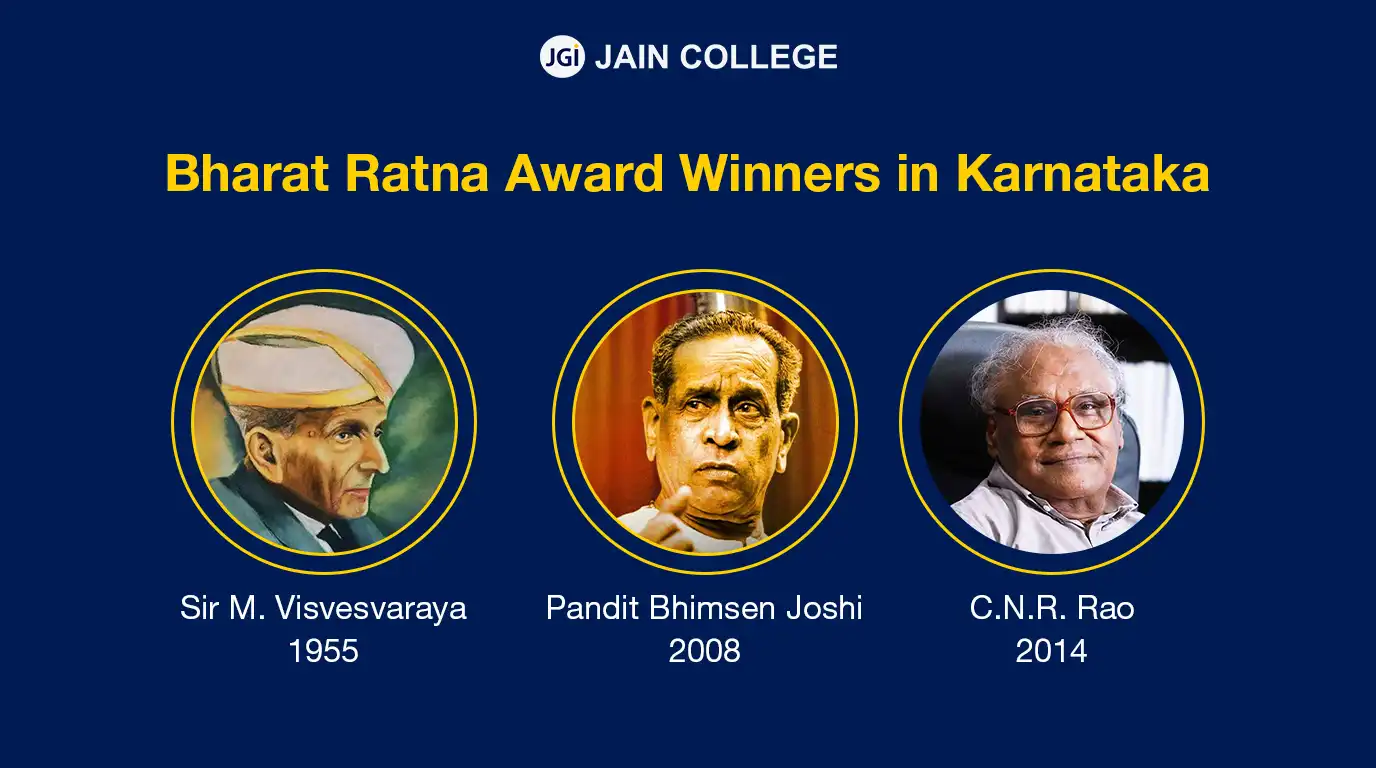
Karnataka has given India several distinguished Bharat Ratna awardees, including:
Their remarkable work highlights the state’s lasting influence on India’s cultural, scientific, and technological progress.
According to the sources, the history of the Bharat Ratna Award goes back to the 1950s.
On January 2, 1954, our first President of India, Dr Rajendra Prasad, established this prestigious award.
The Bharat Ratna, known as India's top civilian honour, was established on January 2, 1954. It is given for contributions or achievements across various domains, including:
Here is a detailed overview of Bharat Ratna Award Winners in Karnataka:
Here is a list of Bharat Ratna Award winners in Karnataka, along with their achievements.
| Bharat Ratna Recipients from Karnataka | ||
|---|---|---|
| Year | Recipient | Achievements |
| 1955 | M. Visvesvaraya | Mysore’s Diwan, statesman, and civil engineer |
| 2009 | Bhimsen Joshi | A Hindustani classical vocalist |
| 2014 | C. N. R. Rao | A chemist, professor and a author |
Sir M. Visvesvaraya, or Mokshagundam Visvesvaraya, was a great Indian Engineer and a versatile personality.
Sir M. Visvesvaraya not only designed and built large dams and water supply schemes, which were his forte (speciality). He also contributed to industrial development by planning a steel plant, the railway system of Mysore, effective technical education for posterity (succeeding generations), and even a reputed financial institution, namely the Mysore Bank.
Key Information about Sir M. Visvesvaraya:
| Born on | September 15, 1861 |
| Birthplace | Muddenahalli village, Chikballapur District, Karnataka State |
| Parents | Father: Srinivasa Shastry and Mother: Venkatalakshamma |
| Nationality | Indian |
| Education | |
| 1881 | Graduated from Central College, Bangalore |
| Civil Engineering from College of Engineering, Pune | |
| 1883 | Scored top marks in the LCE and FCE examinations |
| Profession | Civil engineer and statesman |
| Died on | April 14, 1962 (aged 101), Bangalore |
Personal Life & Legacy:
Sir M. Vishweshwarayia was a man of principles and values. He was a very honest person who gave his best towards his profession and country. He valued cleanliness and was impeccably dressed even when he was well into his 90s. This outstanding Indian engineer lived a long and productive life, passing away on April 14, 1962, at the ripe age of 101 years.
His alma mater, the College of Engineering, Pune, erected a statue in his honour. The Visvesvaraya Industrial and Technological Museum in Bangalore bears his name. After a long and productive life, this outstanding Indian engineer passed away on April 14, 1962, at the age of 101.
Major Works:
Most people remember Sir M. Vishweshwarayia for his instrumental role in the construction of the Krishna Raja Sagara Lake and dam in 1924. This dam not only became the main source of water irrigation for the nearby areas but was also the main source of drinking water for several cities.
Awards and Honours:
Pandit Bhimsen Gururaj Joshi was a legendary Indian classical vocalist and one of the greatest artists of his generation. He had such a distinguished and powerful voice, fine musical sensibility, and an unwavering grasp of the fundamentals that he was the supreme Hindustani vocalist, practising a subtle fusion of intelligence and passion that imbued life and excitement in his music.
Key Information about Bhimsen Gururaj Joshi:
| Birth name: | Bhimsen Gururaj Joshi |
| Born on: | February 4, 1922 |
| Birthplace: | Ron, Gadag, Karnataka, India |
| Parents | Father: Gururajrao Joshi and Mother: Godavaribai |
| Nationality: | Indian |
| Occupation: | Hindustani Classical Vocalist |
| Died on: | January 24, 2011 (aged 88) in Pune, Maharashtra, India |
Personal Life & Legacy:
Pandit Bhimsen Gururaj Joshi was born in Gadag district of the Southern State of
Karnataka, India. He is acknowledged as one of the most eminent Hindustani vocalists. At a very early age, Shri Bhimsen Joshi was fascinated with music and musical instruments.
Major Works:
At the age of eleven, Bhimsen Joshi decided to develop his talent into that of a musician.
Bhimsen Joshi performed in several films as a playback singer. He gave his first live performance in 1941, and his first album was released in the year 1942.
Bhimsen Joshi was not only a classical singer but also a devotional and patriotic singer.
Awards and Honours:
Pandit Bhimsen Gururaj Joshi is noted for his extraordinarily rich and sonorous voice and for the warmth and sensitivity of his rendering. Shri Bhimsen Gururaj Joshi receives the Sangeet Natak Akademi Award for Hindustani Vocal Music due to his eminence in the field of music and his contributions to its enrichment.
Throughout his life, Pandit Bhimsen Gururaj Joshi has received numerous awards and honours. Here are a few of them:
| 1972 | Padma Shri |
| 1975 | Sangeet Natak Akademi |
| 1985 | Padma Bhushan |
| 1998 | Sangeet Natak Akademi Fellowship |
| 1999 | Padma Vibhushan |
| 2002 | Maharashtra Bhushan |
| 2003 | Swathi Sangeetha Puraskaram by the Kerala Government |
| 2005 | Karnataka Ratna |
| 2008 | Bharat Ratna |
Chintamani Nagesa Ramachandra Rao is one of the world's foremost solid-state and materials chemists. He has contributed to the development of the field over five decades.
His main research interests are in solid-state and materials chemistry. He is an author of over 1774 research papers and 54 books.
Key Information about Chintamani Nagesa Ramachandra Rao:
| Born on | June 30, 1934 |
| Birthplace | Bangalore, Karnataka State |
| Parents | Father: Hanumantha Nagesa Rao and Mother: Nagamma Nagesa Rao |
| Nationality | Indian |
| Religion | Hinduism |
| Education | |
| 1940 | Early Schooling |
| 1947 | Secondary school |
| 1951 | Bachelor's degree from Mysore University |
| 1958 | Master’s degree in Chemistry from Banaras Hindu University |
| Completed PhD from Purdue University | |
Personal Life & Legacy:
Professor Chintamani Nagesa Ramachandra Rao, also called C.N.R. Rao, was born in Bangalore. Since his childhood, he has had an immense passion for chemistry. He obtained his master's degree in chemistry.
Major Works:
Rao is currently the National Research Professor, Linus Pauling Research Professor and Honorary President of the Jawaharlal Nehru Centre for Advanced Scientific Research, Bangalore, which he founded in 1989. He was one of the earliest to synthesise two-dimensional oxide materials such as La₂CuO₄. His work has led to a systematic study of compositionally controlled metal-insulator transitions.
Awards and Honours:
Prof. C.N.R. Rao is a part of many of the major science academies throughout the world, including the Royal Society, London; the National Academy of Sciences, U.S.A.; the Academy of Sciences of France and Russia; and more. He has received honoris causa doctorate degrees from 84 universities along with numerous awards. Listed below are a few of them:
| Awards and Honours | |
| 1974 | Padma Shri |
| 1985 | Padma Vibhushan |
| 1989 | Honorary Fellowship of the Royal Society of Chemistry, London |
| 2001 | Karnataka Ratna |
| 2004 | The Somiya Award of the International Union of Materials Research |
| 2005 | Dan David Prize |
| 2005 | Chevalier de la Légion d’Honneur by the President of the French Republic |
| 2012 | National Order of Scientific Merit |
| 2014 | Bharat Ratna |
| 2020 | The International Eni Award |
The Bharat Ratna is India's top civilian honour. Started on January 2, 1954, it rewards outstanding service or achievement in any area, regardless of a person's race, job, status, or gender.
Initially, the Indian government gave this prestigious award for contributions in Arts, Literature, Science, and Public Service.
According to the sources, the total number of Bharat Ratna awardees has reached 53. Five were awarded in 2024, which is the highest number in a single year so far, exceeding the convention of a maximum of three awards per year.
The Government of India conferred the Bharat Ratna upon five eminent personalities, the highest number in a single year.
The five recipients who received this honour in a single year include:
| Year | Recipient | Achievements |
| 2024 | Karpoori Thakur | He was posthumously awarded the Bharat Ratna for his lifelong dedication to social justice and his significant contributions as a freedom fighter. |
| 2024 | L. K. Advani | For his contributions to India over seven decades |
| 2024 | P. V. Narasimha Rao | For transforming India into a strong global economic power |
| 2024 | Charan Singh | For monumental contributions as a champion of farmers' rights |
| 2024 | M. S. Swaminathan | He was posthumously awarded the Bharat Ratna for his monumental role as the "Father of India's Green Revolution.". |
The Bharat Ratna award winners from Karnataka are Sir M. Visvesvaraya (1955), Pandit Bhimsen Joshi (2008), and C.N.R. Rao (2014).
Here is a glimpse into the history and establishment of the Bharat Ratna Award:
| Bharat Ratna Award | |
| Type/Category | National Civilian |
| Description | Highest Civilian Award of the Republic of India |
| Awarded by | Government of India |
| Presented by | President of India |
| Obverse | An image of the Sun along with the words "Bharat Ratna", inscribed in Devanagari script, on a peepal (Ficus religiosa) leaf |
| Reverse | A platinum State Emblem of India placed in the centre with the national motto, "Satyameva Jayate" (Truth alone triumphs) in Devanagari script |
| Established on | 1954; 71 years ago |
| Total awards to date | 53 |
| First award | In 1955, for three recipients:C. V. RamanC. RajagopalachariSarvepalli Radhakrishnan |
| Final award | In 2024, for five recipients:Charan SinghKarpoori ThakurLal Krishna AdvaniM. S. SwaminathanP. V. Narasimha Rao |
| Precedence: | |
| Next higher award | None |
| Next lower award | Param Vir Chakra (military)Padma Vibhushan (civilian) |
The Bharat Ratna award is the Indian Honour and the highest civilian award. This prestigious award is honoured for any person, regardless of race, occupation, position, or sex.
Here is a detailed description of India's highest civilian honour.
Bharat Ratna, which refers to 'Jewel of India' or 'Gem of India' in English, is the Republic of India's highest civilian award.
According to the original specifications of the award, it is attached to a 2-inch-wide (51 mm) white ribbon and is designed to be worn around the recipient's neck. The award includes a Certificate (Sanad) and a medallion that is in the shape of a peepal leaf.
The following is a description of the Bharat Ratna award, which is India's top civilian honour:
A Sanad (certificate):
The Sanad, or certificate, is autographed by the President and officially confers the award.
Medallion:
Manufacturing: The medal is exclusively crafted at the Kolkata Mint
Medal shape and material: The main body is made of pure copper, shaped like a peepal leaf, which is about 5.8 cm long, 4.7 cm wide and 3.1 mm thick
Decorative elements: On its obverse is embossed a replica of the sun, 1.6 cm in diameter
Inscriptions: The medal includes the inscription "Bharat Ratna" on the front and "Satyameva Jayate" on the back. The words are inscribed in Devanagari script using burnished bronze.
Overall, the emblem, sun, and rim are made of platinum. The inscriptions are in burnished bronze.
The Prime Minister of India primarily drives the discreet nomination and selection process for the Bharat Ratna, India's highest civilian award. The process is as follows:-
Recommendations:
Unlike many other awards, there is no open nomination process for the Bharat Ratna. The Prime Minister typically makes recommendations for potential recipients.
Prime Minister's Proposal:
The Prime Minister sends a proposal to the President of India suggesting the names of individuals deemed worthy of this prestigious honour
Presidential Approval:
The President of India, based on the Prime Minister's recommendations, approves the conferment of the award. The President's approval is the final step in the selection process.
Official Announcement:
Once the President approves the recommendations, the names of the recipients are officially announced and published in The Gazette of India. This publication formalises the conferment of the Bharat Ratna.
Bharat Ratna awardees are placed at Position 7A in the Table of Precedence, alongside top dignitaries like Governors, Former Presidents, and the Deputy Prime Minister, ensuring high-level recognition during official events.
Some of the benefits of this award include:
In 1980, the Bharat Ratna was awarded to one naturalised Indian citizen, Mother Teresa, who was a Catholic nun, a member of a religious congregation and the founder of the Missionaries of Charity. The Bharat Ratna Award was also presented to two non-Indians, Khan Abdul Ghaffar Khan in 1987 and Nelson Mandela in 1990.
The awarding of this honour has frequently been challenged in litigation regarding its constitutional basis.
Here are some more fascinating facts about the prestigious award, the Bharat Ratna Award.
Bharat Ratna is the highest civilian award, followed by the three levels of India's Padma Awards.
This prestigious award is conferred every year on the recommendations made by the Prime Minister to the President. The significance of awards can be understood through the insights provided by notable works in sociology, psychology, political science, and economics, each offering a distinct perspective on their multifaceted impact.
Stay tuned with JAIN PU College to discover more about the distinguished Bharat Ratna Award winners from Karnataka, as well as the state's famous literary authors, poets, and Karnataka Ratna Award winners.
The Bharat Ratna, India's top civilian honour, was established on January 2, 1954.
Abdul Ghaffar Khan, a Pakistani politician and anti-colonial activist, was awarded the Bharat Ratna in 1987 for his commitment to non-violence and for his pivotal role in the Indian independence movement.
Abdul Ghaffar Khan, a Pakistani politician and anti-colonial activist, was the first non-Indian to receive the Bharat Ratna award – India's highest civilian award.
Abdul Ghaffar Khan and Nelson Mandela were the two non-citizen recipients of the Bharat Ratna award.

JAIN PU College, a part of the renowned JGI Group, is committed to empowering students with quality education.
Beyond academics, the college ensures its online content reflects the same standard of excellence. Every blog and article is meticulously vetted and proofread by subject matter experts to ensure accuracy, relevance, and clarity. From insightful educational topics to engaging discussions, JAIN PU College's content is crafted to inform, inspire, and add value to its readers, reflecting the institution's commitment to intellectual growth and innovation.
View all Blogs
.jpg)