





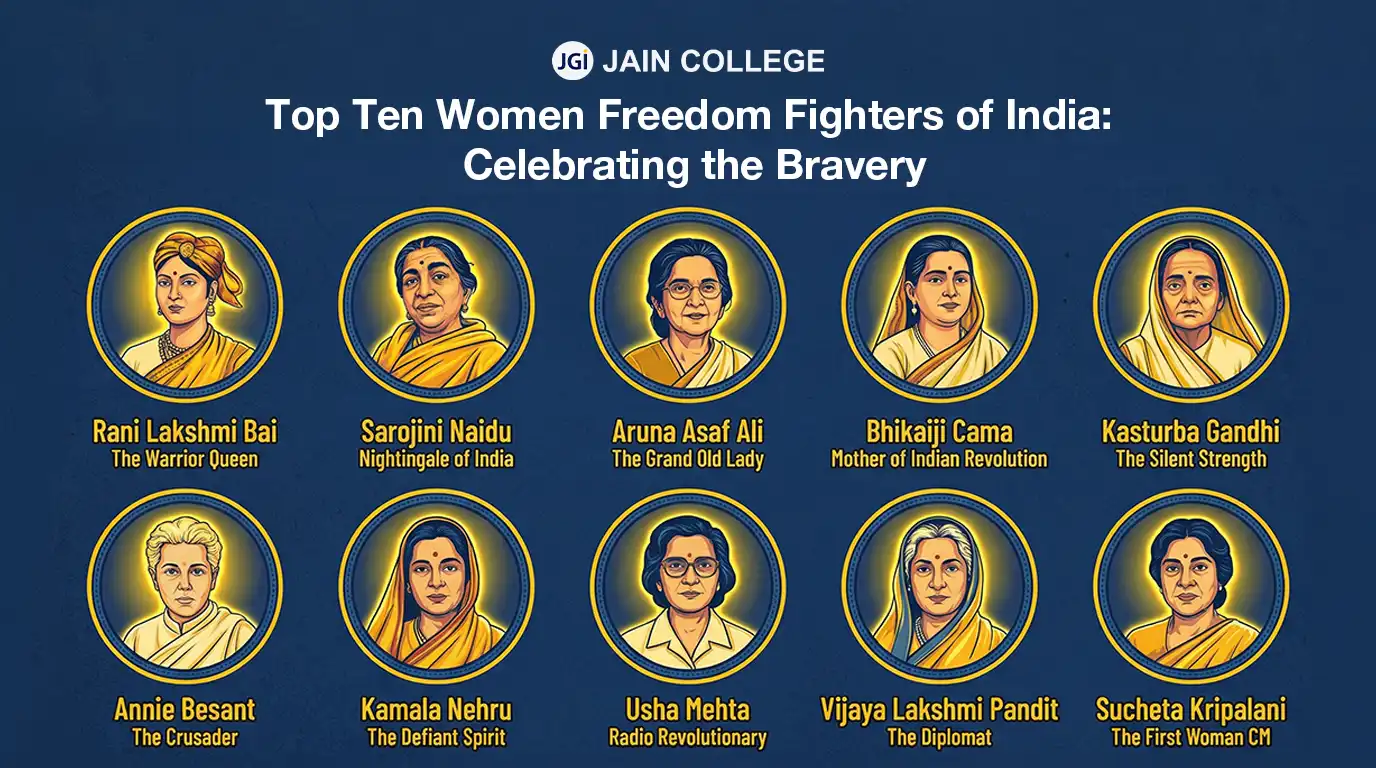
Without acknowledging the contributions of women, our understanding of the Indian freedom struggle would be incomplete. Women played a prominent role in the national movement alongside men, making immense sacrifices for the nation.
Women Freedom Fighters of India fought with unwavering courage and determination, enduring hardship, exploitation, and suffering in their pursuit of freedom.
Some of the most notable Indian women freedom fighters include Sarojini Naidu, Rani Chennamma, Rani Lakshmi Bai, Begum Hazrat Mahal, Rani Velu Nachiyar, and others.
India has a long history of courageous women who have fought for freedom, justice, and equality.
From Rani Lakshmi Bai to Sarojini Naidu, there have been hundreds of female freedom fighters in India who have made immense contributions to the country’s independence.
Let's explore the top women freedom fighters of India and understand their struggles against colonial rule and their role in shaping the nation.
| Freedom Fighter | Lifespan | Region / State | Key Contribution | Movement / Period |
| Keladi Chennamma | 1671–1750 | Karnataka | Defended the Keladi Kingdom and resisted external invasions | Pre-Colonial Resistance |
| Rani Velu Nachiyar | 1730–1796 | Tamil Nadu | First Indian queen to fight against the British East India Company | Early Resistance (1770s) |
| Kittur Rani Chennamma | 1778–1829 | Karnataka | Led the Kittur Revolt against the British East India Company | Early Anti-British Revolt (1824) |
| Begum Hazrat Mahal | 1820–1879 | Awadh, Uttar Pradesh | Led the revolt in Lucknow against British forces | Revolt of 1857 |
| Rani Lakshmi Bai | 1828–1858 | Jhansi, Uttar Pradesh | Led the rebellion against British rule during the Revolt of 1857 | First War of Independence |
| Jhalkari Bai | 1830–1858 | Jhansi, Uttar Pradesh | A soldier in Rani Lakshmi Bai’s army who disguised herself as the queen during battle | Revolt of 1857 |
| Annie Besant | 1847–1933 | Ireland / India | Started the Home Rule Movement and promoted Indian nationalism | Home Rule Movement |
| Bhikaji Cama | 1861–1936 | Maharashtra / International | Unfurled an early version of the Indian national flag in Germany (1907) | Revolutionary Movement |
| Kasturba Gandhi | 1869–1944 | Gujarat | Participated in Satyagraha and civil resistance movements with Mahatma Gandhi | Gandhian Movement |
| Sarojini Naidu | 1879–1949 | Hyderabad | Poet, nationalist leader, and the first Indian woman president of the INC | Civil Disobedience Movement |
| Kamala Nehru | 1899–1936 | Uttar Pradesh | Active participant in Non-Cooperation and Civil Disobedience movements | Gandhian Era |
| Siddhamma Bellari | 1903–Unknown | Karnataka | Participated in Aranya Satyagraha, Mysuru Chalo movement and Quit India Movement | Gandhian Era |
| Sucheta Kripalani | 1908–1974 | Uttar Pradesh | Freedom fighter and later the first woman Chief Minister of Uttar Pradesh | Towards Independence |
| Aruna Asaf Ali | 1909–1996 | Delhi | Hoisted the Indian National Congress flag during the Quit India Movement | Quit India Movement |
| Usha Mehta | 1920–2000 | Gujarat | Operated underground Congress Radio during the Quit India Movement | Quit India Movement |
| Lakshmi Sahgal | 1914–2012 | Tamil Nadu | Commander of the Rani of Jhansi Regiment in the Indian National Army | INA Movement |
Let’s dive right in and learn more about the inspiring Women Freedom Fighters of India who helped shape our nation's independence!
Keladi Chennamma is remembered as one of the earliest women rulers in Indian history who courageously resisted the expansion of British power. She was the queen of the Keladi (Ikkeri) kingdom in Karnataka during the early 19th century.
Rani Velu Nachiyar was a queen of the Sivaganga estate from c. 1780–1790.
She was born in the era where only men used to rule. Early in her life, she has become skilled in handling weapons and martial arts, which was unusual for women of her time and prepared her for her future role as a leader in a male-dominated society. She was married to the prince of Sivagangai in 1746.
Kittur Chennamma was born on Oct. 23, 1778, in Kakati, a small village in the present Belagavi district of Karnataka, India. From a young age, she displayed qualities of courage, intelligence, and leadership that later defined her role in history.
Kittur Rani Chennamma received her training in horse riding, sword fighting, and archery. She was well-known throughout her village for her bravery. At the age of 15, Rani Chennamma was married to Raja Mallasarja Desai, king of Kittur, and became the queen of Kittur.
Begum Hazrat Mahal, also known as the Begum of Awadh, was one of India’s first female freedom fighters, who led the battle of India’s first freedom movement in 1857 against the British East India Company.
Her boldness and bravery marked her place in history as the only major female leader of Awadh. The brave queen never surrendered to the British despite several troubles in her life and even continued resisting the British Raj during her years of exile in Nepal.
Rani Lakshmi Bai, the queen of Jhansi, was one of India's bravest women. A warrior queen and Rani of Jhansi, she was a part of India’s first struggle for Independence. She posed strong resistance to the British army led by General Hugh Rose and did not surrender even after her army got inundated.
Jhalkari Bai was one of the trusted soldiers and advisors to Rani Lakshmibai of Jhansi.
Jhalkari Bai was the commander of Durga Dal, or the women's brigade, in Rani Lakshmi Bai's regular army. It is said that Jhalkari Bai had a close resemblance to Lakshmi Bai. She often disguises herself as a queen and enters the battlefield to deceive the British. When the British Army trapped Rani Lakshmi Bai in the fort, it was Jhalkari Bai who assisted her escape.
Annie Besant was the first female President of the Indian National Congress. Her role in the politics and social activities of India was a considerable one in achieving India‘s freedom. She encouraged the Indians to understand the cultural heritage of India and to feel proud of it.
Madam Cama, aka Bhikaji Cama, a legendary figure who first hoisted India's flag on foreign land, was born on 24th Sept. 1861 AD, at Navsari in Bombay Presidency (British India) in a large, affluent Parsi Zoroastrian family.
Bhikaji Cama not only did revolutionary activities for India's freedom, but she also fought against the societal expectations that cramped women's existence to domestic roles.
Kasturba Gandhi, the wife of Mahatma Gandhi, played a significant role in India's freedom struggle and the nonviolent resistance movement. Kasturba Gandhi faced numerous challenges and hardships during her lifetime, including imprisonment and separation from her family. However, she remained resilient and persevered through difficult times, demonstrating immense strength of character. Kasturba Gandhi's influence on her husband's philosophy of nonviolence was profound and enduring.
She emerged as a prominent Nationalist around 1917. She was the second woman to become the president of INC in 1925. She played a leading role during Civil disobedience and was imprisoned. In 1942, she was arrested during the “Quit India movement”. She travelled across India and delivered lecture on women’s empowerment and nationalist
Kamala Nehru was an Indian independence activist and the wife of Jawaharlal Nehru, the first prime minister of India. During the freedom struggle, she braved lathi charges, organised processions, addressed meetings and led picketing of liquor and foreign cloth shops. She also organised parades, led pickets against liquor and foreign clothing stores, and participated in the liberation fight. She was instrumental in bringing the United Provinces' No Tax Campaign together.
Ballari Siddamma was an active participant in the Aranya Satyagraha, which is also known as the Forest Satyagraha. Siddamma Bellari was born in 1903 to a traditional family in the Haveri District. Her father actively participated in the struggle for liberation. She was really a very brave woman. She toured all the neighbouring villages of Davangere and Chitradurga and addressed men and women in their language and sought their co-operation.
Sucheta Kripalani was an Indian freedom fighter as well as a politician. SHe was India's first woman Chief Minister of the Uttar Pradesh government. Sucheta Kripalani actively participated in the Quit India Movement along with other freedom fighters.
Aruna Asaf Ali's life and career were conditioned by her exposure to a political context which reflected diversity, secularism and anti-colonialism. Her political activism as a freedom fighter and a woman activist encompassed these strands of anti-colonialism and radicalism.
Usha Mehta was the youngest among the freedom fighters and Gandhians. She was nine years old when salt satyagraha happened. Born in 1920 in Gujarat, she was a prominent freedom fighter who participated in every nationalistic and freedom movements of the country for Independence
Lakshmi Sehgal was born on October 24, 1914 in Madras to a talented lawyer and a social worker and freedom fighter's family.
Lakshmi was a medical practitioner, a commander of Subhas Chandra Bose’s Rani of Jhansi Regiment, and also a member of the Communist Party of India (CPI). Laxmi was a true revolutionary who broke social conventions since her early childhood and spoke against the caste practices in Kerala.
The history of the struggle for the independence of India would be incomplete without describing the contribution of women. Women contributed significantly to India’s freedom struggle through:
Very few of us know that there were hundreds of women who fought side by side with their male counterparts. They fought with true spirit and indomitable courage.
| 18th Century |
| Rani Velu Nachiyar (1730–1796)1770s – First Indian queen to fight the British East India Company; led armed resistance in Tamil Nadu. |
| Early 19th Century |
| Rani Chennamma (1778–1829)1824 – Led the Kittur Revolt against British rule in Karnataka. |
| Mid-19th Century (Revolt of 1857) |
| Begum Hazrat Mahal (1820–1879)1857 – Led the revolt in Lucknow against the British. |
| Rani Lakshmibai (1828–1858)1857–1858 – One of the most prominent leaders of the First War of Indian Independence. |
| Early 20th Century |
| Annie Besant (1847–1933)1916 – Launched the Home Rule League movement in India. |
| Sarojini Naidu (1879–1949)1917–1947 – Active in Civil Disobedience; first Indian woman President of the INC (1925). |
| Gandhian Era (1915–1947) |
| Kasturba Gandhi (1869–1944)1917–1944 – Participated in Satyagraha and Civil Disobedience movements. |
| Aruna Asaf Ali (1909–1996)1942 – Hoisted the Indian National Congress flag during the Quit India Movement. |
| Kamala Nehru (1899–1936)1920s–1930s – Active in Non-Cooperation and Civil Disobedience movements. |
| Revolutionary Movement |
| Bhikaji Cama (1861–1936)1907 – Unfurled the Indian national flag at the International Socialist Conference in Germany. |
| Usha Mehta (1920–2000)1942 – Ran the secret Congress Radio during the Quit India Movement. |
| Indian National Army (INA) |
| Lakshmi Sahgal (1914–2012)1943–1945 – Commander of the Rani of Jhansi Regiment of the INA. |
| Towards Independence |
| Sucheta Kripalani (1908–1974)1946–1947 – Worked closely with Congress leaders; later became India’s first woman Chief Minister of the Uttar Pradesh government. |
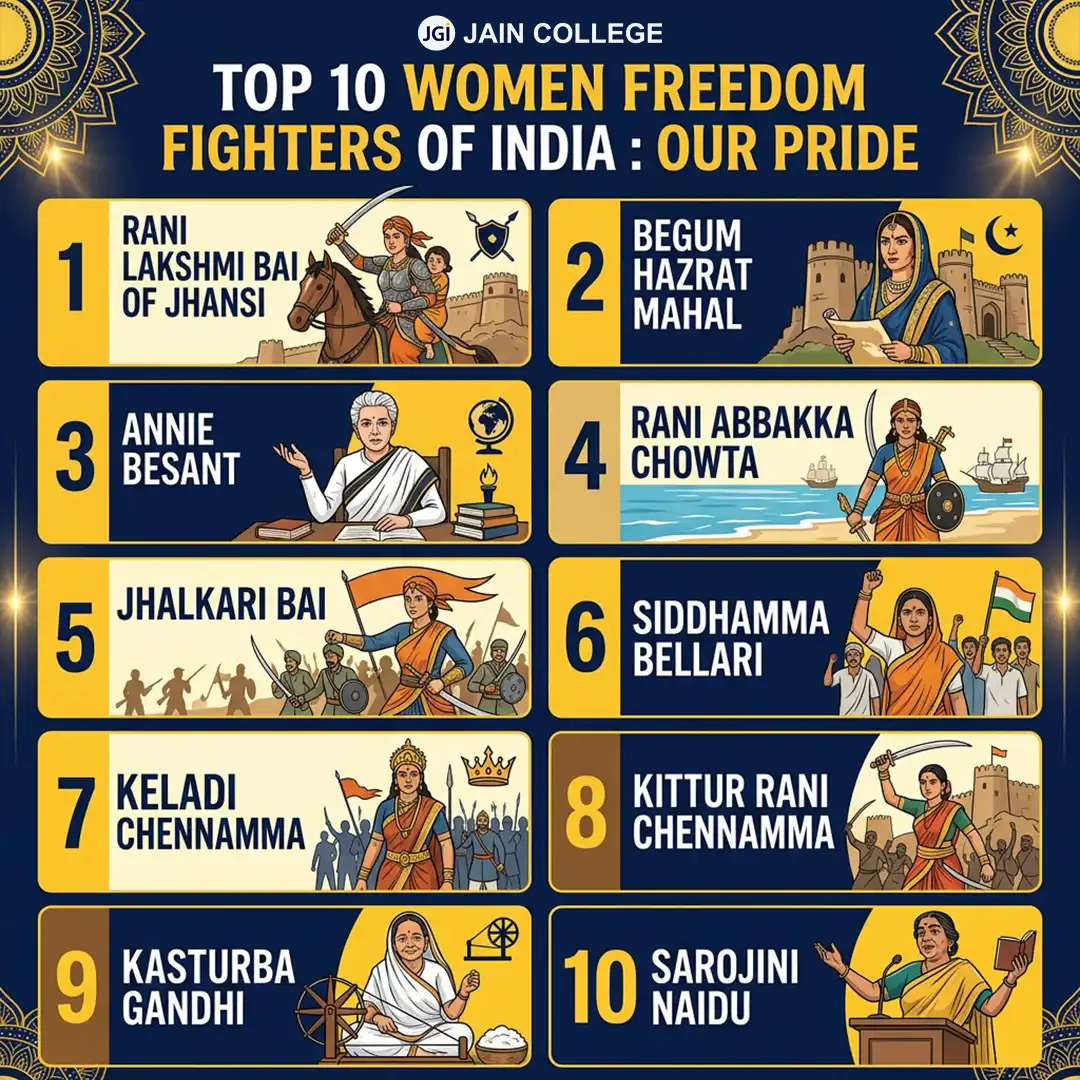
The early nineteenth century saw the participation of women in India's resistance against colonial rule.
During the Third Anglo-Maratha War (1817–1818), Bhimabai Holkar played an important role in opposing British forces led by Sir John Malcolm, demonstrating strong resistance against British expansion.
At this time, the British East India Company was rapidly expanding its empire in India. In 1799, the British defeated and killed Tipu Sultan, and the Third Anglo-Maratha War (1817–1818) subdued the Maratha Confederacy.
Amid these political upheavals, Rani Chennamma, the widowed queen of Raja Mallasarja of Kittur, challenged British attempts to annex her kingdom.
Kittur, located in the present-day Belagavi district of Karnataka, became the centre of her resistance. She fought bravely against the British army and achieved initial military success before eventually being overpowered.
Let us explore the bravery of the top Indian women freedom fighters who shaped India’s struggle for independence.
.webp)
The first name that comes to mind is that of the famous Rani Lakshmi Bai of Jhansi, who led her soldiers to war against the British. Even her enemies admired her courage and daring. She fought valiantly, and although beaten, she refused to surrender and fell as a warrior should, fighting the enemy to the last. Her remarkable courage inspired many men and women in India to rebel against foreign rule.
Indian history has not yet witnessed a woman warrior as brave and powerful as Rani Lakshmi Bai. She is a glorious example of patriotism and national pride.
Rani Lakshmi Bai, the Rani of Jhansi, set an outstanding example for all future generations of women freedom fighters with her heroism and superb leadership.
She married Maharaja Gangadhar Rao, the ruler of the princely state of Jhansi. She was not allowed to adopt a successor after his death by the British, and Jhansi was annexed. With the outbreak of the Revolt, she became determined to fight back. She used to go into the battlefield dressed as a man. Holding the reins of her horse in her mouth, she used the sword with both hands.
Under her leadership, the Rani's troops displayed unwavering courage and successfully repelled every enemy attack.
The British regarded her as the most exceptional and courageous rebel military leader, and she tragically lost her life on the battlefield.
.webp)
Begum Hazrat Mahal was a great Indian freedom fighter who played a major role during India’s First War of Independence. She was also known as the Begum of Awadh and the wife of Nawab Wajid Ali Shah, the eleventh and last King of Awadh.
She led a band of her supporters against the British, and was even able to seize control of
Lucknow. She worked in close association with other leaders of India’s First War of Independence, including Nana Sahib. Begum was not only a strategist but also fought on the battlefield.
When the forces under the command of the British recaptured Lucknow and most parts of Awadh, she was forced to retreat. When her forces lost ground, she fled Awadh, and she organised soldiers again in other places. She turned down all offers of amnesty and allowances by the British rulers.
After the failure of the 1857 uprising, Begum Hazrat Mahal fled Awadh and sought refuge in Nepal. She lived there in exile and died in 1879. To acknowledge her endless efforts in fighting for the freedom of the country, the Government of India issued a stamp on 10th May 1984.
.webp)
Annie Besant, an Irish lady and the leader of the Theosophical Society, joined the Indian National Congress and gave it a new direction. She was the first woman president of the Congress and gave a powerful lead to the women's movement in India. She soon became a prominent labour organiser, strike leader, and reformer.
She also became involved in Indian Nationalism and in 1916 established the Indian Home Rule League, of which she became President. She started a newspaper, “New India," that criticised British rule, which led to her imprisonment for sedition. She later became associated with a rationalist group within the Congress of Workers who did not appreciate Gandhi’s views.
She got involved in political and educational activities and set up a number of Schools and Colleges, the most important of which was Central Hindu College High School at Banaras, which she started in 1913.
.webp)
In the later half of the 16th century, Abbakka Rani was the first Tuluva queen
of Ullal to engage in battle against the Portuguese. She was one of the first women to
resist colonialism and foreign invaders.
Rani Abbakka earned the name Abhaya Rani (fearless queen) for her bravery. Her resistance is considered one of the earliest examples of opposition to European colonial powers in India.
Considering Ullal’s vital location, the Portuguese attempted many times to take
it. For over four decades, Abbakka successfully repelled each of their assaults.
Rani Abbakka gained the respect of her people and accomplished her dream of a free
kingdom, and she is still adored in her hometown of Ullal today.
.webp)
Jhalkari Bai was born on 22 November 1830, in the village of Bhojla near Jhansi. She is known for her bravery and was one of the trusted soldiers and advisors to Rani Lakshmibai of Jhansi.
It is believed that she learned about horseback riding and the art of weaponry at a very young age. Her acts of bravery earned her a position in the army of Rani Lakshmibai, called the Durga Dal.
In 1858, when the British forces attacked and besieged the fort of Jhansi, both Jhalkari Bai and her husband, Puran Kori, put up stiff resistance. At the height of the battle, she disguised herself as the queen, fighting in her stead, and allowing the queen, Rani Lakshmibai, to escape safely.
It was because of her that Rani Lakshmibai could escape from her palace along with her son. She played an important role in laying out the strategy for the battle alongside Rani Lakshmibai, coordinating troop movements and ensuring effective communication among the fighters.
.webp)
Siddhamma Bellari was born in 1903 to a traditional family in the Dundasi Village of the present-day Haveri District. Her father actively participated in the liberation struggle. He used to bring magazines and newspapers for Siddhamma. Her nationalist beliefs grew as a result of this.
Siddhamma Bellari was married to Murugappa, another freedom warrior. Thus, she became actively involved in the independence movement.
In 1938, she joined the Shivapura Congress party and participated in the Aranya Satyagraha in Chitradurga state in 1939, as well as the "Mysuru Chalo" or "Aranmane Sathyagraha" and the Quit India Movement.
Siddhamma Bellari was the first woman in the state of Mysore to hoist the national flag, and she
served a one-month sentence in prison. She was arrested and sentenced to imprisonment time due to the fact that she cut down wild date trees in the Davangere forests of Mayakowda
and Anagond.
Later, she was elected as Davangere’s MLA & suggested that women start
weaving and spinning. To ensure better health among rural women, she created “Mathrumandir”.
Her association with other important freedom fighters, including Sardar Veeranagouda Patil,
S. Nijalingappa and T. Siddhalingaiah made her a powerful leader and a key figure in the state’s history. The state government honoured her with a copper plaque. She contributed to the fight for freedom and uplifting women in general.
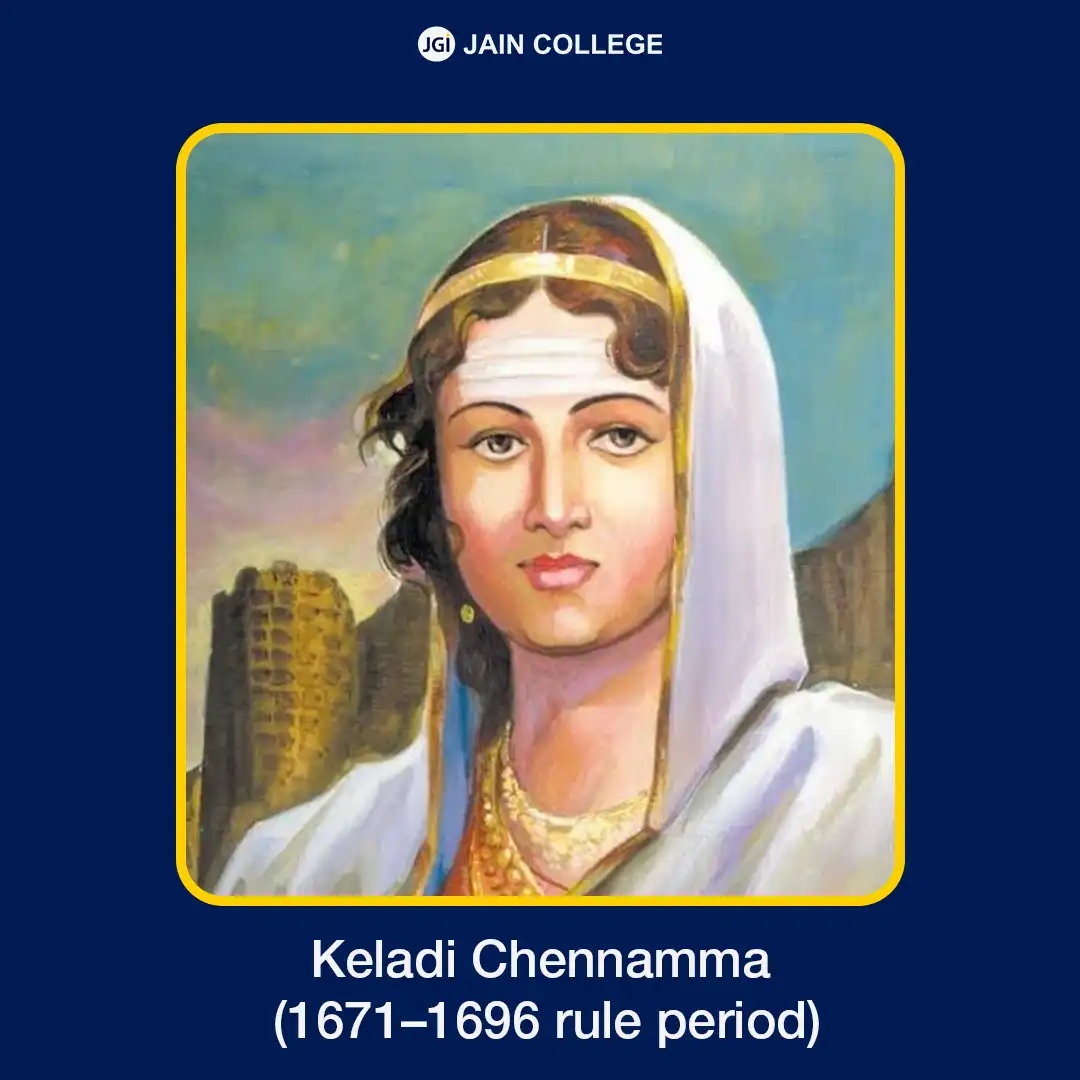
Keladi Chennamma was a prominent queen and warrior of the Keladi Nayaka Kingdom in Karnataka, India.
She was born in 1671 in the Keladi Kingdom, in present-day Shimoga district, and was married to Somashekara Nayaka, the King of Keladi. Her husband, Somashekara Nayaka, died, leaving their young son, Shivappa Nayaka, as the heir to the throne.
During her son’s minority, she served as the regent of the Keladi Kingdom and played a key role in the administration of the state.
In 1734, the Maratha Empire, led by Peshwa Baji Rao, launched an invasion of the Keladi Kingdom, seeking to annex it to their empire. Chennamma, then in her 60s, led the defence against the Maratha army and successfully repelled their invasion.
Her bravery and military skills were instrumental in the Keladi Kingdom’s defence. The Keladi Kingdom continued to prosper under her rule, and she played a crucial role in promoting the welfare of the people. She passed away in 1750, but her legacy still motivates generations of people in Karnataka and beyond.
.webp)
Rani Chennamma was a legendary queen and a freedom fighter from the princely state of Kittur in present-day Karnataka, India.
She was born on October 23, 1778, and lived during the time of Colonial India. Chennamma became the queen of Kittur at the age of 15, following the death of her husband, Mallasarja Desai.
Kittur Rani Chennamma is remembered for her bravery and leadership. She was known for her bravery and leadership during the Kittur Revolt of 1824.
In 1824, when the British East India Company attempted to annex the princely state of Kittur, she led an armed rebellion against them. She formed an army of 2000 soldiers, which included women warriors, and fought against the British forces.
Her army, heavily outnumbered and outgunned, managed to repel the first British attack. The British, however, were determined to capture Kittur and launched a second attack on the kingdom. In 1829, after a long and gruelling battle, she was captured and taken prisoner along with her adopted son, Shivalingappa.
Kittur Rani Chennamma was imprisoned in the Bailhongal Fort, where she breathed her last breath
Kittur Rani Chennamma is regarded as one of the earliest female freedom fighters in India and a symbol of resistance against British imperialism. Her bravery and leadership inspired many other freedom fighters, and she continues to be an icon of courage
and patriotism in India.
To honour her contributions to the Indian freedom struggle, the Government of India issued a stamp with her name in 2007. Today, she is remembered as a legend.
.webp)
Kasturba Gandhi, Mahatma Gandhi's wife, worked with him for many years. Her leadership of the Women's Satyagraha, a nonviolent movement advocating for women's rights and social justice, led to her imprisonment. She helped her husband in the cause of Indigo workers in Champaran, Bihar, and the No Tax Campaign in Kaira, Gujarat.
Kasturba Gandhi was arrested twice for picketing liquor and foreign cloth shops and in 1939 for participating in the Rajkot Satyagraha. She often took her husband's place when he was under arrest.
In January 1944, Kasturba Gandhi suffered two heart attacks, after which she was confined to her bed much of the time. Due to deteriorating health conditions, on 22 February, 1944, she died at the Aga Khan Palace in Poona, aged 74.
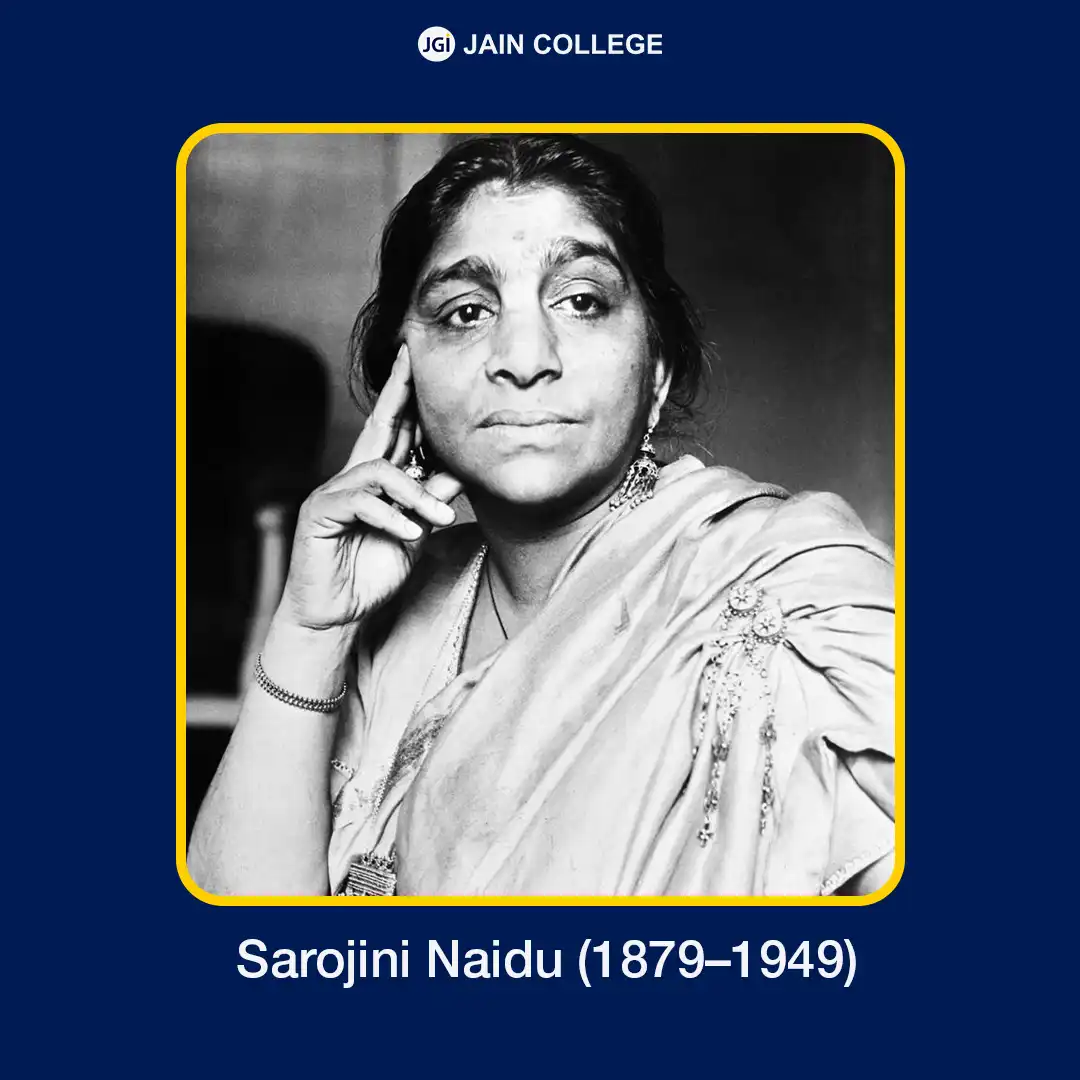
Sarojini Naidu was known as the "Cuckoo of India". She emerged as a prominent nationalist around 1917.
She was a distinguished poet and a renowned freedom fighter. Her father was the principal of Nizam College. At that time, Nizam was not in favour of women’s education; hence, Sarojini Naidu was sent to Madras for schooling, where she topped the matriculation examination at the age of twelve.
Sarojini Naidu met English authors Arthur Symons and Edmond Gosse. It was Gosse who convinced Sarojini to stick with Indian themes – India's great mountains, rivers, temples, and social milieu – to express her poetry.
Sarojini Naidu was elected as president of the Indian National Congress. She was the first Indian woman to become the president of the INC in 1925. She joined the national movement during the protest against the partition of Bengal in 1905.
During the Salt Satyagraha, she was one of the women protesters at the Dharasana salt works.
She played a leading role during the civil disobedience and was imprisoned.
In 1942, she was arrested during the “Quit India" movement. She travelled across India and delivered lectures on women’s empowerment and nationalism. She was also closely associated with the formation of the Women's India Association and accompanied the women’s voting rights delegation to London.
Indian women broke away from various restrictions and left their traditional domestic roles and responsibilities. Therefore, the participation of women in the struggle for freedom and national awakening is significant and historically important. But as warriors in a male-dominated society, women faced many obstacles.
The story of women's participation in India's struggle for freedom is about making bold choices and finding themselves on the streets, inside prisons, and in legislatures.
After so many efforts, India gained independence on August 15, 1947. Thousands of Indian women dedicated their lives to achieving independence for their country. The non-violent movement that led to India's independence depended on women's active participation for its success.
Women shouldered critical responsibilities in India’s struggle for freedom. They held public meetings, organised pickets at shops selling foreign alcohol and articles, sold Khadi, and actively participated in national movements.
Thousands of Indian women dedicated their lives to obtaining freedom for themselves and for our motherland.
Even though women attempted to alter the perception of conservative individuals who believed women were solely responsible for household chores, their efforts were met with resistance. Furthermore, women sacrificed their lives despite these challenges.
Stay tuned with JAIN PU College to learn more about women freedom fighters of India and other related articles.
Which Indian woman freedom fighter would you like to learn more about?
Share your thoughts in the comments below.
Rani Lakshmibai is known as a popular woman freedom fighter of India before 1900. She played a crucial role in the revolt of 1857, which sparked the wave of freedom all over India.
Every year on 13th February, India celebrates National Women’s Day. This celebration honours the strength, courage, and remarkable contributions of women in every field of life.
Aruna Asaf Ali is known as the grand old lady of the independence movement.
Rani Didda is a woman who played a prominent role in shaping the political history of Kashmir in ancient times.
As of 2025, there are 78 women MPs in the Lok Sabha. Our nation will have at least 181 female MPs in the Lok Sabha if the bill is passed.
Kittur Rani Chennamma was one of the first women to lead an armed revolt against the British in India. She is revered as a national hero in Karnataka
Rani Lakshmi Bai was the queen of Jhansi, a northern state of India. Nicknamed Manikarnika, she was born in 1828 in a Maharashtrian family at Kashi.
Kamaladevi Chattopadhyay was a great feminist, a social reformer, and one of the bravest female freedom fighters in India.
Sarojini Naidu was a prominent Indian freedom fighter, political activist, and poet. She was known as the "Nightingale of India".
Vijaya Lakshmi Pandit was one of the most prominent lady freedom fighters of India. She became India’s first Ambassador to the Soviet Union and the first woman President of the United Nations General Assembly (1953)

JAIN PU College, a part of the renowned JGI Group, is committed to empowering students with quality education.
Beyond academics, the college ensures its online content reflects the same standard of excellence. Every blog and article is meticulously vetted and proofread by subject matter experts to ensure accuracy, relevance, and clarity. From insightful educational topics to engaging discussions, JAIN PU College's content is crafted to inform, inspire, and add value to its readers, reflecting the institution's commitment to intellectual growth and innovation.
View all Blogs

.jpg)