









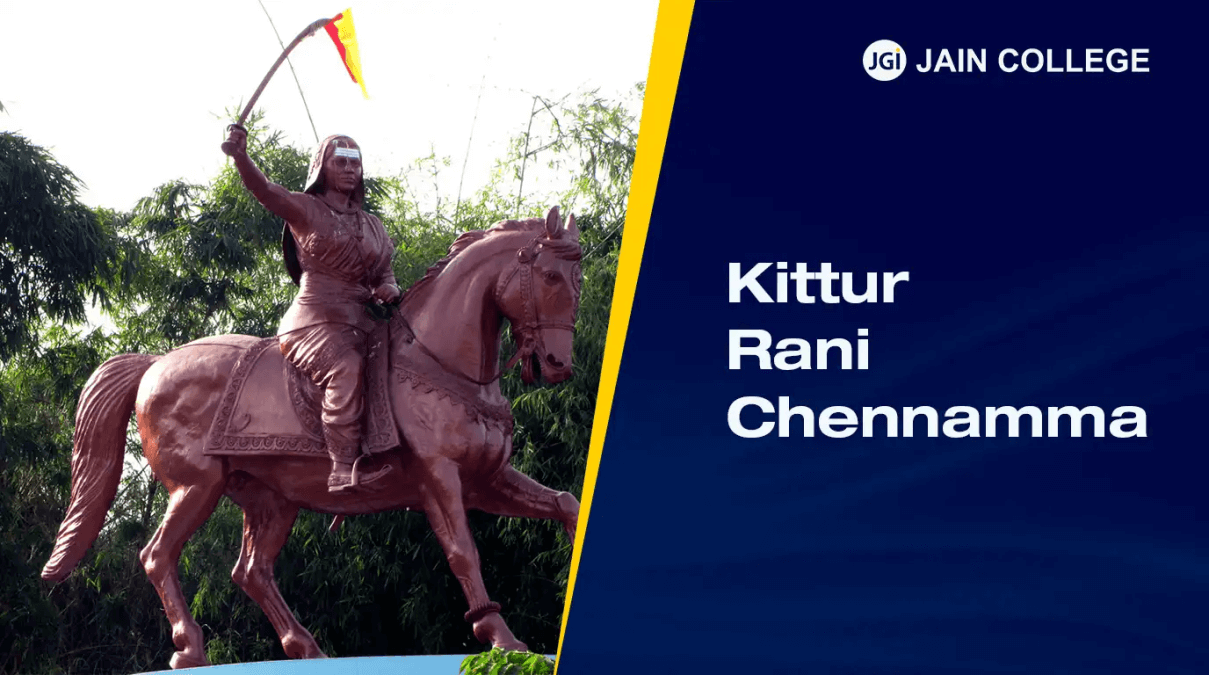
Kittur Rani Chennamma was the Queen of Kittur. She was one of the Indian women rulers to lead an armed revolt against the British East India Company in 1824.
Rani Chennamma became a celebrated freedom fighter in the state of Karnataka and a symbol of the independence movement in India. Kittur Utsav, an annual cultural festival held in October (around 22–25 October) to commemorate Rani Chennamma’s 1824 resistance against the British and her legacy.
| Kittur Rani Chennamma – Queen of Kittur, A Warrior and A Symbol of Courage India’s Early Woman Freedom Fighter (1778–1829) | |
| Early Life: | |
| Name | Kittur Chennamma or Rani Chennamma |
| Birth Date | Oct. 23, 1778 |
| Birthplace | Kakati village, Belagavi District, Karnataka. |
| Marriage | At age 15 |
| Predecessor | Raja Mallasarja Desai |
| Successor | Shivalingappa |
| Died on | Feb. 21, 1829 (aged 50), Bailhongal Fort |
| Family Details: | |
| Parents | Mother: Ambavva Bendre and Father: Ramachandra Bendre |
| Spouse | Raja Mallasarja Desai, king of Kittur |
| Children | One (adopted) |
| Training | Focused on traditional warrior skills like horse riding, sword fighting, and archery from a young age |
| Honours and Remembrance: | |
| The Rani Chennamma Express train | |
| Rani Chennamma University, Belagavi | |
| Statue at Parliament Complex, New Delhi (2007) | |
| Kittur Utsava is celebrated in October in Karnataka to commemorate the heroic rebellion of Rani Kittur Chennamma against the British in 1824. | |
Kittur Rani Chennamma was a brave, iconic freedom fighter and a queen of the princely state of Kittur in the Belgaum district, Karnataka.
Rani Chennamma was the first head of a princely state in India to rise against the powerful British Empire and maintain her independence, even for a brief period. She was queen of a small kingdom and a women of indomitable courage and patriotism. Chennamma had such a deep love for her land and people that she was willing to make any sacrifice to uphold their freedom.
Kittur Chennamma was born on Oct. 23, 1778, in Kakati, a small village in the present Belagavi district of Karnataka, India. From a young age, she displayed qualities of courage, intelligence, and leadership that later defined her role in history.
Chennamma received her training in horse riding, sword fighting, and archery. She was well-known throughout her village for her bravery. At the age of 15, Rani Chennamma was married to Raja Mallasarja Desai, king of Kittur, and became the queen of Kittur.

Kittur Rani Chennamma was the first Indian woman ruler to lead an armed revolt against the British East India Company. She became well known among the Desais of the Kittur region for her early resistance.
Chennamma was one of the earliest and most powerful symbols of resistance against British colonial rule. Her early training proved invaluable in managing royal responsibilities and later leading resistance against British rule. After her marriage with the Raja Mallasarja Desai, the ruler of the princely state of Kittur, she became actively involved in the political affairs of the region.
Gifted with courage and foresight, Chennamma loved the people and interacted closely with them. After the death of Kittur king Raja Mallasarja Desai, Chennamma took significant actions to secure her family's legacy and adopted Shivalingappa with the aim of making him the heir to the throne of Kittur.
The British East India Company denied Shivalingappa as heir of Kittur and ordered his exile from the kingdom under the pretext of the doctrine of lapse.
Kittur Chennamma defied the British order to expel Shivalingappa from the throne. Later, the state of Kittur came under the administration of Mr Thackeray, who was the collector of Dharwad, and Mr Chaplin was the commissioner.
The British East India Company later ordered Rani Chennamma to surrender her kingdom. She once again defied the British order, asserting her sovereignty and refusing to submit to colonial authority.
Rani Chennamma fought a war against British rule when the British East India Company attempted to annex her kingdom, which included the treasures and jewels of Kittur, valued at approximately 15 lakh rupees, during her rebellion against their authority. However, their attempts were unsuccessful.
Rani Chennamma defied the British order, leading to the outbreak of war. In this battle, Rani Chennamma’s force killed St John Thackeray, the British collector and political agent. The British force suffered significant losses in this battle, and Chennamma's army captured two British officers as hostages.
This was the first battle between the British and Kittur, which took place in October 1824.
After achieving victory in the first war, Rani Chennamma, to avoid further destruction, negotiated with the British commissioner and the governor of Bombay to release the hostages after assurances that the conflict would end.
However, this promise turned out to be only an act of deception.
Mr Chaplin, humiliated by their first defeat, purposefully returned to Kittur with much larger forces from Mysore and Sholapur to launch another assault. During the second war, the British East India Company, which had a huge force, defeated the kittur kingdom. After the defeat, Rani Chennamma was captured and imprisoned at the Bailhongal Fort for life.

In 1824, during her imprisonment in Bailhongal Fort, she spent the last five years of her life and took her last breath on Feb. 21, 1829.
Rani Chennamma’s samadhi (burial place) is located in Bailhongal taluk, Belagavi district, in the Indian state of Karnataka. It has become one of the key sites of remembrance for the warrior queen. The state government protects and maintains this memorial, which symbolises woman empowerment and resistance.
Every year, Rani Chennamma's samadhi receives special honour during the annual state-level Kittur Utsav as well as during Kannada Rajyotsava celebrations.
Rani Chennamma assumed administrative control of Kittur as regent after the death of her stepson in 1824. The stepson was the son of Rani Rudramma, the first wife of Mallasarja.
Kittur Rani Chennamma was a warrior queen who led her forces in battle. Her courageous resistance against the colonial authority led to numerous significant accomplishments. Some of them include:
Today in Indian history, Kittur Rani Chennamma is remembered as a symbol of heroism. During the struggle for independence, chennamma was among the women who fought fiercely and successfully defeated the British. She has a strong position in history because she defied the British when they attacked the Kittur region.

On a tribute to her spirit of freedom and leadership:

Kittur Rani Chennamma was the first head of a princely state in India to rise against the British Empire, even if only for a brief period.
During the revolt against the British, her armed rebellion became the theme of several inspirational plays, folk songs, and stories, ensuring that her bravery continued to live on in popular culture.
Even today, people still remember Kittur Rani Chennamma for her valour.
Rani Chennamma symbolised courage and determination among women. Today, Kittur has also become popular, as the remains of the fortress tell the story of Rani Chennamma’s ambition and quest for freedom from the British.
Discover Karnataka's famous freedom fighters, literary authors and poets and other great personalities at JAIN PU College's blogs.
Kittur Rani Chennamma’s legacy reminds us that courage and leadership have no gender.
Have you heard about Kittur Rani Chennamma before?
Share your thoughts in the comments below.
After the death of Kittur king Raja Mallasarja Desai and her stepson Shivalingarudra Sarja, Rani Chennamma ascended the throne. She did not ascend the throne as the primary ruler but served as regent.
After she was imprisoned for life by the British East India Company, Kittur Rani Chennamma spent her remaining days by reading holy texts and performing pooja.
Kittur Rani Chennamma was imprisoned in the fort of Bailhongal for life.
Kittur Rani Chennamma was defeated in the second battle. After her initial victory against the British in October 1824, the East India Company sent reinforced troops.
Sangolli Rayanna was one of the most loyal and patriotic followers of Rani Chennamma. He had promised Kittur Rani Chennamma that he would continue the fight and even raise a revolt against the British administration in Kittur.

JAIN PU College, a part of the renowned JGI Group, is committed to empowering students with quality education.
Beyond academics, the college ensures its online content reflects the same standard of excellence. Every blog and article is meticulously vetted and proofread by subject matter experts to ensure accuracy, relevance, and clarity. From insightful educational topics to engaging discussions, JAIN PU College's content is crafted to inform, inspire, and add value to its readers, reflecting the institution's commitment to intellectual growth and innovation.
View all Blogs








.webp)


.jpg)