








20 questions • One-card-at-a-time • Score calculated • Review at end (selected + correct)
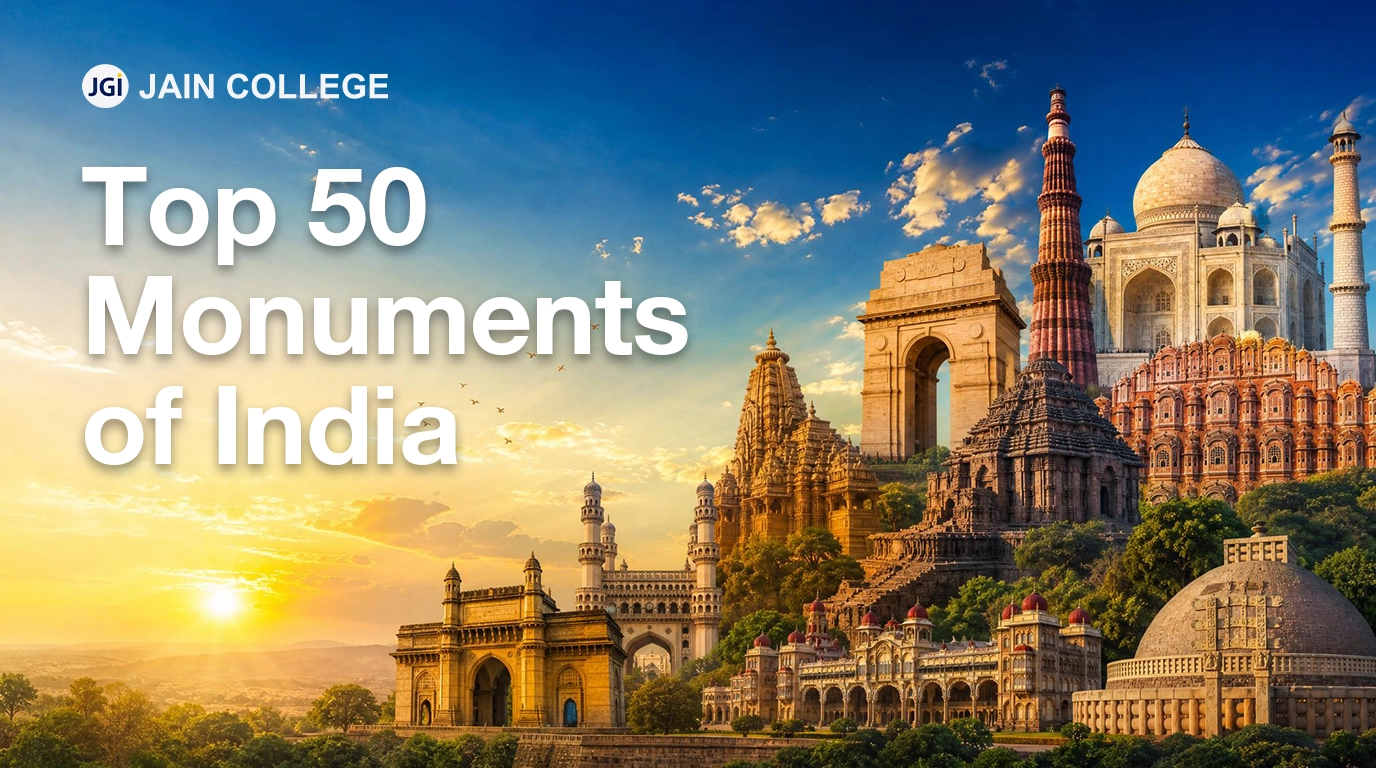
India is home to some of the world's most remarkable monuments, reflecting thousands of years of history, artistic excellence, and architectural innovation.
From ancient temples and Buddhist stupas to majestic forts, palaces, caves, and colonial landmarks, these monuments offer valuable insights into the country's diverse cultural and historical legacy.
Whether you're a student, history enthusiast, or traveller, exploring India's iconic monuments helps you understand the rise of great kingdoms, religious traditions, and architectural styles that have shaped the nation over centuries.
This article presents 50 of the most famous monuments in India, along with their locations, historical significance, and unique features, making it a useful resource for learning about the country's rich architectural and cultural heritage.
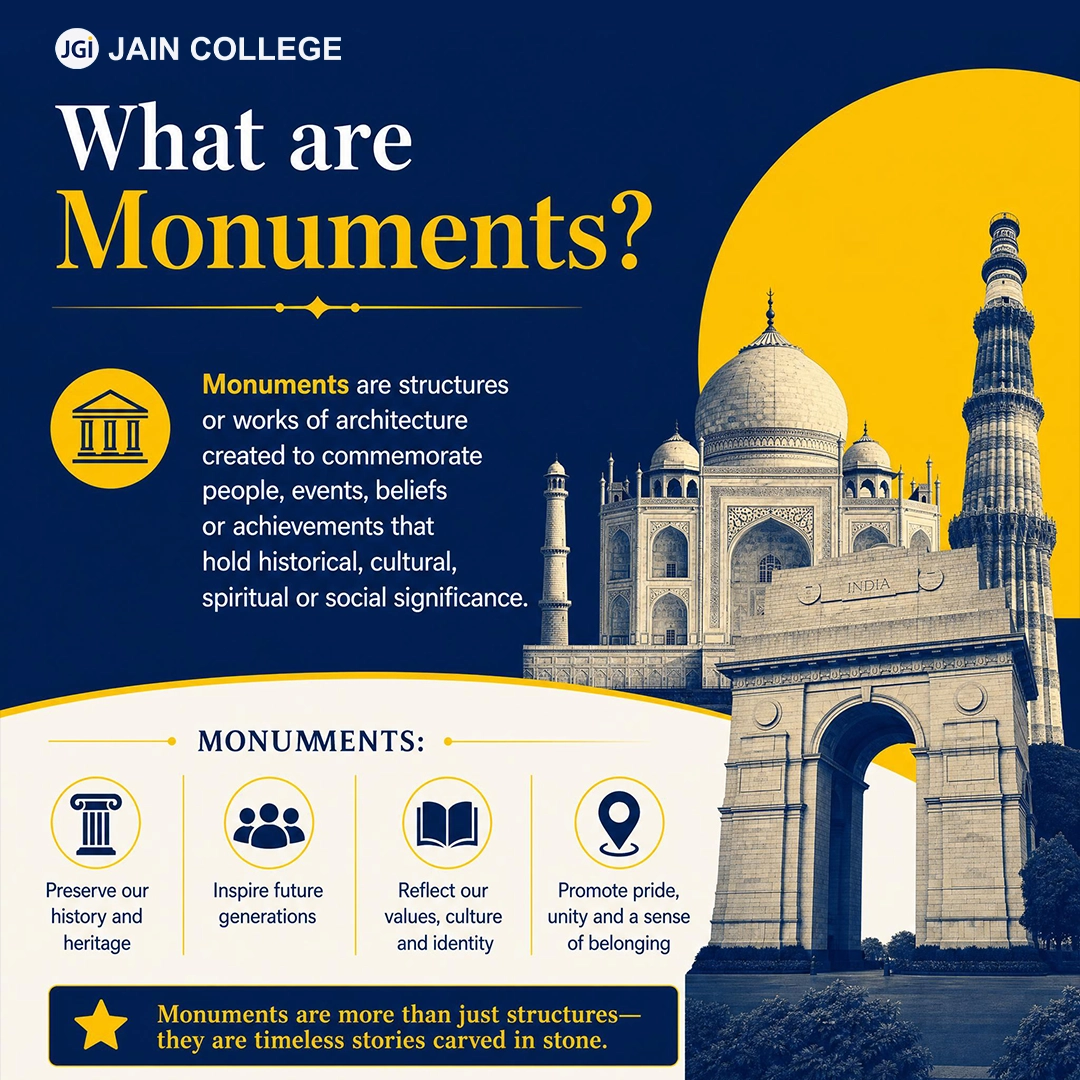
Monuments are structures, sites, or remains that preserve the history, culture, art, and architectural achievements of past civilisations. They offer insightful perspectives on India's rich heritage and help us understand the country's social, religious, and historical development.
India is home to a wide variety of monuments, including temples, forts, palaces, caves, stupas, churches, mosques, tombs, bridges, stepwells, inscriptions, and archaeological sites. Together, these monuments reflect the country's diverse cultural and architectural traditions across different periods of history.
Various famous monuments of India spread across the country. Many emperors, the government, and, in some cases, religious institutions built these monuments.
While some monuments have been destroyed and rebuilt over time, other historical monuments of India have withstood both time and natural calamities.
Here is the list of the Top 50 Monuments of India along with their location and creators. These monuments represent India’s rich historical, cultural, and architectural heritage. From ancient temples and forts to palaces and memorials, each monument reflects the legacy of different dynasties, empires, and rulers across the country.
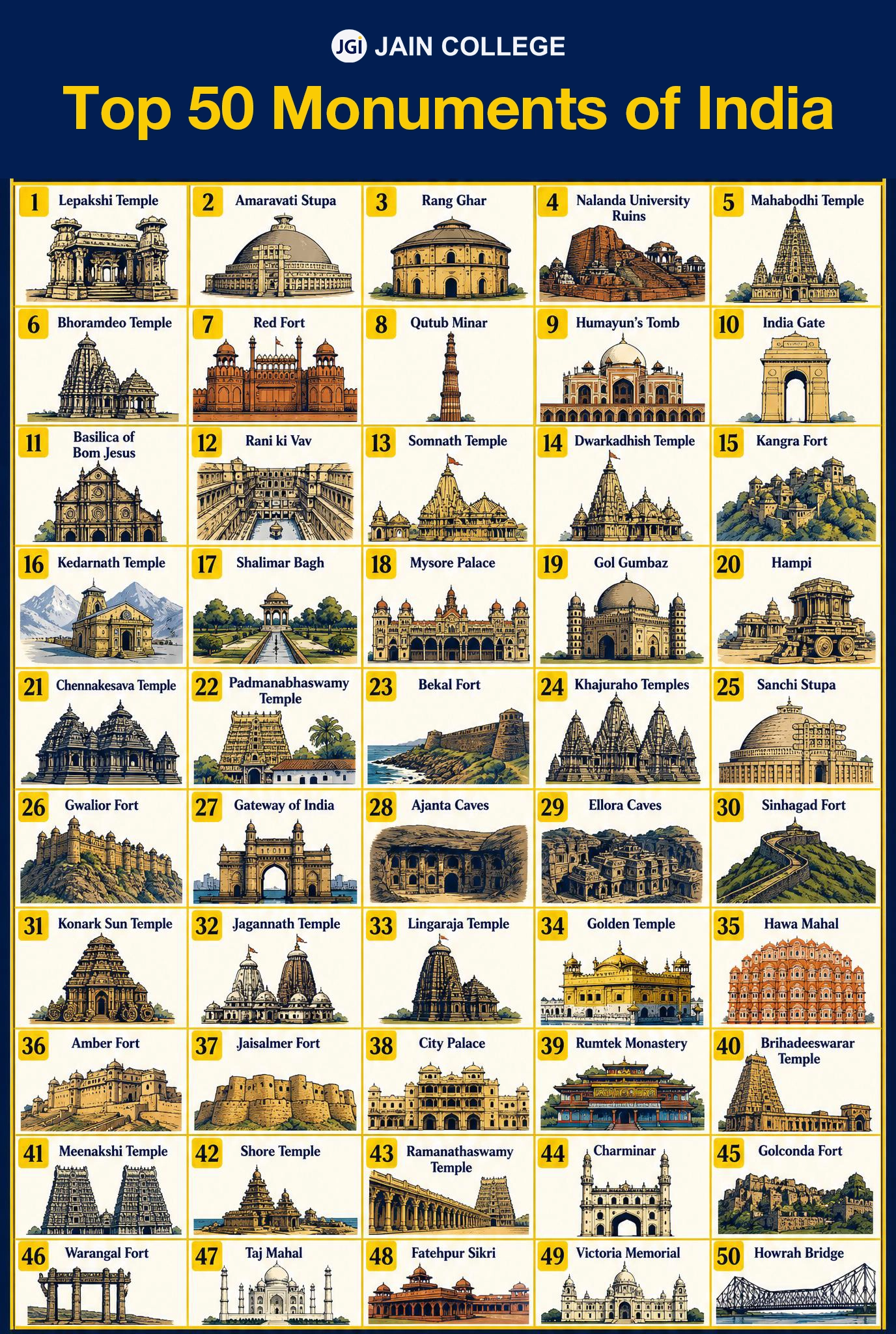
| State | Monument | Place | Built By | Famous for |
| AndhraPradesh | Lepakshi Temple | Lepakshi | Vijayanagara Empire | Hanging pillar and vivid murals |
| AndhraPradesh | Amaravati Stupa | Amaravati | Satavahana Dynasty | Major Buddhist site known for ancient carvings |
| Assam | Rang Ghar | Sivasagar | Ahom Kingdom | Historic amphitheatre; unique Ahom structure |
| Bihar | Nalanda University Ruins | Nalanda | Kumaragupta I | Ancient global learning centre; UNESCO site |
| Bihar | Mahabodhi Temple | Bodh Gaya | Emperor Ashoka | Site of Buddha’s enlightenment; UNESCO |
| Chhattisgarh | Bhoramdeo Temple | Kabirdham | Nagavanshi Dynasty | Known as “Khajuraho of Chhattisgarh” |
| Delhi | Red Fort | Delhi | Emperor Shah Jahan | Mughal-era fort; key Independence Day venue |
| Delhi | Taj Mahal | Agra | Emperor Shah Jahan | An enduring symbol of eternal love |
| Delhi | Qutub Minar | Delhi | Qutb-ud-din Aibak | Tallest brick minaret; UNESCO site |
| Delhi | Humayun’s Tomb | Delhi | Haji Begum | Early grand Mughal garden-tomb: UNESCO site |
| Delhi | India Gate | Delhi | British Government | WWI memorial arch and popular public landmark |
| Goa | Basilica of Bom Jesus | Old Goa | Portuguese | Houses relics of St Francis Xavier; UNESCO |
| Gujarat | Rani ki Vav | Patan | Queen Udayamati | UNESCO stepwell with detailed sculptures |
Gujarat |
Somnath Temple | Somnath | Chalukya Dynasty | One of the 12 Jyotirlingas: historic rebuilds |
Gujarat |
Dwarkadhish Temple | Dwarka | Vajranabha | Major Krishna temple and Char Dham site |
| Himachal Pradesh | Kangra Fort | Kangra | Katoch Dynasty | One of India’s oldest forts; strategic hill fort |
| Jammu &Kashmir | Shalimar Bagh | Srinagar | Jahangir | Mughal gardens are famous for terraced design |
| Karnataka | Mysore Palace | Mysuru | Wadiyar Dynasty | Famous royal palace with grand illumination and festivals |
| Karnataka | Gol Gumbaz | Vijayapura | Mohammed Adil Shah | Massive dome with whispering gallery |
| Karnataka | Hampi | Vijayanagara | Vijayanagara Empire | Vast ruins of a powerful empire; UNESCO site |
| Karnataka | Chennakesava Temple | Belur | Hoysala Dynasty | Hoysala art with detailed stone carvings |
Kerala |
Padmanabhaswamy Temple | Thiruvananthapuram | Travancore Royal Family | Celebrated temple; famed for historic vaults |
| Kerala | Bekal Fort | Kasaragod | Shivappa Nayaka | Scenic coastal fort with sea views |
Madhya Pradesh |
Khajuraho Temples | Khajuraho | Chandela Dynasty | Intricate carvings and temple architecture; UNESCO |
| Madhya Pradesh | Sanchi Stupa | Sanchi | Emperor Ashoka | Ancient Buddhist stupa with iconic gateways; UNESCO |
| Madhya Pradesh | Gwalior Fort | Gwalior | Raja Suraj Sen | Massive hill fort with palaces and temples |
Maharashtra |
Gateway of India | Mumbai | British Government | Colonial-era ceremonial arch on the waterfront |
| Maharashtra | Ajanta Caves | Aurangabad | Satavahanas and later the Vakatakas | Buddhist cave paintings and sculptures; UNESCO site |
| Maharashtra | Ellora Caves | Aurangabad | Rashtrakutas, Kalachuris, and Early Chalukyas | Rock-cut Hindu, Buddhist, Jain caves; Kailasa temple; UNESCO |
| Maharashtra | Sinhagad Fort | Pune | Maratha Empire | Famous for Maratha history and Tanaji’s battle |
| Odisha | Konark Sun Temple | Konark | King Narasimhadeva I | Chariot-shaped Sun temple; UNESCO site |
| Odisha | Jagannath Temple | Puri | King Anantavarman Chodaganga | Major pilgrimage site: famous Rath Yatra |
| Odisha | Lingaraja Temple | Bhubaneswar | Somavanshi Dynasty | Classic Kalinga architecture Shiva temple |
| Punjab | Golden Temple | Amritsar | Guru Arjan Dev | Holiest Sikh shrine; gold-plated sanctum |
| Rajasthan | Hawa Mahal | Jaipur | Maharaja Sawai Pratap Singh | “Palace of Winds” with 953 jharokhas (windows) |
| Rajasthan | Amber Fort | Jaipur | Raja Man Singh I | Rajput-Mughal fort palace with grand architecture |
| Rajasthan | Jaisalmer Fort | Jaisalmer | Rawal Jaisal | Living fort made of golden sandstone |
| Rajasthan | City Palace | Jaipur | Maharaja Sawai Jai Singh II | Royal palace complex with museums and courtyards |
| Sikkim | Rumtek Monastery | Gangtok | Wangchuk Dorje | Major Tibetan Buddhist monastery in Sikkim |
Tamil Nadu |
Brihadeeswarar Temple | Thanjavur | Emperor Rajaraja Chola I | Chola masterpiece; towering vimana; UNESCO |
| Tamil Nadu | Meenakshi Temple | Madurai | Pandya Dynasty | Dravidian temple known for colourful gopurams |
| Tamil Nadu | Shore Temple | Mahabalipuram | Pallava Dynasty | Seaside stone temple complex; UNESCO site |
| Tamil Nadu | Ramanathaswamy Temple | Rameswaram | Pandya Dynasty | Long temple corridors; major pilgrimage (Char Dham) |
| Telangana | Charminar | Hyderabad | Sultan Muhammad Quli Qutb Shah | Landmark monument with four minarets |
| Telangana | Golconda Fort | Golconda | Kakatiya Dynasty and Qutb Shahi Dynasty | Famous acoustics; historic diamond trade fort |
| Telangana | Warangal Fort | Warangal | Kakatiya Dynasty | Kakatiya-era ruins; iconic stone gateways |
| Uttar Pradesh | Taj Mahal | Agra | Shah Jahan | Iconic white-marble mausoleum and symbol of love |
| Uttar Pradesh | Fatehpur Sikri | Agra | Akbar | Mughal city complex; UNESCO site |
| Uttarakhand | Kedarnath Temple | Uttarakhand | Ancient origins | Major Himalayan Jyotirlinga pilgrimage |
| West Bengal | Victoria Memorial | Kolkata | British Government | Grand marble museum of colonial-era history |
| West Bengal | Howrah Bridge | Kolkata | British Indian Government | Iconic cantilever bridge and city symbol |
These are the lists of the top 50 monuments of India. All these monuments are protected by:
India is popular for its wide range of historical monuments.
India was historically referred to as ‘Sone Ki Chidiya’ because of its rich culture, prosperity and architectural heritage.
These monuments were built by Indian kings as a symbol of their glory in wars or to represent the beautiful cultural heritage of India.
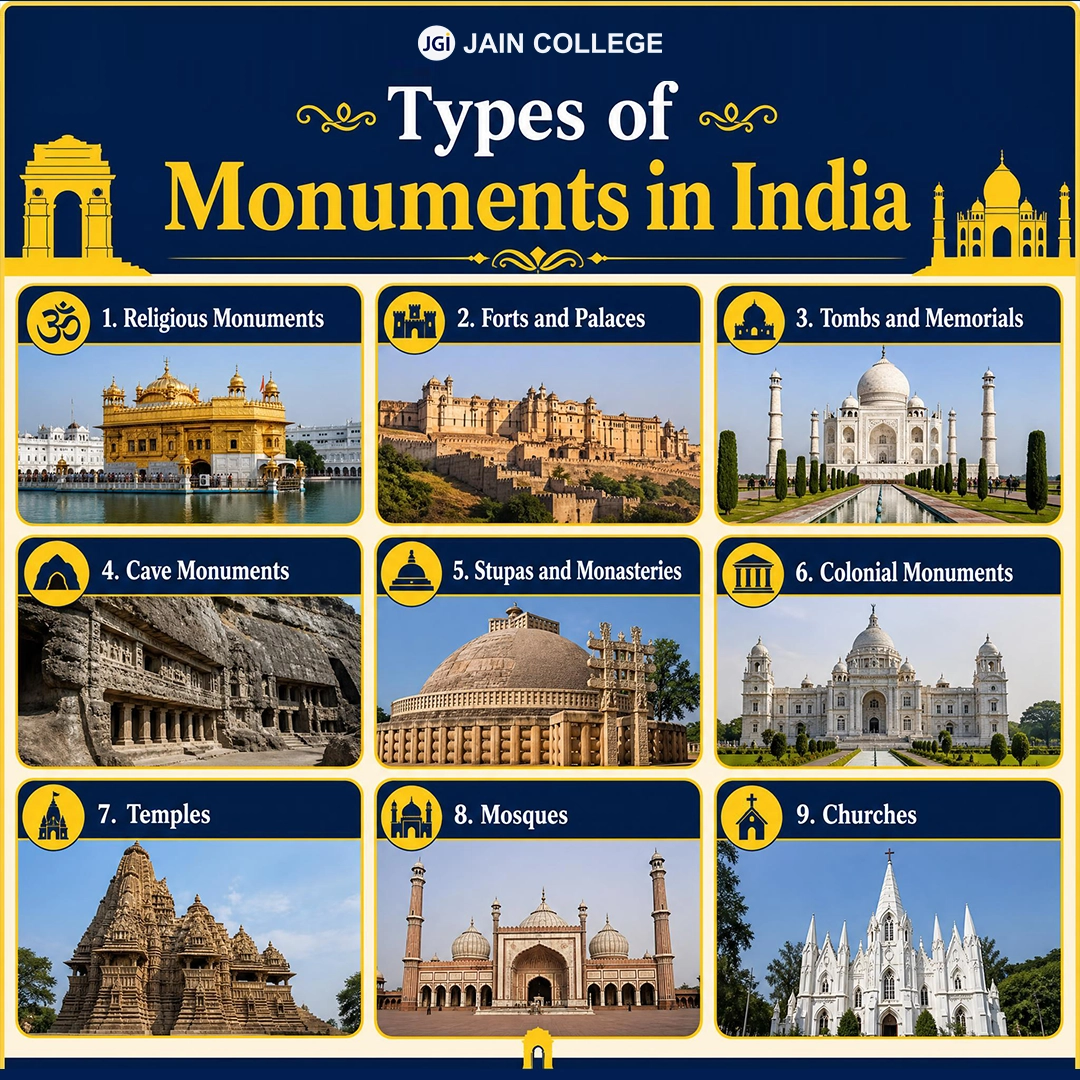
India is home to a wide variety of monuments that reflect its historical significance, culture, religion, and architecture. These monuments can be classified into different types based on their purpose, design, and historical importance.
The different types of monuments are broadly classified into historical, religious, and architectural categories. Here are the different types of monuments:
| Type of Monument | Description | Examples |
| Religious Monuments | Structures built for worship and spiritual purposes | Meenakshi Temple, Golden Temple |
| Forts and Palaces | Royal residences and defensive structures built by kings and rulers | Red Fort, Mysore Palace |
Tombs and Memorials |
Structures built in memory of rulers, leaders, or important personalities | Taj Mahal, Humayun's Tomb |
| Cave Monuments | Rock-cut caves used for religious, cultural, or residential purposes | Ajanta Caves, Ellora Caves |
| Stupas and Monasteries | Buddhist structures used for meditation and preserving relics | Sanchi Stupa, Rumtek Monastery |
Colonial Monuments |
Buildings constructed during British, Portuguese, or other colonial periods | Victoria Memorial, Chhatrapati Shivaji terminus, Mumbai |
| Temples | Sacred places dedicated to Hindu deities | Konark Sun Temple, Brihadeeswarar Temple |
| Mosques | Islamic places of worship with domes and minarets | Charminar, Jama Masjid |
Churches |
Christian religious monuments built during colonial and missionary periods | Basilica of Bom Jesus, St Francis Church |
| Historical Monuments | Sites representing important historical events or eras | Hampi, Fatehpur Sikri |
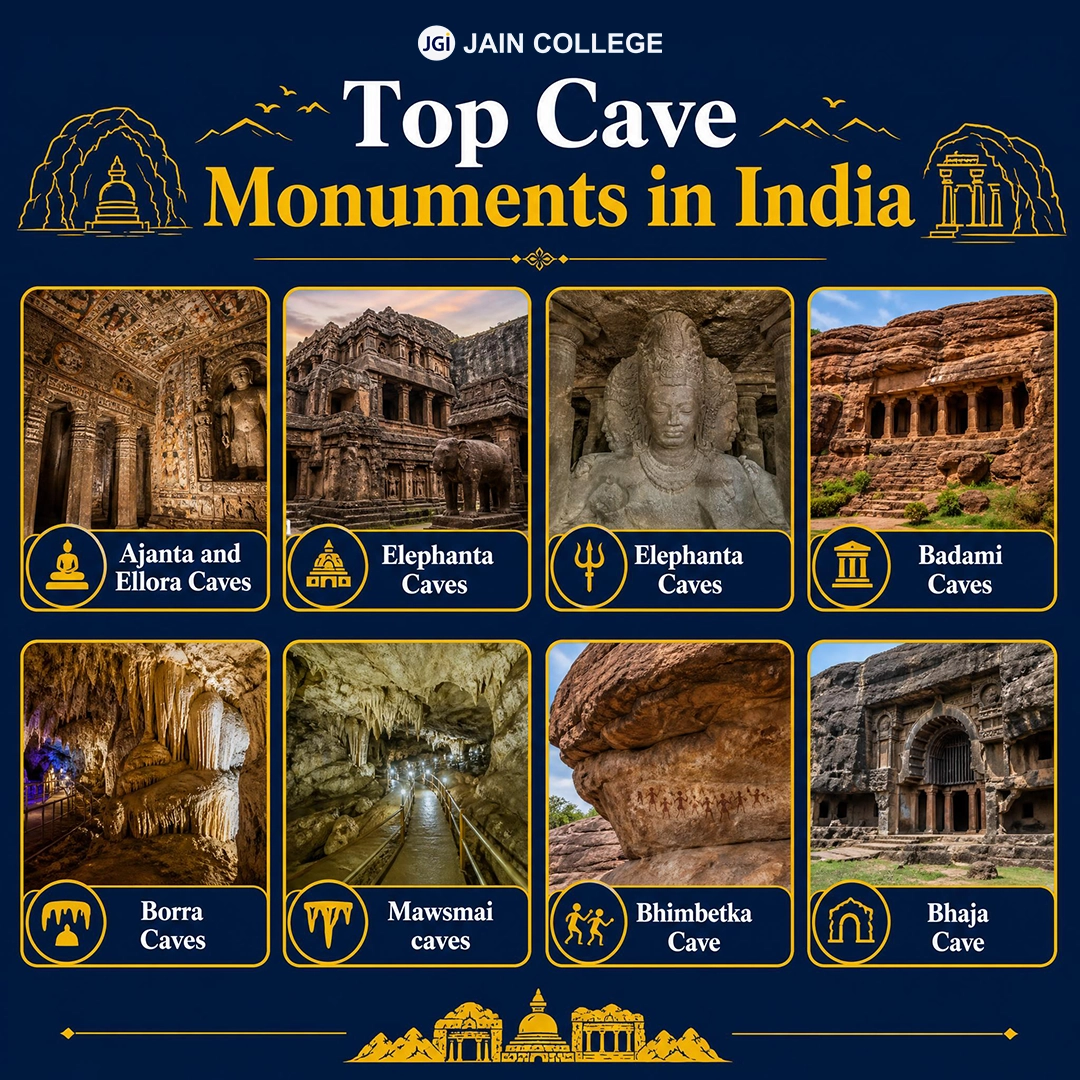
In India, these are the most famous caves to explore, which is certainly an inspiring and exciting experience.
India is home to some of the world's most remarkable rock-cut caves, reflecting centuries of artistic, religious, and architectural achievement. Many of these caves served as places of worship, meditation, and learning for Buddhist, Hindu, and Jain communities, while several are recognised as UNESCO World Heritage Sites.
Here are some of these types of cave monuments in more detail:
The Ajanta and Ellora Caves in Maharashtra are among India's most celebrated rock-cut monuments. Ajanta's 29 caves are renowned for their Buddhist paintings and sculptures, while Ellora's 34 caves feature Hindu, Buddhist, and Jain temples carved into rock between the 6th and 11th centuries.
The Elephanta Caves, located on Elephanta Island near Mumbai, are renowned for their rock-cut sculptures dedicated to Lord Shiva. The UNESCO World Heritage Site is best known for the magnificent three-faced Maheshmurti sculpture.
The Badami Cave Temples in Karnataka were carved during the 6th and 7th centuries under the Chalukya dynasty. The four caves contain Hindu and Jain temples adorned with intricate sculptures and carvings.
The Borra Caves in Andhra Pradesh are naturally formed limestone caves known for their impressive stalactite and stalagmite formations. They were documented by British geologist William King in 1807 and remain a popular tourist destination.
The Mawsmai Caves in Meghalaya are naturally formed limestone caves featuring illuminated passages, chambers, and striking stalactite and stalagmite formations. They offer visitors an accessible glimpse into the region's unique geology.
The Bhimbetka Rock Shelters in Madhya Pradesh contain some of the oldest known rock paintings in India, providing evidence of prehistoric human life dating back thousands of years. They are recognised as a UNESCO World Heritage Site.
The Bhaja Caves near Pune are among India's earliest Buddhist rock-cut cave complexes. Dating from the 2nd century BCE, they are known for their chaitya hall and early examples of Buddhist architecture.
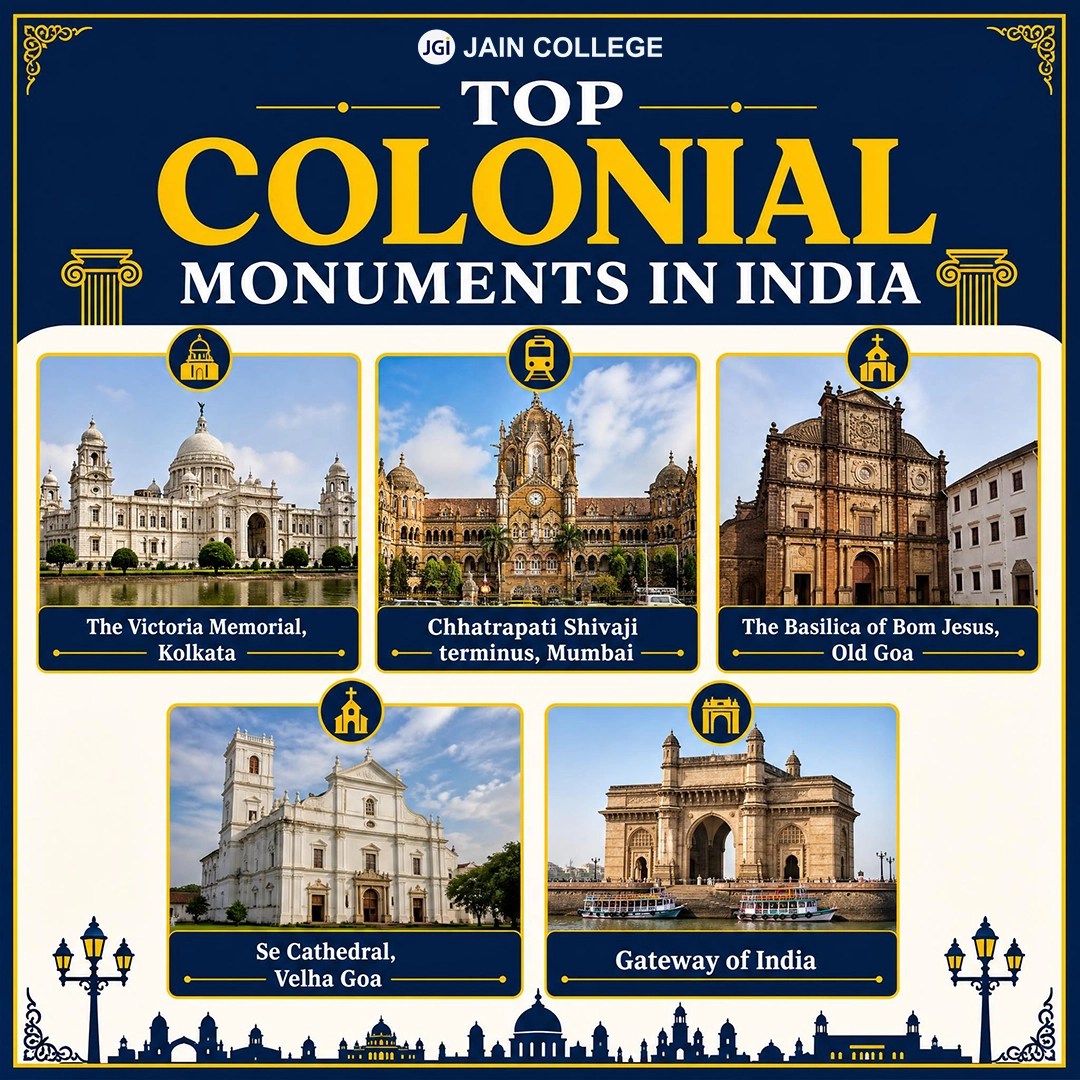
Colonial architecture in India reflects the influence of British, Portuguese, French, and other European powers that ruled different parts of the country. These monuments combine European architectural styles with Indian craftsmanship and continue to be important historical landmarks.
The following are some of these types of Colonial architecture monuments in more detail:
The Victoria Memorial was built between 1906 and 1921 in memory of Queen Victoria. Constructed from white Makrana marble and surrounded by landscaped gardens, it is one of Kolkata's most iconic colonial-era landmarks and now serves as a museum.
Chhatrapati Shivaji Maharaj Terminus (CSMT) is a UNESCO World Heritage Site and one of India's finest examples of Victorian Gothic Revival architecture. Completed in 1887, it blends European design with traditional Indian architectural elements and remains one of the country's busiest railway stations.
The Basilica of Bom Jesus, completed in 1605, is one of India's most important Christian monuments. Built in the Baroque style, it is best known for housing the mortal remains of St. Francis Xavier and is a UNESCO World Heritage Site
Se Cathedral is one of the largest churches in Asia and is dedicated to St. Catherine of Alexandria. It is renowned for its Portuguese-Gothic architecture and the famous Golden Bell, celebrated for its rich tone.
The Gateway of India was built to commemorate the visit of King George V and Queen Mary to Mumbai in 1911. Overlooking the Arabian Sea, it remains one of Mumbai's most recognisable landmarks and a symbol of the city's colonial past.
Colonial monuments across India reflect the architectural influences of British, Portuguese, French, and other European powers. Today, they stand as important reminders of India's colonial history and its rich architectural legacy.
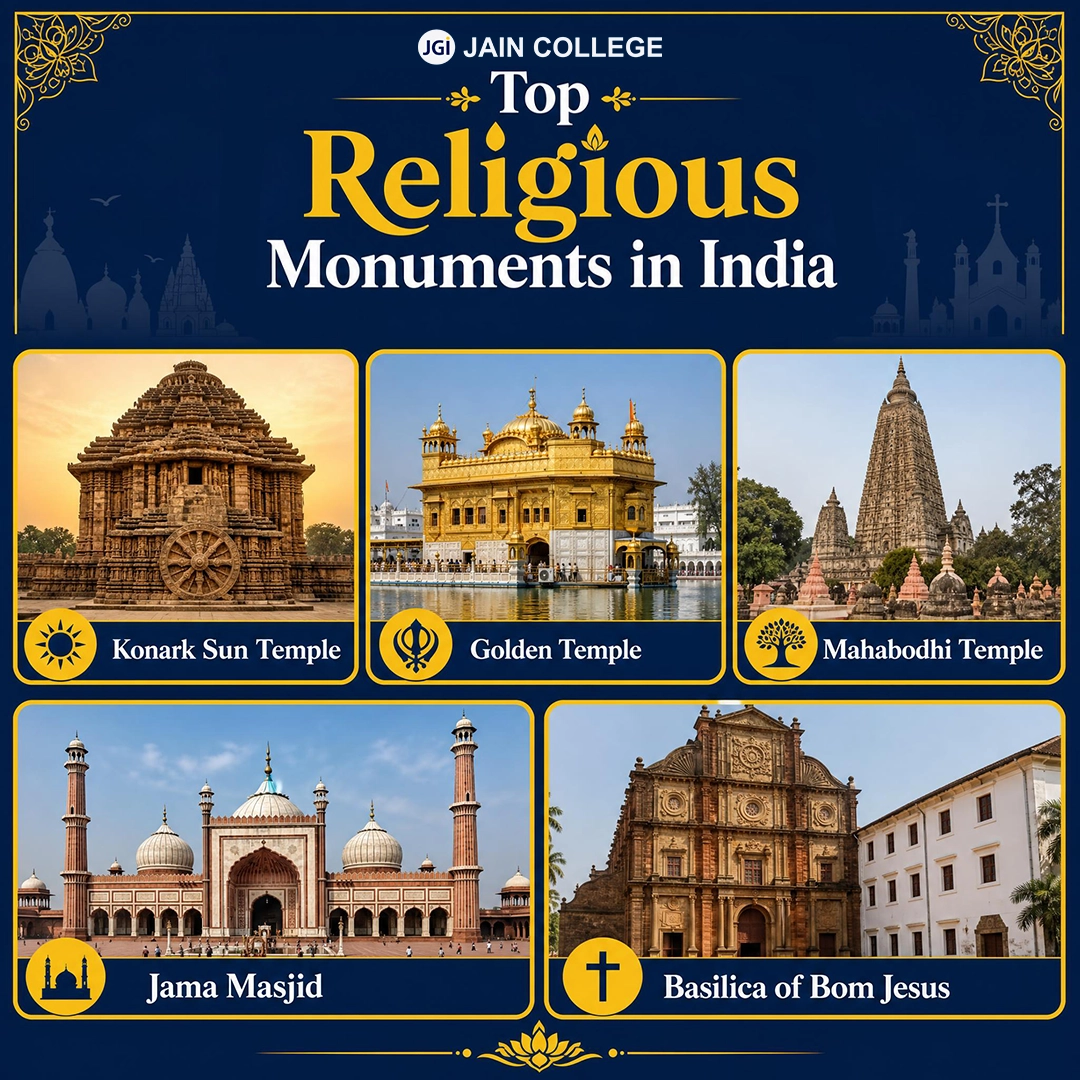
India is home to many significant religious monuments that reflect the country's spiritual traditions and architectural legacy. These sites continue to serve as places of worship while attracting visitors for their historical and cultural importance.
As a secular country, India has many temples devoted to Gods of various religions.
Below are some of these types of religious monuments in more detail:
The Konark Sun Temple in Odisha was built in the 13th century by King Narasimhadeva I in honour of the Sun God, Surya. Designed as a colossal stone chariot with intricately carved wheels and horses, it is regarded as one of India's finest examples of temple architecture.
The Golden Temple (Harmandir Sahib) in Amritsar is the holiest shrine in Sikhism. Surrounded by the sacred Amrit Sarovar, it is renowned for its gold-covered sanctum, welcoming atmosphere, and community kitchen (langar), which serves free meals to visitors regardless of religion or background.
The Mahabodhi Temple in Bodh Gaya, Bihar, marks the place where Gautama Buddha is believed to have attained enlightenment beneath the Bodhi Tree. It is one of Buddhism's most important pilgrimage sites.
The Jama Masjid in Old Delhi, commissioned by Emperor Shah Jahan, is one of India's largest mosques. It is known for its impressive red sandstone and marble architecture and its towering minarets overlooking the city.
The Basilica of Bom Jesus in Goa is one of India's most important Christian monuments. Built in the Baroque style, it is best known for housing the mortal remains of St. Francis Xavier and remains a major pilgrimage site.
These religious monuments highlight India's spiritual traditions, artistic achievements, and centuries of cultural history. Together, they represent the country's diverse religious heritage and continue to inspire visitors from around the world
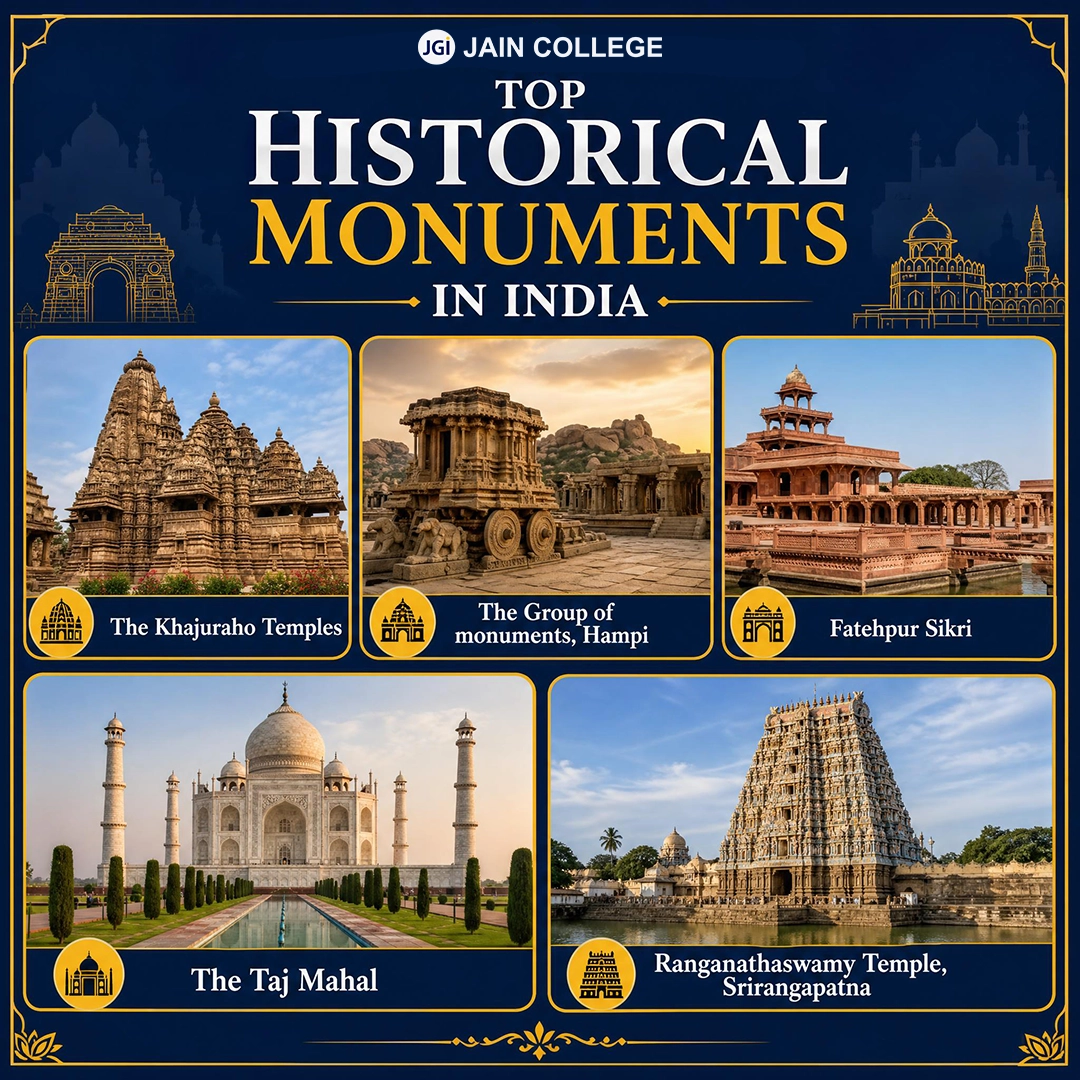
India is a country with varied cultures and a rich heritage value. There are several historical monuments with great significance across the country that showcase its impressive past.
India is home to numerous historical monuments that reflect the country's long and diverse history. Built by different dynasties and civilisations, these landmarks showcase remarkable craftsmanship, artistic achievement, and historical importance.
The following monuments are among the most notable examples of India's architectural and cultural legacy.
Located in Madhya Pradesh, the Khajuraho Temples are renowned for their intricate carvings and sculptures. Built by the Chandela dynasty between the 9th and 12th centuries, they represent a distinctive blend of Hindu and Jain architectural traditions. The temple complex is recognised as a UNESCO World Heritage Site and remains one of India's most celebrated historical landmarks.
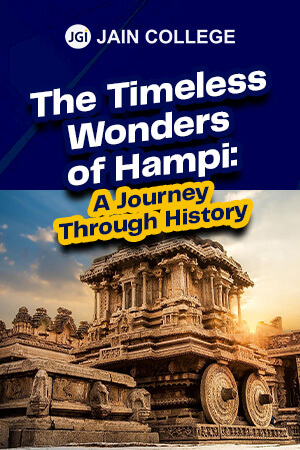
Hampi, a UNESCO World Heritage Site in Karnataka, was once the capital of the Vijayanagara Empire. Today, it is known for its extensive collection of temples, palaces, marketplaces, and other historic structures. Notable attractions include the Virupaksha Temple, Vittala Temple, and the iconic Stone Chariot.
Located near Agra, Fatehpur Sikri was founded by the Mughal Emperor Akbar in the 16th century and briefly served as the capital of the Mughal Empire. The city is renowned for its well-planned layout and impressive Mughal architecture. Key attractions include the Buland Darwaza, Jama Masjid, and Panch Mahal.
The Taj Mahal, located in Agra, is one of the world's most recognised monuments and a UNESCO World Heritage Site. Mughal Emperor Shah Jahan built the white marble mausoleum in memory of his wife, Mumtaz Mahal, and completed it in 1653. Renowned for its symmetry, intricate craftsmanship, and landscaped gardens, it is widely regarded as a masterpiece of Mughal architecture.
The Ranganathaswamy Temple in Srirangapatna, Karnataka, is an important Vaishnavite temple dedicated to Lord Ranganatha, a form of Vishnu. Recognised as a protected monument by the Archaeological Survey of India, it is one of the five sacred temples that form the Pancharanga Kshetram pilgrimage circuit in southern India.
There are various cultural heritage sites in India, highlighting their historical and architectural significance.
These monuments offer a glimpse into India's rich past and the achievements of the civilisations that shaped the country. Each landmark tells a unique story, making it an important part of India's historical legacy and a valuable destination for visitors and students alike.
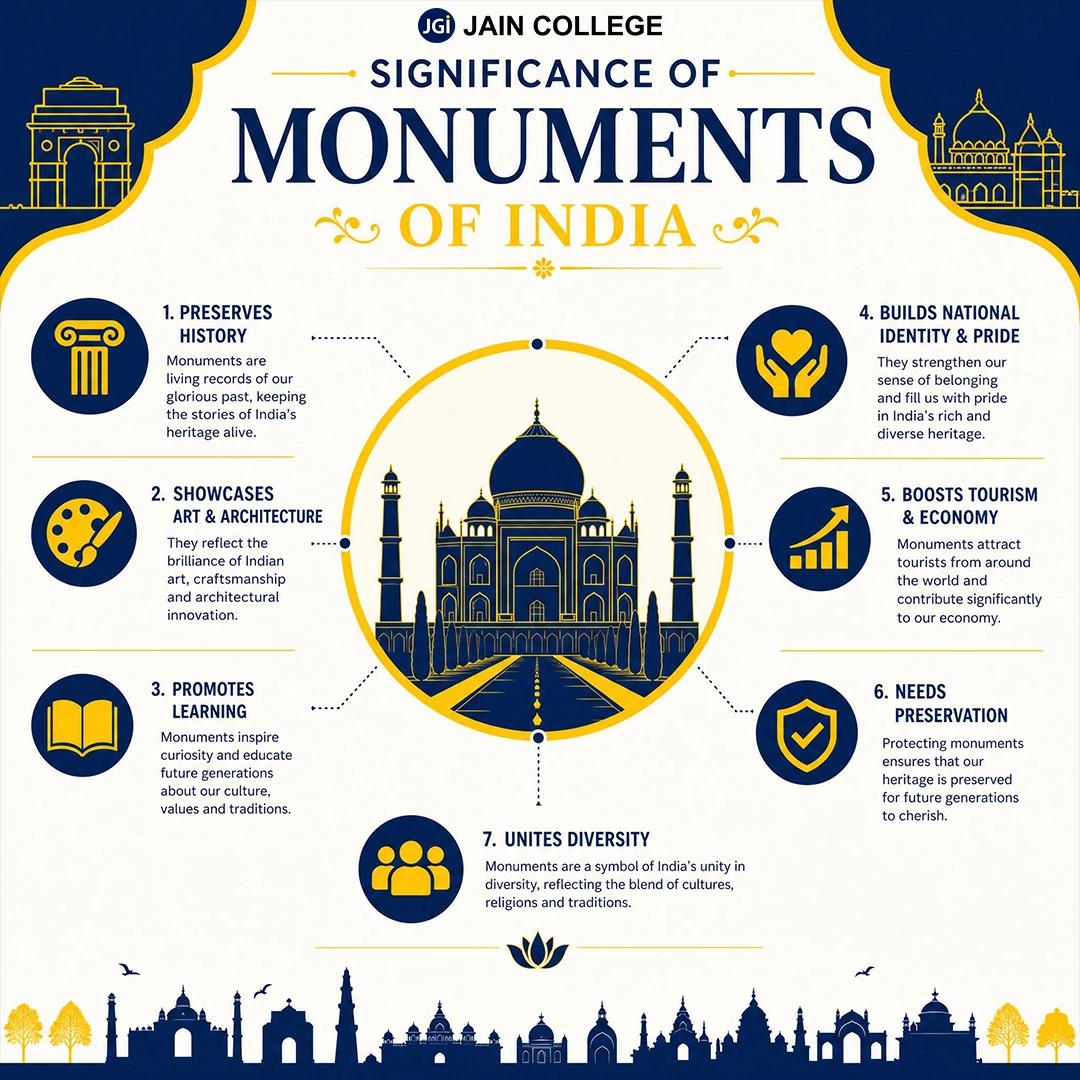
Indian monuments reflect the country's rich history, cultural diversity, and architectural excellence. Built over centuries by different dynasties and civilisations, they showcase a wide range of artistic styles, engineering techniques, and religious influences.
Many of these monuments serve as national treasures or UNESCO World Heritage Sites, which helps preserve India's cultural legacy for future generations.
Today, they continue to attract visitors from around the world and provide insightful perspectives on the nation's past.
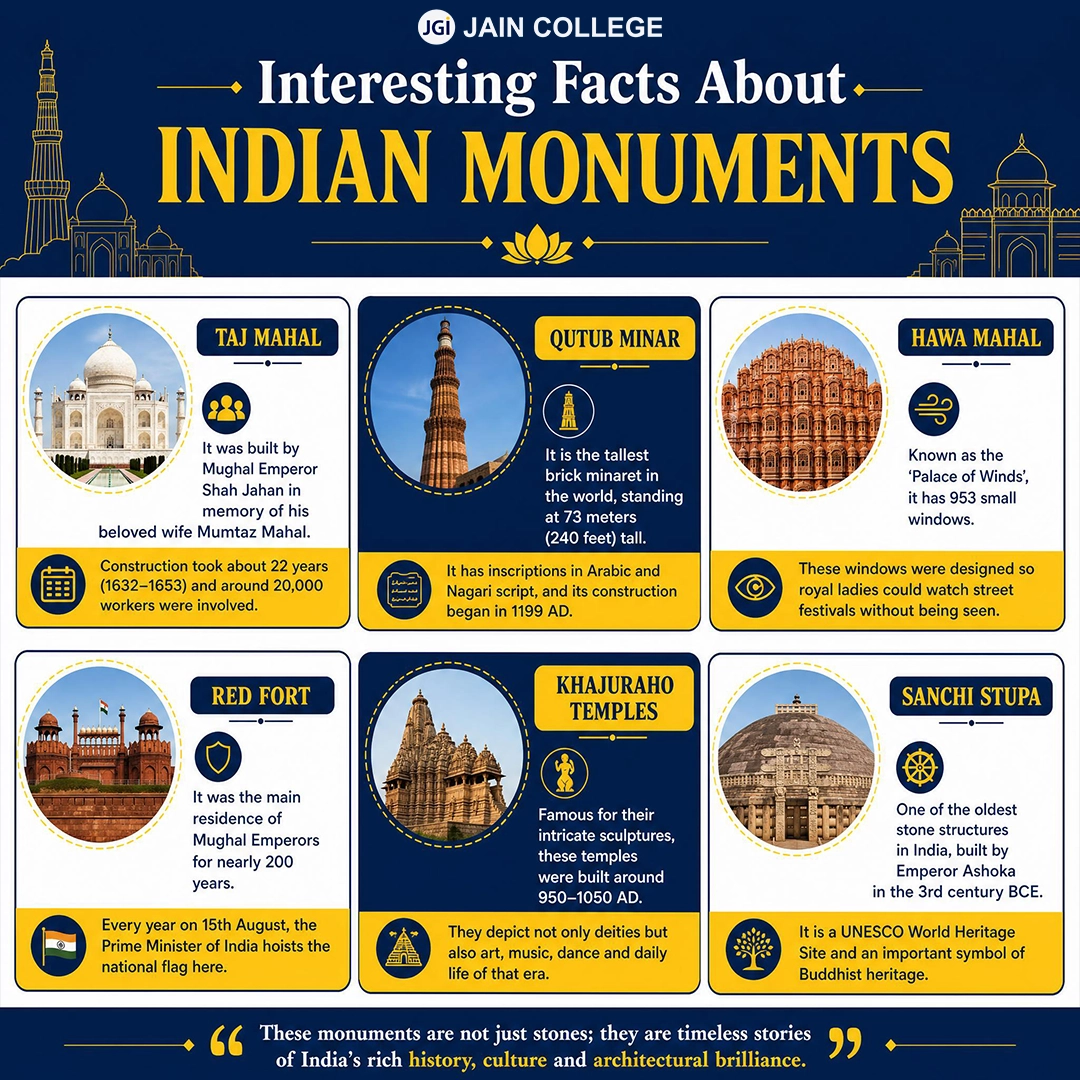
India is a country with a rich heritage of historical monuments that showcase its diversity in terms of culture and architecture. Famous monuments are the Taj Mahal, the Qutub Minar, and the Red Fort, as well as Hampi.
Let us explore some interesting facts about Indian Monuments
India’s monuments reflect its vibrant culture and amazing architecture. Visiting these heritage locations helps us to learn more about India’s past and highlights the skill of ancient builders.
From ancient temples to magnificent forts, India's monuments showcase centuries of architectural excellence and cultural diversity. Each site tells a unique story worth exploring.
To continue exploring India's history and culture, browse our related articles on heritage sites, museums, and historical landmarks at the JAIN PU College blogs.
From the Taj Mahal to Hampi — every monument tells a story of India’s glorious past.
Every stone has a story; every monument has a legacy. India’s monuments keep inspiring generations around the world.
Which monument deserves the #1 spot according to you?
Share your thoughts in the comments below.
The Khajuraho Temples in Madhya Pradesh are well-known for their detailed carvings and erotic sculptures. It exhibits a unique mix of Hindu and Jain architecture and is regarded as one of India’s most important architectural marvels.
Hawa Mahal, which refers to the ‘Palace of Winds’ or the ‘Wind Palace', is one of the major attractions in Jaipur.
The main speciality of Hawa Mahal is the presence of 953 small windows, called 'Jharokas.' Other stunning fusions are of Islamic and Rajput heritage. The Hawa Mahal's architectural brilliance is evident from its lovely pink façade.
The Hawa Mahal is pink in colour; it was constructed using natural, locally sourced red and pink sandstone.
The Group of Monuments at Mahabalipuram was founded by the Pallava kings and includes 40 ancient monuments and Hindu temples, such as the Descent of the Ganges, also known as Arjuna's Penance.
The Purana Qila fort is a historical monument located in Delhi. It is one of the oldest forts in Delhi. This monument was built by Sher Shah Suri.
The Khajuraho Temples in Madhya Pradesh are regarded as one of India’s most important architectural marvels, as they showcase a unique mix of Hindu and Jain architecture and
Mysore Palace is also known as Amba Vilas Palace. It is one of the beautiful architectural wonders of India. This palace is in Mysuru, Karnataka.
The Ajanta and Ellora caves are located in the Aurangabad district of Maharashtra state, India
The Ajanta and Ellora caves are important heritage sites in India.
These caves are renowned for their ancient rock-cut architecture, artistic masterpieces, distinct cultural and artistic achievements, and sculptures and paintings. This architecture, which dates back to the 2nd century BCE, is renowned for its beautiful sculptures and paintings.
The Ajanta caves focus mainly on Buddhism. These caves showcase the artistic and architectural skills of ancient India.
The Ellora Caves include various Buddhist, Hindu, and Jain temples. These caves showcase the artistic and architectural skills of ancient India.
No. The Gateway of India and India Gate are two entirely different monuments built for distinct purposes.
India Gate was built in memory of the 90,000 Indian soldiers who laid down their lives during World War I.
The Gateway of India is an arch monument built during the 20th century in Bombay (Mumbai), India.
The pancharanga Kshetram or five sacred sites or pilgrimage sites of Sri Vaishnavism, include:

JAIN PU College, a part of the renowned JGI Group, is committed to empowering students with quality education.
Beyond academics, the college ensures its online content reflects the same standard of excellence. Every blog and article is meticulously vetted and proofread by subject matter experts to ensure accuracy, relevance, and clarity. From insightful educational topics to engaging discussions, JAIN PU College's content is crafted to inform, inspire, and add value to its readers, reflecting the institution's commitment to intellectual growth and innovation.
View all Blogs