








The Telangana Movement was a long-standing political and social campaign that sought the creation of a separate Telangana state from the erstwhile Andhra Pradesh. The demand emerged due to concerns over employment opportunities, education, irrigation, allocation of resources, political representation, and regional development.
This movement demanded a separate state for the Telangana region and eventually resulted in the formation of Telangana on 2 June 2014.
| Aspect | Details |
| Movement | Telangana Statehood Movement |
| Region | Telangana |
| Parent State | Andhra Pradesh (1956–2014) |
| Major Demand | Separate Telangana State |
| Key Leader | K. Chandrashekar Rao |
| Major Agitation | Telangana Agitation (1969) |
| Political Party | Telangana Rashtra Samithi |
| Statehood Process Announced | 9 December 2009 |
| State Formation | 2 June 2014 |
| Capital | Hyderabad |
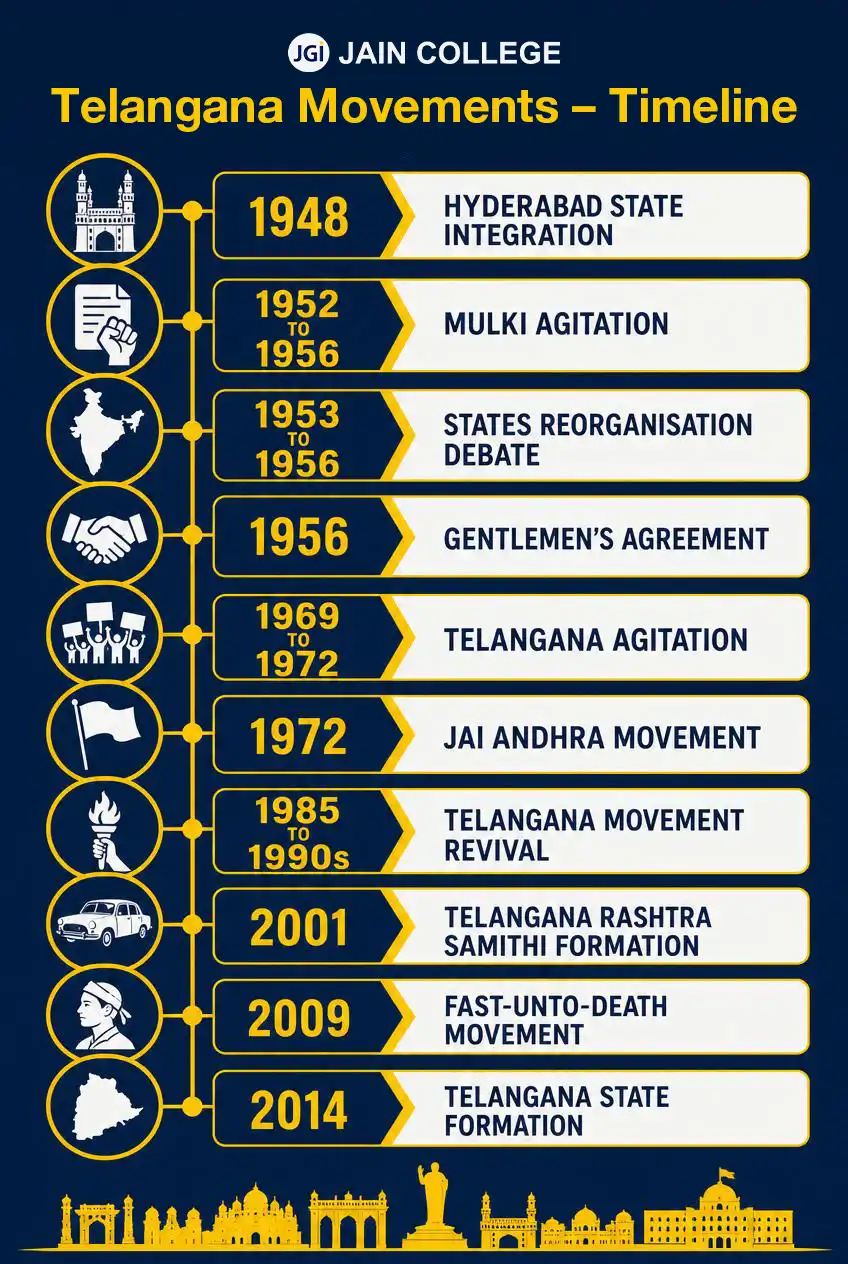
This timeline shows the major phases of Telangana’s political and social movements from 1948 integration to the formation of Telangana state in 2014.
| Year | Phase / Movement | Key Features | Main Leaders / Groups | Outcome / Impact |
| 1948 | Hyderabad State Integration | Integration of princely Hyderabad State into Indian Union through “Operation Polo” | Sardar Patel &Indian Government, | End of Nizam rule; Hyderabad merged with India |
| 1952 to1956 | Mulki Agitation | Demand for local jobs (Mulki rules) in Hyderabad region | Local youth & Telangana employees | Highlighted employment discrimination issues |
| 1953 to1956 | States Reorganisation Debate | Demand for separate Telangana state vs merger with Andhra | Andhra leaders & Telangana leaders | Led to formation of unified Andhra Pradesh in 1956 |
| 1956 | Gentlemen’s Agreement | Safeguards for Telangana in unified state | Telangana & Andhra leaders | Promised protections for Telangana (largely ineffective later) |
| 1969 to1972 | Telangana Agitation | Major movement demanding separate Telangana state due to violation of safeguards | Chenna Reddy, students & employees | Large-scale protests; loss of lives; movement suppressed |
| 1972 | Jai Andhra Movement | Counter-movement demanding separate Andhra state | Andhra leaders | Political instability led to President’s Rule |
| 1985 to1990s | Telangana Movement Revival | Renewed concerns over employment, water, and budget allocation | Civil groups & employees' unions | Movement remained active but fragmented |
| 2001 | Telangana Rashtra Samithi Formation | Formal political movement for statehood | K. Chandrashekar Rao (KCR) | Strengthened unified political demand |
| 2009 | Fast-unto-death movement | Massive protests and hunger strike demanding statehood | KCR Students & Political groups | Renewed national attention: process of state formation began |
2014 |
Telangana State Formation | Official creation of separate Telangana state | Government of India | Telangana became the 29th state of India |
Let us learn more in detail about the Telangana movements.
The Telangana Movement was a long political and social movement that demanded the formation of a separate Telangana state from the formerly united Andhra Pradesh.
Supporters argued that Telangana faced inequalities in employment, education, irrigation, and resource allocation and therefore required separate state administration.
Telangana officially became India's 29th state on 2 June 2014 following the implementation of the Andhra Pradesh Reorganisation Act, 2014.
The formation has been the result of decades of political and social movements demanding separate statehood.
The Telangana Movement was a long political and social struggle demanding a separate state for the Telangana region from Andhra Pradesh. This movement continued for several decades and finally led to the formation of Telangana on 2 June 2014, making it the 29th state of India.
Here is a detailed overview:
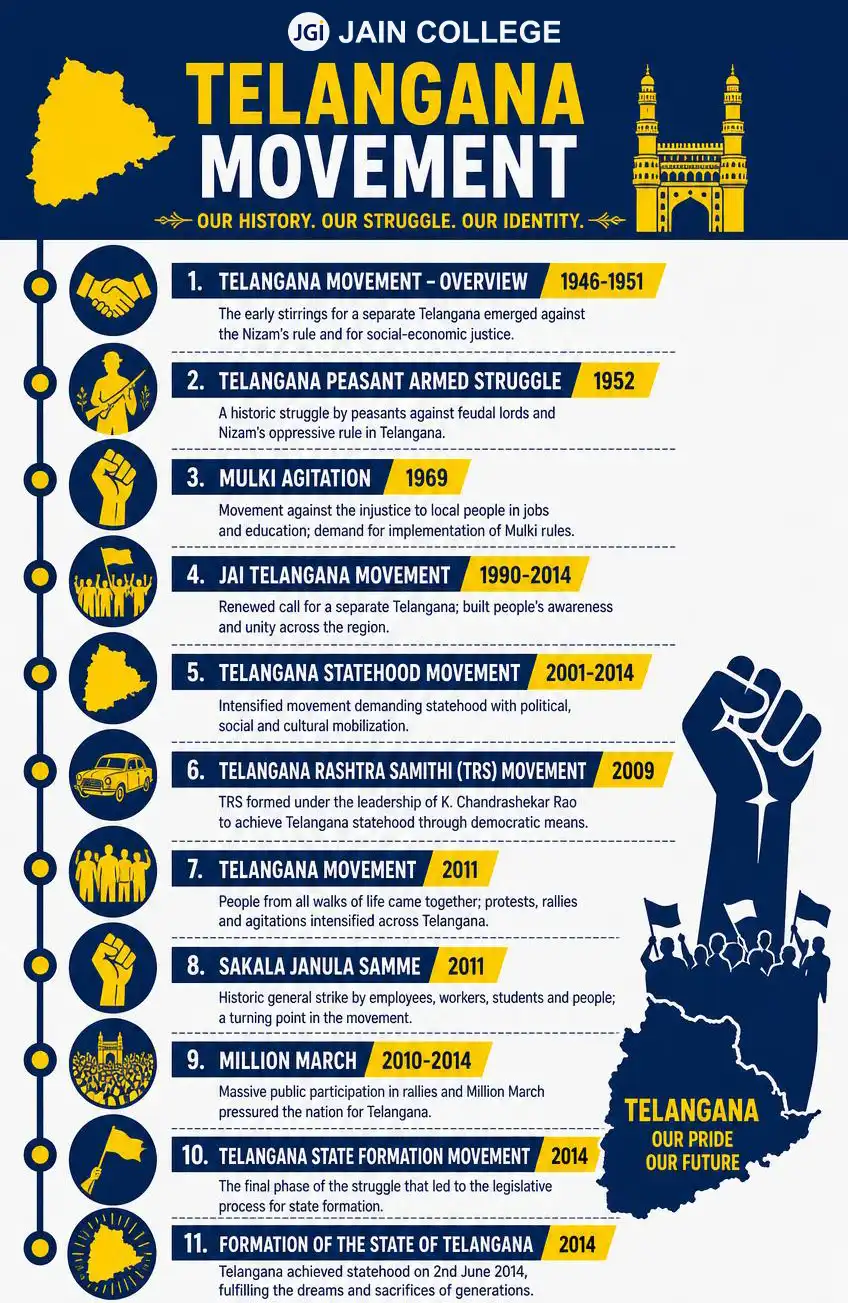
Telangana Peasant Armed Struggle (1946-1951)
The peasants led revolts against feudal landlords and the Nizam’s reign. This was one of the largest peasant uprisings in modern Indian history. The peasants were instrumental in abolishing feudal customs in the area.
Mulki agitation, 1952
Protest seeking to safeguard local employment prospects for the people of Telangana. The agitation sought the implementation of the Mulki Rules to protect local employment opportunities.
Jai Telangana Movement (1969)
Intense agitation for an independent state of Telangana. Students, employees, and political leaders primarily drove this movement. This movement raised the regional issues of Telangana to the national level.
Telangana Statehood Movement (1990s-2014)
Regional discontent has persisted for decades, and people have revived the demand for a separate state. Intellectuals, students, employees, and political organisations supported this movement.
Telangana Rashtra Samithi (TRS) Movement (2001-2014)
This was a political movement headed by K. Chandrashekar Rao and TRS. It was instrumental in generating support for the statehood of Telangana.
Telangana movement, 2009
In November 2009, KCR began an indefinite hunger strike demanding the creation of a separate Telangana state. His protest quickly escalated into a major political crisis and saw considerable public engagement across Telangana.
Sakala Janula Samme 2011
This movement was among the largest general strikes in the history of Telangana. Government employees, teachers, miners and workers took part, which increased the pressure on the central government.
Million March (2011)
Massive public protest in Hyderabad for statehood. Turned into a symbol in the last phase of the movement.
Telangana State Formation Movement (2010-14)
Last stage of the statehood battle. It involved protests, rallies, political negotiations and public campaigns. This led to the formation of Telangana on 2 June 2014.
Formation of the State of Telangana (2014)
Result of decades of demonstrations and agitations. Telangana was formed as the 29th state of India on 2 June 2014.
Key Dates to Remember:
Here are some important dates of Telangana movements:
| Date | Significance |
| 17 September 1948 | Hyderabad State integrated into India |
| 1 November 1956 | Andhra Pradesh formed through merger of Telangana and Andhra regions |
| 1969 | Telangana movement |
| 27 April 2001 | TRS established |
| 9 December 2009 | Centre announced initiation of Telangana statehood process |
| 2 June 2014 | Telangana officially became a state |
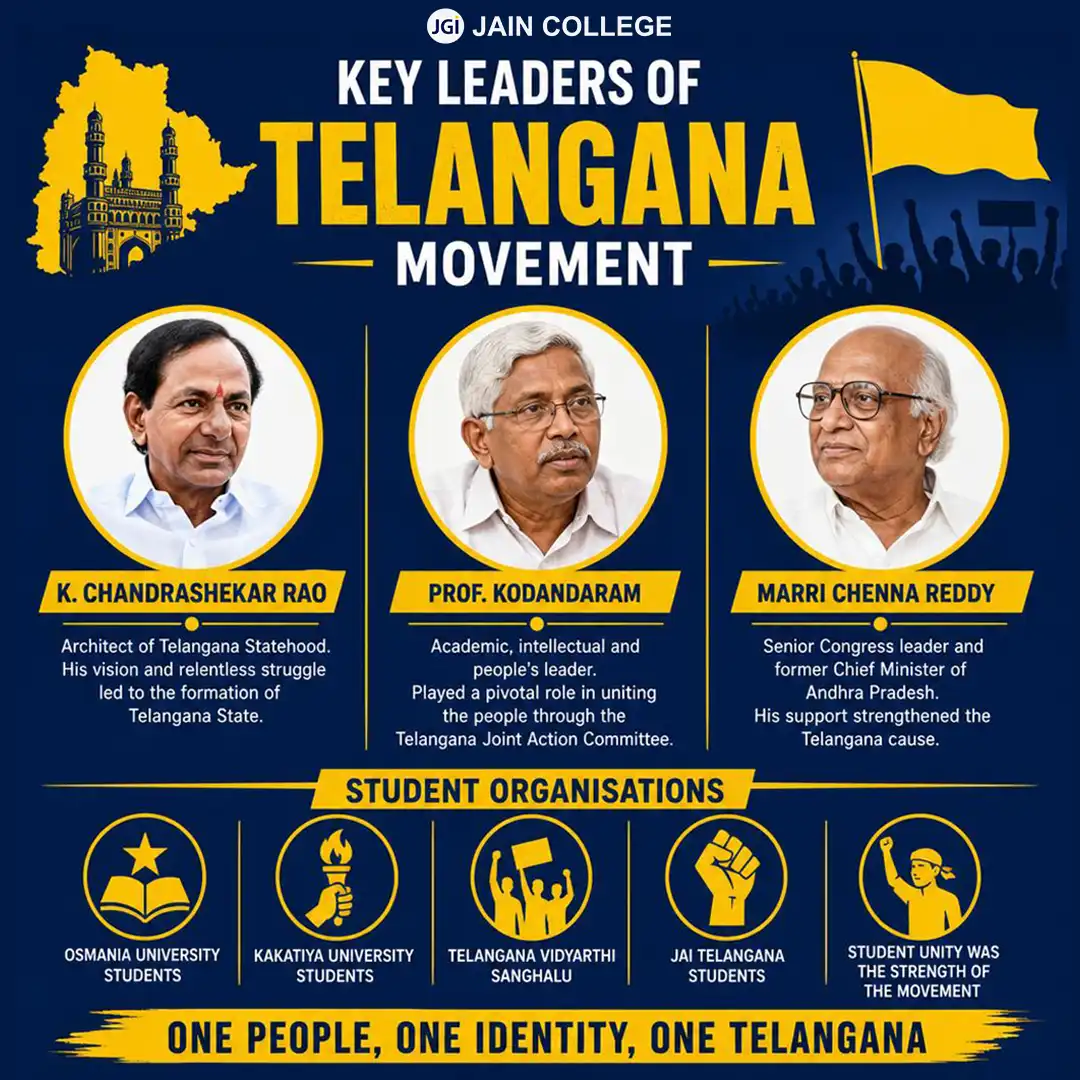
Here are some important leaders of Telangana movements:
| Leader | Contribution |
| K. Chandrashekar Rao | Founded TRS and led final movement |
| Prof. Kodandaram | Telangana JAC leader |
| Marri Chenna Reddy | Telangana Praja Samiti |
| Student Organisations | Led 1969 agitation |
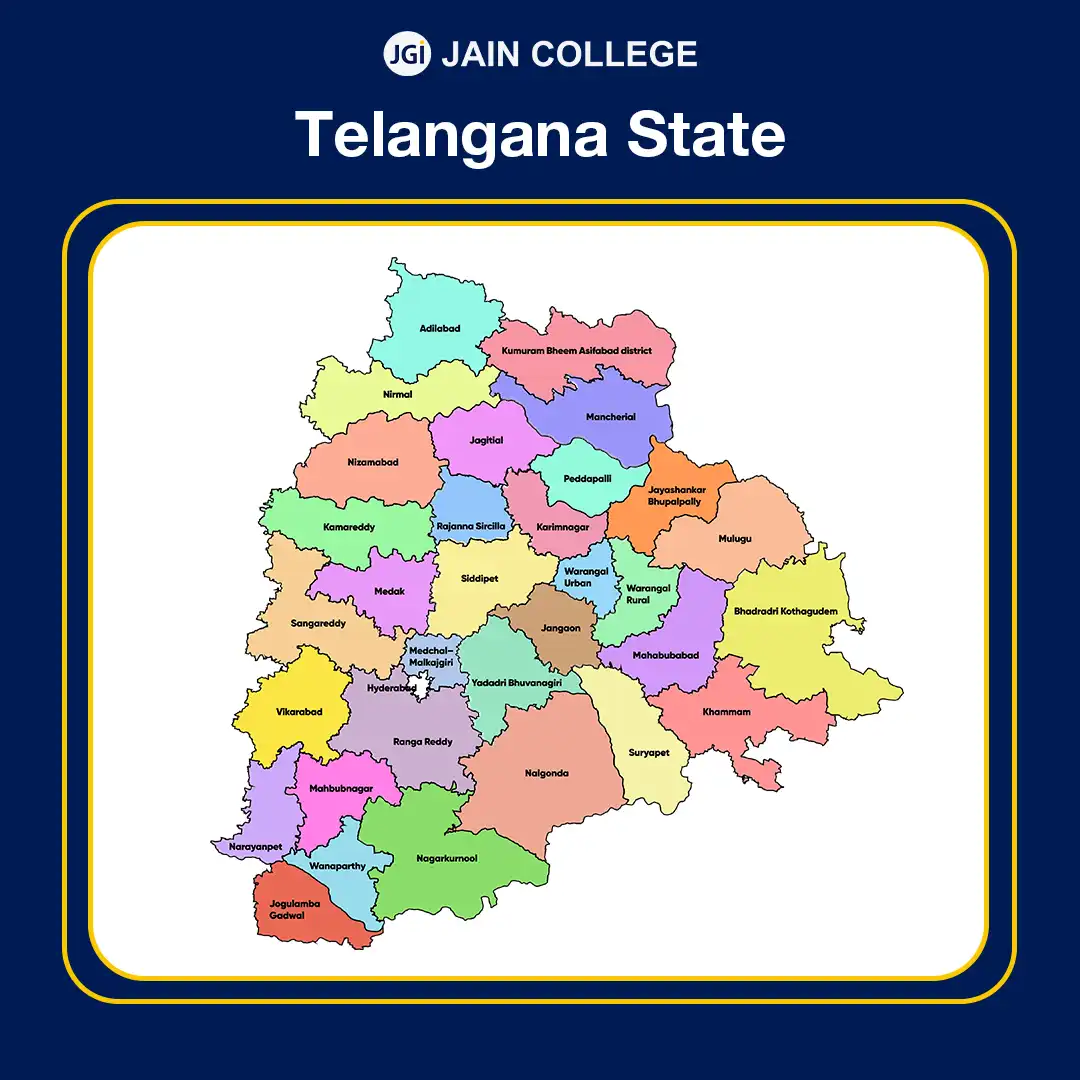
After India's independence, the Telangana region remained part of the Hyderabad State until 1956. During the reorganisation of states on linguistic lines, Telangana was merged with the Andhra State to form Andhra Pradesh.
Although the States Reorganisation Commission expressed certain reservations regarding an immediate merger, political negotiations and assurances regarding safeguards for Telangana led to the formation of Andhra Pradesh in 1956.
Over time, concerns emerged in Telangana regarding the implementation of these safeguards. Many people believed that the region was not receiving an adequate share of public employment opportunities, educational benefits, and development expenditure. These concerns contributed to the Telangana movement of 1969.
To represent the demand for a separate Telangana state, regional leaders formed the Telangana Praja Samiti (TPS). The organisation mobilised public support and became an important political platform that advocated for separate statehood for Telangana.
In response to the agitation, the central government initiated discussions with various stakeholders and announced the Eight-Point Plan in 1969. The plan proposed several measures, including the establishment of committees to examine grievances and recommend solutions. However, many activists considered these measures inadequate, and dissatisfaction continued.
A related political development occurred in 1972 with the Jai Andhra Movement in the Seemandhra region. This movement emerged partly in response to policies intended to address Telangana's concerns, particularly the implementation of Mulki rules relating to local employment. Protesters in the coastal Andhra and Rayalaseema regions demanded equal opportunities and greater regional development. Students played a significant role in the agitation.
The demand for a separate Telangana state continued over the following decades. The movement was driven by several factors, including historical grievances, perceived economic disparities, demands for social justice, concerns about political representation, and the desire to preserve Telangana's distinct cultural identity. These factors ultimately contributed to the formation of the separate state of Telangana in 2014.
The table below summarises the political history of the Telangana state formation from 1956 to 2014:
| Year/Date | Political Event in Telangana State Formation |
1956 |
Telangana, comprising the predominantly Telugu-speaking region of the erstwhile Hyderabad State, was merged with the Andhra State to form Andhra Pradesh under the provisions of the States Reorganisation Act, 1956, and the Gentlemen's Agreement. |
1969 |
The Jai Telangana Movement was launched, demanding a separate Telangana state due to concerns over the implementation of safeguards promised in the Gentlemen's Agreement. The movement witnessed widespread student participation and public protests. |
1972 |
The Jai Andhra Movement emerged in the Andhra region in response to the Mulki Rules and demands for regional safeguards, further highlighting regional tensions within Andhra Pradesh. |
| 1997 | Several political parties, including the Bharatiya Janata Party, formally supported the demand for a separate Telangana state, bringing the issue back into national political discourse. |
| 2001 | K. Chandrashekar Rao founded the Telangana Rashtra Samithi (TRS) with the sole objective of achieving a separate Telangana state. |
Dec 9, 2009 |
The union government announced the initiation of the process for the formation of a separate Telangana state following widespread agitations and K. Chandrashekar Rao's indefinite hunger strike. |
Dec 23, 2009 |
The central government put the process for forming the Telangana state on hold following protests and opposition from leaders in the Coastal Andhra and Rayalaseema regions. |
| Feb 3, 2010 | The Government of India constituted the Srikrishna Committee to examine the Telangana issue and recommend possible solutions. |
| July 30, 2013 | The Congress Working Committee unanimously resolved to recommend the creation of a separate Telangana state. |
| Oct 3, 2013 | The Union Cabinet approved the proposal for the creation of Telangana and initiated the process for drafting the Andhra Pradesh Reorganisation Bill. |
| Dec 5, 2013 | The Union Cabinet approved the draft Andhra Pradesh Reorganisation Bill, 2013, and sent it to the Andhra Pradesh Legislative Assembly for its views. |
| Jan 30, 2014 | The Andhra Pradesh Legislative Assembly, by voice vote, rejected the Andhra Pradesh Reorganisation Bill and sent its opinion to the central government. |
| Feb 17, 2014 | The Union Cabinet cleared the bill. The Lok Sabha passed the Andhra Pradesh Reorganisation Bill on February 18, 2014. |
| Feb 20, 2014 | The Rajya Sabha passed the Andhra Pradesh Reorganisation Bill, completing its parliamentary approval. |
March 1, 2014 |
The Andhra Pradesh Reorganisation Bill received the assent of Pranab Mukherjee, the President of India, becoming the Andhra Pradesh Reorganisation Act, 2014. |
June 2, 2014 |
Telangana was officially formed as the 29th state of India, with Hyderabad serving as the joint capital of Telangana and Andhra Pradesh for a transitional period. |
Many people in Telangana believed that the safeguards promised to the region at the time of the formation of Andhra Pradesh were not being adequately implemented.
Despite these efforts, many activists and student groups remained dissatisfied with the pace and effectiveness of implementation. Consequently, the agitation persisted and evolved into one of the most significant phases in the history of the Telangana statehood movement.
Telangana was officially formed on 2 June 2014 and became the 29th state of India. Following the state's formation, Sri K. Chandrashekar Rao became the first chief minister of Telangana and led the newly established state government.
The Telangana Movement developed into one of the most prominent regional statehood movements in modern India. Some of its key features included:
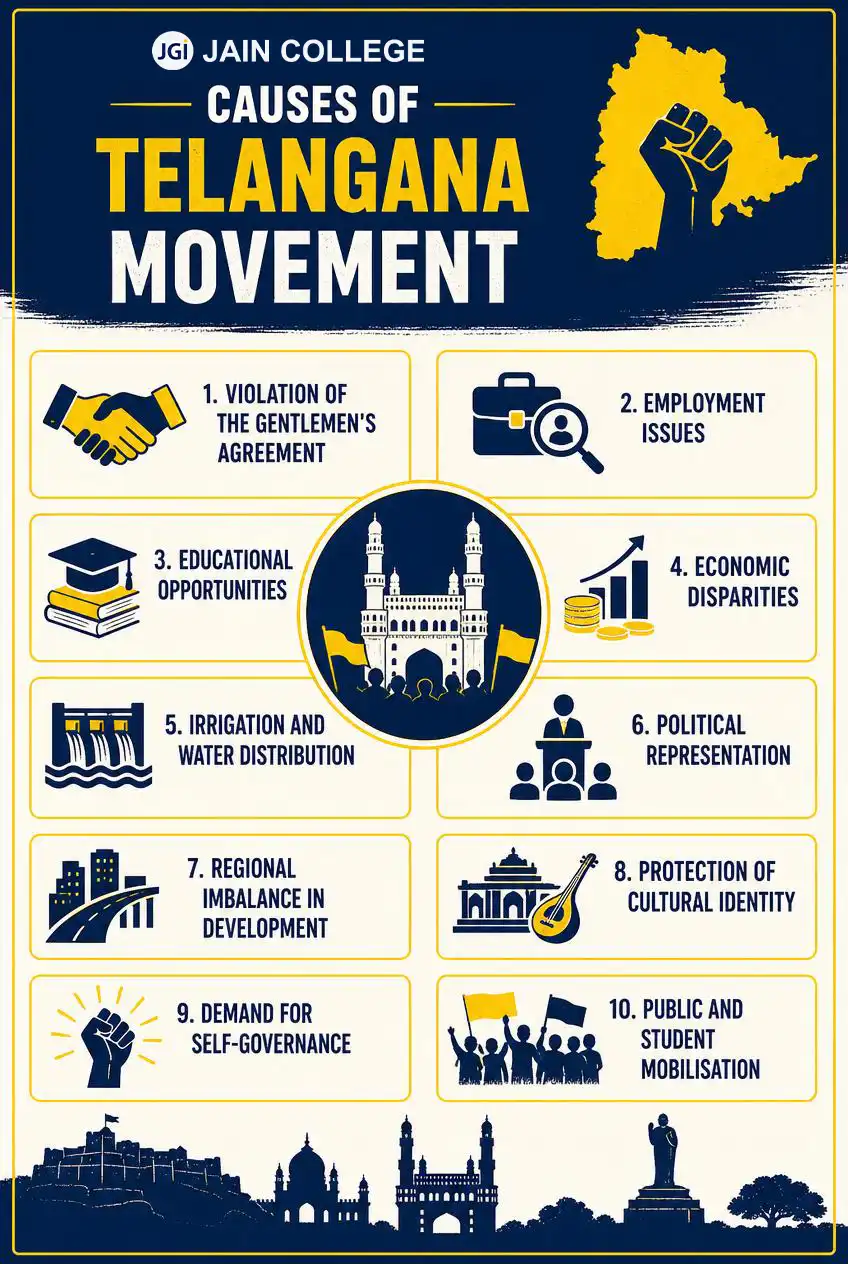
Telangana became a separate state in the Union of India on 2 June 2014 after a prolonged democratic movement advocating greater regional development, equitable resource distribution, employment opportunities, and political representation.
The demand for a separate Telangana state emerged from concerns that safeguards promised to the region following its merger with Andhra State in 1956 were not being adequately implemented. Over time, issues relating to employment, education, irrigation, regional development, and cultural identity strengthened the demand for separate statehood.
The table below summarises the major causes of the Telangana Statehood Movement:
| Causes | Explanation |
| Violation of the Gentlemen's Agreement | Many people believed that the safeguards promised to Telangana during the formation of Andhra Pradesh had not been fully implemented. |
| Employment Issues | Concerns were raised regarding the implementation of local employment protections, including the Mulki Rules, in government recruitment. |
| Educational Opportunities | Students and youth sought greater access to educational institutions and professional opportunities within the region. |
| Economic Disparities | People perceived that Telangana was not using its financial resources proportionately for the region's development. |
| Irrigation and Water Distribution | Concerns existed regarding the allocation of Krishna and Godavari river waters and irrigation infrastructure. |
| Political Representation | Many residents sought greater representation in administrative and political decision-making processes. |
| Regional Imbalance in Development | Differences in infrastructure, industrial growth, healthcare, and public services contributed to regional dissatisfaction. |
| Protection of Cultural Identity | Telangana possesses a distinct history, dialect, traditions, and cultural heritage that many sought to preserve and promote. |
| Demand for Self-Governance | Supporters argued that a separate state would enable more focused governance and development policies. |
| Public and Student Mobilisation | Students, employees, civil society organisations, and political groups played a significant role in advancing the demand for statehood. |
The Telangana Statehood Movement was driven by a combination of economic, political, social, cultural, and administrative factors. These concerns ultimately led to the creation of Telangana on 2 June 2014, making it the 29th state of India.
The Telangana Movement was one of the most significant regional statehood movements in independent India. Driven by demands for equitable development, employment opportunities, political representation, and regional identity, it culminated in the formation of Telangana on 2 June 2014 as India’s 29th state. The movement demonstrated the power of democratic mobilisation in addressing regional aspirations and remains an important example of federalism and responsive governance in India.
| Quick Facts About Telangana Movement: | |
| Fact | Details |
| 1950s | Movement Start |
| 1969 | Major Agitation |
| Political Party | Telangana Rashtra Samithi (TRS) |
| Key Leader | K. Chandrashekar Rao |
| Statehood Announcement | 9 December 2009 |
| State Formation | 2 June 2014 |
The Telangana Movement was a democratic struggle that led to the creation of Telangana as a separate state in 2014.
Share your thoughts in the comments below.
In 2001, K. Chandrashekar Rao formed the Telangana Rashtra Samithi (TRS)
The demand for Telangana statehood regained strength during the 1990s and early 2000s.
The Telangana movement evolved over several decades, and no single founder can be identified. However, K. Chandrashekar Rao played a key role in reviving and leading the final phase of the statehood movement.
The Telangana Movement refers to the series of political and social movements demanding a separate Telangana state, culminating in statehood in 2014.
Professor K. Jayashankar (Kothapalli Jayashankar) is widely regarded as the father of the Telangana movement
The Telangana movement (1946-1951) was a result of a combination of economic exploitation, feudal oppression, caste discrimination, and political uncertainty.
The 1969 Telangana movement featured several important factions and leaders. It was originally sparked by students at Osmania University. On 8 January 1969 in Khammam, Ravindranath went on a hunger strike.
The five types of protests of the Telangana movement include the following:
The primary names of the movements in the Telangana movement are as follows:
The 1969 movement was one of the first major agitations demanding a separate Telangana state after the formation of Andhra Pradesh. Its causes include:

JAIN PU College, a part of the renowned JGI Group, is committed to empowering students with quality education.
Beyond academics, the college ensures its online content reflects the same standard of excellence. Every blog and article is meticulously vetted and proofread by subject matter experts to ensure accuracy, relevance, and clarity. From insightful educational topics to engaging discussions, JAIN PU College's content is crafted to inform, inspire, and add value to its readers, reflecting the institution's commitment to intellectual growth and innovation.
View all Blogs