









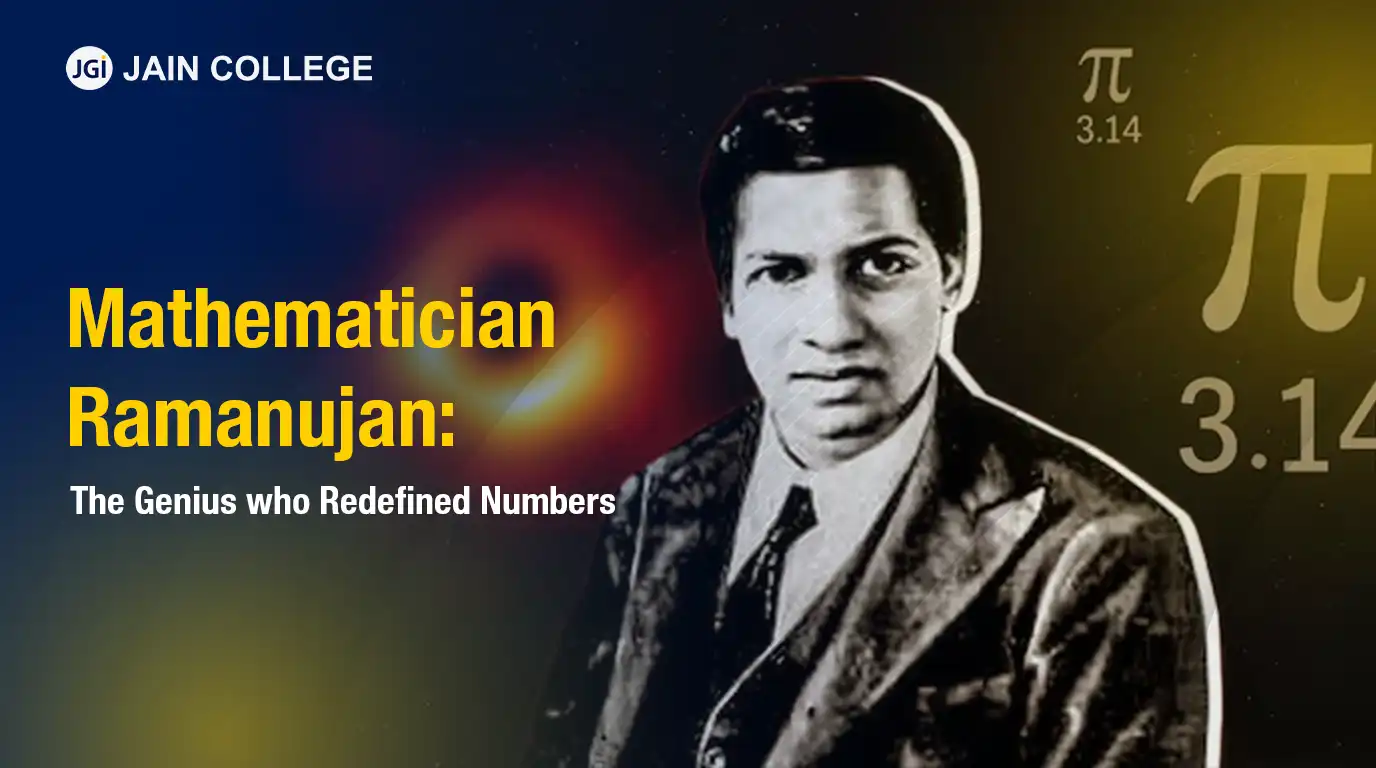
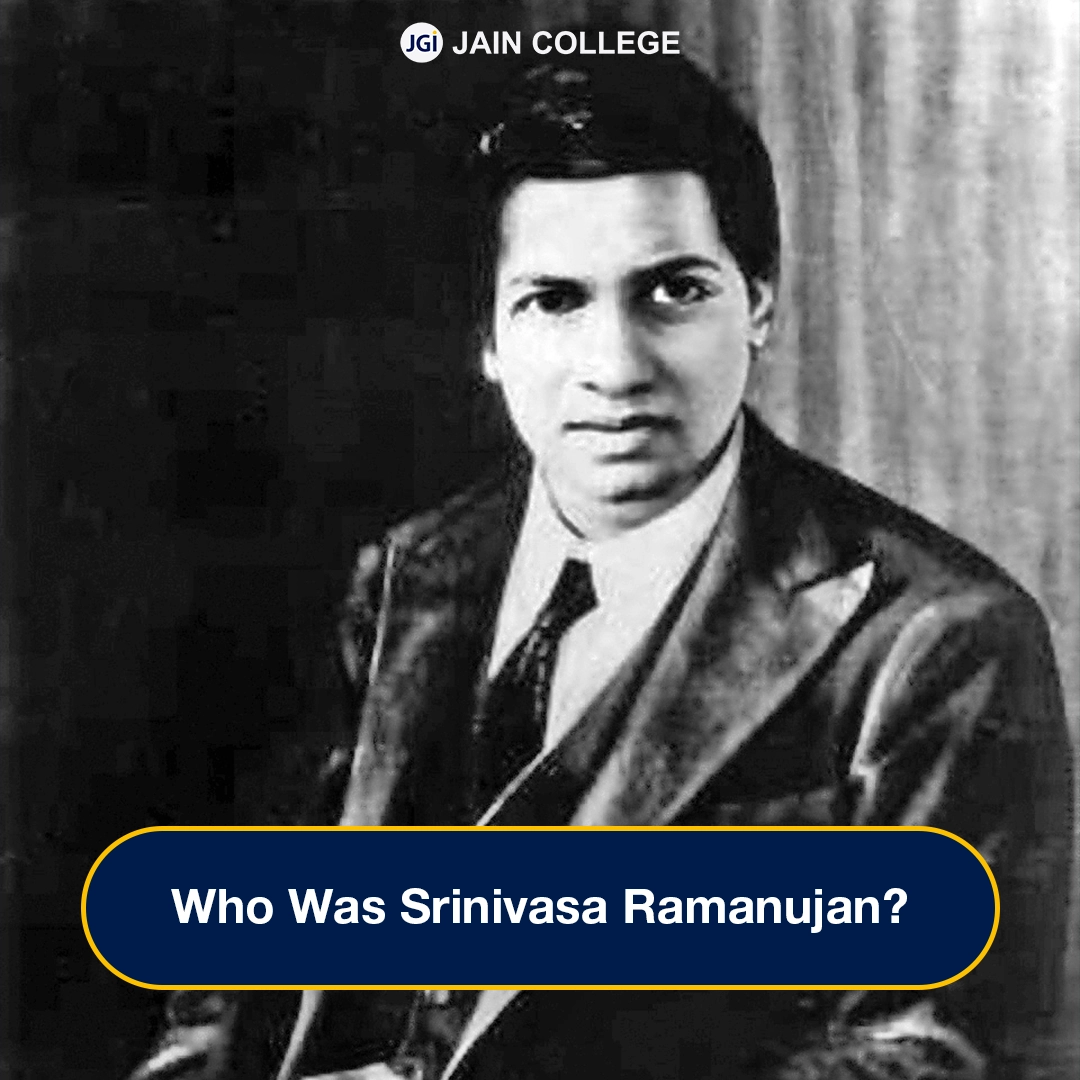
Srinivasa Ramanujan (1887–1920) was an Indian mathematician whose intuitive breakthroughs reshaped number theory, infinite series, and the partition function. Despite limited formal training, his ideas—many later proved by other mathematicians—remain essential to modern mathematics.
Indian mathematicians have made lasting contributions to mathematics through early work in topics like algebra, trigonometry, geometry, statistics, number theory, and calculus. These contributions were instrumental in establishing the foundation of modern mathematics.
Srinivasa Ramanujan, the genius who redefined numbers, was a famous Indian mathematician who made extensive contributions to mathematical analysis and continued fractions.
Srinivasa Ramanujan made substantial contributions to mathematical analysis, number theory, infinite series, and continued fractions. Some of his key contributions included discovering the Ramanujan-Hardy asymptotic formula for partition numbers, proving properties of the partition function, and deriving infinite series for pi. His mathematical methods influenced later research in number theory. He also did important work related to highly composite numbers, elliptic curves, and hypergeometric series.
In this blog, let us discover the impactful contributions of renowned Indian mathematician Srinivasa Ramanujan
Table of Contents
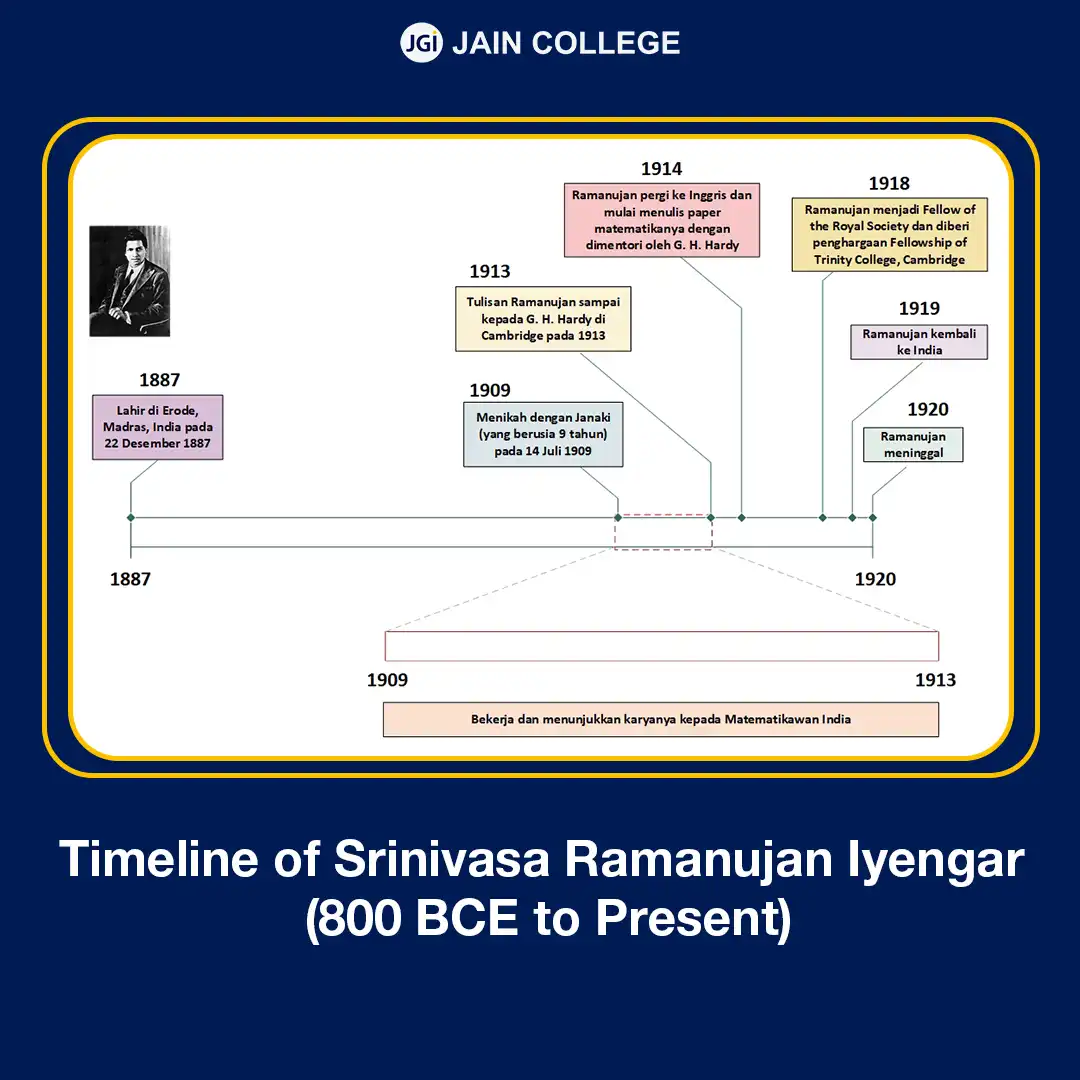
| Name | Srinivasa Ramanujan |
| Born on | Dec. 22 ,1887, Erode, Tamil Nadu |
| Parents | Komalatammal and Kuppuswamy Srinivasa Iyengar |
| Spouse | Janakiammal |
| Residence | Kumbakonam, Tamil Nadu, India |
| Nationality | Indian |
| Fields | Mathematics |
| Early Education (1898–1903) | Studied at schools in KumbakonamShowed exceptional talent in mathematics |
| Higher Education | Received a scholarship to study at the Government Arts CollegeContinued independent mathematical work at Pachaiyappa's CollegeConducted advanced mathematical research with G. H. Hardy in Trinity College, Cambridge. |
| Mathematical Inspiration (1903) | Began self-studying advanced mathematics and independent discoveriesEncounters: A Synopsis of Elementary Results in Pure Mathematics |
| Independent Work (1909–1912) | Started independent mathematical research.Developed original results in:Infinite seriesNumber theoryContinued fractionsWorks in Madras as a clerk |
| 1913 | Wrote famous letter to G. H. Hardy |
| 1914 | Travelled to Cambridge University |
| 1918 | Became Fellow of the Royal Society |
| Known for | Ramanujan's sumRamanujan primeRamanujan conjectureMock theta functionsRamanujan–Sato seriesRamanujan's congruencesRamanujan theta functionLandau–Ramanujan constantRamanujan's master theoremRamanujan–Soldner constantRogers–Ramanujan identitiesHardy–Ramanujan asymptotic formula |
| Awards | Fellow of the Royal Society |
| Died on | April 26, 1920 (age 32 years), Chetpet, Chennai |
| Key Contributions | Infinite seriesPartition functionRamanujan primesContributions to number theory |

Srinivasa Ramanujan was born on December 22, 1887, in Erode, Tamil Nadu, to a Tamil Brahmin Iyengar family. From his early age, this genius who redefined numbers showed an extraordinary aptitude for mathematics.
His mother was a housewife, and his father worked as a clerk in a sari shop. In 1892, at the age of five, Ramanujan was enrolled at the local school and later attended Kangayam Primary School.
Srinivasa Ramanujan grew up in financially challenging circumstances that affected his early education and living conditions. In 1897, he passed his primary examinations in English, Tamil, arithmetic and geography with the best scores. Ramanujan was largely self-taught in advanced mathematics.
Later on, after his admission into Town's higher secondary school, Ramanujan encountered formal mathematics for the first time
In 1904, Ramanujan graduated from the town's higher secondary school, and the school's headmaster awarded him the Ranganatha Rao prize for mathematics. He also received a scholarship to study at Government Arts College, Kumbakonam. However, Ramanujan could not focus on any other subjects and failed most of them, losing his scholarship in the process.
He later enrolled at Pachaiyappa's College in Madras. He again excelled in mathematics but performed poorly in other subjects. Without a degree, he left college and continued to pursue independent research in mathematics.
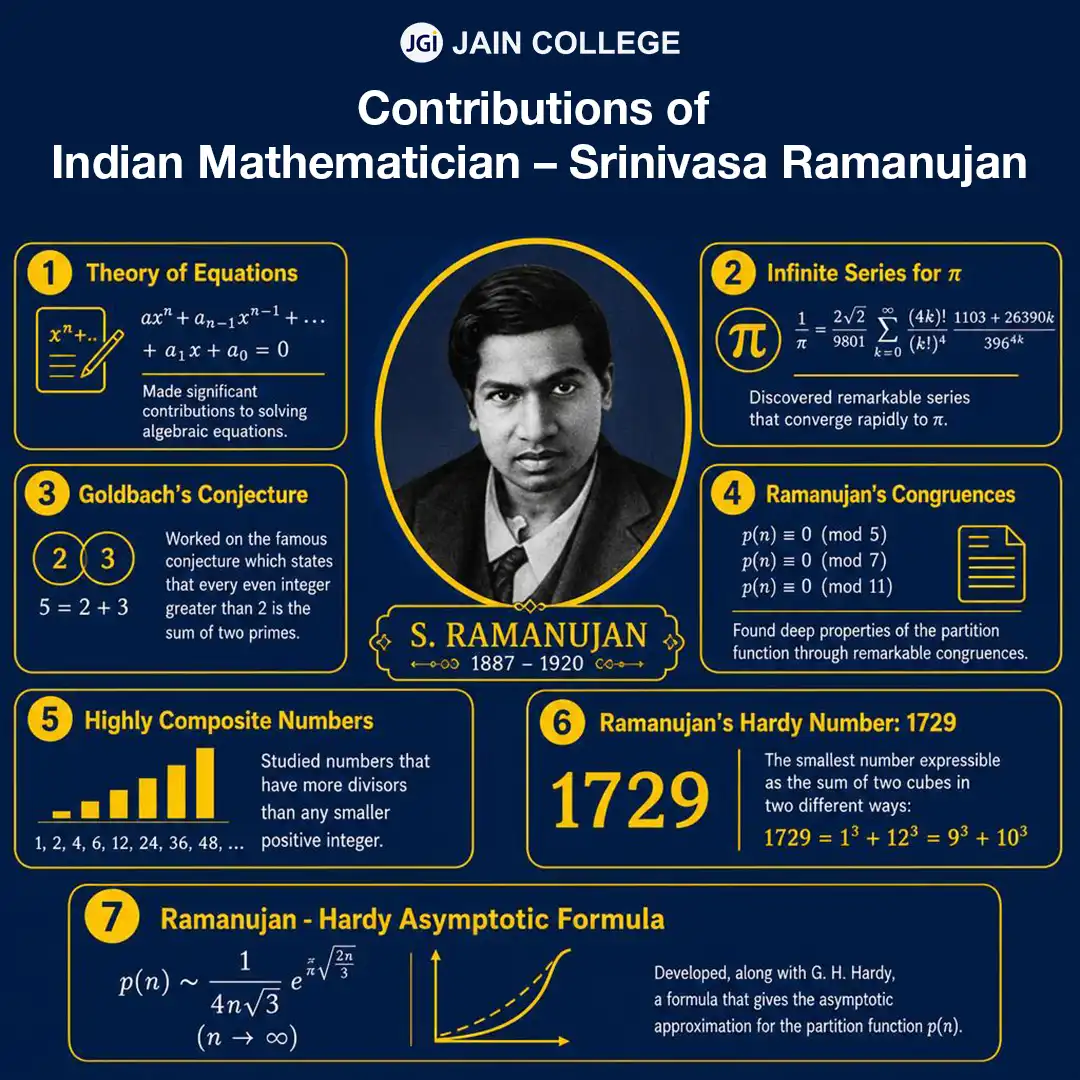
India's remarkable mathematical genius made substantial contributions to the analytical theory of numbers, elliptic functions, continued fractions, and infinite series.
His contributions include the following:
Once Hardy visited Putney, where Ramanujan was hospitalised. He visited there in a taxicab having the number 1729.
Hardy was very superstitious due to his nature; when he entered into Ramanujan’s room, he quoted that he had just come in a taxicab having number 1729 which seemed to him an unlucky number
At that time, Ramanujan promptly replied that this was a very interesting number, as it is the smallest number that can be expressed as the sum of the cubes of two numbers in two different ways:
| 1729 = 13 + 123 = 103 + 93 |
Later some theorems were established in the theory of elliptic curves, which involves this fascinating number.
Srinivasa Ramanujan also discovered some remarkable infinite series for π around 1910.
The series,
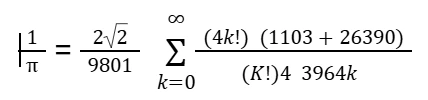
Computes a further eight decimal places of π with each term in the series. Later on, number theorists developed several efficient algorithms using the infinite series of π given by Ramanujan.
Srinivasa Ramanujan did not directly solve problems such as Goldbach’s conjecture, but his analytical methods and discoveries in number theory later influenced research in these areas.
Goldbach's Conjecture is one of the important illustrations of Ramanujan's contributions to the proof of the conjecture.
The statement is that every even integer greater than 2 is the sum of two primes, such as 6 = 3 + 3. Ramanujan and his associates showed that every large integer can be expressed as the sum of at most four.
In 1902, Ramanujan was shown how to solve cubic equations, and he later developed his own method for solving quadratic equations. He derived the formula to solve the biquadratic equations.
Ramanujan’s one of the major works was in the partition of numbers.
In a joint paper with Hardy, Ramanujan gave asymptotic formulas for p(n).
In fact, a careful analysis of the generating function for p(n) leads to the Hardy–Ramanujan asymptotic formula given by,
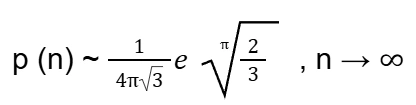
In their proof, they discovered a new method called ‘circle method', which made the Hardy –
Ramanujan formula that p(n) has exponential growth. It had the remarkable property that it appeared to give the correct value of p(n), and this result was later proved by Rademacher using special functions, and then Ken one gave the algebraic formula to calculate the partition function for any natural number n.
Ramanujan’s congruences are some remarkable congruences for the partition function. He discovered the congruences.
| p (5n + 4) ≡ 0 (mod 5), p (7n + 5) ≡ 0 (mod 7), p (11n + 6) ≡ 0 (mod 11) Ɐ n ∈ N |
Where:
In his 1919 paper, he gave proof for the first 2 congruences using the following identities and the Pochhammer symbol Notation. After the death of Ramanujan, in 1920, the proof of all the above congruences was extracted from his unpublished work.
For example,
n = 36 is highly composite because it has d(36) = 9, and smaller natural numbers have fewer divisors.
If n = 2K2 3K3 4K4 5K5 PKP [by the fundamental theorem of arithmetic]
is the prime factorization of a highly composite number n, then the primes 2, 3, …, p form a chain of consecutive primes where the sequences of exponents is decreasing, i.e.,
K2 ≥ K3 ≥ K4 ≥ …………………. Kp and the final exponent is 1, except for n = 4 and n = 36
A natural number n is said to be a highly composite number if it has more divisors than any smaller natural number. If we denote the number of divisors of n by d(n), then we say is called a highly composite
| d(m) < d(n), Ɐ m < n, where m ∈ N |
Here,
This notation means that the number nnn has more positive divisors than every natural number mmm that is smaller than nnn. This property is used to define a highly composite number.
Ramanujan’s research on highly composite numbers significantly influenced later work in number theory and divisor functions.
Examples of Highly Composite Numbers
1, 2, 4, 6, 12, 24, 36, 48, 60
Ramanujan’s research on highly composite numbers significantly influenced later work in number theory and divisor functions.
Some other contributions of Ramanujan's:
Apart from the contributions mentioned above, Ramanujan worked in some other areas of mathematics, such as hypergeometric series, Bernoulli numbers, and Fermat’s last theorem.
He focused mainly on developing the relationship between partial sums and products of hypergeometric series.
He independently discovered Bernoulli numbers, and using these numbers, he formulated the value of Euler’s constant up to 15 decimal places. He nearly verified Fermat’s last theorem, which states that no three natural numbers x, y, and z satisfy the equations.
The book examines Ramanujan's Lost Notebook, which was discovered in 1976 and contains nearly 650 unpublished claims by Ramanujan. Andrews and Berndt have taken on the task of sorting the notebook, numbering the claims, and providing proofs for each one. The reviewed book is the first volume and examines 442 entries, focusing on continued fractions and q-series. It provides valuable insights into Ramanujan's genius and unlocks new mathematical discoveries within his lost work.
Here is a more detailed view of this "Lost Notebook"
Ramanujan had noted down the results of his research, without proofs, in three notebooks, between the years 1903 and 1914, before he left for England.
The first notebook has 16 chapters in 134 pages
The second is a revised, enlarged version of the first, containing 21 chapters in 252 pages
The third notebook contains 33 pages of unorganised material (included at the end of volume 2 of the facsimile edition [VII]).
Ramanujan took these notebooks with him to Cambridge. In one of his letters to a friend, he wrote that he had no time to look into them, and most probably he did not put them to use during his five-year stay abroad.
Sixty-seven years after the death of Ramanujan, due to the discovery of the ‘lost’ notebook by Prof. George Andrews in 1976, and the editing of the three Notebooks of Ramanujan by Prof. Bruce Berndt, there has been a resurgence of interest in the work of Ramanujan. These notebooks of Ramanujan have formed the basis for numerous papers by many mathematicians, who gave proofs of the theorems and conjectures of Ramanujan that he obtained through his intuition and sheer brilliance. This resurgence is a singular and unparalleled phenomenon in the annals of mathematics.
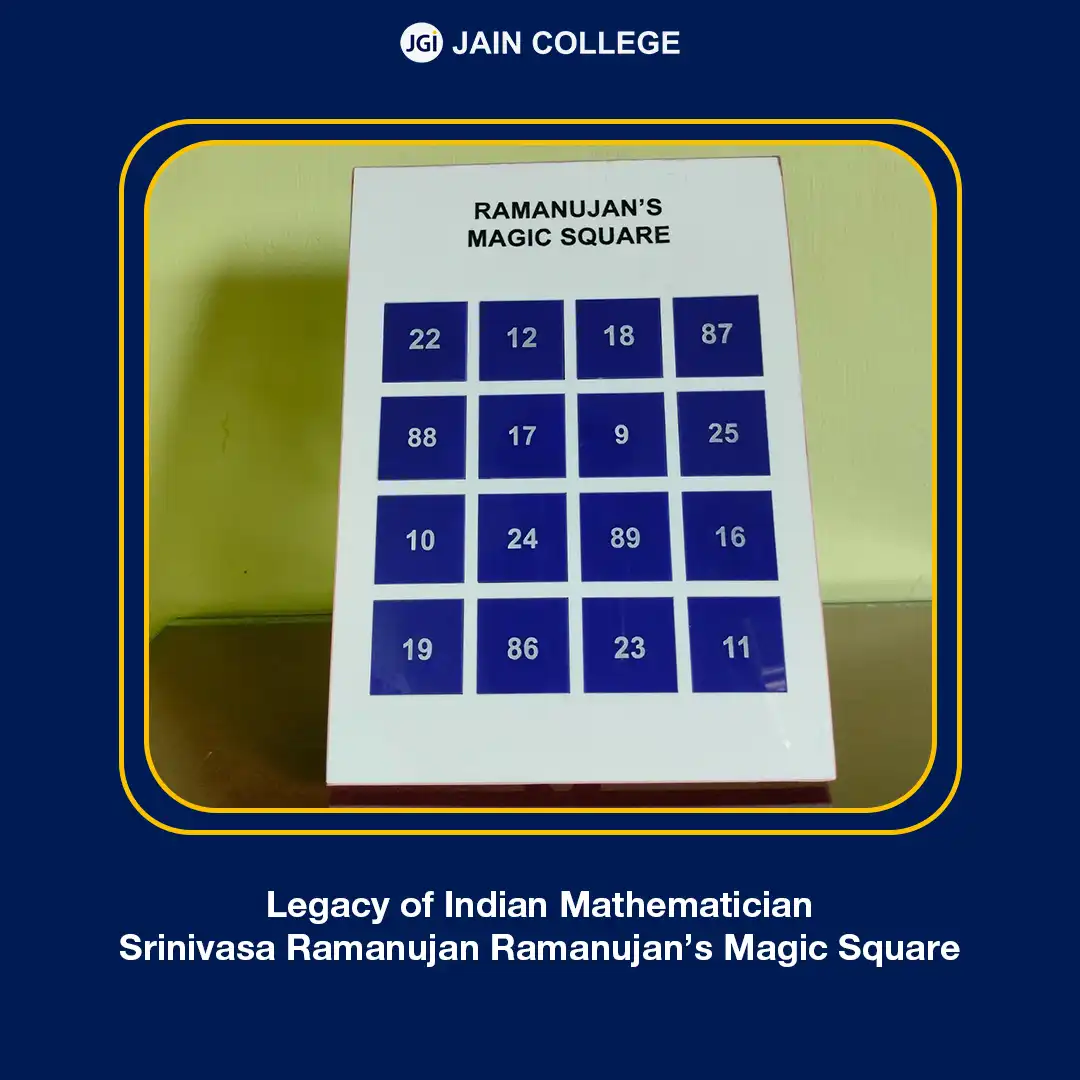
Ramanujan, the genius who redefined numbers, made deep and lasting contributions. His work was often intuitive; he claimed many formulas came to him through inspiration, which he later verified mathematically.
Some of his lasting contributions include:
Some of the other lasting contributions of Ramanujan include the following:
Ramanujan has left a number of theorems and his notebooks, which researchers are still working on.
The Prime Minister of India, Dr Manmohan Singh, has declared the year 2012 as the “National Mathematical Year", and the date December 22, being the birthday of Srinivasa Ramanujan, has been declared as the “National Mathematics Day” to be celebrated every year.
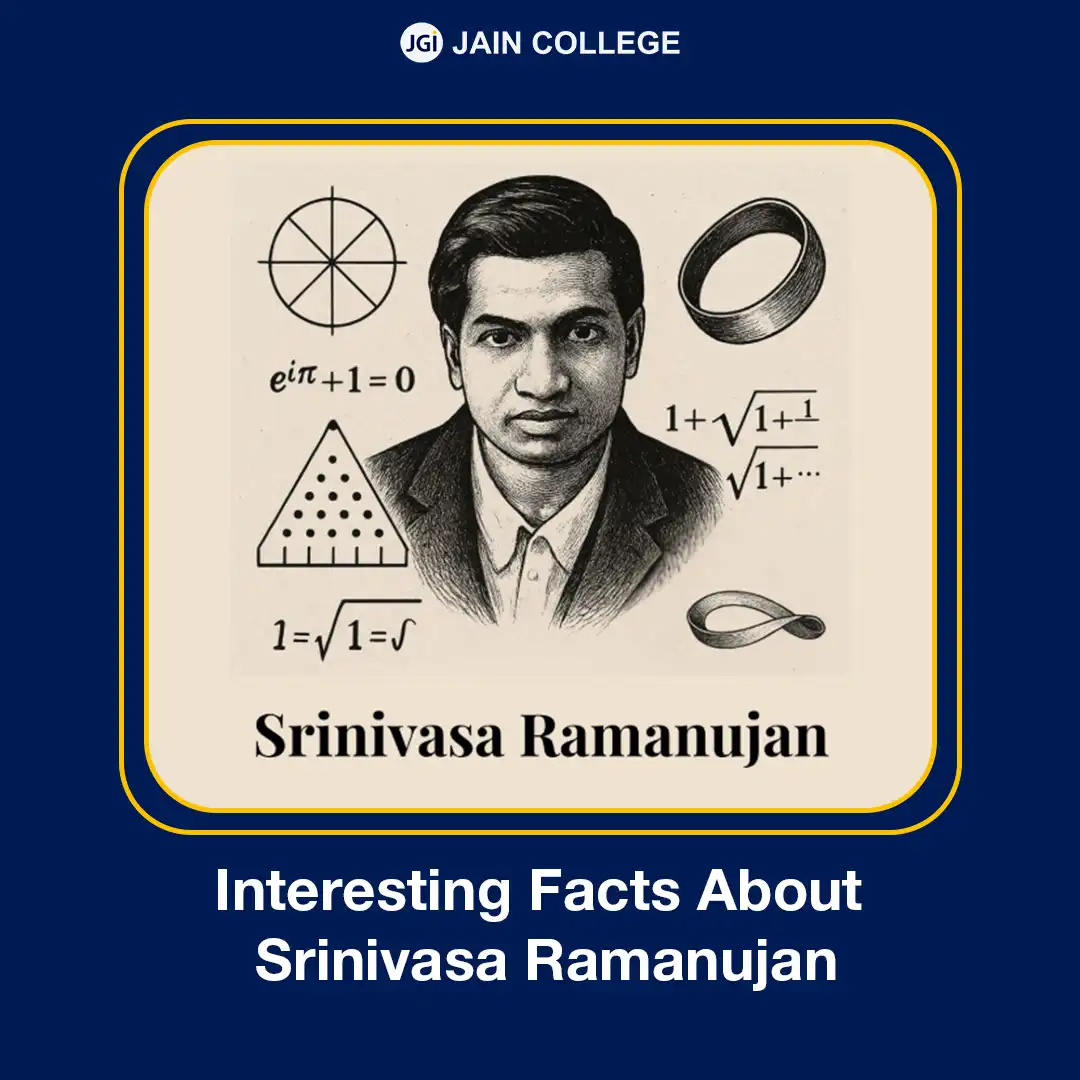
Srinivasa Ramanujan was a renowned Indian mathematician who made extraordinary contributions to mathematical analysis, number theory, infinite series, and continued fractions despite having no formal training in pure mathematics.
Here are some remarkable facts about Srinivasa Ramanujan, the genius who redefined numbers
This quote is about the mathematical genius of Srinivasa Ramanujan’s formulas, written by G.H. Hardy
G.H. Hardy, who was known as a great mathematician and one of Ramanujan’s academic advisors with J.E. Littlewood, said only a few giant mathematicians like Euler, Gauss, and Newton had the same talent which Ramanujan had
This quote is about the mathematical genius of Srinivasa Ramanujan, written by G. H. Hardy, one of the most influential mathematicians of the 20th century.
In simpler terms, Hardy was trying to say:
"Ramanujan had an astonishing natural gift for discovering mathematical formulas, so remarkable that it seemed almost supernatural."
Famous History:
A popular mythical figure associated with Srinivasa Ramanujan describes his early curiosity about mathematics during primary school.
According to the story,
One day, a primary school teacher of the third class was explaining to his students,
“If three fruits are divided among three persons, each would get one."
Thus, it was generally accepted that any number divided by itself equals one.
Ramanujan questioned what would happen if zero were divided by zero.
Although the story is personally based and not historically verified, it is often used to illustrate his exceptional curiosity and independent approach to mathematical thinking from a young age.
Srinivasa Ramanujan died on 26 April 1920 in Kumbakonam, at the age of 32.
The exact cause of the death of Srinivasa Ramanujan remains uncertain. However, historians and medical researchers generally agree that a combination of illness, malnutrition, and difficult living conditions contributed to his early death.
The mystery of Srinivasa Ramanujan's illness:
| Factor | Explanation |
| Malnutrition | As a strict vegetarian living in wartime England, Ramanujan struggled to obtain adequate food that met his dietary requirements, leading to poor nutrition and weakened health. |
| Harsh Climate | The cold and damp English climate was very different from his native South India and may have worsened his health problems. |
| Chronic Illness | Ramanujan suffered from a serious, long-term illness during his stay in England (1914–1919). He experienced recurring fevers, severe weight loss, and digestive problems. |
| Overwork and Stress | Ramanujan devoted enormous amounts of time and energy to mathematical research, often working despite being seriously ill. Physical exhaustion likely contributed to his decline. |
| Limited Medical Knowledge | Medical diagnosis and treatment in the early 20th century were less advanced than today, making it difficult to accurately identify and effectively treat his condition. |
| Possible Amoebic Liver Infection | Some modern researchers believe he may have suffered from hepatic amoebiasis (a liver infection caused by amoebic dysentery), which was difficult to diagnose and treat at the time. |
In memory of Srinivasa Ramanujan, several books and films have been created to highlight his life and mathematical contributions.
One notable example is "The Man Who Knew Infinity", which was adapted from the biography “The Man Who Knew Infinity” by Robert Kanigel.
The big mathematicians and specialists of that time noted that Ramanujan’s talent reminded them of Gauss, Jacobi, and Euler.
Stay tuned to JAIN PU College blogs and learn more about the famous Indian Mathematicians, their work on pi and series, mathematical research and other related articles.
Do you know any other famous Indian mathematicians?
Share your thoughts in the comments below.
Srinivasa Ramanujan is renowned for his extraordinary contributions to number theory, infinite series, partitions, and continued fractions. Despite limited formal education, he developed groundbreaking mathematical formulas that continue to influence modern mathematics and scientific research.
Ramanujan studied at schools in Kumbakonam and later attended Government Arts College and Pachaiyappa’s College in Madras. In 1914, he travelled to England to work and study at Trinity College, Cambridge, alongside British mathematician G. H. Hardy.
At the age of 15, Ramanujan came across the book A Synopsis of Elementary Results in Pure Mathematics by George Shoobridge Carr. The book contained thousands of mathematical theorems, which deeply inspired him and helped shape his independent mathematical discoveries.
Ramanujan made important contributions to:
He also developed remarkable formulas related to ? and discovered several mathematical identities that remain important today.
The number 1729 is known as the Hardy-Ramanujan number because it is the smallest number that can be expressed as the sum of two cubes in two different ways:
1729 = 1³ + 12³ = 9³ + 10³
This number became famous after a conversation between Ramanujan and Hardy.
Yes, Ramanujan was largely self-taught. He learnt advanced mathematics independently through books and personal research. Despite having little formal training in higher mathematics, he produced some of the most original mathematical discoveries of his time.
No, many of Ramanujan’s formulas and theorems were written without detailed proofs. Later mathematicians verified and proved many of his discoveries, confirming the brilliance of his mathematical intuition.
In 1911, Ramanujan published his first research paper in the Journal of the Indian Mathematical Society. Later, his work appeared in several English and European mathematical journals.
In 1918, Srinivasa Ramanujan was elected as a Fellow of the Royal Society, becoming one of the youngest mathematicians to receive this honour.
Ramanujan is remembered for his extraordinary mathematical genius, intuitive discoveries, and lasting contributions to modern mathematics. His work continues to motivate mathematicians and researchers worldwide.
Ramanujan left behind notebooks filled with thousands of mathematical formulas and ideas, including the famous “lost notebook". Many of his unpublished discoveries continued to influence modern mathematics, physics, and computer science long after his death, as researchers studied and verified them.
Ramanujan died on April 26, 1920, at the age of 32 due to prolonged illness and poor health. Historians believe he may have suffered from tuberculosis or hepatic amoebiasis, along with severe nutritional deficiencies during his years in England.
Ramanujan’s discoveries continue to influence fields such as cryptography, quantum physics, computer science, artificial intelligence, and advanced number theory. His work remains highly relevant in modern scientific research.
Aryabhata is considered India’s earliest known mathematician whose works are available to modern scholars. His contributions to algebra, astronomy, and trigonometry laid the foundation for Indian mathematics.
Srinivasa Ramanujan was called “The Man Who Knew Infinity” because of his extraordinary understanding of complex mathematical concepts involving infinite series, number theory, and partitions. The phrase became widely popular through the biography and film The Man Who Knew Infinity based on his life.

JAIN PU College, a part of the renowned JGI Group, is committed to empowering students with quality education.
Beyond academics, the college ensures its online content reflects the same standard of excellence. Every blog and article is meticulously vetted and proofread by subject matter experts to ensure accuracy, relevance, and clarity. From insightful educational topics to engaging discussions, JAIN PU College's content is crafted to inform, inspire, and add value to its readers, reflecting the institution's commitment to intellectual growth and innovation.
View all Blogs