








The Greek philosopher Aristotle is regarded as the father of biology. His classification of living things was one of the earliest. In his lifetime, Aristotle
The field of biology gradually evolved through the contributions of several scientists. Early work by Aristotle, who is widely regarded as the father of biology, laid the foundation by classifying living organisms based on observation
In the centuries that followed, specialised branches of biology developed through the work of notable scientists:
Greek philosopher Aristotle is considered the father of biology and the first to classify living things.
Table of Contents
When people say “Father of Biology", they do not mean one person who created the entire subject from scratch. It refers to a greater degree of attributing credit to someone who played an important role from the beginning and helped shape how the subject began to evolve.
In science, these titles usually go to individuals whose contribution has had a long-term impact.
Before biology became a proper field of study, explanations about living things were often based on beliefs or guesswork. There was not a clear method. This concept slowly transformed when some philosophers began systematically examining plants, animals and other living organisms more systematically and formally recording their observations. The corresponding shift made a big difference.
One of the earliest people associated with this change was Aristotle.
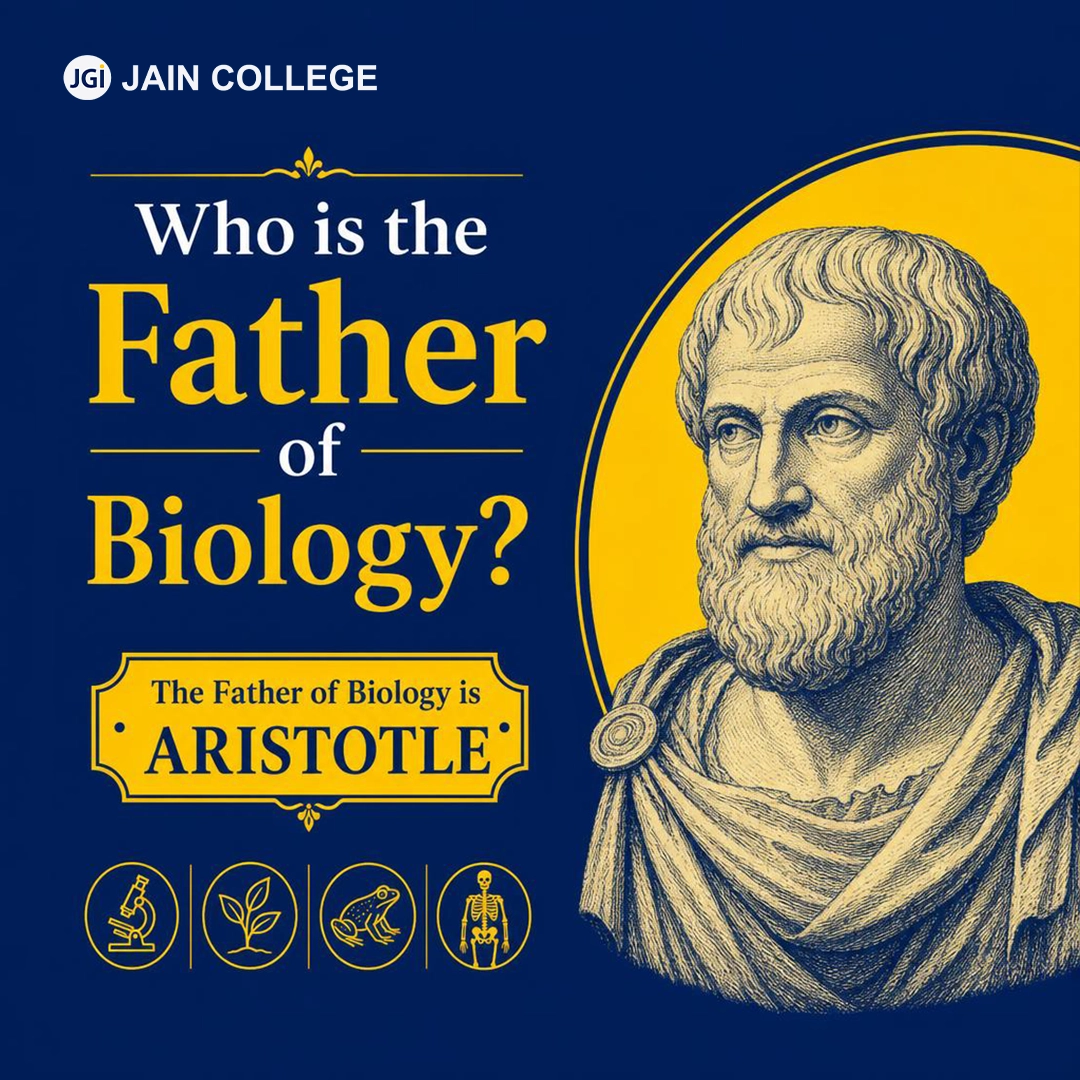
Aristotle’s name comes up often in this context because of how he approached the study of living things.
Rather than relying on what people thought, he tried to figure things out for himself. He spent time observing animals and plants and noting their features. He spent time observing animals and plants and noting their features. He also tried grouping them based on similarities, which might seem basic now, but at the time it was a significant improvement.
He wrote down a lot of what he observed. Some of it was accurate, some of it wasn’t—but that’s expected, considering how limited tools were back then. What really mattered was the approach. He was trying to make sense of life in a structured way.
His work, including writings like History of Animals, was used and discussed for many years after. Even though modern biology has moved far beyond his ideas, people still recognise his early efforts as an important starting point.
Biology is also referred to as 'life science’ — the study of life.
Among the several biologists who have contributed to the field of biology, here is a list of those who have made significant contributions and are considered "Fathers of" various biological disciplines.
Aristotle is known for his systematic study of living organisms and for his early classification methods. Some of his scientific explorations were as wide-ranging as his philosophical speculations were profound.
Aristotle’s work laid the foundation for scientific inquiry, classification, and logical reasoning, influencing both science and philosophy for centuries.
Aristotle was a Greek philosopher, logician, and scientist. He was born in 384 BCE in Stagira, a small town in northern Greece. His father Nicomachus was a court physician to the king of Macedon, Amyntas II.
After Plato's death in 347 BC, Aristotle left Athens and began travelling throughout the Greek world. He was sent to the city of Athens for his higher education when he was 17 years old. In 347 BC, after the death of his teacher Plato, Aristotle leaves the city of Athens. In 338 BC, Aristotle became the tutor of Alexander the Great, the son of King Philip II of Macedon.
In 335 BC, after Alexander the Great succeeded his father, King Philip II, Aristotle returned to Athens and established the Lyceum.
In 335 BC and with Alexander's permission, Aristotle establishes his school in Athens, called the Lyceum. Aristotle spent most of his remaining life working as a teacher, researcher and writer at the Lyceum in Athens.
Here is a timeline highlighting the key events in the life of Aristotle:
| Aristotle: 384-322 BC | |
| Name | Aristotle |
| Date of Birth | c. 384 BCE |
| Place of Birth | Stagira, Greece |
| Education | Studied at the Academy in Athens under Plato |
| Qualification | Not formally defined (ancient system) |
| Occupation | Philosopher |
| Residence | Stagira, Athens, and later Chalcis |
| Ethnicity | Greek |
| Fields | Philosophy, Biology, Zoology, Logic, Ethics, Politics, Metaphysics |
| Known for | Founder of formal logicFather of Biology and ZoologyClassification of living organisms |
| Notable Awards | None (formal award systems did not exist during his time) |
| Date of Death | c. 322 BCE , Chalcis, Greece |
| Key Insight:Aristotle’s work laid the foundation for influencing multiple disciplines for centuries, including:Scientific classificationLogical reasoningPolitical theory | |
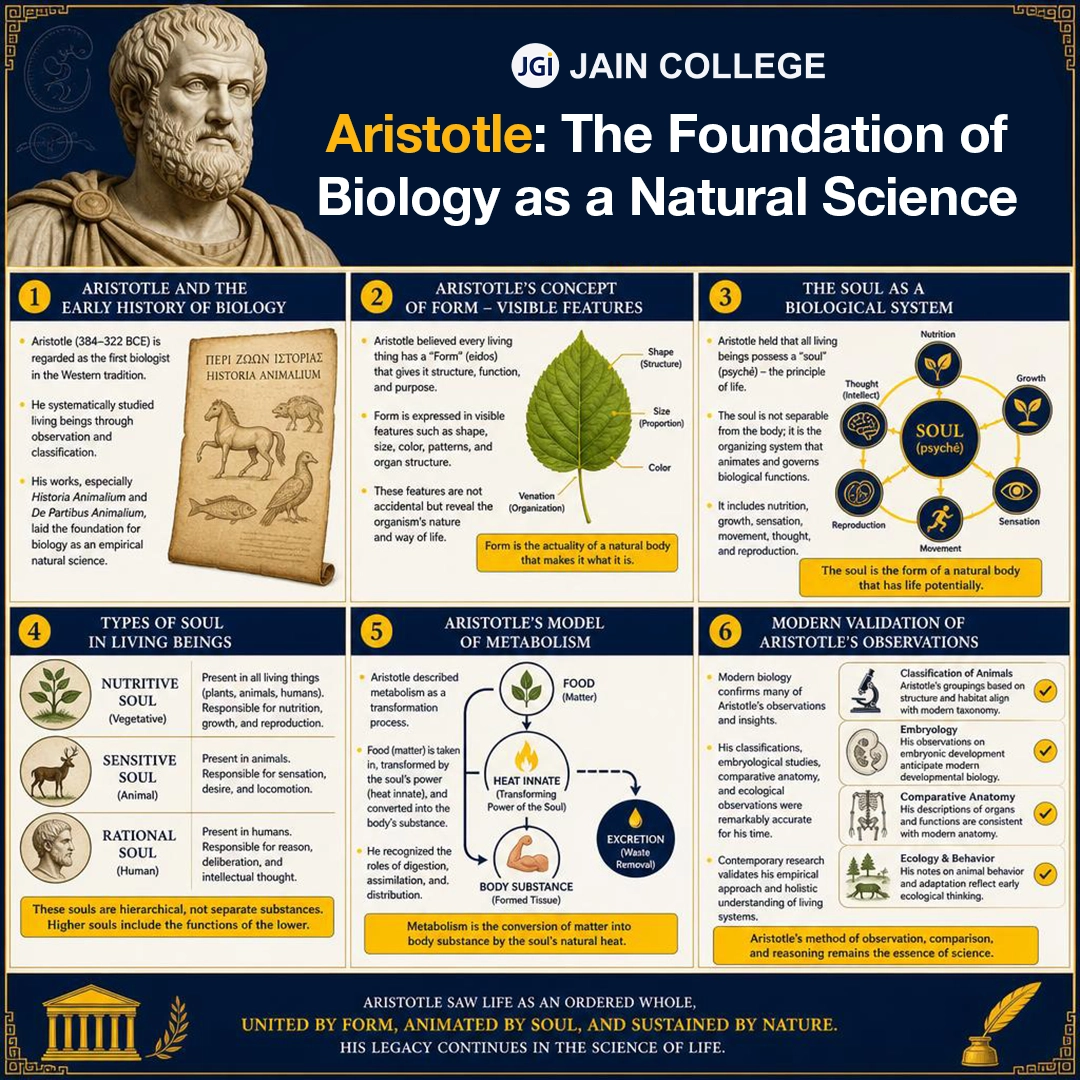
Aristotle is widely regarded as the father of biology and one of the first scholars to systematically classify living organisms. His work marked an early shift toward studying life through observation rather than purely philosophical speculation.
Through the contributions of later scientists such as William Harvey, Antonie van Leeuwenhoek, Gregor Mendel, and Charles Darwin, biology continued to evolve, develop and advance.
Aristotle's biological studies established the foundation for the scientific study of life. Aristotle developed one of the earliest comprehensive approaches to biology through systematic observation and detailed documentation, particularly of animal specimens.
Much of his research was conducted during his time on the island of Lesbos, where he studied marine organisms and explored topics such as zoology, marine biology, and embryology.
Aristotle's approach was distinctive for combining empirical research with philosophical reasoning, allowing him to interpret natural phenomena in a structured way. His biological writings spread across multiple works, which constitute a significant portion of his surviving texts and have influenced scientific thinking for centuries.
As a way of describing the visible characteristics of a living organism, Aristotle used the Greek word (εἶδος) “eidos”.
| Indivisible Forms | Aristotle recognised variation within a group (e.g., different birds or fish), referring to them as atoma eidē (indivisible forms). |
| Inheritance of Forms | Aristotle proposed that offspring inherit traits from their parents, an early idea resembling inheritance. |
| Material Analogy | Aristotle compared form and matter to a woodcarving—where design (form) shapes raw material (matter). |
Aristotle viewed the “soul” (psyche) as the principle of life, responsible for biological functions:
| Inheritance | Transmission of traits from parents to offspring |
| Development | Processes of growth and embryonic formation |
| Metabolism | Intake and transformation of nutrients for growth and survival |
| Information Processing | Sensory perception and response leading to movement |
| Temperature Regulation | Maintenance of internal balance, which weakens with age |
| Plant Soul | Plants possess a vegetative soul, responsible for reproduction and growth |
| Animal Soul | Animals have both a vegetative and a sensitive soul, enabling mobility and sensation |
| Human Soul | Humans uniquely possess a vegetative, sensitive, and rational soul, capable of thought and reflection |
| Food Intake | Food is transformed into blood, which nourishes the body |
| Blood Distribution | Blood contributes to the formation of tissues such as flesh and bones |
| Fat Production | Excess material is converted into fat |
| Semen Formation | Certain substances were believed to form reproductive material (semen) |
| Waste Excretion | Waste is eliminated as urine, bile, and faeces, with heat released from the body |
*Note: This model is historically important but not scientifically accurate by modern standards.
Some of Aristotle’s observations have been validated over time:
| Octopus Camouflage | His description of adaptive colour change is supported by modern marine biology |
| Elephant Swimming Behaviour | Elephants are known to use their trunks for breathing while swimming |
| Marine Biology Insights | Several of his detailed observations of marine life have proven to be remarkably accurate |

Aristotle was considered one of the earliest scientists to apply systematic observation. He was one of the greatest philosophers, who made pioneering contributions to all fields of philosophy and science. He contributed to the field of formal logic, and he identified the various scientific disciplines and their relationship to each other.
Besides being a conventional educator, Aristotle made significant contributions across multiple fields and is widely regarded as the father of biology, father of zoology, father of logic, and father of political science.
| Homology Concept: The concept of homology in biology began with Aristotle |
| Evolutionary Biology: Some modern evolutionary developmental biologists find Aristotle's work relevant to understanding deep homologies |
| Taxonomic Influence: The influence of Aristotle's great chain of being is still perceptible in the use of terms like "lower" and "upper" in taxonomy |
From his classification of living beings, he primarily focused only on different species within the animal kingdom. Aristotle’s history, movements, and progression of animals were studied based on different types of animals that live on land, in water, and in the air.
One of his early observational experiments involved him dissecting bird eggs at different stages of embryonic development within the egg.
In his book Historia Animalium, Aristotle was the first person in history to venture into the classification of different animals.
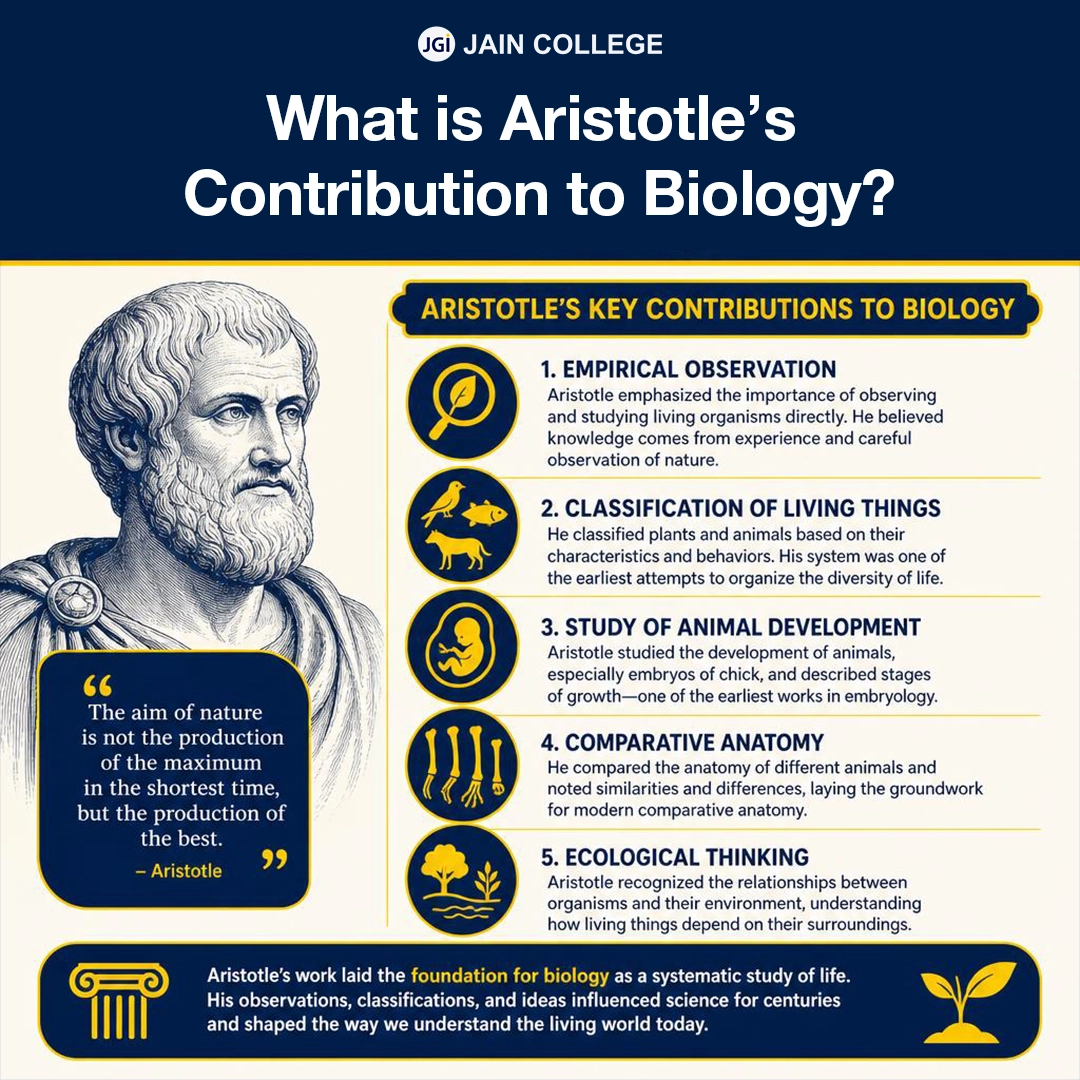
Through systematic observation and empirical studies of living organisms, Aristotle laid the foundations of natural science. His work focused on key disciplines including zoology, embryology and marine biology.
He explored early ideas related to:
Accordingly, Aristotle proved a remarkable understanding of biological processes for his time.
His writings influenced later scholars, including Theophrastus, and continued to shape scientific thought for centuries.
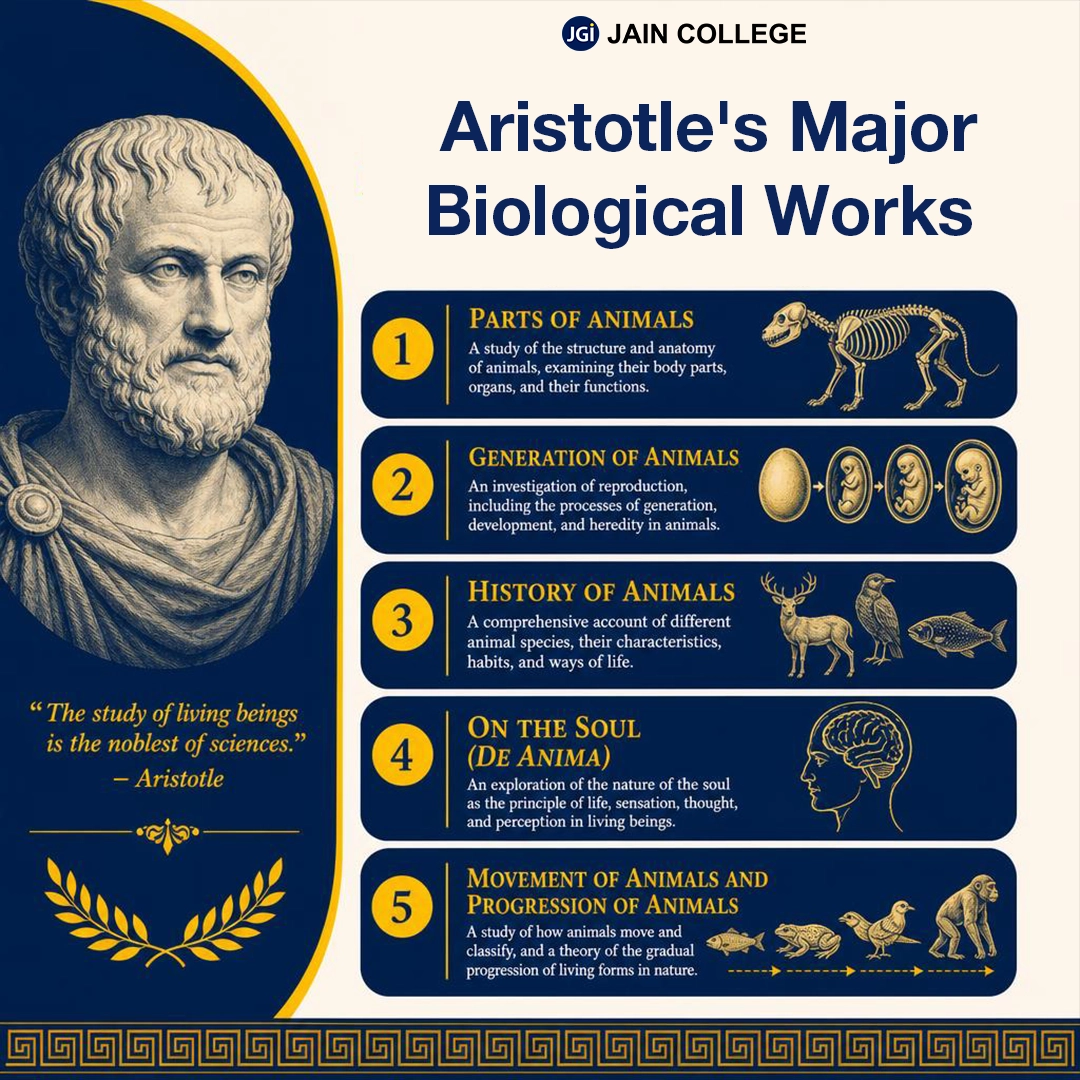
| Parts of Animals: A detailed study of animal anatomy and structure |
| Generation of Animals: Focuses on reproduction and early development (embryology) |
| History of Animals: A broad account of animal life, behaviour, and classification |
| On the Soul (De Anima): Explores the nature of life, the soul, and consciousness |
| Movement of Animals and Progression of Animals: Examine how animals move and the mechanics of locomotion |
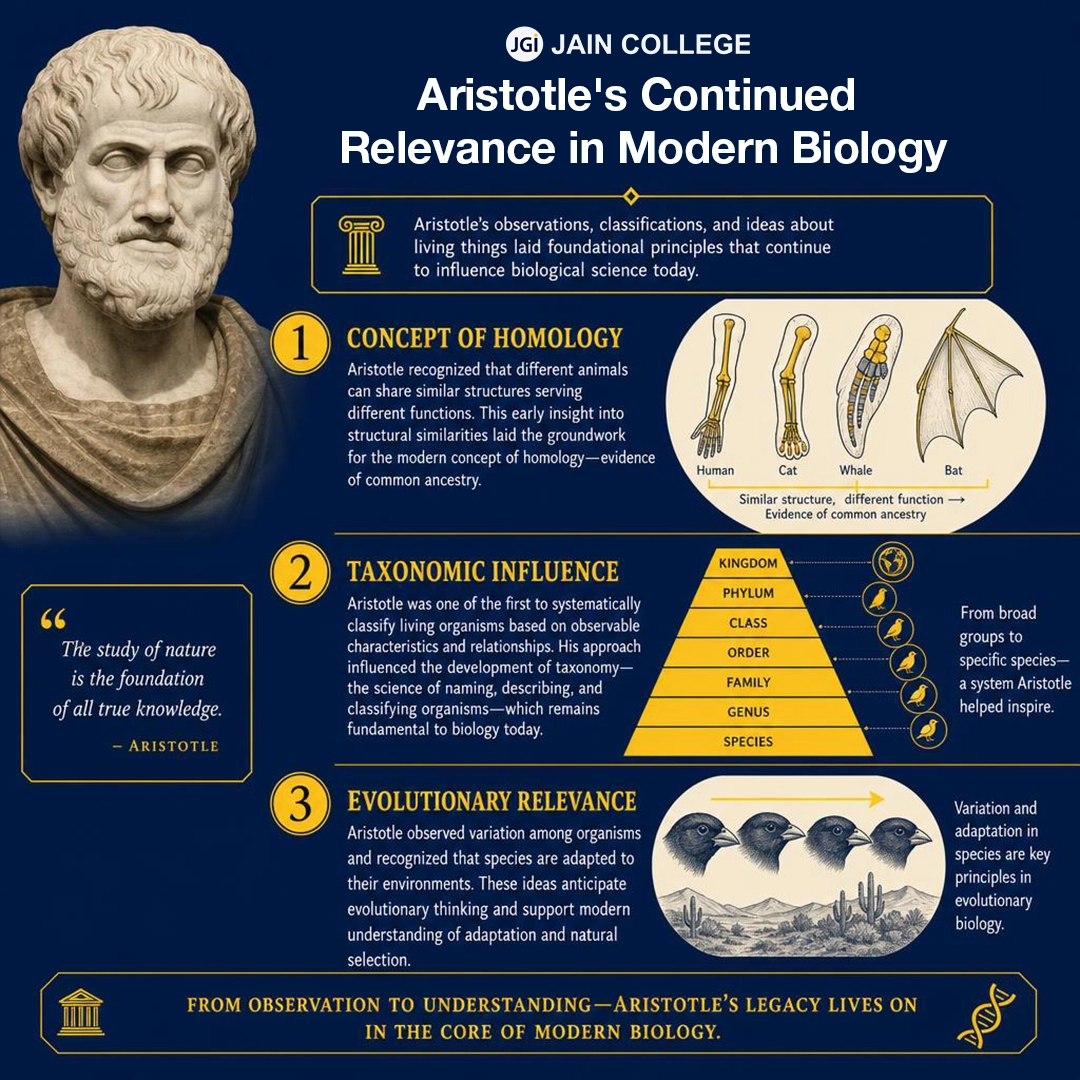
Aristotle is often referred to as the "father of biology" and "father of marine biology" for his foundational work:
| Concept of Homology: Early observations comparing structures in organisms laid groundwork for later biological concepts |
| Taxonomic Influence: His idea of a hierarchical organisation of life influenced early classification systems |
| Evolutionary Relevance: Some modern evolutionary developmental studies revisit Aristotle’s insights on organism structure |
Aristotle was one of the greatest philosophers who ever lived and the first genuine scientist in history. He made pioneer contributions to all fields of philosophy and science; he identified the various scientific disciplines and explored their relationship to each other.
Visit the blogs on our website at JAIN PU College and learn more about the famous Indian scientists, biologists, famous personalities, literary authors, poets, and Kannada Jnanapeetha/Jnanpith winners.
Which Biology topic do you enjoy learning about the most?
Share your thoughts in the comments below.
Aristotle is often referred to as the "father of biology" and "father of marine biology" for his foundational work.
Empiricism is a theory of knowledge that states that knowledge comes only or primarily from sensory experience.
Aristotle is an empiricist because he thinks that all knowledge comes to human beings from and through sensation. Our minds start out as blank slates, and from sensation we get our ideas or the so-called "contents" of our minds.
Some of Aristotle's major biological works include the following:
Some of Aristotle's biological rules include the following:
Temperature, paternal age, semen strength and other environmental factors are responsible for impacting inheritance in Aristotle's theory.

JAIN PU College, a part of the renowned JGI Group, is committed to empowering students with quality education.
Beyond academics, the college ensures its online content reflects the same standard of excellence. Every blog and article is meticulously vetted and proofread by subject matter experts to ensure accuracy, relevance, and clarity. From insightful educational topics to engaging discussions, JAIN PU College's content is crafted to inform, inspire, and add value to its readers, reflecting the institution's commitment to intellectual growth and innovation.
View all Blogs