






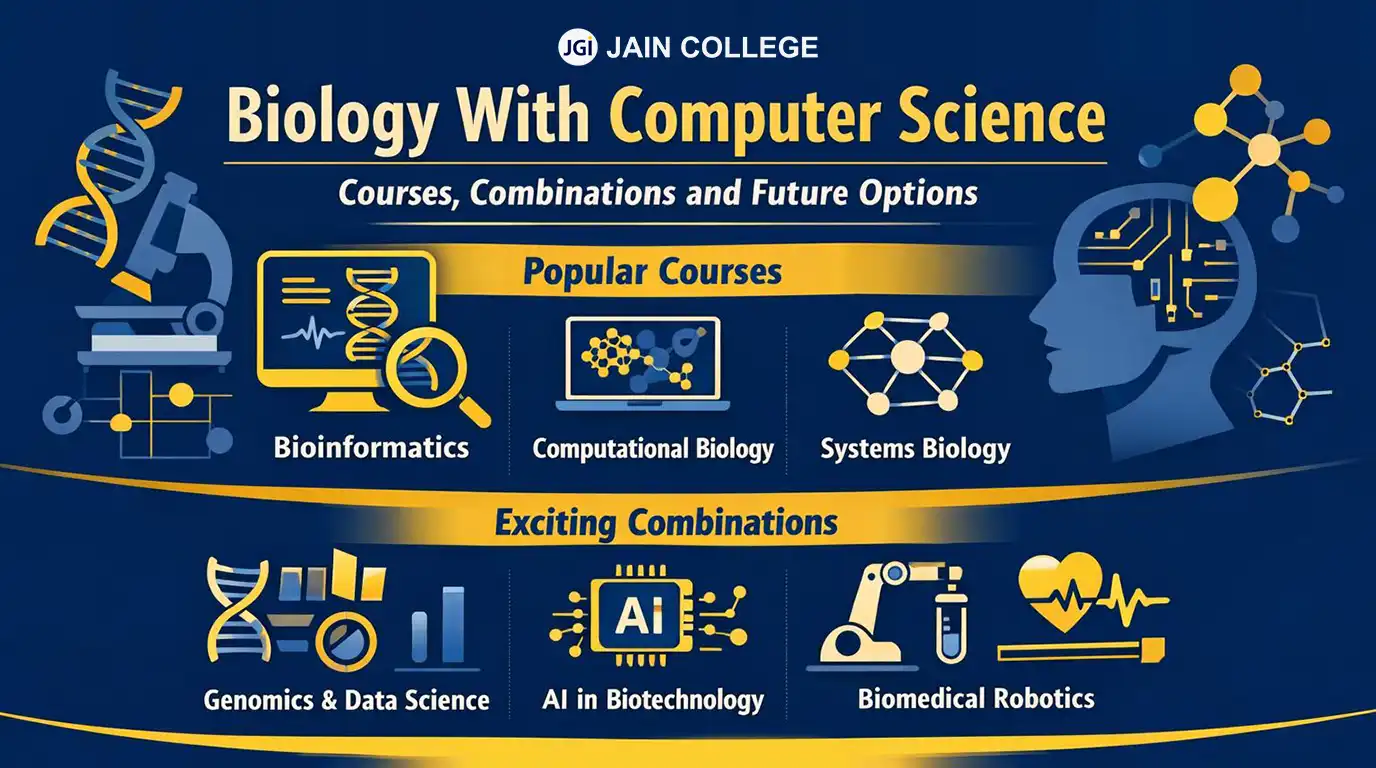
Biology with Computer Science is a field. It combines life sciences with programming, data analysis, and AI. This interdisciplinary field is used to solve biological and medical problems, leading to careers in bioinformatics, healthcare AI, and research.
Students interested in pursuing this interdisciplinary path often begin by exploring the Best PU Colleges in Bangalore that offer strong foundations in Biology, Computer Science, and PCMB combinations at the pre-university level.
This interdisciplinary course prepares students for highly specialised, in-demand roles. Some of the top career options available include
Biology is the natural science that deals with the study of life and living organisms.
The word Biology is derived from two Greek words – 'Bios' refers to life, and 'Logos' refers to study.
Biology is a broad scientific discipline focused on understanding the structure, function, development, origin, evolution, and distribution of living organisms. Studying Biology is not only useful. It is essential, as it connects and supports understanding in other scientific disciplines
Other specialised fields in biology include genetics, cell biology, molecular biology, biotechnology, and other disciplines.
During the course of time and as technology advanced, new branches of Biology emerged. This broad concept of science is also referred to as life sciences.
Biology is primarily divided into three main branches, which are mainly based on the type of organism studied:
Computer Science is the study of computation, algorithms, data structures, software systems, and computational theory.
The intersection of Computer Science and Biology is known as Computational Biology.
Computational Biology is mainly used to:
Computational Biology is a very broad discipline. It focuses on the study of the sequence and structure of biological molecules. It builds models for various types of experimental data and biological systems.
This discipline integrates biological research with advanced computational techniques. It leverages biological processes to perform computational tasks.
Various fields of Biology, including genomics, transcriptomics, proteomics, metabolomics, and bioinformatics, employ computational biology.
Computational Biology represents an experimental and emerging area of research that explores biological processes for computational purposes. While promising, most applications remain in research and development stages.
The key components of Computational biology include:
An interdisciplinary domain that combines Computer Science and Biology is termed 'Computational Biology'.
This interdisciplinary field has significantly advanced the development of algorithmic and computational models. It is used in studying biological systems in many areas of Biology, including:
Some applications of Computational Biology in genomics and personalised medicine include the following:
Biology with Computer Science is a unique combination.
As a result, Computational Biology:
Through these experiential learning opportunities, students develop innovative theoretical and practical knowledge. This approach brings together nature and Computer Science.
Listed below are integrated programmes which combine Biology with Computer Science
| Course Name | Duration | Main Focus |
| B.Sc. Bioinformatics | 3 Years | Biology & Programming, data analysis, genetic data, biological databases |
| B.Sc. Biotechnology & Computer Science | 3 Years | Core biotech subjects with basic programming & IT tools |
| B.Sc. Data Science with Biology | 3 Years | Biological data analysis, statistics, machine learning |
| B.Sc. Life Sciences with Computer Applications | 3 Years | Biology & software tools, lab tech & IT skills |
| B.Sc. Computational Biology | 3 Years | Mathematical & computer modelling of biological systems |
| B.Tech Biotechnology & Computer Science | 4 Years | Biotechnology with coding, AI, data science, and computational tools |
| B.Tech Bioengineering | 4 Years | Engineering principles applied to biology and computational tools |
| M.Sc. Bioinformatics | 2 Years | Advanced genomic analysis, algorithms, research tools |
| M.Sc. Computational Biology | 2 Years | Advanced biological modelling and simulation |
| M.Tech Bioinformatics | 2 Years | Research-level biotech & high-level computing |
| Integrated M.Sc. Bioinformatics | 5 Years | UG & PG combined programme in bio & computing |
*Note: These courses are pursued after class 12 with PCMB, PCB
Most of the above-mentioned B.Sc. programmes include Mathematics & Statistics as a core component. This may again vary by the universities.
For example, some universities require mathematics for the B.Sc. data science programme.
These combinations equip students with a diverse skill set. This enables them to navigate and contribute effectively to various fields.
For instance, Computational Biologists develop machine learning tools. They apply these tools to investigate hidden processes driving biological systems.
This course combination offers extensive research opportunities across academic, industrial, and applied domains.
Listed below are the best future options after studying Biology with Computer Science.
| Career Field | Job Role | Job Responsibilities |
Bioinformatics | Bioinformatician | Analyse DNA, RNA, and protein data using software |
| Genomics Analyst | Study genome data for research & medicine | |
Computational Biology | Computational Biologist | Model biological systems using computer simulations |
| Systems Biology Analyst | Study complex biological networks | |
| Healthcare IT | Health Informatics Specialist | Manage digital health records & hospital data |
| Clinical Data Analyst | Analyse clinical and patient data | |
Data Science | Healthcare Data Scientist | Apply data science to medical & biological datasets |
| Biostatistician | Statistical analysis for biology & health research | |
Artificial Intelligence | Medical AI Analyst | Develop AI tools for diagnosis & healthcare |
| Machine Learning Engineer (Life Sciences) | Build ML models for biotech & pharma | |
Pharmaceutical Industry | Drug Discovery Analyst | Use AI & bio-data for new drug development |
| Pharmacogenomics Specialist | Personalised medicine using genetics | |
Biotechnology Industry | Biotech Software Specialist | Develop software for biotech labs & companies |
| Biomedical Data Analyst | Analyse lab & biomedical datasets | |
Research & Academia | Research Scientist | Conduct bio- and computational research |
| Computational Research Fellow | Advanced interdisciplinary research | |
| Public Health | Public Health Data Analyst | Disease trends & population health analytics |
| Medical Devices | Biomedical Informatics Engineer | Software & data for medical devices |
| Environmental & Agri-Tech | Bio-Data Analyst | Analyse biological & environmental data |
| Startups & Consulting | HealthTech Consultant | Technology solutions for healthcare |
| Biotech Startup Founder | Launch bio- and tech-based ventures |
The study of Computational Biology has many practical and academic applications in the modern-day world. It provides a broad skill set and versatile knowledge base that are highly valued in academia, professional life, and research.
The field encourages collaboration across Biology and Computer Science while also drawing from related scientific areas such as:
This interdisciplinary domain approach enables the analysis of complex biological data, particularly in genomics and molecular studies.
With advances in technology, Computational Biology plays a key role in understanding genetic information and supporting research-driven innovation across the life sciences.
Some of the top reasons behind choosing this interdisciplinary course are:
Typically, these courses fall into the category of Bioinformatics or Computational Biology. The skills, include
Programming skills
These skills include:
Statistical Skills
These skills include:
Bioinformatics Skills
These skills include:
General Biology Knowledge
It includes
Biology and Computer Science disciplines prepare students for the jobs of the future.
Computational Biology has also been instrumental in the development of new technologies.
After completing PUC or Class 12, students can pursue these interdisciplinary courses that integrate concepts from Biology and Computer Science programmes.
Stay tuned to the JAIN PU College blog for more articles related to Biology, Computer Science, and other relevant topics.
Still confused about choosing Biology with Computer Science or PCMB?
Share your thoughts in the comments below.
Bioinformatics is a multidisciplinary field that uses computational tools, statistics, and software to store, analyse, and interpret biological data.
Biological data is information about living organisms, which mainly involve
This is an interdisciplinary research area that links Biology, Computer Science, and Engineering.
Bioinformatics involves using information technology to:
Biomolecular computing is also known as molecular computation. It represents a breakthrough in computational technology.
The Bio Computer Science course includes Biology, Life Science Mathematics & Statistics and Computer Science as core subjects.

JAIN PU College, a part of the renowned JGI Group, is committed to empowering students with quality education.
Beyond academics, the college ensures its online content reflects the same standard of excellence. Every blog and article is meticulously vetted and proofread by subject matter experts to ensure accuracy, relevance, and clarity. From insightful educational topics to engaging discussions, JAIN PU College's content is crafted to inform, inspire, and add value to its readers, reflecting the institution's commitment to intellectual growth and innovation.
View all Blogs