





The best courses after 2nd PUC Science include engineering and medical programmes through CET or NEET, as well as pure science degrees such as B.Sc. Physics, Biotechnology, Microbiology and Data Science for students who do not appear for entrance exams.
Both the CET and NEET entrance examinations are mandatory for engineering, medical and professional courses.
CET is a state entrance-level exam, while NEET is a national-level exam.
Top courses after 2nd PUC Science with NEET
NEET is mandatory only for medical and AYUSH courses, not engineering.
Best courses after 2nd PUC Science with NEET include:
Top courses after 2nd PUC Science with CET
CET is not mandatory for all Engineering courses.
Best courses after 2nd PUC Science with CET include
Engineering (B.E./B.Tech) is offered in specialisations such as:
Excellent courses available
After completing 2nd PUC Science, students can choose various undergraduate bachelor’s degree programmes with or without entrance examinations. These undergraduate degree programmes provide good career prospects, depending on skills and further specialisation.
Some of these pure science courses include
JAIN PU College is recognised as one of the top PU colleges in Bangalore with NEET coaching by offering a rigorous and comprehensive coaching programme.
The CET, or Common Entrance Test, is a standardised examination conducted at the state or national level for admission to various undergraduate courses.
Different states and universities in India conduct CETs for different streams, including engineering, law, and management.
Some popular state-wise CETs include:
Significant elements about the CET exam:
| CET Full Form | Common Entrance Test |
| Conducting Body | Different CETs have different authorities (Varies with states) |
| Examination Level | Undergraduate (UG) Exam at the state level |
| Age Limit | The minimum age requirement is 17 |
| Nationality | Indian citizens |
| Exam Frequency | Once a year |
| Mode of Examination | Not always offline |
| Eligibility | Class 12 pass with Physics, Chemistry & Biology / Mathematics |
| Exam Duration | KCET is ~80 mins |
| Minimum Marks Required | Usually 50% for the general category, 40-45% for the reserved categories |
* Note: Admission cut-offs vary by category, college, and year.
The National Eligibility cum Entrance Test (NEET) is the single national-level entrance examination in India for admission to undergraduate medical courses such as MBBS, BDS, and other allied medical programmes.
On an annual basis, approximately 1.5 to 2 million students appear for the NEET-UG, and this figure continues to increase gradually.
The NEET entrance examination is organised by the National Testing Agency (NTA) for students seeking admission to medical courses in both government and private medical institutions across the country. Due to the intense level of competition, students must be well prepared to secure admission to top medical colleges.
The eligibility criteria required for this medical entrance examination are that
| Age Limit: | Minimum 17 years |
| Academic Qualification: | A student must have passed Class 12 or its equivalent with Physics, Chemistry, and Biology/Biotechnology as core subjects |
| Minimum Marks (PCB): | The student must have obtained a minimum of 50% aggregate marks in these subjects, with a relaxation for reserved categories in accordance with government norms. |
Key points about the NEET exam:
| NEET Full Form | National Eligibility cum Entrance Test |
| Conducting Body | National Testing Agency (NTA) |
| Examination Level | CETs are not uniformly UG-only |
| Exam Frequency | Once a year |
| Age criteria | A minimum of 17 years |
| Nationality categories | Citizens of India, NRIs, OCIs, and PIOs |
| Mode of Examination | CETs are not always offline. |
| Eligibility | Class 12 pass with Physics, Chemistry & Biology |
| Exam Duration | Typical durations range from 2 to 3 hours, depending on the exam. |
*Note:
Non-Resident Indians (NRIs)
Persons of Indian Origin (PIO)
Overseas Citizens of India (OCI)
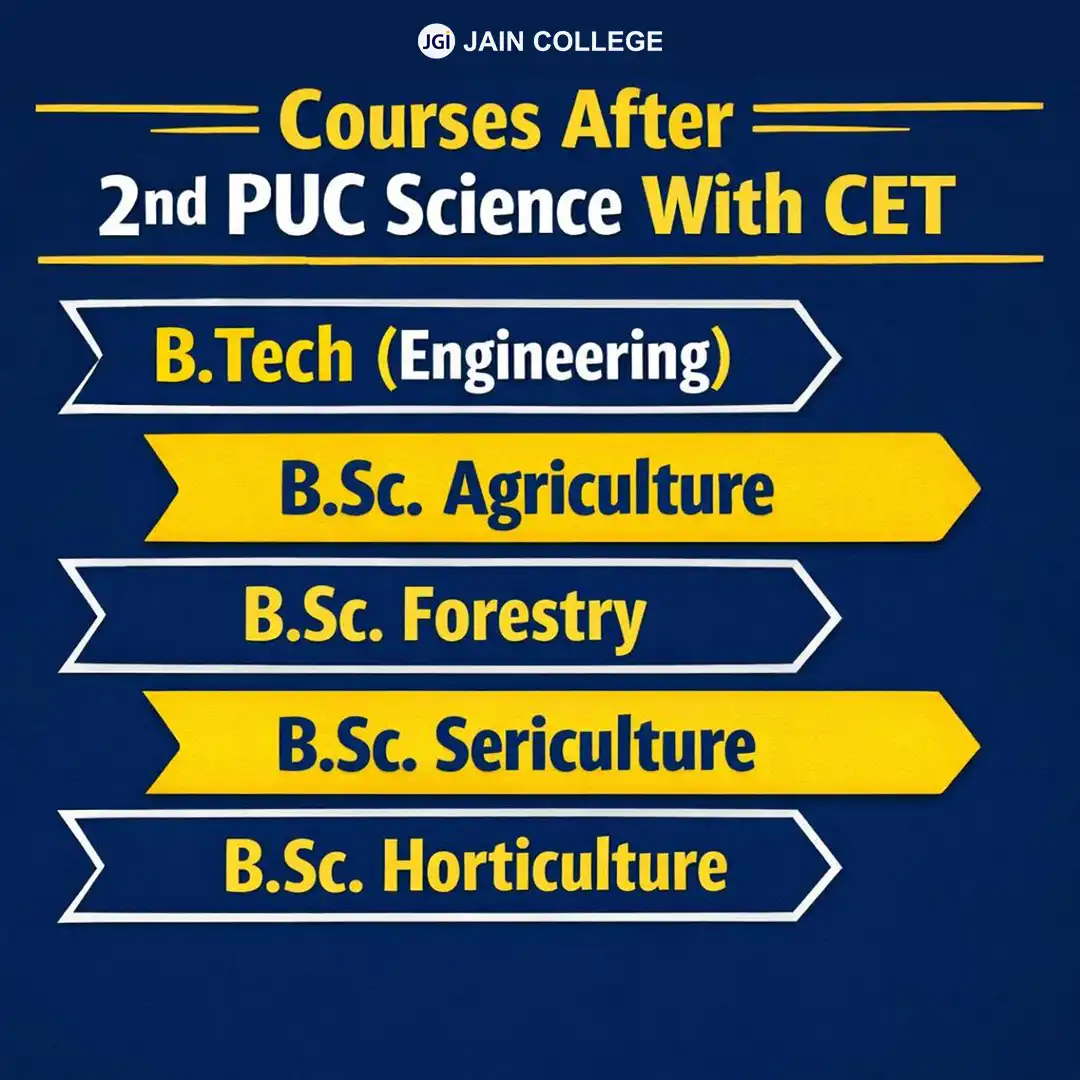
| Course | Stream Eligibility | Course Duration |
| B.Tech (Engineering) | PCM | 4 years |
| B.Sc. Agriculture | PCB/PCM or Agriculture | 4 years |
| B.Sc. Forestry | PCB/PCM/CBZ | 4 years |
| B.Sc. Sericulture | PCB | 4 years |
| B.Sc. Horticulture | PCB or Agriculture | 4 years |
PCB: Physics, Chemistry, Biology
PCM: Physics, Chemistry, Mathematics
CBZ: Chemistry, Biology, Zoology
A B.Tech., or Bachelor of Technology, is an undergraduate programme that provides the basis for pursuing a career in engineering and technology. This programme is designed to provide students with theoretical frameworks and practical experience across engineering disciplines.
Key features:
| Degree Name | Bachelor of Technology (B.Tech.) |
| Degree Type | Undergraduate- Bachelor of Technology |
| Duration | 4 Years |
| Eligibility Criteria | 10+2 with science (PCM) stream from a recognised board with a minimum of 55 per cent |
| Job Profiles | Software Engineer, Data Analyst, Design Engineer, Project Manager, Civil Engineer, etc. |
| Top recruiters | TCS, Infosys, Wipro, L&T, Amazon, Microsoft |
Students interested in agricultural sciences have various alternatives, ranging from a B.Sc. in Agriculture to B.Tech. in Agriculture courses (4 years). This undergraduate bachelor’s degree programme is mainly meant to prepare students for careers in agriculture and food processing.
Candidates with a 45%–50% aggregate in their 10+2 (science stream) are eligible to apply for this undergraduate programme. In some colleges, a separate entrance exam is required for admission.
Numerous fields and branches of further education are directly related to agriculture. Students have the opportunity to pursue their interests in
Key features:
| Degree Name | B.Sc. Agriculture Honours |
| Degree Type | Bachelor of Science |
| Duration | 4 years |
| Eligibility Criteria | 10+2 with science (PCB) stream from a recognised board with a minimum of 55 per cent |
| Job Profiles | Agriculture officer, Assistant Plantation Manager, Agricultural Research Scientist, Agriculture Development Officer, Agriculture Technician |
| Top recruiters | Agrotech Food, Research labs, ITC Limited, Government Institutes, Colleges |
This is an undergraduate academic degree which prepares students to manage forests, cash crops, sanctuaries, botanical gardens, and plantations.
The BSc Forestry syllabus is designed to offer knowledge on traditional plantation management, new plantation techniques, wildlife ecosystem conservation, environmental science, etc.
Key features:
| Degree Name | B.Sc. Forestry |
| Degree Type | Bachelor of Science |
| Duration | 4 years |
| Eligibility Criteria | 10+2 with science (PCB) stream from a recognised board with a minimum of 55 per cent |
| Job Profiles | Forest Officer, Professor, Agri-Credit Manager, Conservationist and Ecologist |
| Top recruiters | Research, Agriculture, Forest Services, Nursery and Educational Institutions |
In this course, students are well-equipped to work in the traditional silk industries and will be involved in developing innovative methods for silk production.
This course provides students with hands-on experience on
Key features:
| Degree Name | B.Sc. Sericulture |
| Degree Type | Bachelor of Science |
| Duration | 4 years |
| Eligibility Criteria | 10+2 with science (PCB) stream from a recognised board with a minimum of 55 per cent |
| Job Profiles | Sericulture Officer, Farm Manager, Quality Control Specialist and Textile Industry Specialist |
| Top recruiters | Silk Mark Organisation of India, Central Silk Board, Tasar Silk Development Corporation, Aditya Birla Group, Vardhman Textiles and Raymond Limited |
Horticulture is a branch of plant agriculture that is primarily involved in cultivating and producing plants, crops, and medicinal ingredients.
A Bachelor of Science in Horticulture is a valuable degree. In this programme, students develop key skills, including research, analytical thinking, communication and and teamwork, which will be beneficial in the field.
Key features:
| Degree Name | B.Sc. Horticulture |
| Degree Type | Bachelor of Science |
| Duration | 3 years |
| Eligibility Criteria | 10+2 with science (PCB) stream from a recognised board with a minimum of 55 per cent |
| Job Profiles | Horticulturist, Farm Manager, Agriculture Officer, Food Inspector, etc. |
| Top recruiters | State Forestry Departments, State Agriculture Departments and other Pesticide industries, including pesticides, farming, agriculture and educational institutes |
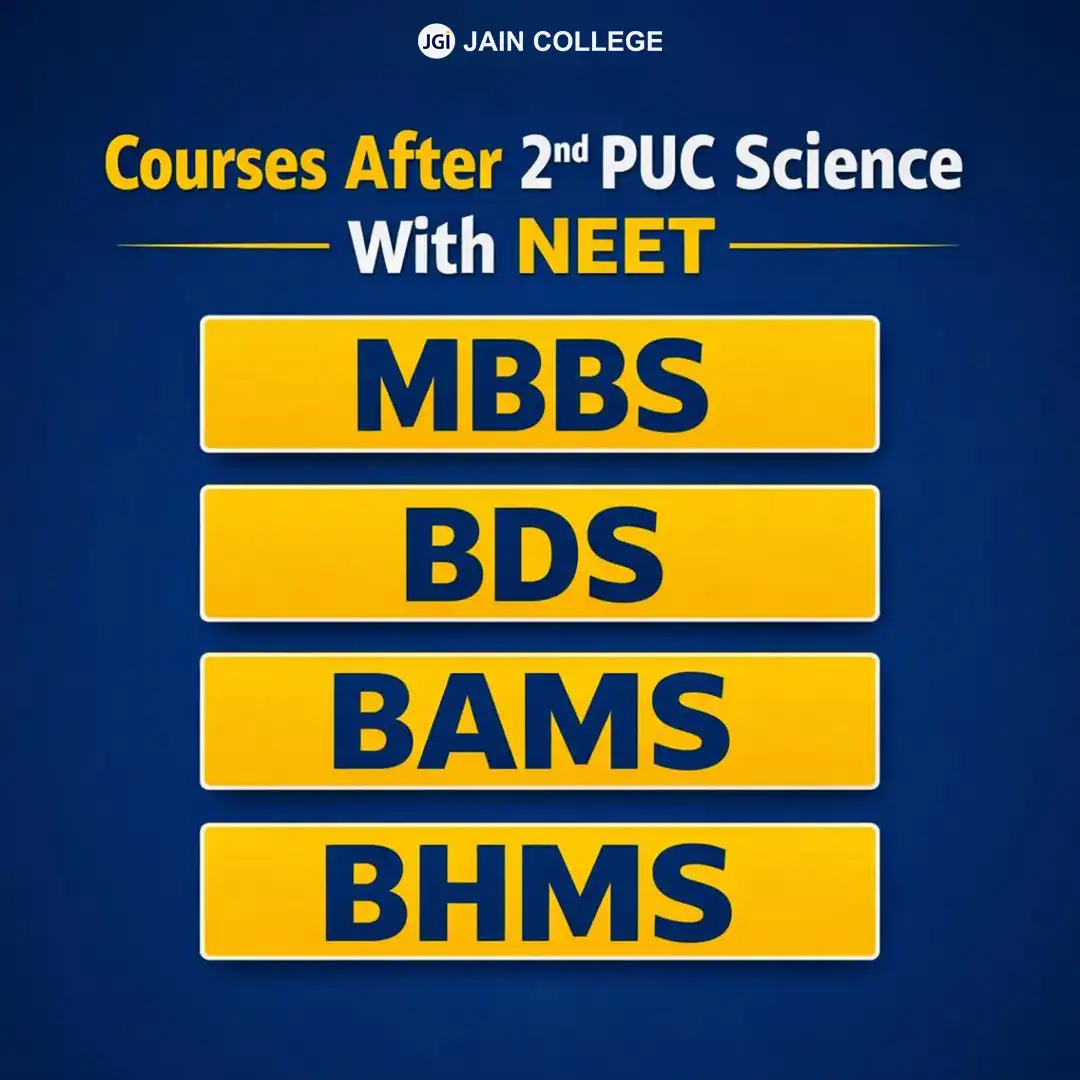
| Course | Course Duration |
| MBBS (Bachelor of Medicine & Bachelor of Surgery) | 5.5 years (4.5 yrs + 1 yr internship) |
| BDS (Bachelor of Dental Surgery) | 5 years (4 yrs + 1 yr internship) |
| BAMS (Bachelor of Ayurvedic Medicine & Surgery) | 5.5 years |
| BHMS (Bachelor of Homoeopathic Medicine & Surgery) | 5.5 years |
| Paramedical Sciences and Allied Health Sciences | 3 to 4.5 years |
An MBBS is a prestigious and respected profession in society.
The Bachelor of Medicine and Bachelor of Surgery, commonly known as MBBS, is an integrated undergraduate medical degree that contains two specialised degrees: the Bachelor of Medicine and the Bachelor of Surgery.
MBBS is among the most challenging and rigorous courses for students to pursue after 10+2.
Key features:
| Degree Name | Bachelor of Medicine and Bachelor of Surgery |
| Degree Type | Undergraduate |
| Duration | 5 years and 5 months internship |
| Eligibility Criteria | Candidates must have achieved a minimum of 50% in Science (PCB). |
| Job Profiles | Government health services, private hospitals, research, academia, biomedical engineering, and private practice or pursue a master's degree |
| Top recruiters | Apollo, Aster, Fortis, Manipal and more |
The BDS programme is designed to impart comprehensive knowledge and practical skills in the dental sciences. This includes the proper diagnosis, prevention, care, and treatment of diseases and conditions in the oral cavity.
Key features:
| Degree Name | Bachelor of Dental Surgery |
| Degree Type | Undergraduate |
| Duration | 5 years + 6 months internship |
| Eligibility Criteria | Candidates must have achieved a minimum of 50% in Science (PCB). |
| Job Profiles | Dentists, dental surgeons, lecturers, or forensic scientists. |
| Top recruiters | Clove Dental, My Dentist, or establishing independent dental clinics |
The BAMS course is regulated by the Central Council of Indian Medicine (CCIM). It offers the students an integrated pattern of syllabus, which covers the traditional Ayurvedic system. The course is structured and designed to impart:
Key features:
| Degree Name | Bachelor of Ayurvedic Medicine & Surgery |
| Degree Type | Undergraduate |
| Duration | 5.5 years (4.5 years of study + 1 year internship). |
| Eligibility Criteria | Candidates must have achieved a minimum of 50% in Science (PCB). |
| Job Profiles | Ayurvedic Doctor, Medical Officer, Hospital Administrator |
| Top recruiters | Dabur, Himalaya, Ministry of Ayush, Patanjali |
BHMS is an equally in-demand medical course. It is recognised by the Ministry of AYUSH, Government of India. The course curriculum includes both modern medical sciences and specialised homoeopathic subjects, including:
Key features:
| Degree Name | The Bachelor of Homeopathic Medicine & Surgery |
| Degree Type | Undergraduate |
| Duration | 5.5 years (4.5 years of study + 1 year internship). |
| Eligibility Criteria | Candidates must have achieved a minimum of 50% in Science (PCB). |
| Job Profiles | Homeopathic doctors in government/private hospitals, private clinics, or in research fields |
| Top recruiters | Homeocare International, Patanjali Ayurveda, Surya Herbal Limited, and Bharat Homoeopathic |
Paramedical Sciences and Allied Health Sciences courses are two prominent fields of medicine.
Though they are interconnected, these fields serve different purposes within the healthcare system.
*Note: Starting from the 2026–27 NEET-UG is compulsory for admission to Allied and Healthcare undergraduate courses.
Key features:
| Degree Name | Paramedical Sciences and Allied Health Sciences |
| Degree Type | Undergraduate or Diploma |
| Duration | BSc 3-4 year or diploma 2-year course |
| Eligibility Criteria | Candidates must have achieved a minimum of 50% in Science (PCB). |
| Job Profiles | Radiology Technicians, Medical Laboratory Technicians, Operation Theatre Technicians, Dialysis Technicians, Physiotherapists |
| Top recruiters | All leading hospital chains, diagnostic labs, and medical technology firms |
*Note
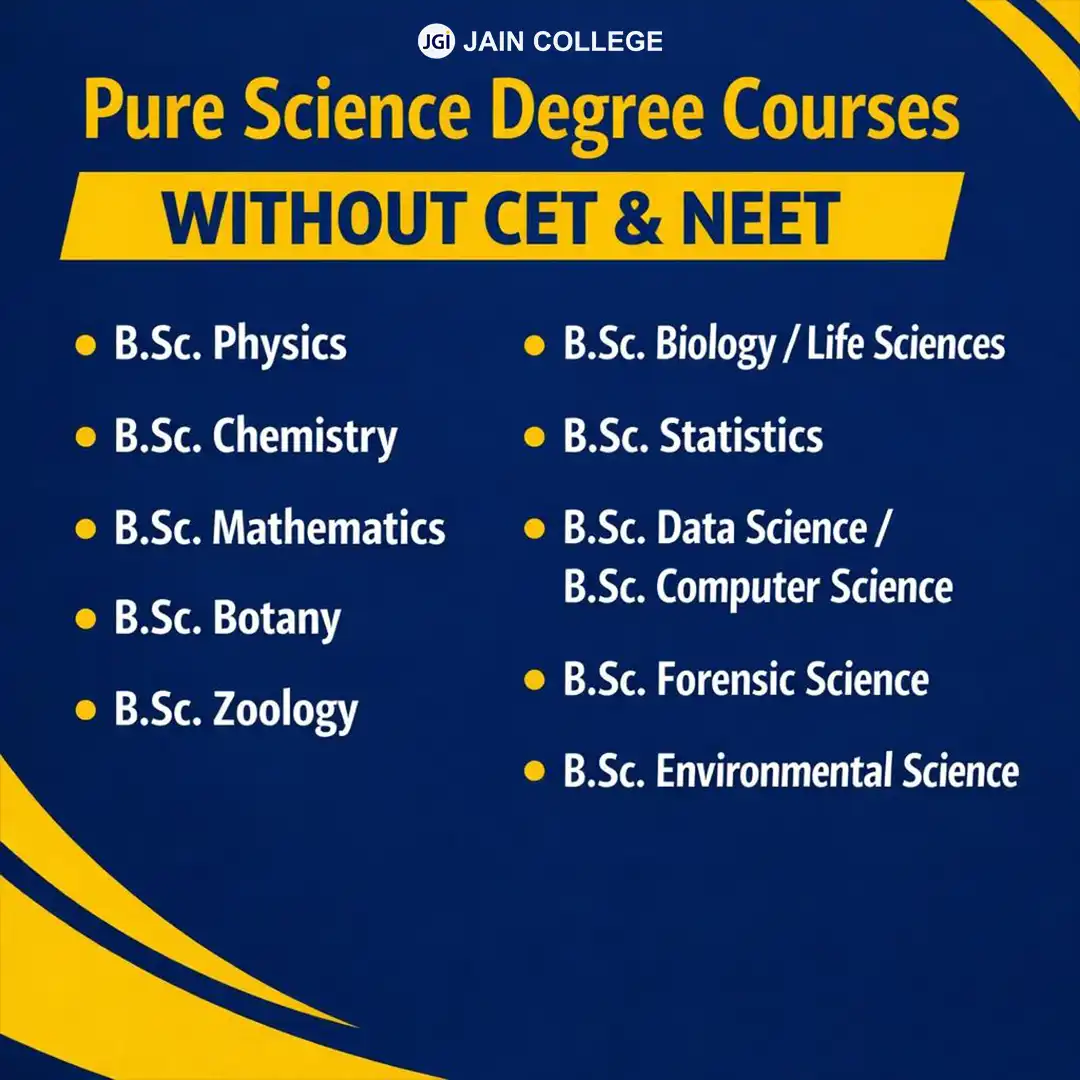
Pure Science focuses on theoretical knowledge, principles, and fundamental laws of nature. It involves studying scientific concepts, discoveries, and research without necessarily considering their direct practical use.
There are numerous top-ranked, non-engineering, and non-medical degree courses available without a CET or NEET.
These courses follow a merit-based admission process, and they span across biotechnology, medical laboratory technology, microbiology, and more.
Pursuing pure science after class 12/PUC offers many exciting possibilities for students who desire to study subjects like PCMB—Physics, Chemistry, Mathematics, and Biology.
This course provides a strong academic foundation for diverse career paths.
Here is more detailed information about these courses.
| Degree / Course | Duration | Focus |
| B.Sc. Physics | 3 years | Focus on mechanics, optics and quantum physics. |
| B.Sc. Chemistry | 3 years | Study the matter, reactions, and materials. |
| B.Sc. Mathematics | 3 years | Focus on algebra, calculus and statistics. |
| B.Sc. Botany | 3 years | Study plant biology and ecology. |
| B.Sc. Zoology | 3 years | Focus on animal life and behaviour. |
| B.Sc. Biology / Life Sciences | 3 years | Covers cell biology, biotechnology, ecology and genetics. |
| B.Sc. Statistics | 3 years | Statistical modelling and data analysis |
| B.Sc. Data Science / B.Sc. Computer Science | 3 years | Focus on data and programming analytics. |
| B.Sc. Forensic Science | 3 years | Application of science (biology/chemistry) to crime investigation |
| B.Sc. Environmental Science | 3 years | Focus on environment, ecosystems and conservation science |
*Note
The eligibility criteria required for these pure science courses include 10+2 with relevant science subjects from a recognised board.
Choosing the right courses after 12th science is crucial for shaping a successful career.
Here are some key considerations or tips that students should focus on while choosing the best course after Class 12/PUC Science.
Choosing the best course or stream after Class 12 or PUC Science depends on students' interests, future aspirations and job market trends.
Students with a science stream have a plethora of career opportunities, including engineering, medical and pure science degree courses.
Students who successfully pass or clear their CET or NEET examinations can pursue structured professional courses, while those without appearing for these entrance exams can still build strong careers through pure science degree courses.
Thus, with academic commitment, proper guidance, and skill development, students can achieve success in both traditional and emerging fields.
Confused about choosing the right course after 2nd PUC Science?
Speak to expert academic counsellors at JAIN PU College and get personalised guidance for CET, NEET or pure science pathways.
Stay tuned to https://www.jaincollege.ac.in/blogs and explore more informative articles on education and career planning.
Are you preparing for CET or NEET, or exploring options without entrance exams? Share your thoughts in the comments below.
Clearing the National Eligibility cum Entrance Test (NEET-UG) is mandatory for admission to the BYNS (Bachelor of Yoga and Naturopathy Sciences) programme
JEE, CET, COMEDK and NEET are the most important exams, which students need to prepare for after 2nd PUC Science.
Clearing the National Eligibility cum Entrance Test (NEET-UG) is mandatory for admission to the Bachelor of Dental Surgery programme.
The best courses to choose after 2nd PUC Science with CET include
Clearing the National Eligibility cum Entrance Test (NEET-UG) is mandatory for admission to the BAMS (Bachelor of Ayurvedic Medicine and Surgery) programme.
Yes. The demand for biotechnology professionals is rising due to the advancement of gene therapy, artificial intelligence and research.
Clearing the National Eligibility cum Entrance Test (NEET-UG) is mandatory for admission to the BUMS (Bachelor of Unani Medicine and Surgery) programme
With the pure sciences programme, students can choose careers in research, education, etc. Some of the best career prospects mainly include:
No. NEET is not required to pursue forensic science after 2nd PUC Science. The admissions are solely merit-based.

JAIN PU College, a part of the renowned JGI Group, is committed to empowering students with quality education.
Beyond academics, the college ensures its online content reflects the same standard of excellence. Every blog and article is meticulously vetted and proofread by subject matter experts to ensure accuracy, relevance, and clarity. From insightful educational topics to engaging discussions, JAIN PU College's content is crafted to inform, inspire, and add value to its readers, reflecting the institution's commitment to intellectual growth and innovation.
View all Blogs