






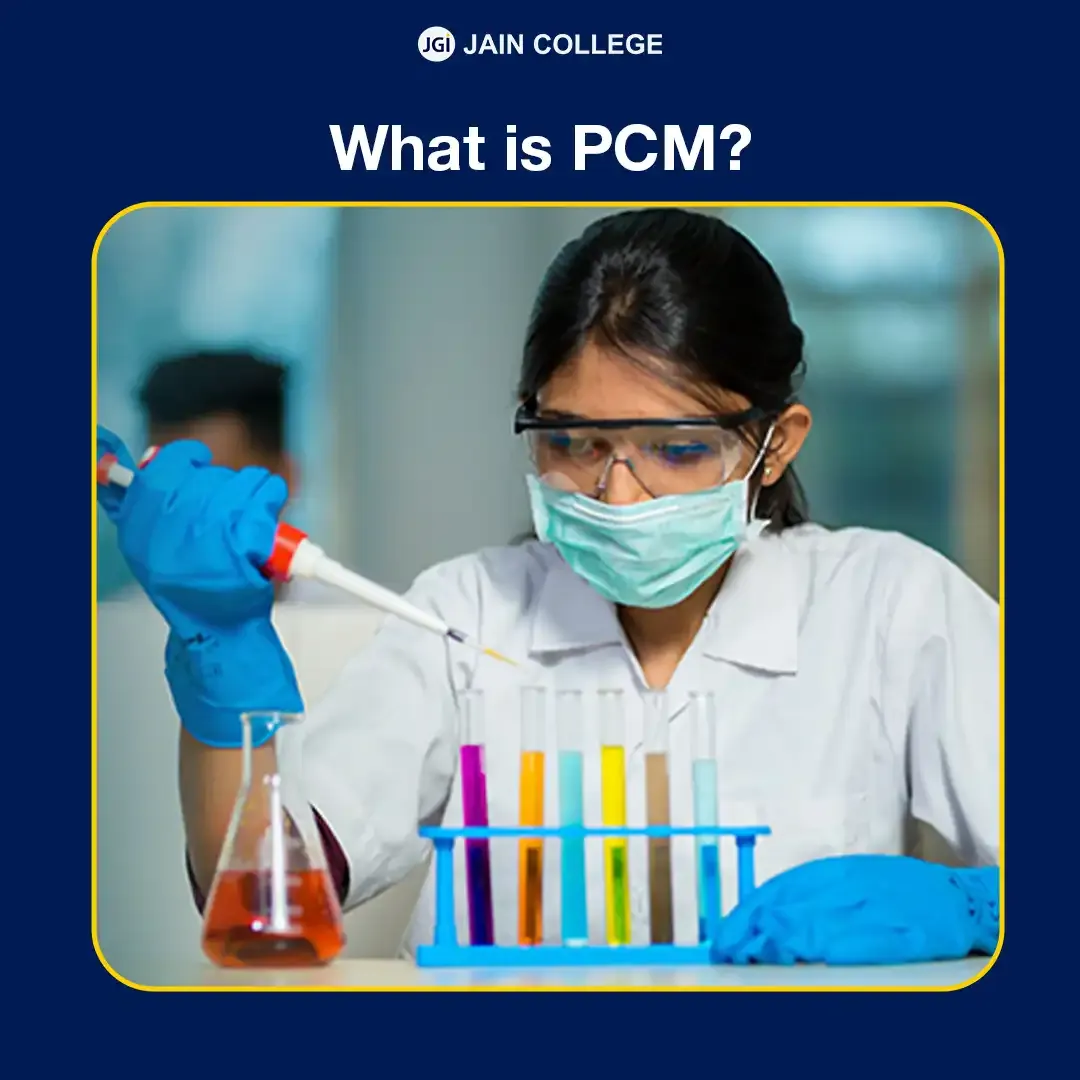
PCM: Physics, Chemistry, Mathematics.
Preparing for an entrance exam after PCM requires students to follow a structured approach, such as:
The PCM stream is one of the most commonly preferred subject combinations after Class 10. It includes three core subjects: Physics, Chemistry, and Mathematics.
Students often choose the PCM combination in their Class 11, who are:
The PCM core subjects, Physics, Chemistry, and Mathematics, serve as the foundation for a wide range of professional careers such as architecture, applied sciences, AI/ML engineering, aerospace, computer science, data science, engineering, robotics, and more.
Choosing PCM in Class 11 helps build a strong base for higher education and careers in engineering, architecture, data science, and related fields. The science stream with Physics, Chemistry, and Mathematics (PCM) as subject combinations is thought to be the basis for most careers that offer growth, new ideas, and high pay.
With increased digital transformation, fields like Computer Science and Information Technology have become the best career options after 12th Science PCM.
After completing 12th PCM, there are several promising career options beyond engineering.
JAIN PU College, recognised as one of the top integrated PU colleges in Bangalore for JEE preparation, offers a structured learning environment that supports student achievement.
In collaboration with ALLEN JEE Coaching, the college provides access to modern laboratories, well-equipped classrooms, and a comprehensive library to support effective JEE preparation.
These exams serve as a pathway for admission to top educational institutions to assess a student's knowledge, skills, and aptitude for a particular course.
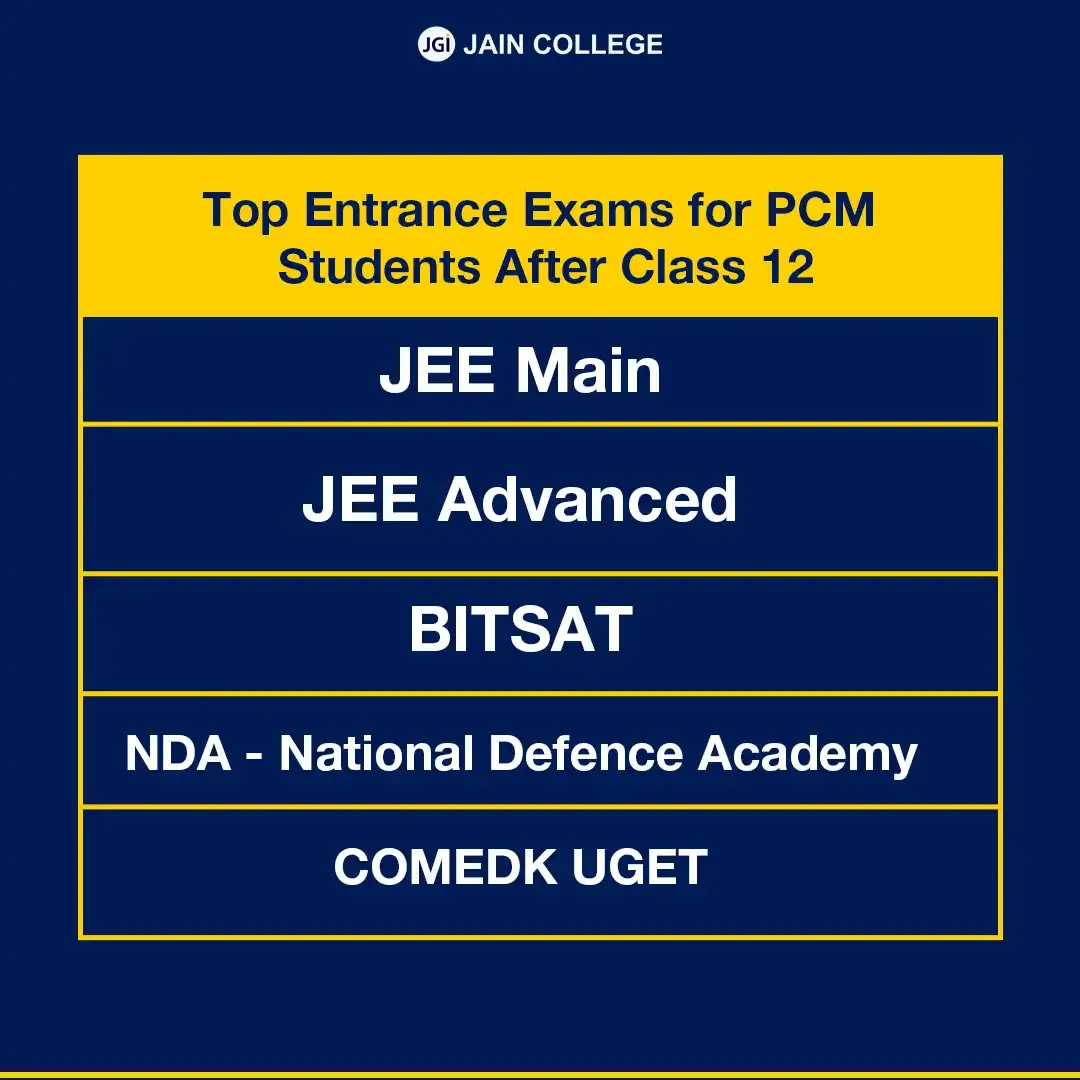
After successful completion of class 12 with the PCM combination, students can apply for several entrance exams to pursue higher education and careers in engineering and other related career fields.
Here are the top PCM entrance exams available after the Class 12 PCM:
| Mode of Examination: | Online |
| Time Duration: | 180 Minutes |
| Subjects: | Physics, Chemistry, and Mathematics (equal weightage) |
| Test Pattern: | 90 Questions (Students should attempt 75) |
| Question Types | 20 MCQs and 5 Numerical Types (from each subject) |
| Total Marks: | 300 |
| Tentative Schedule | Examination Dates: Multiple dates in January and April Application Forms Released: Mid-December (Session 1) and February (Session 2) Last Date for Form Submission: 2nd week of January and March |
| Mode of Examination: | Online (Computer-Based Test) |
|---|---|
| Time Duration: | 180 Minutes per paper |
| Subjects: | Physics, Chemistry, and Mathematics (equal weightage) |
| Test Pattern: | Total Questions: 10251 questions per paper (Paper 1 and Paper 2) |
| Question Types | Matching-Type QuestionsNumerical Value QuestionsMultiple Choice Questions (MCQs) |
| Total Marks: | 360 (180 per paper) |
| Tentative Schedule | Examination Date: 1st week of June Application Forms Released: Last week of April Last Date for Form Submission: 1st week of May |
| Mode of Examination: | Online (Computer-Based Test) |
| Time Duration: | 180 Minutes |
| Subjects: | Physics, Chemistry, Mathematics, English Proficiency and Logical Reasoning |
| Test Pattern: | 130 (Core Questions) |
| Question Types | Multiple Choice Questions (MCQs) |
| Total Marks: | 390 (Core) |
| Distribution of Questions and Marks | Physics: 30 questions–90 marks.Chemistry: 30 Questions – 90 Marks.English Proficiency: 10 Questions – 30 Marks.Logical Reasoning: 20 Questions – 60 marks.Mathematics: 40 Questions – 120 Marks. |
| Tentative Schedule | Application Forms Released: Last week of January Last Date for Application: April & June (session-wise) Examination Dates: 4th week of May & 3rd week of June |
| Mode of Examination: | Offline (Pen-and-Paper/OMR based) |
| Time Duration: | 5 hours (2.5 hours per paper) |
| Subjects: | Mathematics and General Ability Test (GAT includes English, Physics, Chemistry, History, Geography, and General Science) |
| Question Types | Multiple Choice Questions (MCQs) |
| Total Marks: | 900 |
| Distribution of Questions and Marks | Paper I - Mathematics - 2.5 Hours, 300 MarksPaper II - General Ability Test (GAT): 2.5 Hours — 600 MarksTotal: 5 Hours, 900 Marks. |
| Tentative Schedule | Application Forms Released: Last week of December & third week of May Last Date for Application: Second week of January & second week of June Examination Dates: Second week of April & first week of September |
| Mode of Examination: | Online (Computer-Based Test) |
| Time Duration: | 180 Minutes |
| Subjects: | Physics, Chemistry, Mathematics |
| Test Pattern: | 130 Core Questions12 Optional Bonus Questions |
| Question Types | Multiple Choice Questions (MCQs), |
| Total Marks: | 390 (Core) + 36 (Bonus) = 426 Maximum |
| Tentative Schedule | Application Forms Released: Last week of January Last Date for Application: April & June Examination Dates:4th week of May & 3rd week of June |
*Note: The number of questions, date and marks allotment may vary each year as per the official notification.
This is the list of the top entrance exams after the PCM for Engineering course.
Besides these entrance examinations, there are other state-level and University entrance examinations for admission into various undergraduate engineering programmes.
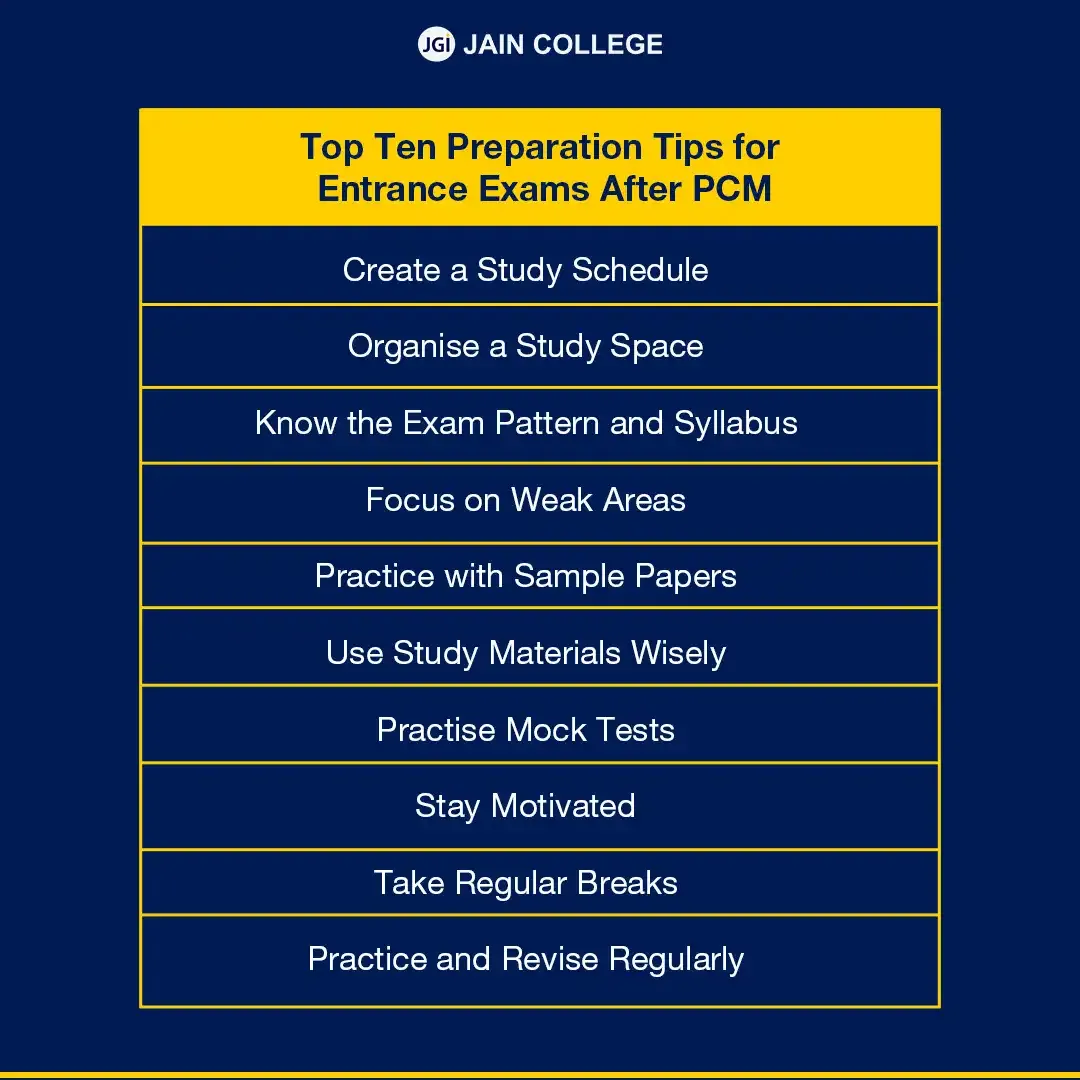
Entrance examinations are conducted by many central agencies, state-level authorities and other independent universities to ensure that only the most deserving students secure admission to the institution of their choice.
To maximise studying time and enhance their understanding of subjects, students need effective and efficient study techniques.
Here are some important techniques to consider:
Active Learning
Active recall is a unique form of retrieval practice that focuses on prompting one's memory, rather than merely absorbing information. The active learning engagement is superior for retention and understanding. This method involves students engaging themselves by taking notes, summarising concepts and applying the learned concepts to real-life examples and more.
Mnemonics
Mnemonics are memory tools that can help students to retain complex information
Mnemonics help students remember the mathematical sequences, chemistry reactions, mechanisms, reagents, and conditions accurately. This technique helps in:
Flashcards
Flashcards are the most effective way for motivated learners to study and retain factual knowledge. This technique helps students memorise formulas quickly and efficiently. Flashcards can also be used for quick revisions or last-minute revision strategies.
Visualisation
Visualisation plays a key role in successful entrance exams. This powerful mental technique helps students to recall topics more easily. Drawing flowcharts, conceptual diagrams and graphs are examples of visualisation for effective long-term memory.
However, with the right approach and strategy, students can ace any entrance exams after the Class 12 PCM.
After Class 12 PCM, students gain limitless career possibilities, from technology and architecture to research and defence.
Choosing the right entrance exam is the first step toward achieving the dream.
Whether students aim to innovate at IITs, are passionate about serving the nation, or aspire to build successful careers in technology, success begins with preparation and confidence.
Stay focused, plan ahead, and take one step toward long-term success.
Stay tuned to JAIN PU College and learn more preparation tips, study plans and resources to ensure success in the competitive landscape.
Which entrance exam are you currently preparing for after choosing PCM?
Share your thoughts in the comments below.
Yes. The negative marking in the BITSAT is -1 for every incorrect answer.
Yes. There is negative marking for every incorrect answer in the NDA examination.
The difficulty is mainly due to the competition and syllabus depth.
Yes. NDA (National Defence Academy) is a Government competitive exam. This entrance examination is conducted by UPSC – Union Public Service Commission
The Birla Institute of Technology and Science Admission Test (BITSAT) is a university-level entrance exam for admission to undergraduate engineering programmes at BITS Pilani and its various campuses.

JAIN PU College, a part of the renowned JGI Group, is committed to empowering students with quality education.
Beyond academics, the college ensures its online content reflects the same standard of excellence. Every blog and article is meticulously vetted and proofread by subject matter experts to ensure accuracy, relevance, and clarity. From insightful educational topics to engaging discussions, JAIN PU College's content is crafted to inform, inspire, and add value to its readers, reflecting the institution's commitment to intellectual growth and innovation.
View all Blogs