








Chemistry did not develop into a science overnight. It was created step by step gradually as scientists began to study matter and the changes it undergoes through experiments and careful observation.
In earlier times, scientists mostly relied on traditional beliefs and assumptions to explain how substances changed from one form to another. There was not much scientific evidence to back up these explanations. This situation began to change slowly as scientists began to test ideas with experiments and carefully made notes of what they saw.
One among the renowned scientists who was instrumental in this change was Antoine Lavoisier. He brought accurate measurements and systematic experiments into chemistry. This made the subject more reliable and scientific.
His work is often cited as the reason for Lavoisier being called the Father of Chemistry. His work also led to what is known as the ‘chemical revolution', where chemistry became a more organised and quantitative branch of science.
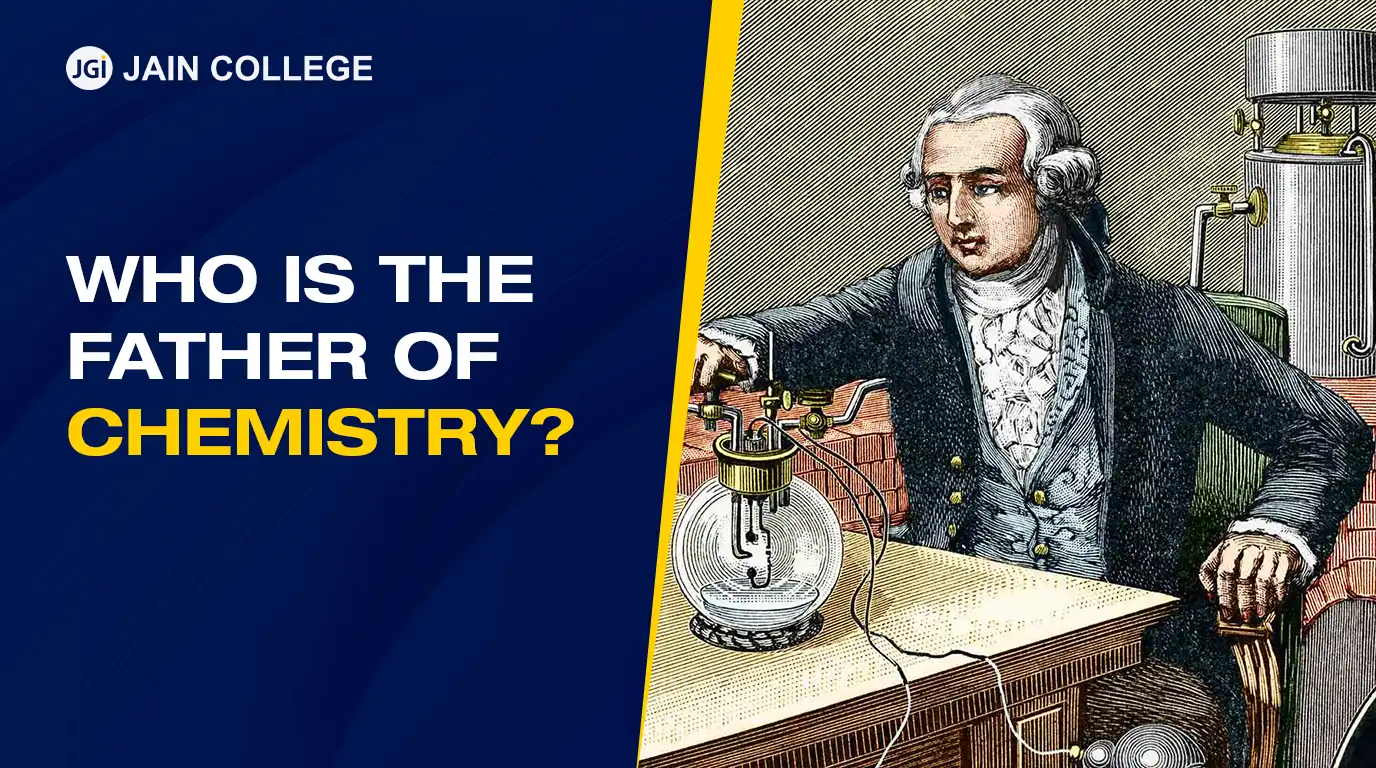
Antoine Lavoisier is widely recognised as the Father of Chemistry for establishing the fundamental principles that shaped modern chemical science and for introducing systematic experimental methods into the field.
Antoine Lavoisier drove the “chemical revolution” by making chemistry quantitative.
| Key Scientific Contributions:Conservation of massWater as a compoundOxygen’s role in combustionHe helped modernise chemical nomenclature and published a landmark textbook in 1789. |
Let us explore the story of Antoine-Laurent Lavoisier- An influential figure in the history of chemistry and pioneering experiments to his revolutionary theories.
Science can be viewed as a continuing human effort to systematise knowledge for describing and understanding nature.
Many of us encounter various natural substances and observe changes in them in our daily lives. We often come across changes such as curd formation from milk, vinegar formation from sugarcane juice after prolonged storage, and the rusting of iron.
For the sake of convenience, science is subdivided into various disciplines: Chemistry, Physics, Biology, Geology, etc.
The branch of science that studies the preparation, properties, structure and reactions of material substances is called Chemistry.
Chemistry is the science of molecules and their transformations. It is the science not of the one hundred elements but of the infinite variety of molecules made from them.
Antoine Lavoisier (1743–1794), a French nobleman, is considered the father of modern chemistry for transforming it into a quantitative science.
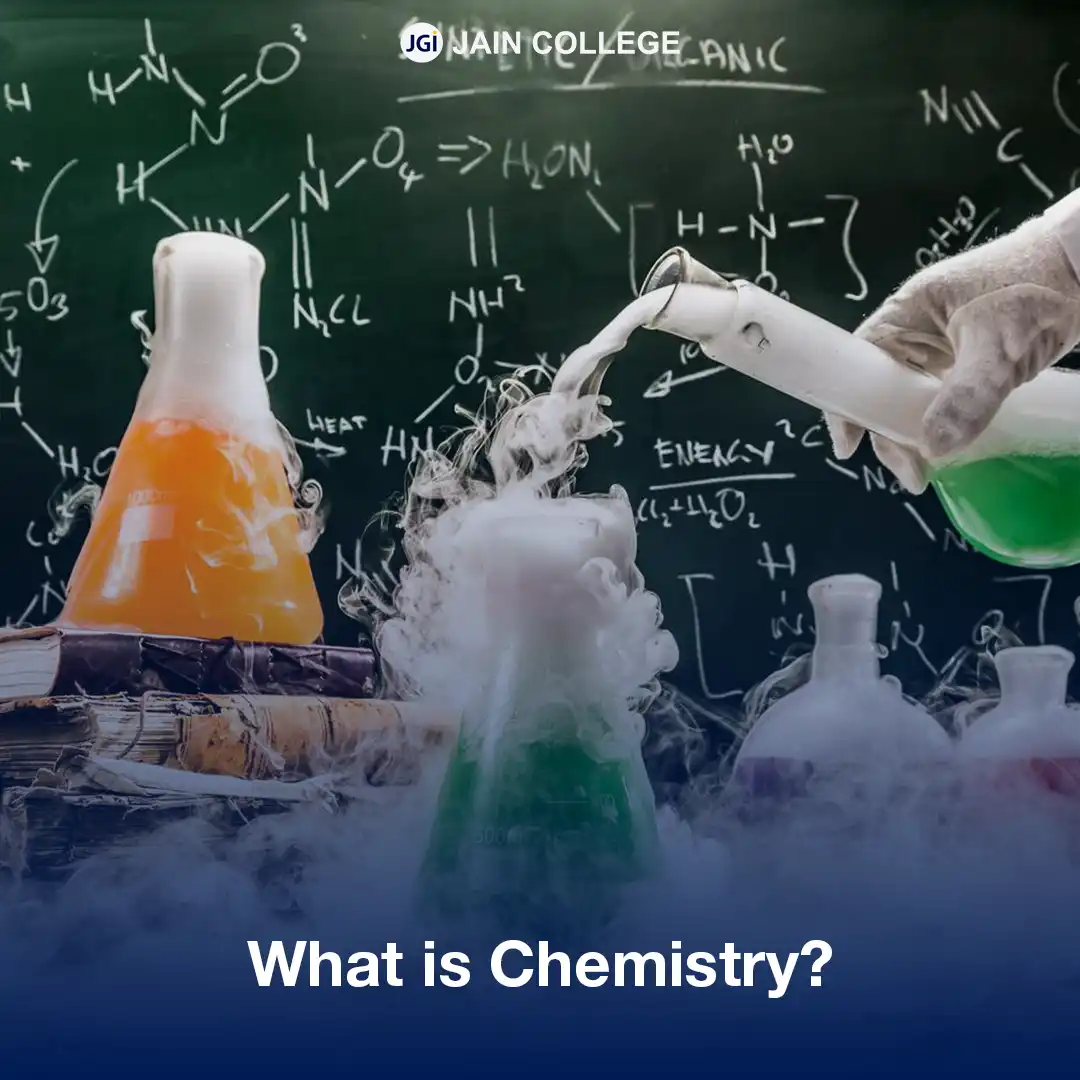
In simple terms, Chemistry is everywhere and contributes to everyone’s daily life. Anything that can be touched, tasted, smelt, seen or felt is made of chemicals.
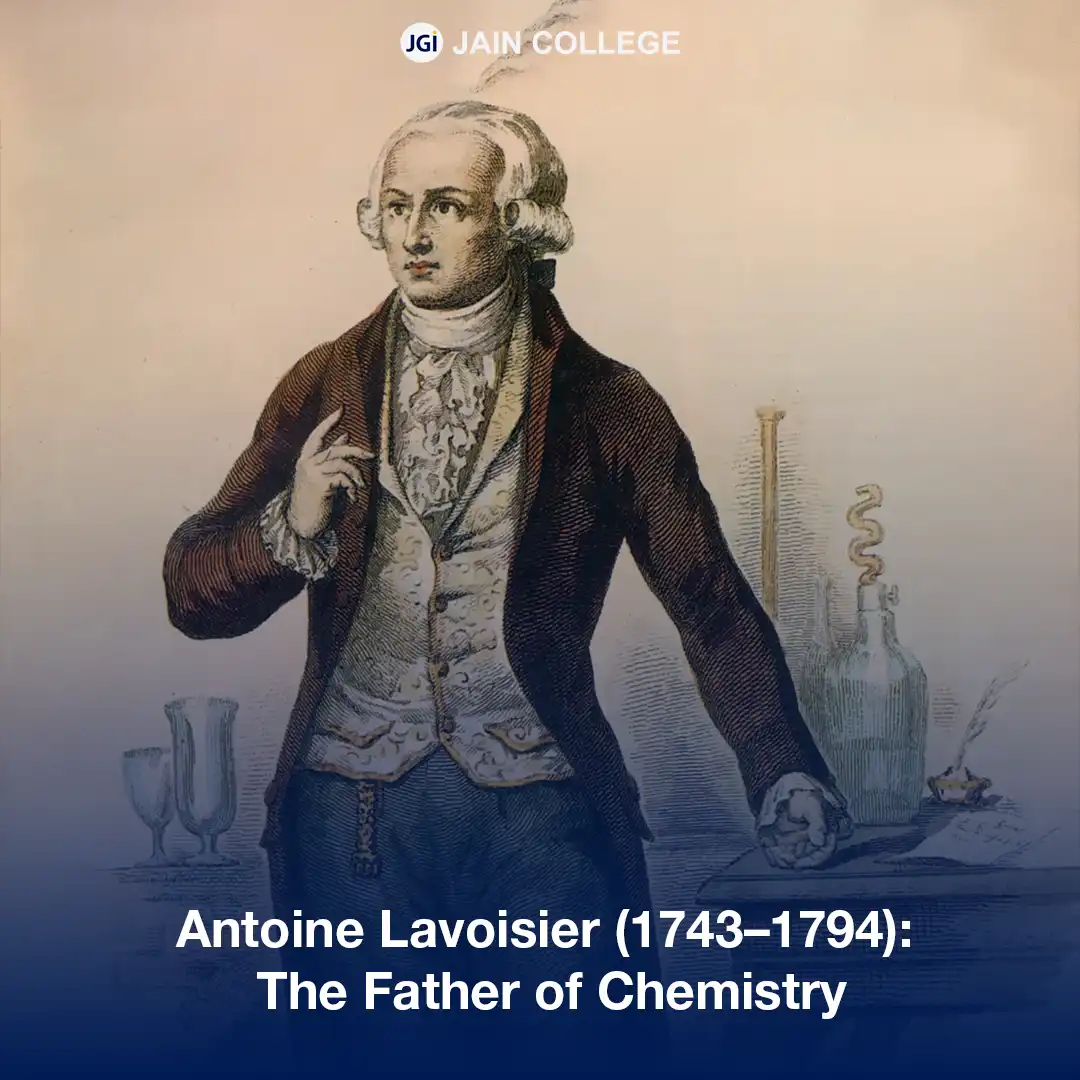
Antoine Lavoisier (1743–1794) is widely recognised as the Father of Modern Chemistry.
He was an 18th-century chemist who transformed chemistry into a measurement-based science by:
Proving the law of conservation of mass
Explaining combustion through oxygen and
Helping create a standard system for naming chemical substances.
Antoine Lavoisier was an influential French chemist who discovered the role of oxygen in combustion and respiration, proved the law of conservation of mass, and reformed chemical nomenclature.
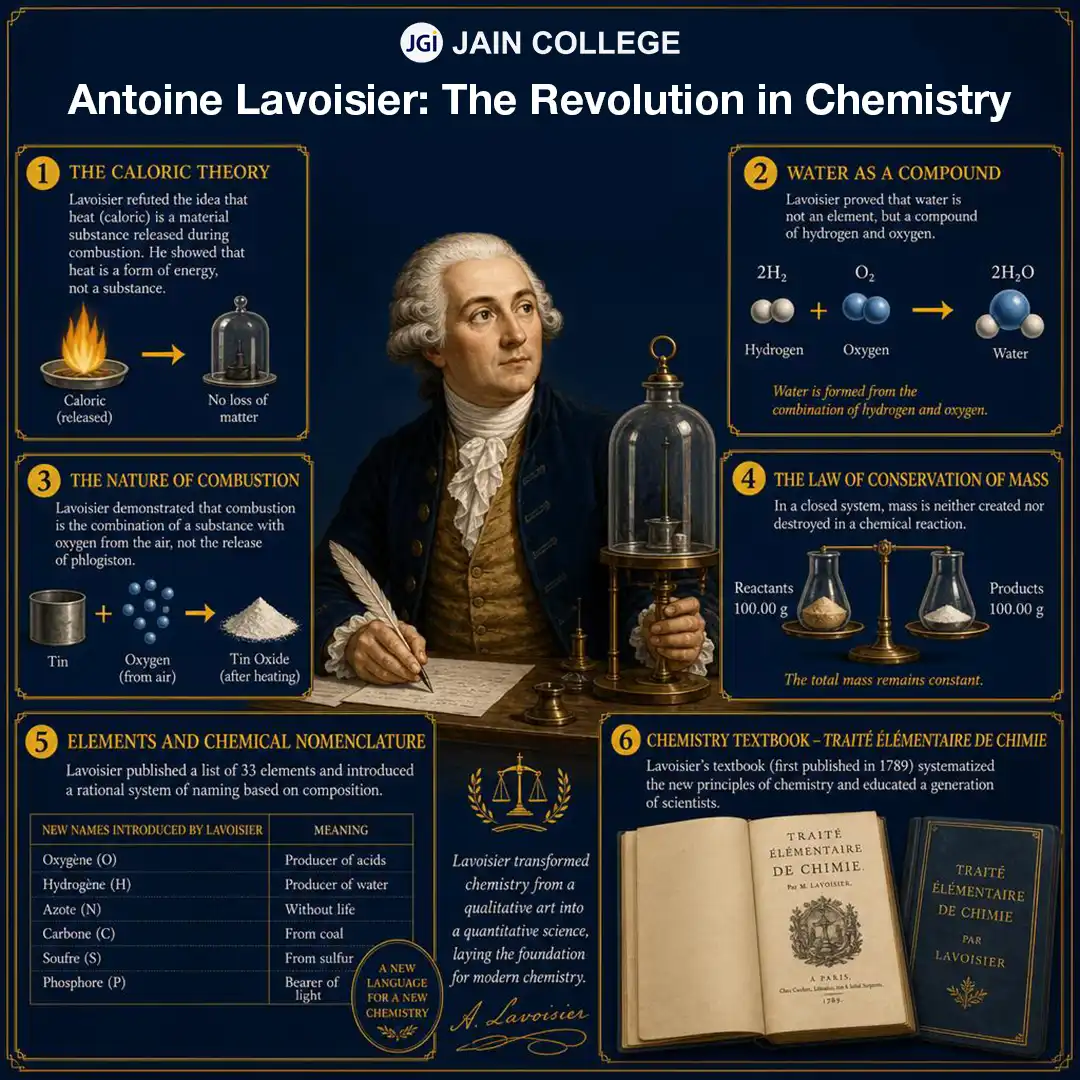
Lavoisier is to the science of chemistry what Newton is to physics.
Antoine-Laurent de Lavoisier, an 18th-century French chemist, is widely known as the Father of Modern Chemistry.
Antoine Lavoisier played a major role in transforming chemistry into a systematic scientific discipline through careful experimentation and quantitative analysis.
He conducted numerous experiments that debunked the phlogiston theory and demonstrated the role of oxygen in combustion. His research improved the understanding of chemical reactions and introduced methods that influenced the future development of chemistry.
Antoine Lavoisier is often referred to as the 'Father of Modern Chemistry' due to his pioneering work in the field. His contributions laid the foundation for the chemical revolution, transforming chemistry into a systematic science.
Some of his discoveries include:
Law of Conservation of Mass This law was put forth by Antoine Lavoisier in 1789
He performed careful experimental studies on combustion reactions and reached the conclusion that in all physical and chemical changes, there is no net change in mass during the process.
Thus, he reached the conclusion that matter can neither be created nor destroyed.
This principle is called the ‘Law of Conservation of Mass’, which formed the basis for several later developments in chemistry.
In fact, this was the result of exact measurement of masses of reactants and products, and carefully planned experiments performed by Lavoisier
Lavoisier's contributions to chemistry earned him a prominent place in scientific history, with many of his principles still taught in classrooms today. Various awards and institutions named in his honour celebrate his legacy and reflect his lasting impact on the field.
Here is a list of contributions from several important chemists and scientists, along with their significant scientific discoveries and advances in chemistry.
Famous chemists and their contributions:
| Chemist | Field / Discovery | Contribution |
|---|---|---|
| Dmitri Mendeleev | Periodic Classification | Created the periodic table of elements |
| John Dalton | Atomic Theory | Proposed the atomic theory of matter |
| J. J. Thomson | Atomic Structure | Discovered the electron |
| Ernest Rutherford | Nuclear Physics | Discovered the nucleus and proposed the nuclear model of the atom |
| Marie Curie | Radioactivity | Researched radioactivity; discovered radium and polonium |
| Niels Bohr | Atomic Structure | Developed the Bohr model of the atom |
| Robert Boyle | Gas Laws | Formulated Boyle’s Law relating pressure and volume of gases |
| Amedeo Avogadro | Molecular Chemistry | Proposed Avogadro’s Law |
| Joseph Priestley | Gases | Discovered oxygen independently |
| Henry Cavendish | Gases | Discovered hydrogen |
| Svante Arrhenius | Physical Chemistry | Developed the theory of ionisation |
| Gilbert N. Lewis | Chemical Bonding | Introduced electron pair bonding and Lewis structures |
| Linus Pauling | Quantum Chemistry | Worked on chemical bonding and molecular structure |
| Friedrich Wöhler | Organic Chemistry | Synthesised urea, disproving vitalism |
| Louis Pasteur | Biochemistry | Developed pasteurisation and studied fermentation |
| Alfred Nobel | Explosives | Invented dynamite and established the Nobel Prize |
| Rosalind Franklin | Biochemistry | Contributed to discovering the DNA structure |
| Ahmed Zewail | Physical Chemistry | Founder of femtochemistry |
| Asima Chatterjee | Organic Chemistry | Research on medicinal plants and anti-malarial drugs |
| Prafulla Chandra Ray | Chemical research | Founder of Bengal Chemicals; pioneer of chemical education in India |
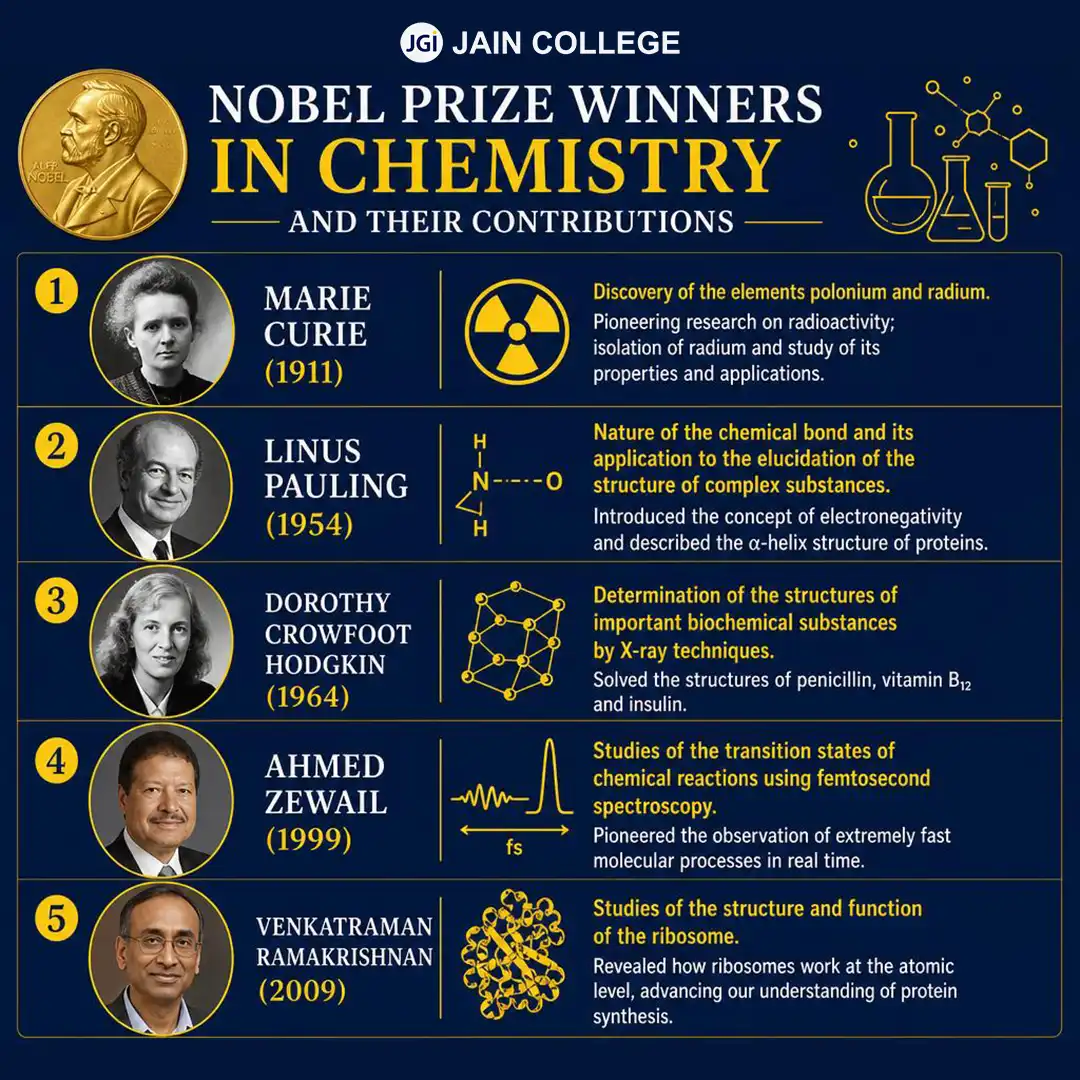
The Nobel Prize in Chemistry was established because chemistry was the most important science for Alfred Nobel’s own work. The development of his inventions, as well as the industrial processes he employed, was based upon chemical knowledge.
Chemistry was the second prize area that Nobel mentioned in his will.
Over the years, chemists from different countries have received the Nobel Prize for achievements in areas such as molecular science, biochemistry, materials science, medicine, and environmental chemistry. The award continues to represent one of the highest recognitions in the scientific community.
Some notable Nobel Prize winners in Chemistry include:
| Scientist | Contribution |
| Marie Curie | In 1911, Marie Curie was awarded the Nobel Prize in Chemistry for her services to the advancement of chemistry by the discovery of the elements radium and polonium, by the isolation of radium and the study of the nature and compounds of this remarkable element |
| Linus Pauling | In 1954, Linus Pauling was awarded the Nobel Prize in Chemistry for his research into the nature of the chemical bond and its application to the elucidation of the structure of complex substances |
| Ahmed Zewail | In 1999, Ahmed Zewail was awarded Nobel Prize in Chemistry, for his studies of the transition states of chemical reactions using femtosecond spectroscopy |
| Venkatraman Ramakrishnan | In 2009, Venkatraman Ramakrishnan shared the Nobel Prize in Chemistry Thomas A. Steitz and Ada E. Yonath "for studies of the structure and function of the ribosome" |
| Dorothy Crowfoot Hodgkin | In 1964, Dorothy Crowfoot Hodgkin was awarded Nobel Prize in Chemistry, for her determinations by X-ray techniques of the structures of important biochemical substances |
Quick Summary:
Antoine Lavoisier is often referred to as the Father of Modern Chemistry due to his revolutionary approach to chemical reactions and the law of conservation of mass. His research and meticulous experiments:
For more information about the renowned scientists, chemists, literary figures, notable personalities, and Kannada Jnanapeetha award winners, explore the educational resources and blogs available on the JAIN PU College website.
Which renowned scientists and researchers inspire you the most?
Share your thoughts in the comments below.
Many educational references identify Acharya Prafulla Chandra Ray as the “Father of Chemistry in India” because of his impact on chemical education and industry.
In most general contexts, people use both titles for Antoine Lavoisier because his methods transformed chemistry into a modern science based on measurement.
Chemistry is the study of matter, its structure and properties. It also deals with how different forms of matter interact and change states.
Russian chemist Dmitri Mendeleev – the author of the first modern periodic table of elements and interchemical transformations.
There are five major branches of chemistry, each with several areas of study.
Biochemistry
Organic chemistry
Physical chemistry
Inorganic chemistry
Analytical chemistry
Marie Curie was the first woman laureate to win Nobel Prizes in Chemistry, for her discovery of radium and polonium.
The oldest Nobel Prize laureate in chemistry to date is John B. Goodenough. He was 97 years old when he was awarded the chemistry prize in 2019.
The youngest Nobel Prize laureate in chemistry is Frédéric Joliot. He was 35 years old when he was awarded the chemistry prize in 1935, together with his wife, Irène Joliot-Curie.
Benzene, the cornerstone of aromatic organic molecules, was discovered by an English chemist, Michael Faraday.
Lorenzo Romano Amedeo Carlo Avogadro was an Italian scientist who is most noted for his contribution to molecular theory now known as Avogadro's law, relating amounts of gases to moles.
Antoine Lavoisier is called the Father of Modern Chemistry because of the following:
On 11 April 1865, Louis Pasteur obtained a patent that offered a means to get rid of the contaminating bacteria by heating the wines at 64°C for 30 min. This process was later adapted for other products and was called pasteurisation.

JAIN PU College, a part of the renowned JGI Group, is committed to empowering students with quality education.
Beyond academics, the college ensures its online content reflects the same standard of excellence. Every blog and article is meticulously vetted and proofread by subject matter experts to ensure accuracy, relevance, and clarity. From insightful educational topics to engaging discussions, JAIN PU College's content is crafted to inform, inspire, and add value to its readers, reflecting the institution's commitment to intellectual growth and innovation.
View all Blogs
