






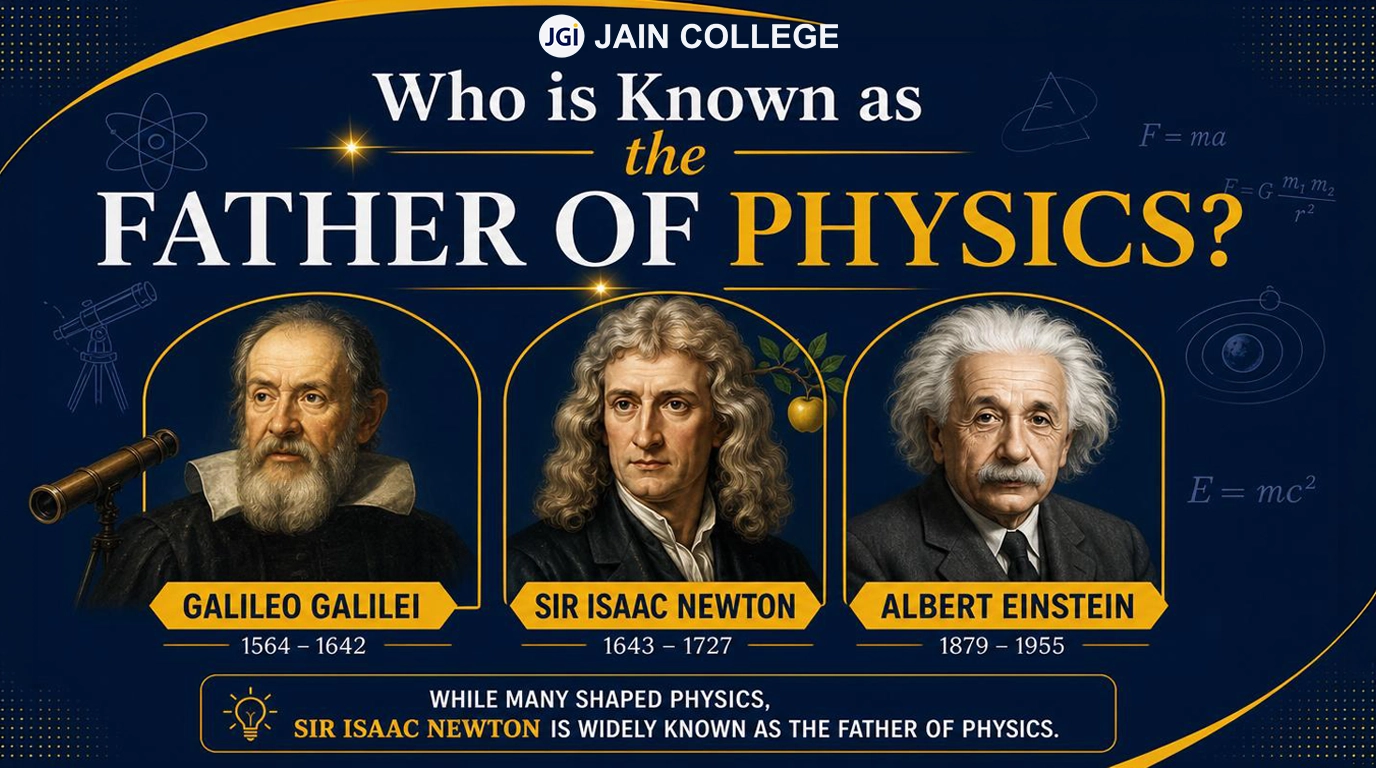
The title “Father of Physics” is, therefore, not attributed to a single individual.
The title "Father of Physics" is often given to Isaac Newton
Newton’s discoveries laid the foundation for classical physics. This designation is because of his major role in developing the basic laws of motion and gravity. His work helped people understand how objects move and interact in the physical world.
However, in modern times, Albert Einstein is also called the Father of Modern Physics because of his famous theory of relativity, which changed how we understand time, space, and energy.
Both scientists made giant contributions that shaped the way we study and understand the physical universe today.
Sir C.V. Raman is widely regarded as the "Father of Physics in India" and the "Father of Modern Indian Physics".
Table of Contents
Even though the title “Father of Physics” has not been assigned to any single individual, it is often used to refer to a few key figures in the field.
Galileo, Isaac Newton, and Albert Einstein were pioneers who contributed much of their knowledge and efforts to studying physics and have been called the “fathers of physics” in Western cultures.
In this article, let us learn more in detail about the fathers of physics:
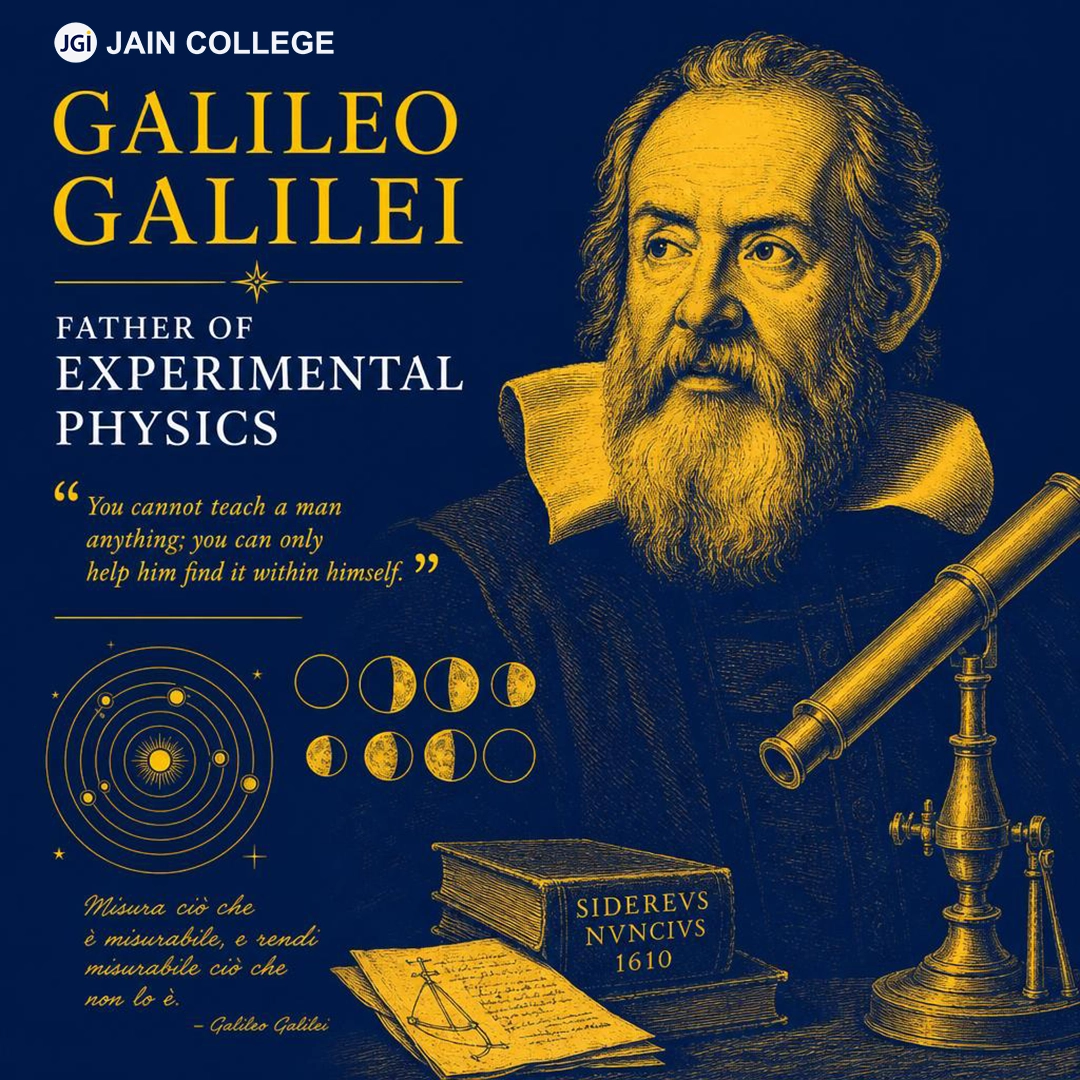
Galileo Galilei was an Italian scientist, astronomer, mathematician, physicist, philosopher, and scholar. He is widely known for his contributions to modern science and for improving the telescope used in astronomical observations.
Galileo’s discoveries were fundamental to modern physics and astronomy. In general, he made important observations of nature that have lasting implications for the study of physics.
Galileo is often called the “Father of Modern Physics” and the “Father of Observational Astronomy” due to his use of experimentation and observation.
Here is a detailed overview:
After his education, in 1589 Galileo was offered a teaching position at the University of Pisa and began tutoring students and continuing his experiments.
| Academic Career and Early Discoveries: | |
| 1589 | Appointed professor of mathematics at the University of Pisa |
| 1592 | Moves to the University of Padua; begins significant scientific work |
| 1604 | Studies motion and develops early ideas on inertia |
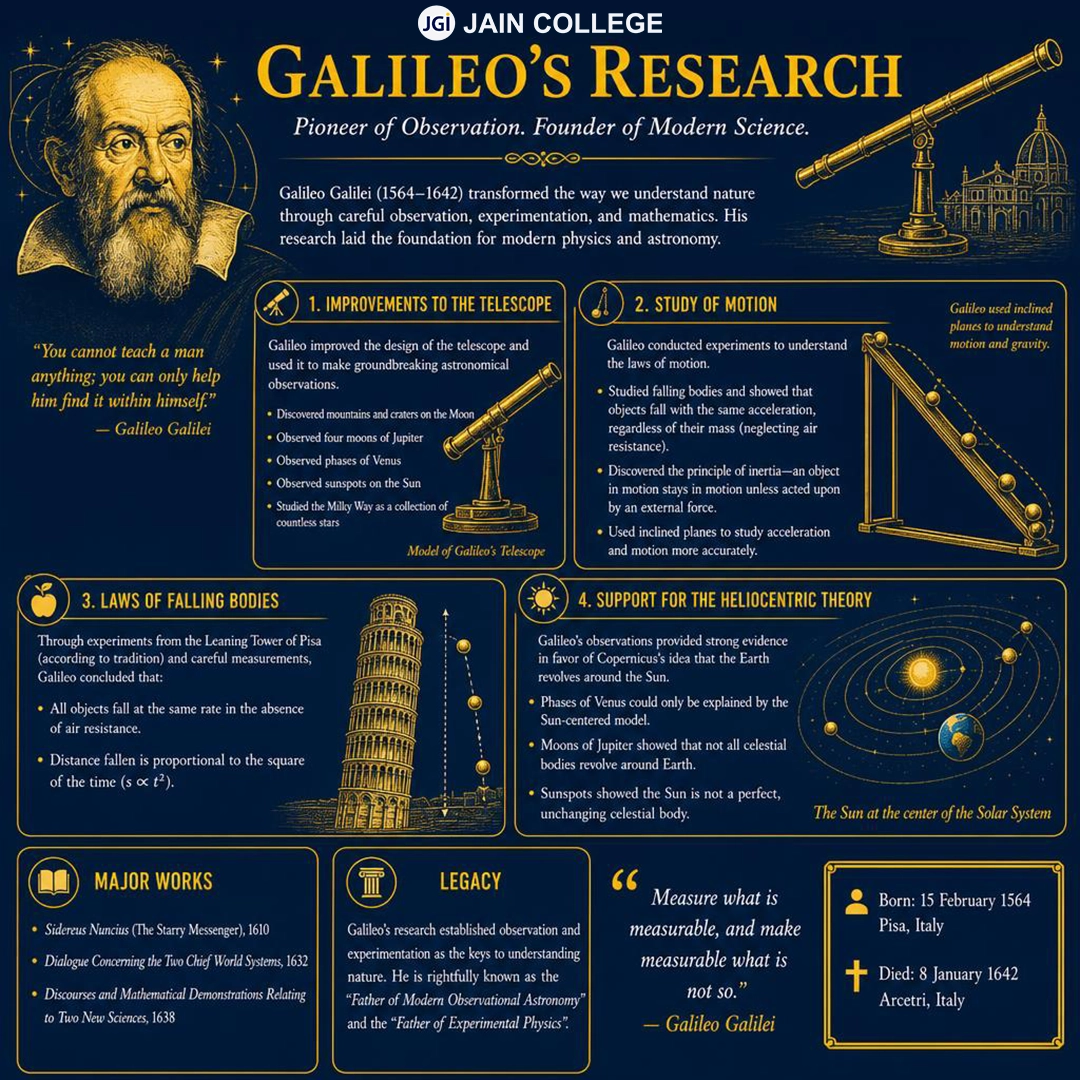
Galileo Galilei, an Italian astronomer who made several important scientific discoveries that helped overturn the prevailing geocentric view of the universe.
Through observations with his telescope, Galileo discovered mountains on the moon, that the Milky Way is made of stars, and sunspots.
He also observed the phases of Venus and moons orbiting Jupiter, which supported the heliocentric model of Copernicus. Despite scientifically proving Copernicus correct, Galileo was found guilty by the Catholic Church of breaching the 1616 Inquisition and defending the Sun-centered model, and was sentenced to house arrest for the rest of his life.
| Astronomical Breakthroughs: | |
| 1609 | Builds an improved telescope |
| 1610 | Discovers four moons of Jupiter (Io, Europa, Ganymede, Callisto) |
| 1610 | Publishes Sidereus Nuncius (Starry Messenger) |
| 1611 | Observes phases of Venus, supporting heliocentrism |
| Final Years and Legacy: | |
| 1638 | Publishes Two New Sciences, laying foundations of physics |
| 1642 | Dies in Arcetri, Italy |
In 1593, Galileo invents a water-lifting machine, a pump driven by horses. He receives a patent for the machine in 1594.
In 1597, Galileo invents a sector, a calculating instrument consisting of two equal-length rulers joined by a hinge. It was used to solve practical mathematics problems involving proportion, trigonometry, multiplication, and division.
In 1607, Galileo invents a thermoscope, a primitive thermometer that could register variations in temperature.
In early 1609 Galileo built a 3x magnification telescope based on descriptions of Hans Lipperhey’s invention the previous year. By the fall of the same year he had developed an eight-powered telescope.
Using this higher-powered telescope, in 1609, Galileo was the first to observe lunar mountains and craters on Earth’s moon.
In January of 1610, Galileo discovered four satellites in orbit around Jupiter: Io, Europa, Callisto and Ganymede. Initially, he named these Medicean stars after one of his patrons.
In 1610, Galileo observed that Venus exhibited a full set of phases similar to that of the Moon. The heliocentric model of the solar system developed by Nicolaus Copernicus predicted that all phases would be visible.
In 1612, Galileo observed the Sun through his telescope and saw that the Sun had dark patches on it (what we now call sunspots). He also observed the motion of the sunspots, indicating that the Sun was rotating on an axis. There is more evidence supporting the Copernican heliocentric model of the solar system.
Galileo Galilei was an Italian physicist, mathematician, astronomer, and philosopher who played a major role in the Scientific Revolution.
Here is an overview of Galileo Galilei's life and a detailed timeline of his history
| Galileo Galilei (1564-1642) | |
| Name | Galileo Galilei |
| Date of Birth | Feb. 15, 1564 |
| Place of Birth | Pisa, Italy |
| Died On | Jan. 8, 1642 |
| Residence | Florence and Padua |
| Ethnicity | Italian |
| Fields | PhysicsAstronomyMathematicsEngineering |
| Known for | Discoveries such as:Phases of VenusMoons of JupiterImprovements to the telescopeWork on motion and falling bodiesSupport for the heliocentric model (Sun-centered system) |
| Notable Awards | None (modern award systems did not exist during his lifetime) |
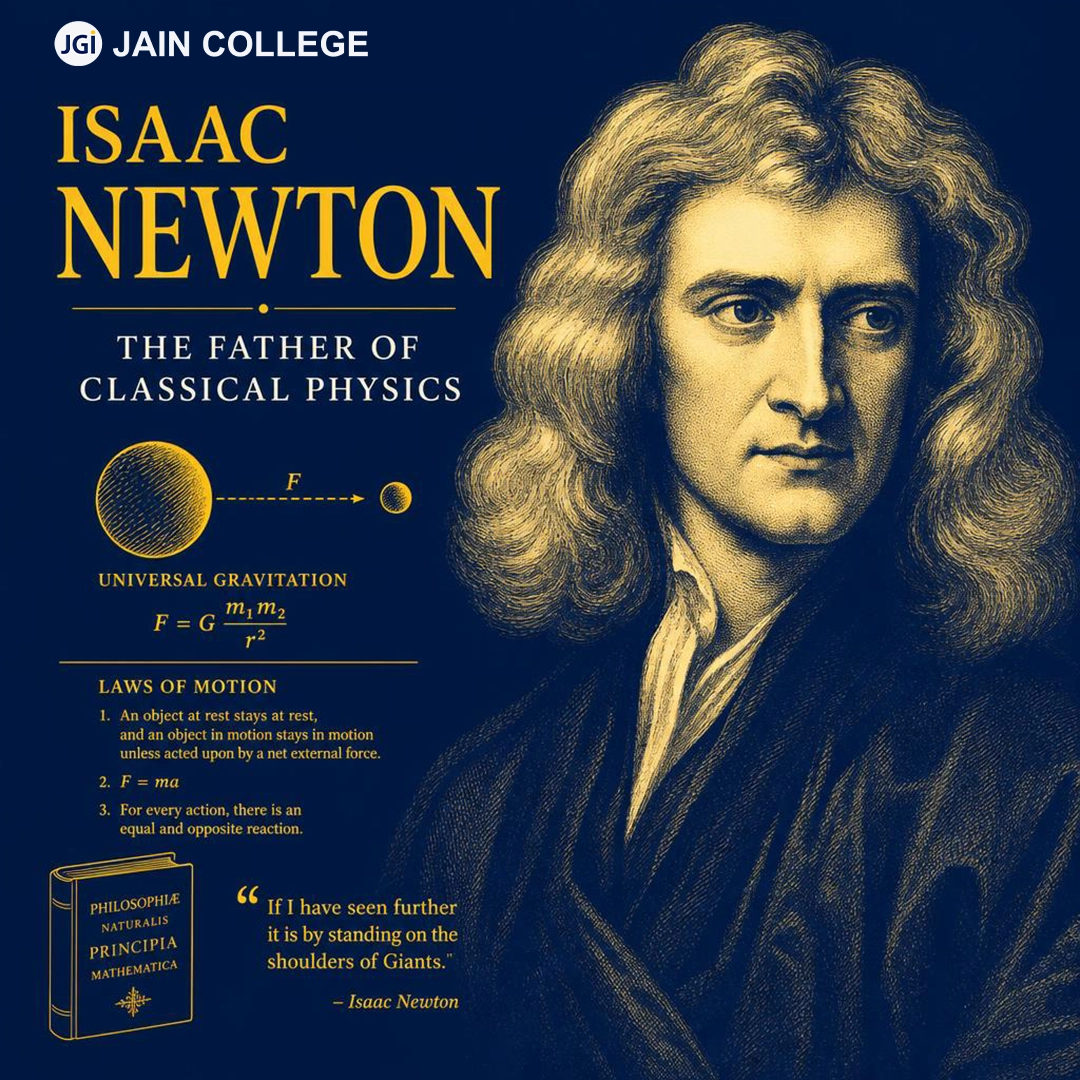
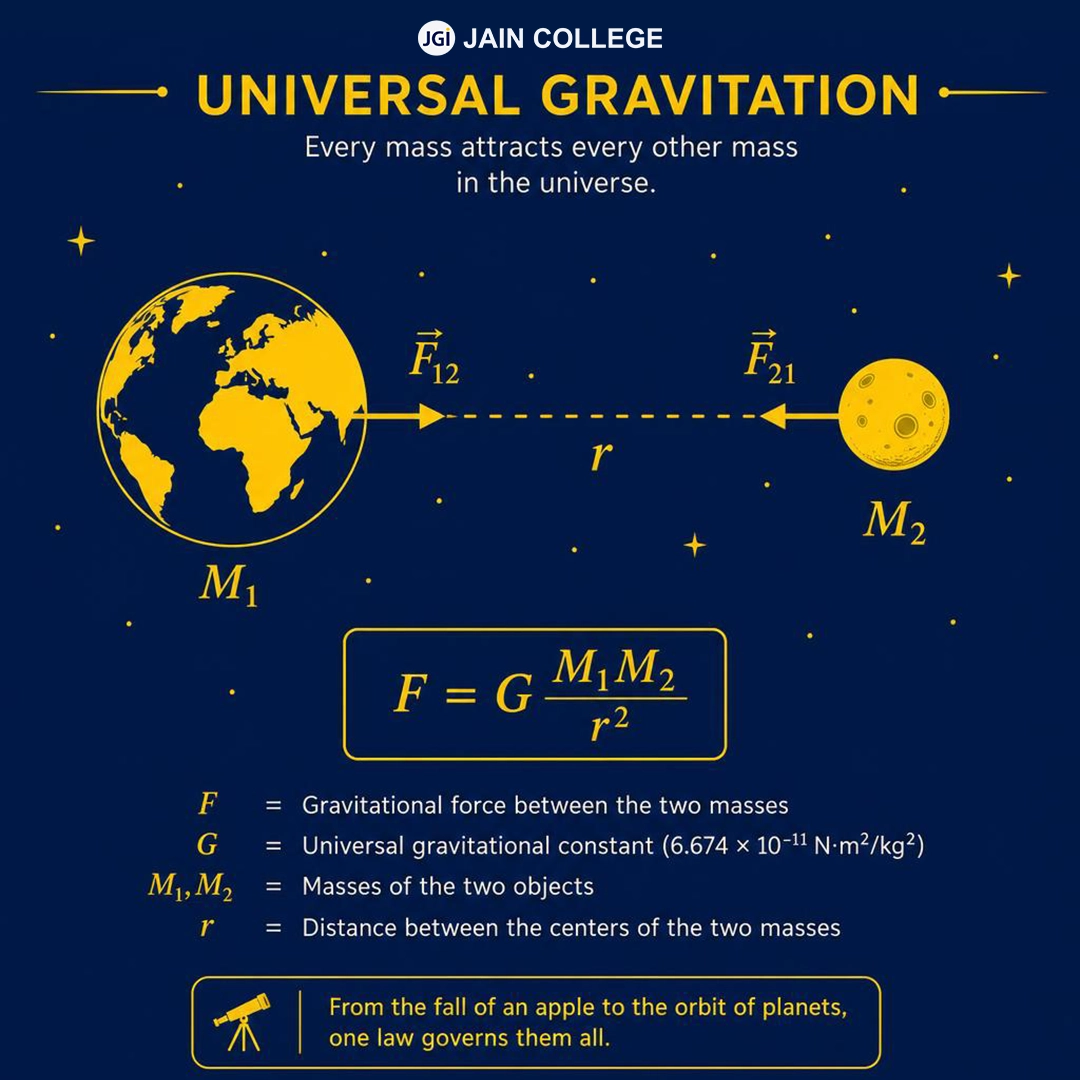
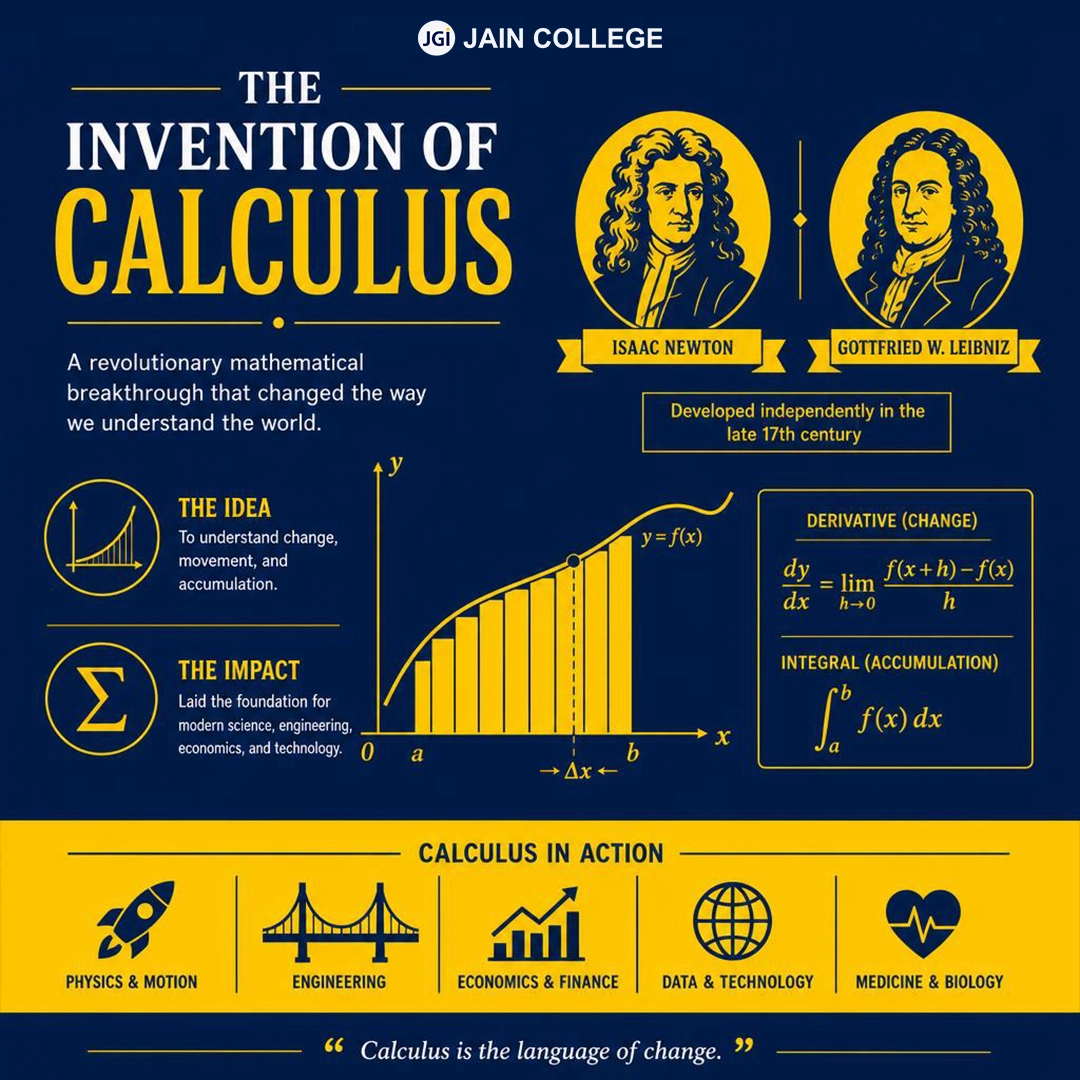
Isaac Newton is known for his laws of motion and universal gravitation. He also independently developed calculus, earning a lasting legacy in mathematics and science despite conflicts with contemporaries like Robert Hooke.
| Year | Achievements and Inventions |
| 1665–1666 | Developed early ideas on calculus, motion, and gravity during the Great Plague period |
| 1666 | Observed the falling apple, leading to ideas about gravity |
| 1668 | Built the first practical reflecting telescope |
| 1669 | Appointed Professor of Mathematics at Cambridge |
| 1672 | Published research on light and colors; became a member of the Royal Society |
| 1687 | Published Principia Mathematica, explaining laws of motion and gravitation |
| 1696 | Appointed Warden of the Royal Mint |
| 1703 | Became President of the Royal Society |
| 1705 | Knighted by Queen Anne (became “Sir Isaac Newton”) |
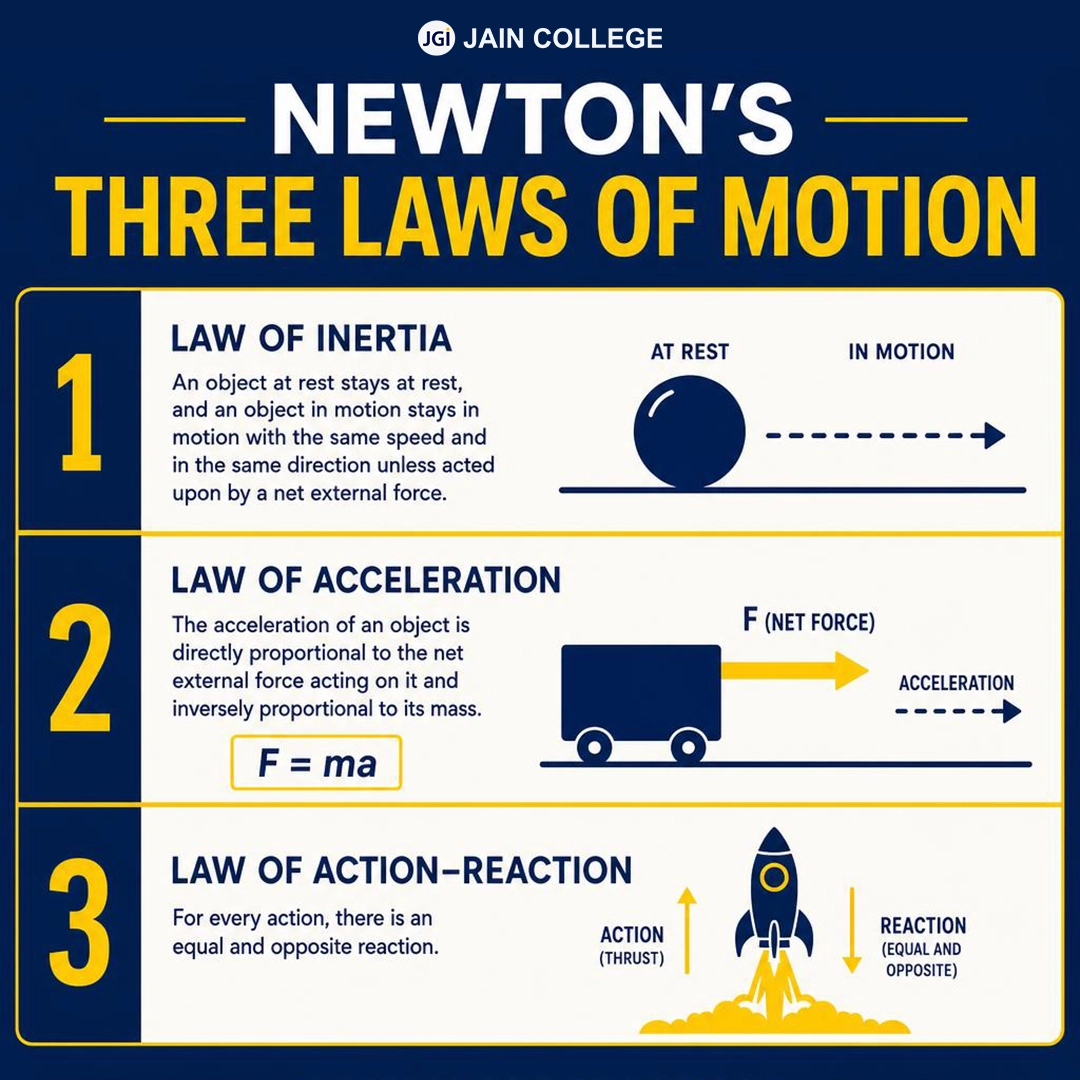
Law 1:
Every body continues in its state of rest or of uniform rectilinear motion unless compelled by forces acting on it to change that state.
Law 2:
The change in motion is proportional to the applied force and occurs in the direction of the straight line along which the force acts.
Law 3:
To every action, there is always an equal and opposite reaction.
| Newton’s first law of motion gives a definition of (zero) force and defines an inertial frameNewton’s third law of motion emphasises the conservation of momentum |
Here is an overview of Isaac Newton’s life and a detailed timeline of his history.
| Isaac Newton (1643–1727) | |
| Name | Isaac Newton |
| Date of Birth | Jan. 4, 1643 |
| Place of Birth | Woolsthorpe, England |
| Died On | Mar. 31, 1727 in London, England |
| Residence | Woolsthorpe Manor, Lincolnshire, England |
| Ethnicity | English |
| Fields | Physics, Mathematics, Astronomy, Optics & Natural Philosophy. |
| Known for | The Three Laws of MotionContributions to CalculusResearch on Light and OpticsThe Law of Universal GravitationThe invention of the Reflecting Telescope |
| Notable Awards | Knighthood by Queen Anne (1705), President of the Royal Society (1703), Lucasian Professor of Mathematics at University of Cambridge |
Isaac Newton (1643–1727) was one of the most influential scientists in history and is widely regarded as the Father of Classical Physics. His work laid the foundation for mechanics, optics, and mathematics.
He is best known for the following:
Isaac Newton's famous book, Philosophiæ Naturalis Principia Mathematica, was published in 1687. Among all his books, this one is considered one of the most important works in science.
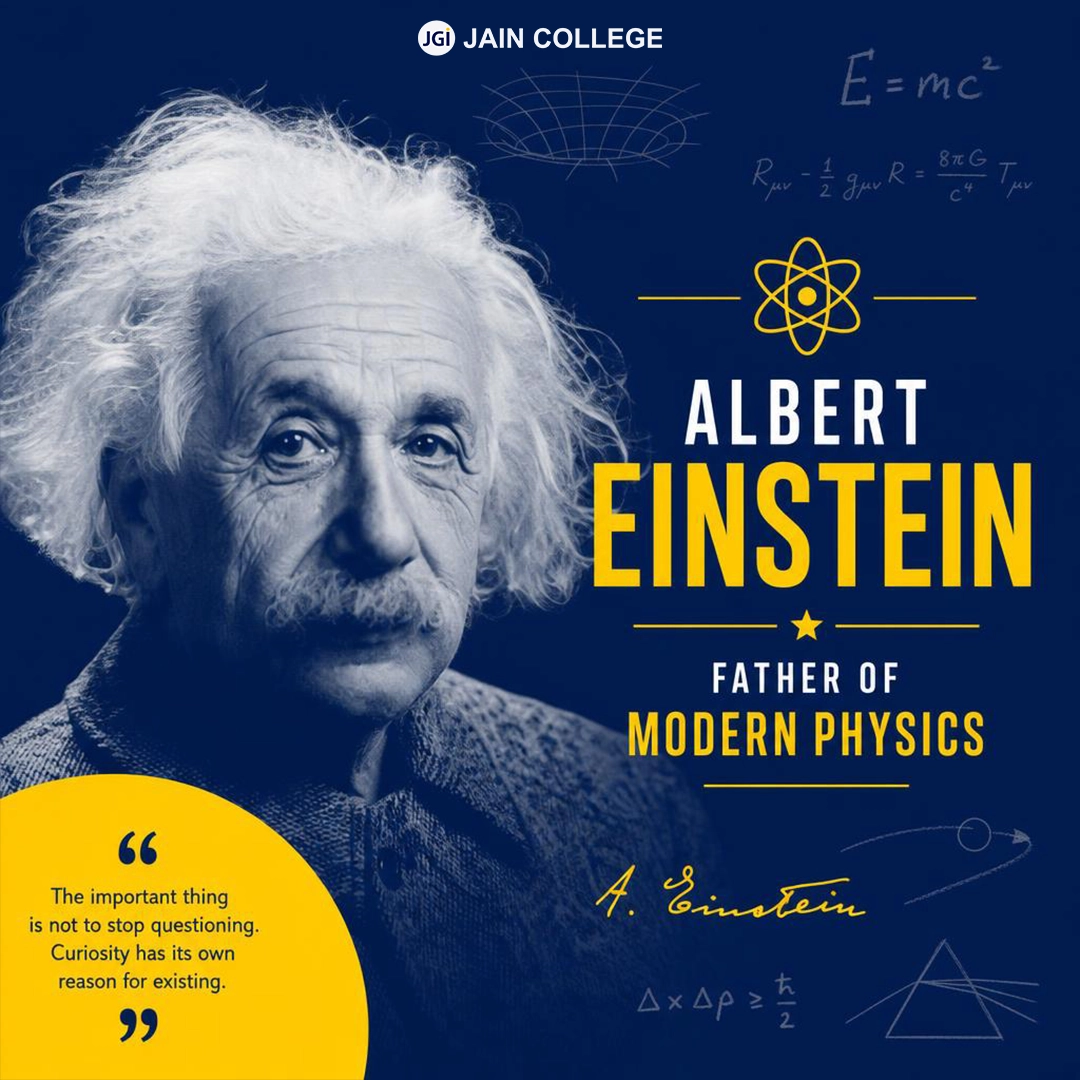
Albert Einstein was a German-born theoretical physicist and philosopher. He developed the theory of relativity, one of the pillars of modern physics. He is regarded as one of the most influential scientists of the 20th century. Einstein received the Nobel Prize in Physics in 1921 for his services to theoretical physics and especially for his discovery of the law of the photoelectric effect. He immigrated to the United States in 1933 and became an American citizen in 1940. Einstein died at the age of 76 in Princeton, New Jersey.
Albert Einstein revolutionised Physics with his theory of relativity, which transformed our understanding of space, time, and gravity. His contributions to quantum theory and the concept of energy-mass equivalence further solidified his status as one of the most influential physicists in history.
Here is a detailed overview:
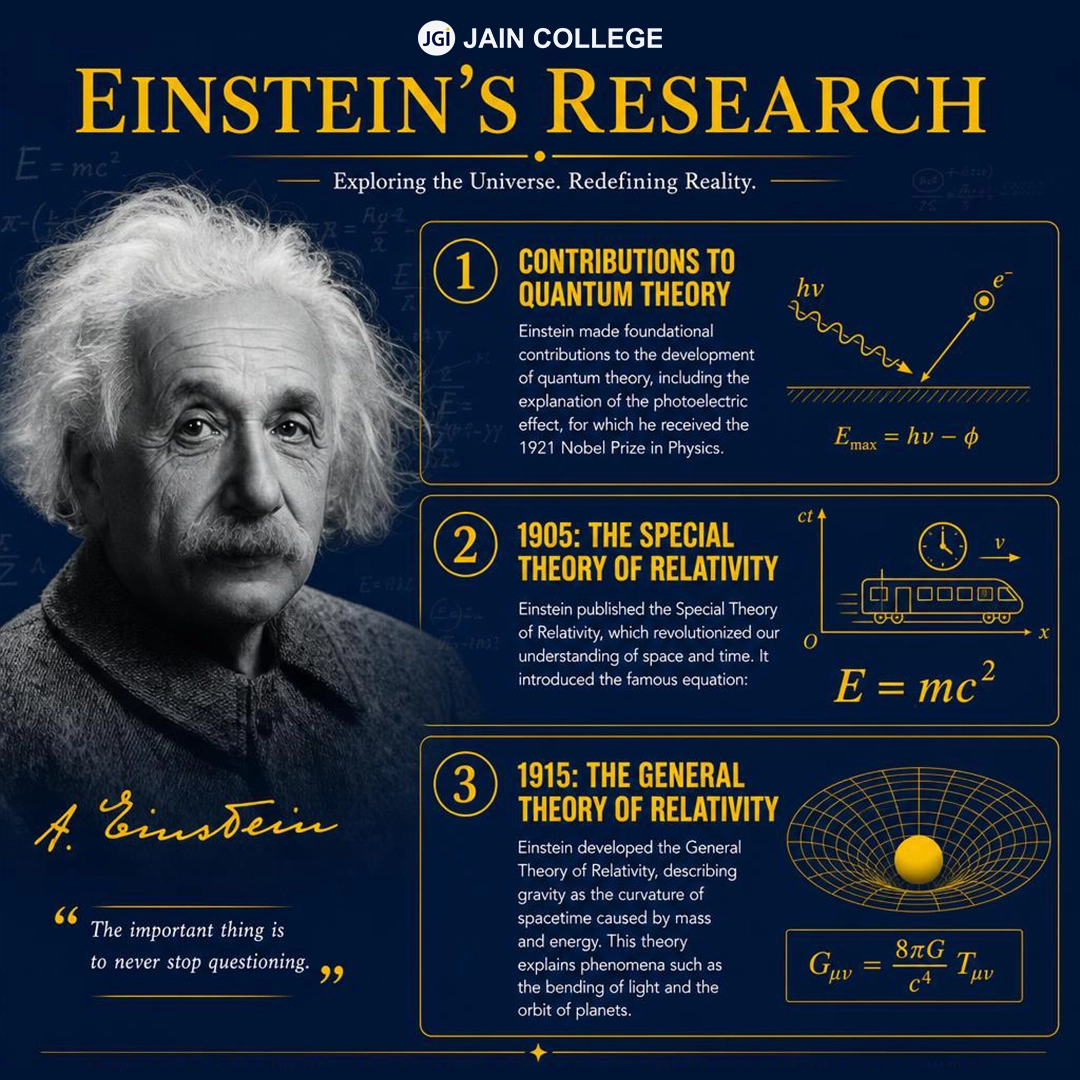
Theory of Relativity
Einstein's most famous work is his ”Theory of Relativity”. It consists of two major components: the special theory of relativity and the general theory of relativity.
Einstein introduced the concept of spacetime, where space and time are no longer separate entities but interconnected dimensions
This concept states that the laws of physics are the same for all observers in uniform relative motion and that the speed of light is a constant that cannot be exceeded
Einstein expanded upon the special theory and provided a new understanding of gravity
According to this theory, gravity is not a force but a result of the curvature of spacetime caused by mass and energy
This theory explains phenomena such as the bending of light around massive objects and the existence of black holes
Contributions to Quantum Theory
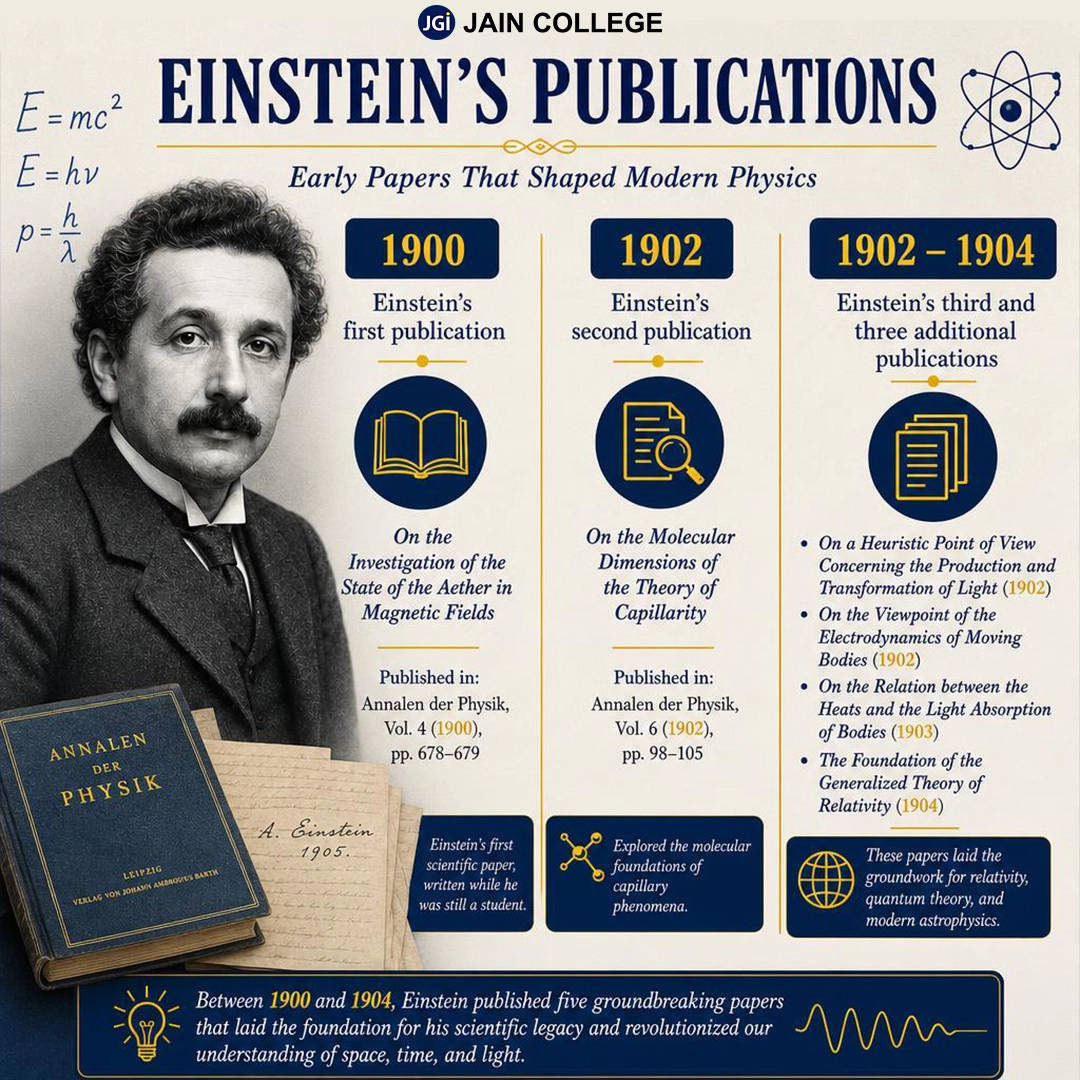
Einstein published more than 300 scientific and over 150 non-scientific works. He is often regarded as the father of modern physics.
Some of his publications include:
1900: Einstein’s first publication
Albert Einstein started his career as a scientific author on Dec. 13, 1900, when he was then 21 years old. He submitted an article to the Annalen der Physik, at that time probably the most prestigious and oldest physics journal. In this journal Einstein developed a semi-empirical theory to interpret extant experimental data
1902: Einstein’s second publication
Einstein’s second article was submitted to and appeared in the “Annalen” in 1902. It also, corresponds to the field of physical chemistry
In contrast to his first paper, in this article he developed a theory, based on thermodynamics, which should have been helpful to interpret
a large number of experiments concerning contact potentials between metals and their fully dissociated salts in solution.
1902 - 1904: Einstein’s third and three additional publications
Einstein submitted and published three articles in the “Annalen” during the years 1902-1904
These three articles dealt with:
These papers resulted from his attempts at teaching himself the disciplines of thermodynamics, kinetic theory and statistical mechanics.
Here is an overview of Albert Einstein’s life and a detailed timeline of his history.
| Albert Einstein (1879 – 1955) | |
| Name | Albert Einstein |
| Date of Birth | March 14, 1879 |
| Place of Birth | Ulm, Kingdom of Württemberg, German Empire |
| Died On | April 18, 1955 (aged 76) |
| Residence | Germany, Italy, Switzerland, and the USA. |
| Ethnicity | Jewish |
| Fields | Physics |
| Known for | General relativity Special relativity Photoelectric effect Brownian motion Mass-energy equivalence Einstein field equations Unified Field Theory Bose–Einstein statistics |
| Notable Awards | Nobel Prize in Physics (1921) Copley Medal (1925) Max Planck Medal (1929) Time Person of the Century |
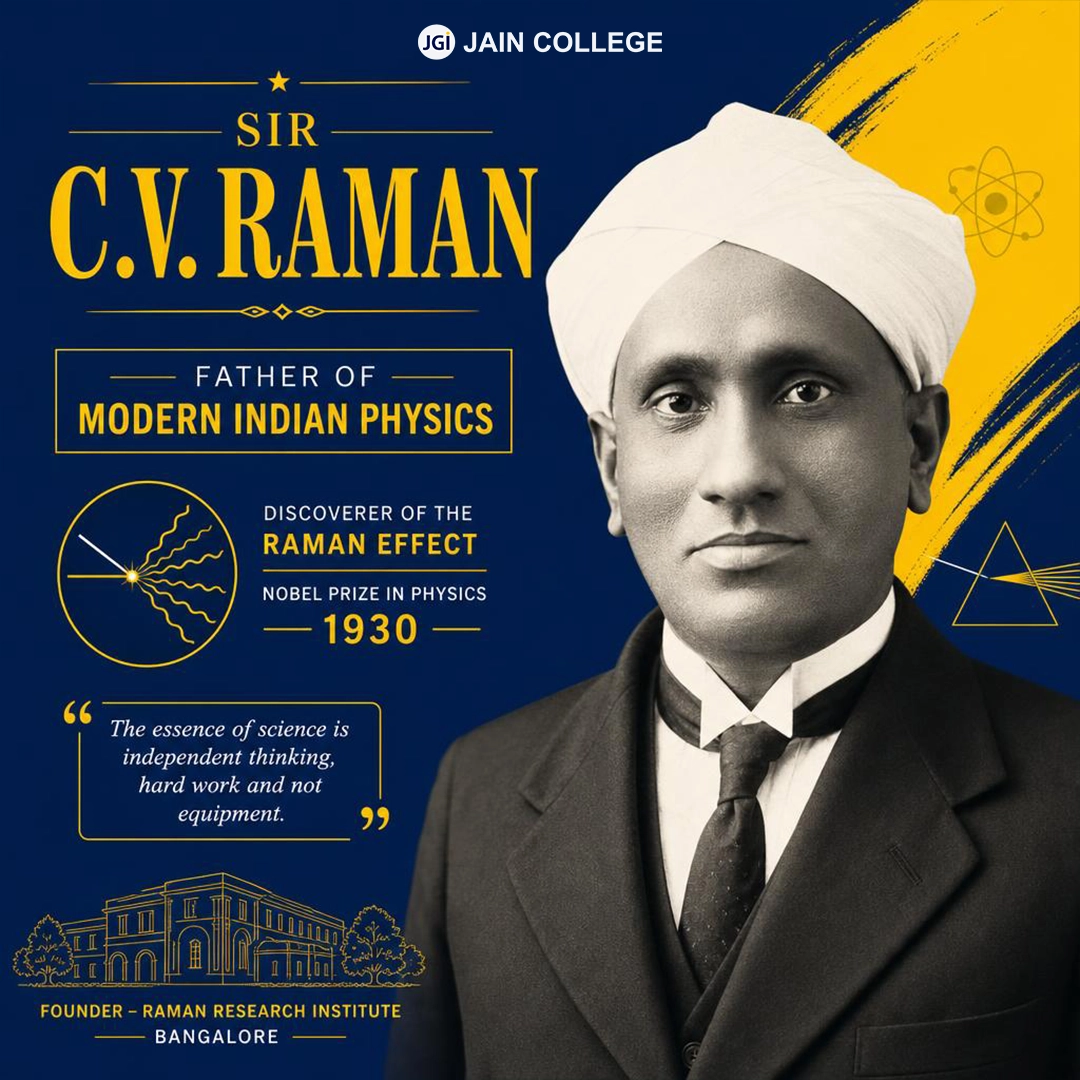
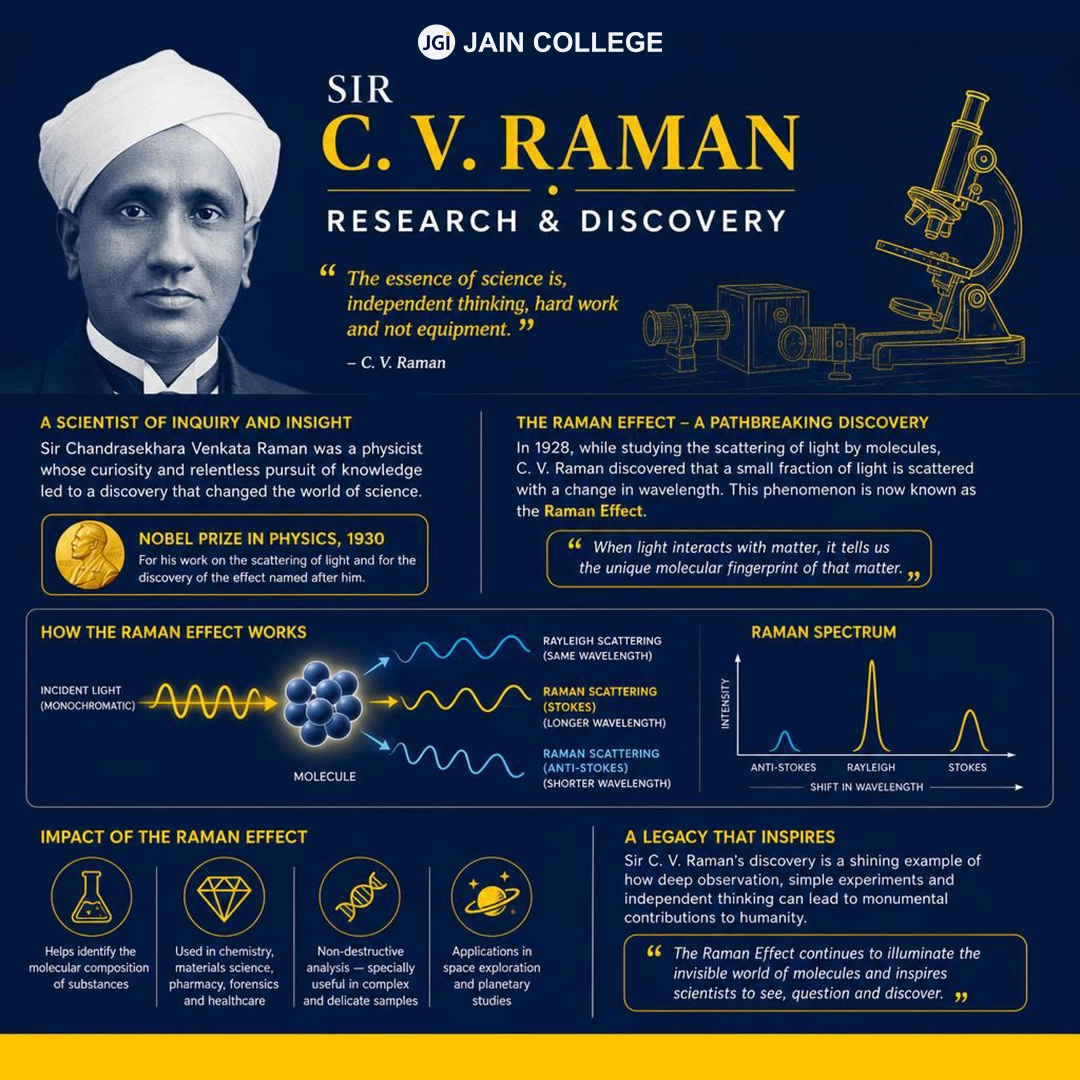
C.V. Raman was born in 1888 in India. He showed great academic aptitude from a young age, passing examinations at early ages and winning medals. He discovered what is now known as Raman scattering or the Raman effect in 1928, while studying the scattering of light.
This discovery showed that a small fraction of light changes wavelength when scattered, revealing information about molecular vibrations.
For this discovery, Raman received the Nobel Prize in Physics in 1930, becoming the first Asian to win a Nobel Prize. He received many other honours over his career for his scientific achievements and contributions.
The famous Raman effect: the light can undergo a scattering through a liquid, resulting in a change in its frequency.
The Raman effect took an additional four years for the entire team to complete, and the team was confident by 1927, with the discovery occurring on 28th February.
This date is celebrated as National Science Day.
For this discovery, C. V. Raman received the Nobel Prize for Physics in 1930. His papers are published in international journals.
Here is an overview of Sir C.V. Raman's life and a detailed timeline of his history
| C.V. Raman (1888–1970) | |
| Name | Chandrasekhara Venkata Raman |
| Date of Birth | Nov. 7, 1888 |
| Place of Birth | Tiruchirappalli, an ancient city in India's southern Tamil Nadu state. |
| Died On | November 21, 1970 |
| 1900 | Completed matriculation at a very young age (around 11 years old) |
| 1902 | Joined Presidency College for higher studies |
| 1904 | Completed B.A. in Physics with top rank and a gold medal |
| 1907 | Completed M.A. in Physics with highest distinction |
| 1907 | Joined the Indian Finance Service as an Assistant Accountant General in Calcutta |
| 1907–1917 | Conducted scientific research in his free time at the Indian Association for the Cultivation of Science |
| 1917 | Appointed Professor of Physics at the University of Calcutta |
| Residence | Primarily lived and worked in Kolkata and Bangalore; associated with the Raman Research Institute |
| Ethnicity | Indian (Tamil Brahmin background) |
| Fields | Physics, Optics, Acoustics |
| Known for | Discovery of the Raman Effect (scattering of light)Contributions to light scattering and spectroscopy |
| Notable Awards | Knight Bachelor (1929)Nobel Prize in Physics (1930)Bharat Ratna (1954) |
Raman joined IACS (Indian Association for the Cultivation of Science) and performed the legendary experiments on light.
Raman at waves and sound
He was fascinated by waves and sound and seemed to have carried in his mind the memory of reading Helmholtz’s book in his school days. He was decided to study musical instruments.
In this research, Sir C.V. Raman has explained the working of Ektara. He continued his research on acoustics. Besides the violin, he studied the Veena, Tambura, Mridangam, Tabla and others
Other Discoveries of C. V. Raman include the following:
Several brilliant minds have shaped the world of physics throughout history. Among the most influential figures are Galileo Galilei, Isaac Newton, and Albert Einstein, whose groundbreaking discoveries laid the foundation for many areas of modern physics.
In India, C. V. Raman is often regarded as the Father of Physics in India for his pioneering work on the scattering of light, which led to the discovery of the Raman Effect. Other distinguished Indian physicists include Homi J. Bhabha, known for his contributions to nuclear science; Meghnad Saha, renowned for the Saha Ionization Equation; and Satyendra Nath Bose, whose work in quantum mechanics laid the foundation for Bose-Einstein statistics. Their contributions have played a significant role in advancing physics both in India and around the world.
Visit the blogs on our website at JAIN PU College and learn more about the famous Indian scientists, famous personalities, literary authors, poets, and Kannada Jnanapeetha/Jnanpith winners.
Which renowned Physicist inspires you the most?
Share your thoughts in the comments below.
According to the "Excerpts from Newton’s Principia", the quantity of matter is measured by its density and bulk together.
According to the "Excerpts from Newton’s Principia", the quantity of motion is measured by the product of velocity and quantity of matter taken together.
Sir C.V. Raman is regarded as a father of modern physics in India for his pioneering work in light scattering, which earned him the 1930 Nobel Prize in Physics.
The Einstein refrigerator is an absorption refrigerator which has no moving parts and requires only a heat source to operate. In 1926, Albert Einstein and his former student jointly invented this project.
Newton’s second law of motion states that the change in motion is proportional to the applied force and occurs in the direction of the straight line along which that force acts.
The specific definitions that paved the way for Newton’s laws of motion are the following:

JAIN PU College, a part of the renowned JGI Group, is committed to empowering students with quality education.
Beyond academics, the college ensures its online content reflects the same standard of excellence. Every blog and article is meticulously vetted and proofread by subject matter experts to ensure accuracy, relevance, and clarity. From insightful educational topics to engaging discussions, JAIN PU College's content is crafted to inform, inspire, and add value to its readers, reflecting the institution's commitment to intellectual growth and innovation.
View all Blogs