








Table of Contents
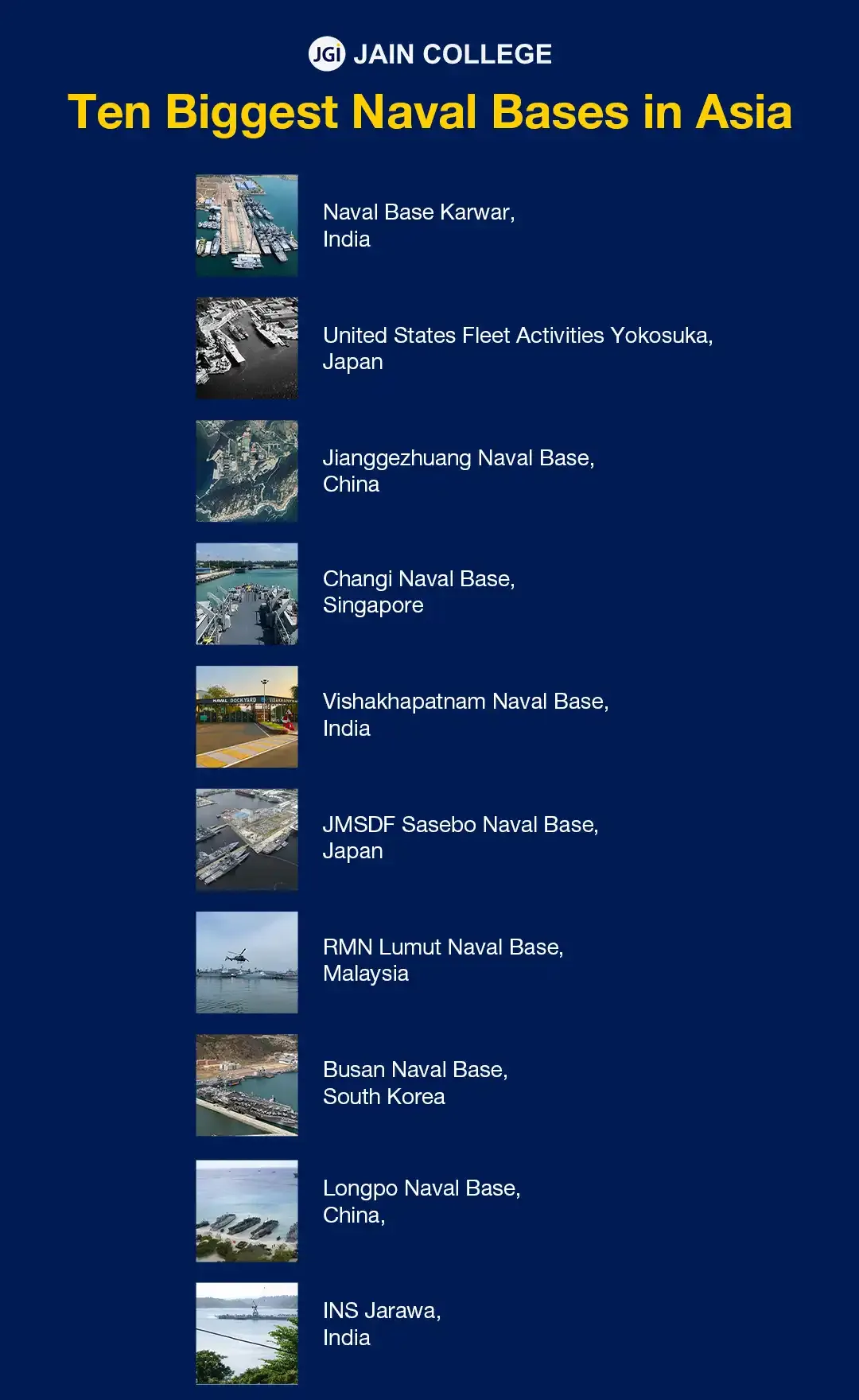
| The top ten of Asia's biggest naval bases: a symbol of maritime power and innovation. |
India, China, Japan, and Singapore are the primary locations of major naval bases in Asia.
They mainly focus on strategic maritime security, aircraft carrier support, and nuclear submarine capabilities.
INS Kadamba is situated near Karwar, a small coastal city that serves as the administrative headquarters of the Uttara Kannada district in Karnataka, India. This base is present on India’s west coast. Upon completion of its ongoing expansion, INS Kadamba is expected to become one of the largest naval bases in Asia and among the largest in the Eastern Hemisphere.
| Naval Base | Country |
| Naval Base Karwar | India |
| United States Fleet Activities Yokosuka | Japan |
| Jianggezhuang Naval Base | China |
| Changi Naval Base | Singapore |
| Vishakhapatnam Naval Base | India |
| JMSDF Sasebo Naval Base | Japan |
| RMN Lumut Naval Base | Malaysia |
| Busan Naval Base | South Korea |
| Longpo Naval Base | China |
| INS Jarawa | India |
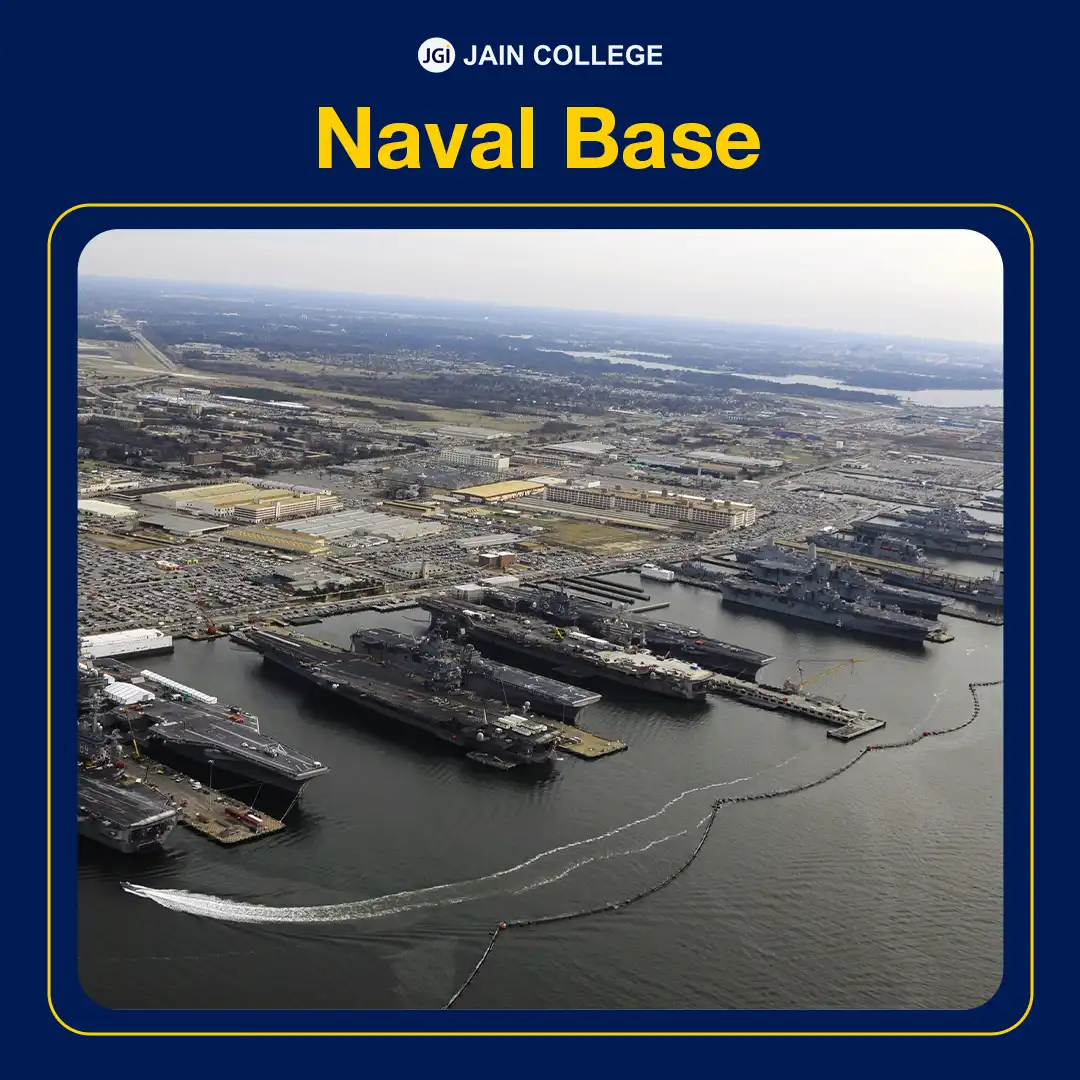
A naval base is a military facility where warships and nuclear submarines are docked when they:
These bases are strategically important, and their open seafront locations require robust security measures.
A naval base located within a country plays a crucial role in national defence and security. It contributes to the development of sea power by supporting military operations and force deployment.
A naval base functions as a home base and supports five key operational roles, commonly known as the Five Rs.
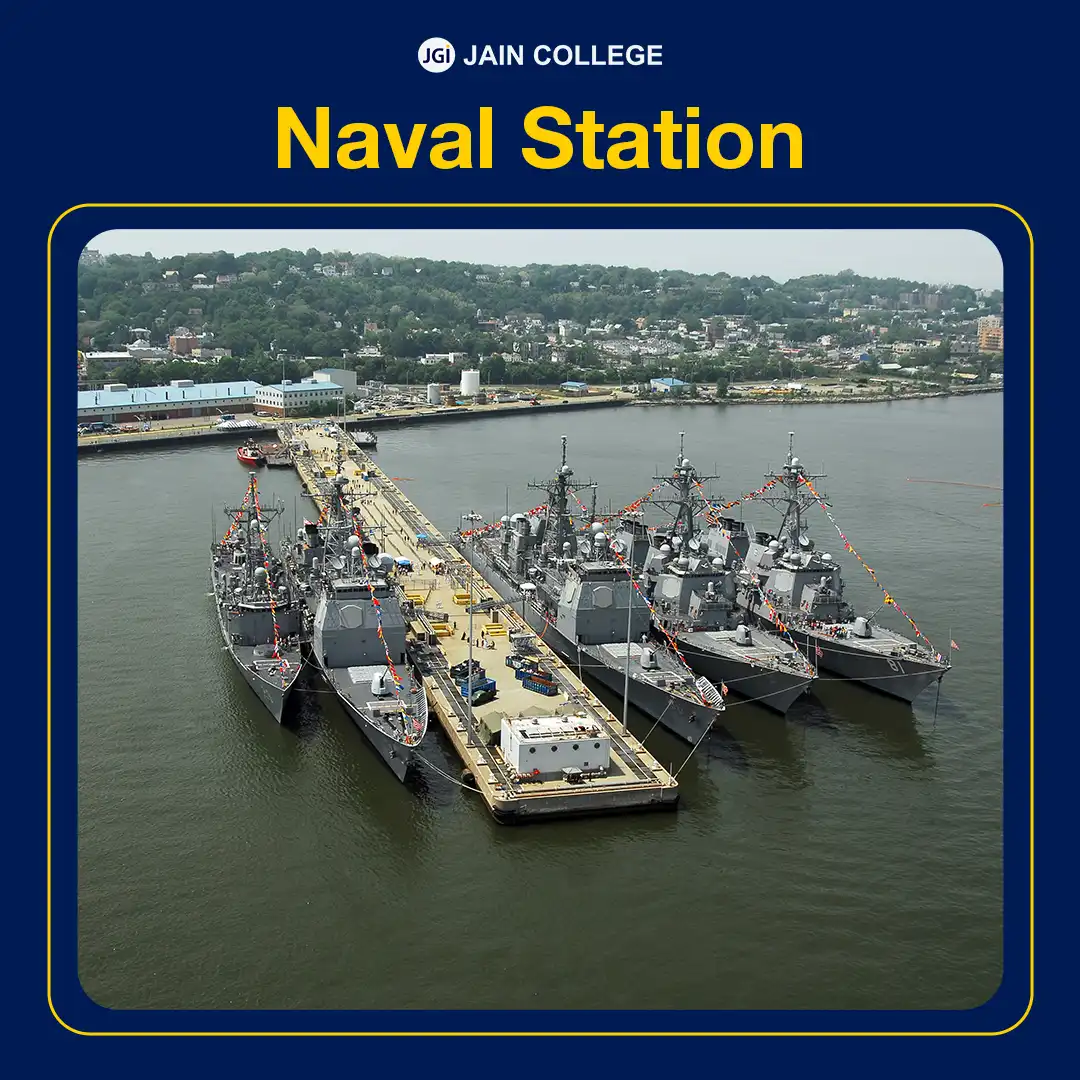
A naval station is a coastal or near-coastal military facility that houses ships, submarines, and personnel.
A nation's navy operates naval stations, which function as permanent shore facilities for organising, supporting, and managing its naval forces.
The primary functions of naval stations include:
INS Kadamba (Karwar) is a major Indian Navy installation that functions as a naval station within a broader naval base system.
All naval stations are part of a naval base system. However, not all naval bases function solely as naval stations.
For example:
INS Kadamba (Karwar) is a major naval base. Some smaller facilities under it may be called naval stations.
Naval Base vs. Naval Station:
| Naval Base | Naval Station |
| Larger in size | Smaller in size |
| Located near major coastal areas | Located near coastal areas or ports |
| Serves as a major operational centre | Serves specific operational functions |
| Includes repair yards, air stations and command headquarters | Includes limited repair, training, and logistics facilities |
| Primary and strategic installation | Secondary or auxiliary installation |
Many navy installations are large and well-established and host some of the largest tenant commands’ operations. Let’s explore the top ten biggest naval bases in Asia and the military operations these stations manage.
Key Features of Naval Base:
The U.S. Navy base at Yokosuka, Japan, supports U.S. Naval Forces Japan and hosts the U.S. Seventh Fleet and other forces operating in the Western Pacific.
This Navy Base was constructed in 1870 and served as a strategic facility in naval battles fought during the World War Era, the Korean War and even the Vietnam War.
Key Features of Naval Base:
This naval facility is commonly referred to as Submarine Base No. 1 (Jianggezhuang Submarine Base). It is located approximately 18–20 km east of Qingdao along the Yellow Sea coast. The base extends over approximately 1.9 km of coastline, with its primary facilities in the eastern section of the bay. The base is an enclosed harbour with breakwaters, and it has a single entrance. It also has specialised facilities for safely loading ballistic missiles on submarines. It hosts China’s Type 092-class ballistic missile submarine and Type 091-class nuclear attack submarines. It is a modern naval facility equipped with deep-water berths and advanced logistical infrastructure to support surface vessels and submarines.
Key Features of Naval Base:
It is officially designated as RSS Singapura (Republic of Singapore Ship) and is a major facility of the Republic of Singapore Navy. It is located adjacent to Changi Air Base on Singapore’s eastern coast. It was constructed on reclaimed land, officially opened in 2004, and a navy museum was built at the entrance of the base in 2012.
Key Features of Naval Base:
This naval base was established in 1968; it is of 2,700 acres naval base and can accommodate 50 ships and nuclear-powered submarines of the Arihant class. This base is home to the Indian Navy’s Eastern Naval Command, which is responsible for all naval forces in the Bay of Bengal and parts of the Indian Ocean, along with naval establishments on India’s east coast.
Key Features of Naval Base:
The Sasebo Naval Base was established in 1889. This naval base comprises a group of ports and land facilities of the Japan Maritime Self-Defence Force, deployed in several districts of Sasebo City, Kyushu.
This naval base ensures the safety and security of the region and undertakes disaster response and logistics support for front units such as the:
Key Features of Naval Base:
This is the largest naval base of the Royal Malaysian Navy in Lumut, Perak. It is 160 km from Kuala Lumpur. This base is the headquarters of the Navy’s Western Fleet Command.
The Lumut Naval Base occupies a coastal site in Lumut, a town in Perak state on the west coast of Peninsular Malaysia along the mouth of the Sungai Dinding (Dinding River) and the Straits of Dindings.
Key Features of Naval Base:
The Republic of Korea Navy owns several ports and land facilities in Nam-Gu, Busan, which make up this Korean naval base. This facility also houses the headquarters of the U.S. Naval Forces Korea. Work on this facility began in 2001 and concluded in 2006. It began operations in 2007 when the Korean Navy relocated to Busan from the Jinhae Naval Base.
Key Features of Naval Base:
This naval base is also referred to as the East Yulin Naval Base.
This facility for nuclear submarines lies along Hainan Island’s southern shores. It is an underground base that can accommodate or hide approximately 20 nuclear submarines. The harbour is large enough to accommodate aircraft carriers.
Key Features of Naval Base:
This naval base of the Indian Armed Forces is under the joint services of the Andaman and Nicobar Command, located in Port Blair in the Andaman and Nicobar Islands. It was commissioned in 1964, but repair facilities were started in 1979.
Key Features of Naval Base:
Asia is home to some of the largest naval bases in the world.
These naval bases play a vital role in the region’s geopolitical dynamics by supporting military operations, protecting maritime trade routes, and ensuring national security.
Overall, these naval bases serve as tools of power projection and deterrence.
Naval bases differ significantly in scale and technological sophistication, with India operating extensive facilities and Japan maintaining highly advanced naval hubs. They are home to the world’s most advanced warships.
Stay tuned to https://www.jaincollege.ac.in/blogs and explore more about the naval bases and other related articles.
Which naval base in Asia do you find most impressive, and why?
Share your thoughts in the comments below.
Chhatrapati Shivaji Maharaj is considered the father of the Indian Navy, as he introduced the idea of the navy.
The primary role of the Indian Navy is to:
Naval bases are strategic facilities used to anchor, repair, and maintain ships.
The naval stations are specialised facilities located in coastal areas or near the sea to safeguard our nation's coastline borders.
A naval base helps safeguard the maritime borders of the country, ensure maritime safety and security and also provide disaster relief and humanitarian aid in times of crisis

JAIN PU College, a part of the renowned JGI Group, is committed to empowering students with quality education.
Beyond academics, the college ensures its online content reflects the same standard of excellence. Every blog and article is meticulously vetted and proofread by subject matter experts to ensure accuracy, relevance, and clarity. From insightful educational topics to engaging discussions, JAIN PU College's content is crafted to inform, inspire, and add value to its readers, reflecting the institution's commitment to intellectual growth and innovation.
View all Blogs