





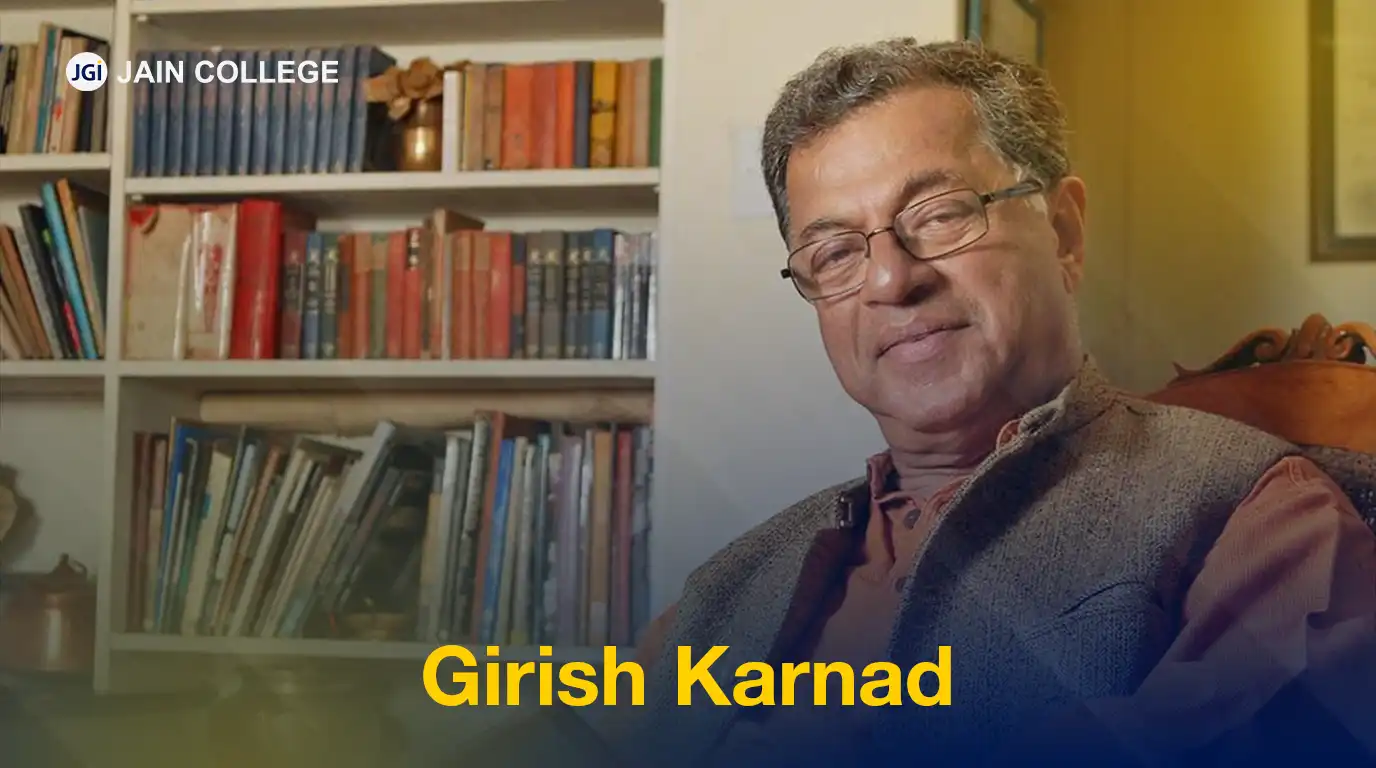
Girish Karnad (1938–2019) was an Indian playwright, actor, and film director who played a key role in shaping modern Kannada theatre. He won the Jnanpith Award in 1998 and used mythology, history, and modern themes in his plays and movies.
Indian English drama often reinterprets traditional Indian beliefs and values within modern contexts, reflecting the cultural and ideological tensions faced by post-independence writers.
Girish Karnad was one such writer, excelling not only as a playwright but also as an actor and film director.
Girish Raghunath Karnad was a contemporary writer, playwright, screenwriter, actor, and film director in the Kannada language. His ascendance to prominence as a playwright in the 1960s symbolised the emergence of modern Indian playwriting in Kannada.
This article explores the literary and cinematic legacy of Girish Karnad, one of the most influential figures in his work.
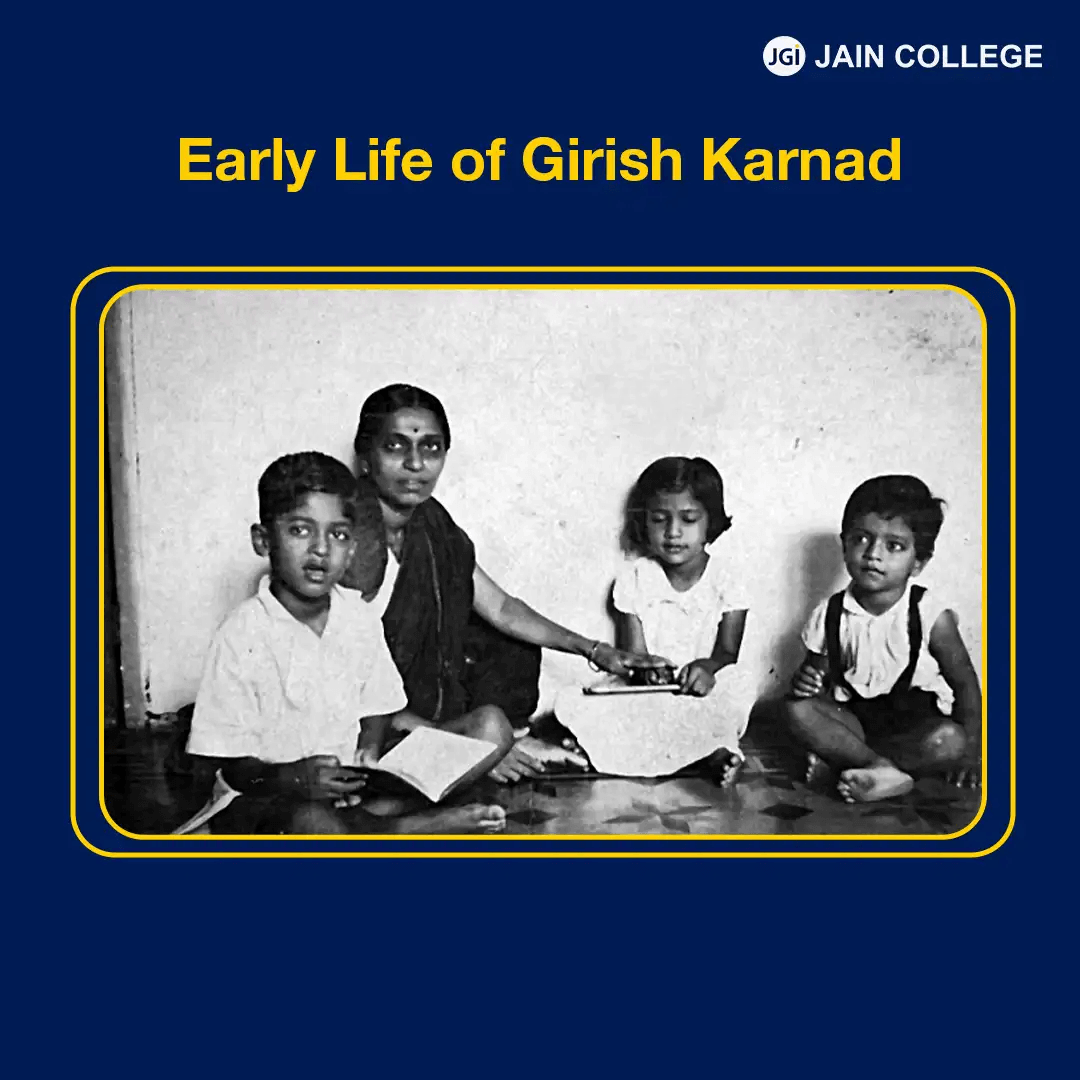
Girish Karnad was born on May 19, 1938, in Matheran, a hill station near Mumbai in the western Indian state of Maharashtra. He was born into a Saraswat Brahmin family with both Marathi and Kannada cultural roots. His father was a medical doctor.
Karnad spent his early childhood in Sirsi, a small town in Karnataka. He received his early education in Karnataka. After completing his undergraduate studies at Karnataka University, Dharwad, Karnad went to the University of Oxford as a Rhodes Scholar for higher studies.
After receiving the Rhodes scholarship, he moved to the research University of Oxford, England (1960 to 1963), to pursue further studies. Later, he was awarded the Bhabha Fellowship to study abroad from 1970 to 1972. In 1987, he went to the USA as a Fulbright Scholar in Residence at the Department of South Asian Languages and Civilisations, University of Chicago.
Here is an overview of Karnad and a detailed timeline of his history.
| Girish Karnad’s Chronology (1938–2019) | |
| Early Life | |
| Full Name | Girish Raghunath Karnad |
| Birth Date | May 19, 1938 |
| Birthplace | Matheran, Bombay Presidency, British India (now in Maharashtra, India) |
| Nationality | Indian |
| Occupation | Playwright, Director and Actor |
| Genre | Drama |
| Literary movement | Navya movement |
| Died on | June 10, 2019 (aged 81), Bengaluru, Karnataka, India |
| Family Details | |
| Parents | Dr Raghunath Karnad and Krishnabai |
| Spouse | Saraswathy Ganapathy |
| Children | Two (one son and one daughter) |
| Education & Career | |
| Early Education | Schooling at the Basel Mission Boys School, Dharwad |
| 1958 | A Bachelor of Arts degree from Karnataka University, Dharwad |
| 1960 to 1963 | Master of Arts in Philosophy, Politics, and Economics from Oxford University |
| Literary Contributions | |
| Autobiography | Aadaadtha Aayushya. Manohara Grantha Mala This Life At Play: Memoirs. Translated by Girish Karnad and Srinath Perur. Fourth Estate |
| Film Production by Girish Karnad: | Om NamoKusuma Bale |
| Films directed by Girish Karnad: | Hindi film Utsav Godhuli (Hindi film) Hindi film Cheluvi Kaadu (Kannada film)Vamsha Vriksha (Kannada film)A documentary on D.R. Bendre Kanooru Heggadithi (Kannada film)Ondanondu Kaladalli (Kannada film)A documentary on The Lamp in the NicheTabbaliyu Neenade Magane (Kannada film)Kannada TV film for DD1 Chidambara Rahasya The Hindi film Woh Ghar. This film was based on Kirtinath Kurtakoti's Kannada play Aa Mani |
| Karnad’s TV series | KhandaanApna Apna AasmanIndradhanush, as Appu and Bala's fatherMalgudi Days, as Swamy's father in Swamy and Friends (Episodes 1 to 8)Swarajnama, as the main host and director, aired on DD1 and Doordarshan |
| Other than these, Karnad also translated many of his works into English, Hindi, and other languages. | |
| Recognition and Awards | |
| For Literature | Padma ShriPadma BhushanKalidas Samman Jnanpith AwardRajyotsava Award Sahitya Akademi AwardKannada Sahitya Parishat AwardSangeet Natak Akademi award and Varthur navya AwardHonorary doctorate from the University of Southern California, Los Angeles |
| For Cinema | National Film AwardsFilmfare Awards SouthFilmfare Awards HindiKarnataka State Film Awards |
Girish Karnad’s early exposure to travelling theatre troupes, such as Natak Mandalis, can be traced back to his parents’ keen interest in theatrical performances.
As a young boy, he developed a deep admiration for Yakshagana and the local theatre traditions of his region.
Karnad belongs to the formative generation of Indian playwrights who came of age in the decades following Independence and collectively transformed Indian theatre into a major national institution in the latter half of the twentieth century.
His work is historically connected to the emergence of modern theatrical forms in India, which developed under the influence of Western models in metropolitan centres such as Calcutta and Bombay during the colonial period.
Also Read:
After completing his master’s degree, Girish Karnad returned to India and began his professional career.
In 1963, he joined Oxford University Press in Madras (now Chennai), where he worked as an editor. He resigned from the organisation in 1972 to devote himself fully to writing, theatre, and film.
Karnad served as a Visiting Professor at the University of Chicago from 1987 to 1988. He was Chairman of the Sangeet Natak Akademi from 1988 to 1993 and later served as Director of the Nehru Centre, London, from 2000 to 2003.
He was Director of the Film and Television Institute of India (FTII), Pune, during 1974–1975 and later served as its Chairman from 1999 to 2001.
Karnad wrote more than ten plays, primarily in the Kannada language, many of which he translated into English himself. His plays frequently draw upon history, mythology, and folk theatre traditions to address contemporary social and political issues. He was also actively involved in Indian cinema as an actor, director, and screenwriter in both Kannada and Hindi films.
Here is a brief overview of Girish Karnad's career:
| 1963–1970 | Worked with the Oxford University Press, Chennai |
| 1974–1975 | Served as director of the Film and Television Institute of India |
| 1987–1988 | Served as a visiting professor and Fulbright Scholar at the University of Chicago. |
| 1988–1993 | Served as a member of Akademi, the National Akademi of the Performing Arts. |
| 2000–2003 | Served as Director of the Nehru Centre, London, under the Indian High Commission |
Girish Karnad wrote 15 major plays, primarily in Kannada, many of which he later translated into English himself.
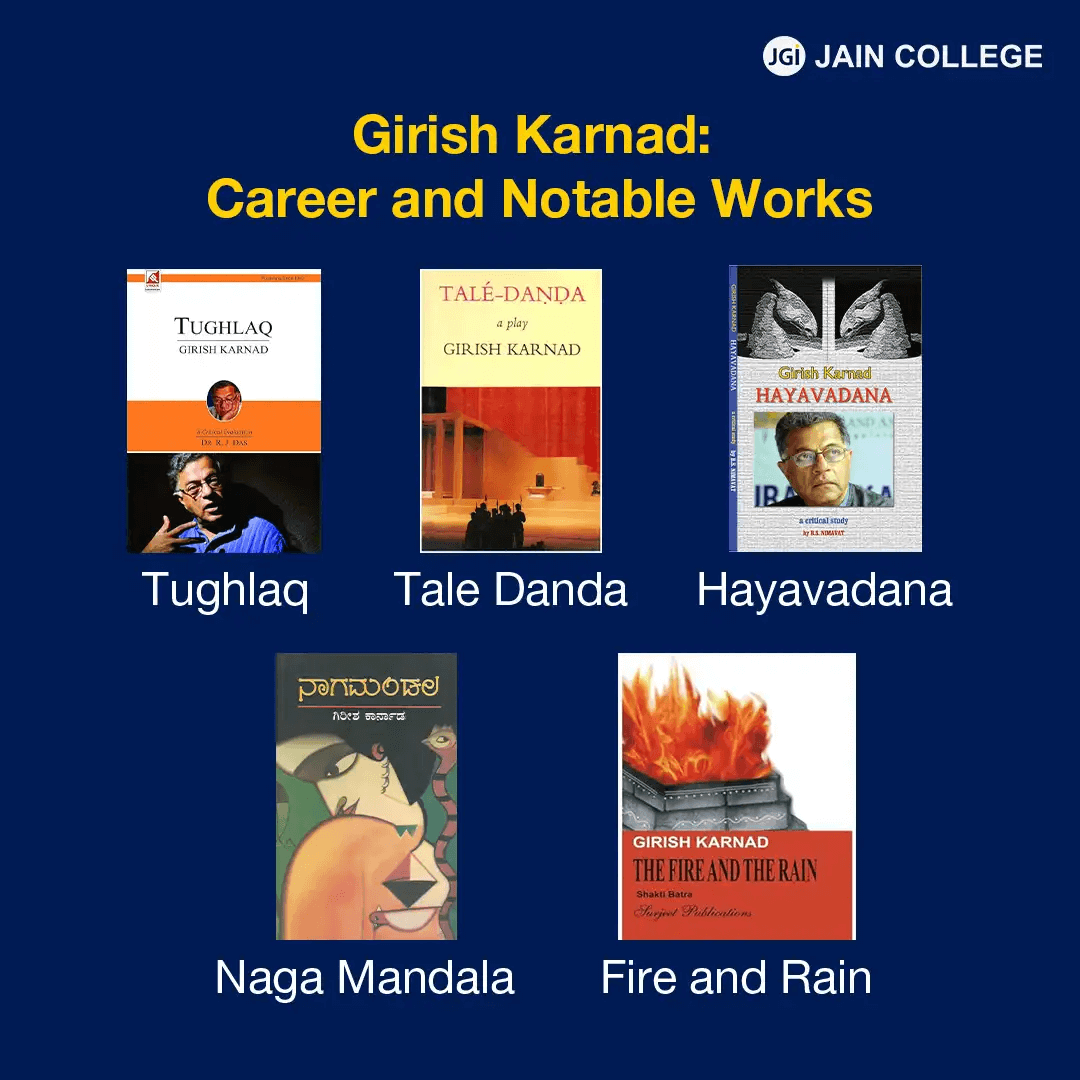
| 1961 | Yayati |
| 1964 | Tughlaq |
| 1971 | Hayavadana |
| 1977 | Angumalige |
| 1980 | Hittina Hunja |
| 1988 | Naga-Mandala |
| 1990 | Tale-Danda |
| 1995 | Agni Mattu Male |
Girish Karnad is a multifaceted personality. To the average person, he is primarily an actor.
For an English literature student, Karnad is a renowned dramatist who has elevated Indian English drama to a level comparable to poetry and novels. His genius in roleplaying and direction is also fascinating, nearly as much as his playwriting.
Girish Karnad started his career in acting and screenwriting in Kannada movies in the 1970s and acted in more than 50 films, including Hindi and other regional languages. Karnad has acted in several films directed by Nagesh Kukunoor, appeared in movies produced by Yash Raj Films, and collaborated with lead actor John Abraham, among others.
The notable among them are:
| Kannada Movies: | |
| 1970 | Samskara |
| 1972 | Vriksha |
| 1974 | Kaadu |
| 1978 | Ondanondu Kaladalli |
| 1993 | Cheluvi |
| Hindi Movies: | |
| 1975 | Nishant |
| 1976 | Manthan |
| 1977 | Swami |
| 2000 | Pukar |
| 2005 | Iqbal |
| 2010 | Aashaein |
| 2012 | Ek Tha Tiger |
| 2017 | Tiger Zinda Hai |
In addition to these roles, Karnad provided the voice for APJ Abdul Kalam, the former President of India, in the audiobook of Kalam's autobiography, "Wings of Fire," produced by Charkha Audiobooks.
Girish Karnad possesses a multitude of talents. He was a renowned actor, film producer and playwright. He is a contemporary writer, playwright, actor and film director in the Kannada language.
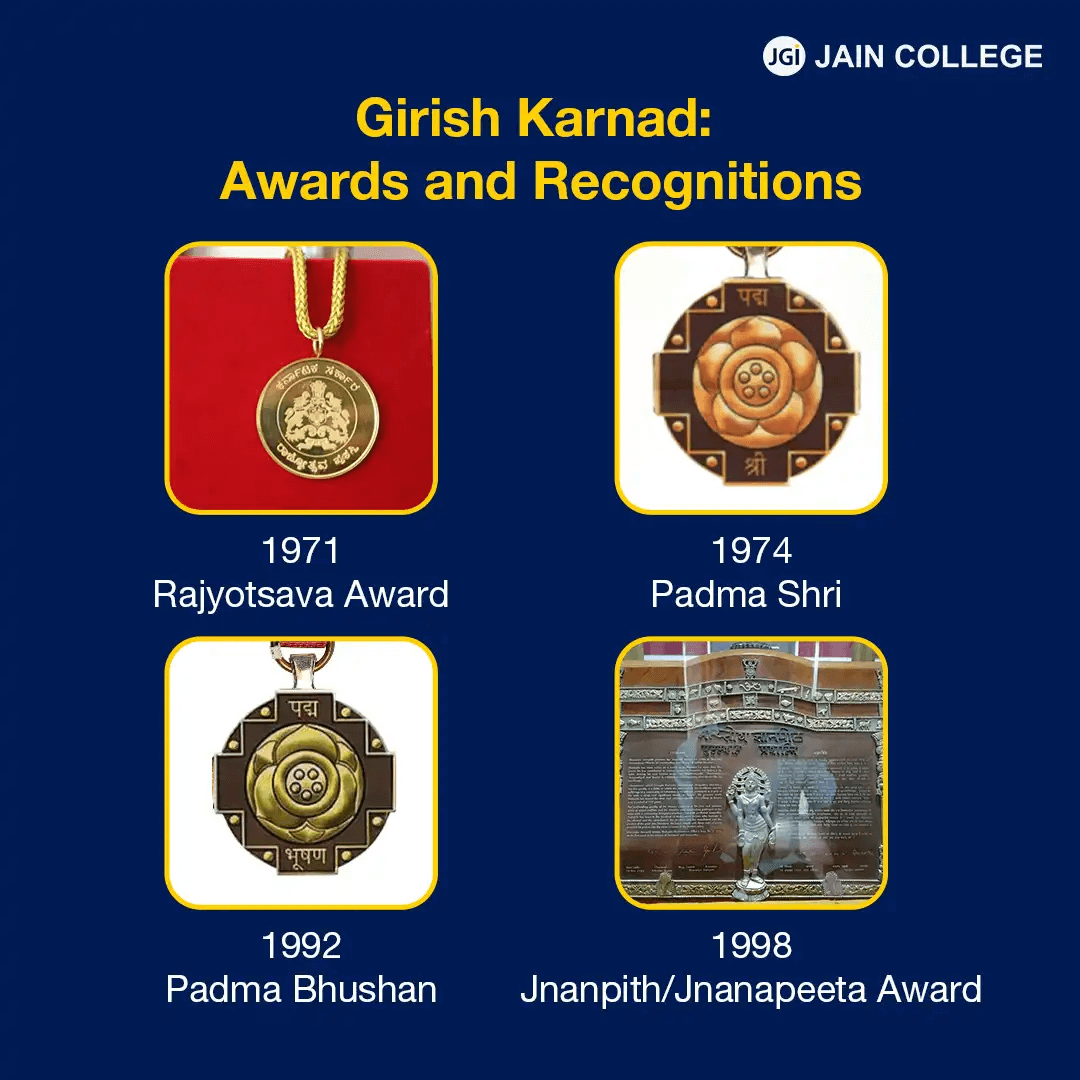
Here’s a summary of Karnad’s major awards and recognitions:
| For Literature: | |
| 1971 | Rajyotsava Award |
| 1972 | Sangeet Natak Akademi Award |
| 1974 | Padma Shri |
| 1992 | Padma Bhushan |
| 1992 | Kannada Sahitya Akademi Award |
| 1994 | Sahitya Academy Award |
| 1994 | D. Litt., Karnatak University |
| 1998 | Jnanpith/Jnanapeeta Award |
| 1998 | Kalidas Samman |
| 2011 | Honorary Doctorate, University of Southern California, Los Angeles |
Karnad directed several movies in Kannada and Hindi. Some of his Filmfare Awards include
| Award Name | Year | Categories |
| Filmfare Awards | 1980 | Best Screenplay - Godhuli |
Filmfare Awards South | 1979 | Best Director - Ondanondu Kaladalli |
| 1973 | Best Director - Vamsha Vriksha | |
| National Film Awards, India | 1978 | Best Screenplay - Bhumika |
* Source
Girish Karnad belongs to the formative generation of Indian playwrights who matured in the two decades following Independence and collectively reshaped Indian theatre into a major national institution in the latter half of the twentieth century.
Girish Karnad is regarded as a pioneer of the Kannada film industry for several significant reasons:
Overall, Karnad’s pioneering contributions across literature, cinema, and cultural discourse firmly establish him as a pioneer of the Kannada film industry.
Girish Karnad’s contributions to theatre and cinema reshaped modern Indian storytelling. By blending mythology, history, and contemporary concerns, he created works that remain relevant across generations
Karnad is a master storyteller whose works explore life's depths with wit and creativity. His impactful plays and films blend tradition with innovation. He has made major advances in the fields of literature and filmmaking. He has been widely acclaimed for his works. He has received many awards for writing plays and working in the cinema.
Today Karnad is the name of an actor and a director, as well as a scriptwriter. Each of his works has received praise and awards.
Visit our website at JAIN PU College blogs to learn more about Karnataka's famous literary authors, poets, and Kannada Jnanapeeta winners.
Yayati is Girish Karnad’s first play, written in 1961. It is based on a mythical character from the Mahabharata.
Girish Karnad was born into a Konkani-speaking Chitrapur Saraswat Brahmin family.
No. Malgudi Days is a TV series based on the books of R. K. Narayan.
The majority of Karnad’s plays employ narratives drawn from myth, history, and folklore.
Tughlaq is a historical play written by Karnad that explores the paradox of the idealistic Sultan Muhammad Tughlaq.
In 1998, Girish Karnad received the Kalidas Samman for his significant contributions to the arts.
Girish Karnad made his debut as an actor and scriptwriter in the Kannada movie Samskara (1970). The film, based on a novel by U. R. Ananthamurthy and directed by Pattabhirama Reddy, won the President’s Gold Medal.
In the TV series Malgudi Days, Girish Karnad played the role of Swami’s father.
Hayavadana (1971) is based on a theme drawn from The Transposed Heads, a 1940 novella by Thomas Mann, which itself traces back to stories from the Kathasaritsagara.
Girish Karnad was conferred the Padma Shri and Padma Bhushan by the Government of India. He also won four Filmfare Awards, including Filmfare Awards for Best Director – Kannada, and the Filmfare Award for Best Screenplay.

JAIN PU College, a part of the renowned JGI Group, is committed to empowering students with quality education.
Beyond academics, the college ensures its online content reflects the same standard of excellence. Every blog and article is meticulously vetted and proofread by subject matter experts to ensure accuracy, relevance, and clarity. From insightful educational topics to engaging discussions, JAIN PU College's content is crafted to inform, inspire, and add value to its readers, reflecting the institution's commitment to intellectual growth and innovation.
View all Blogs