





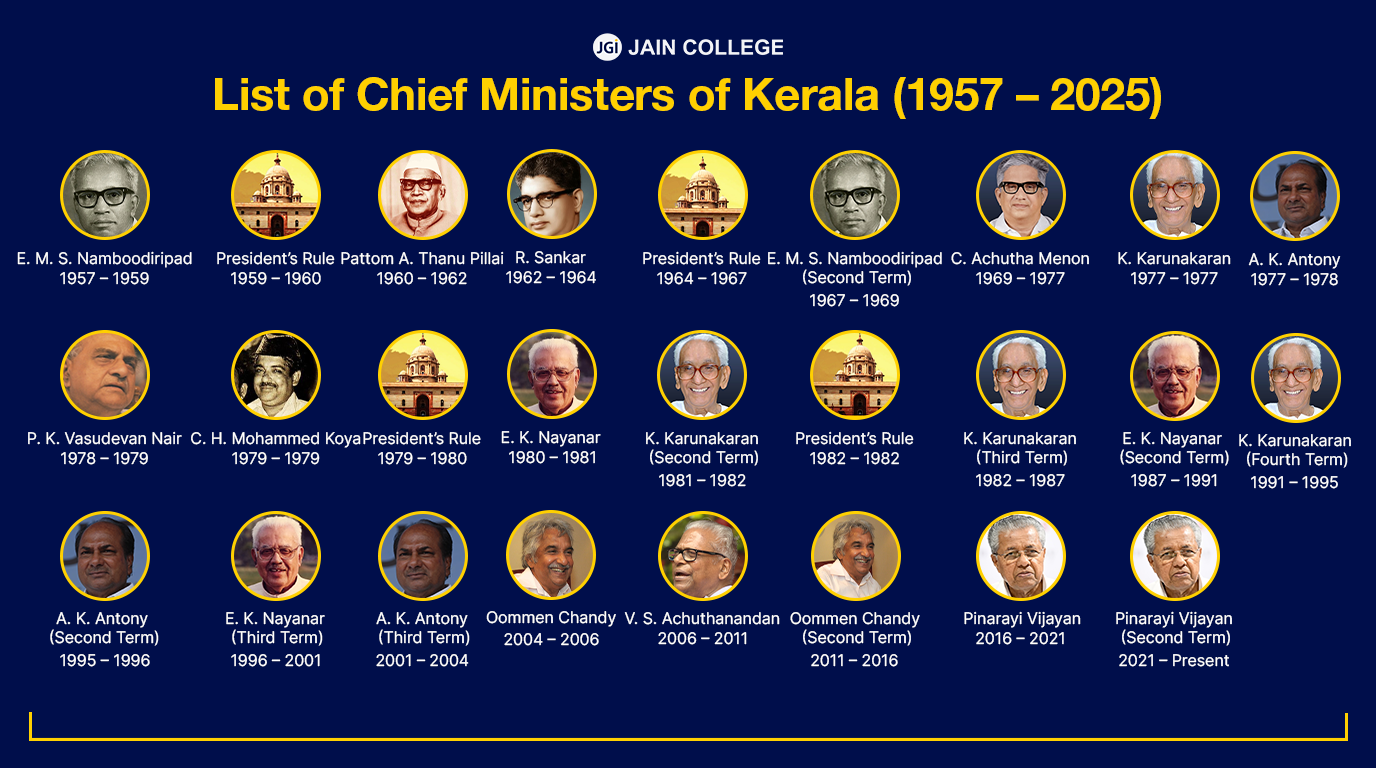
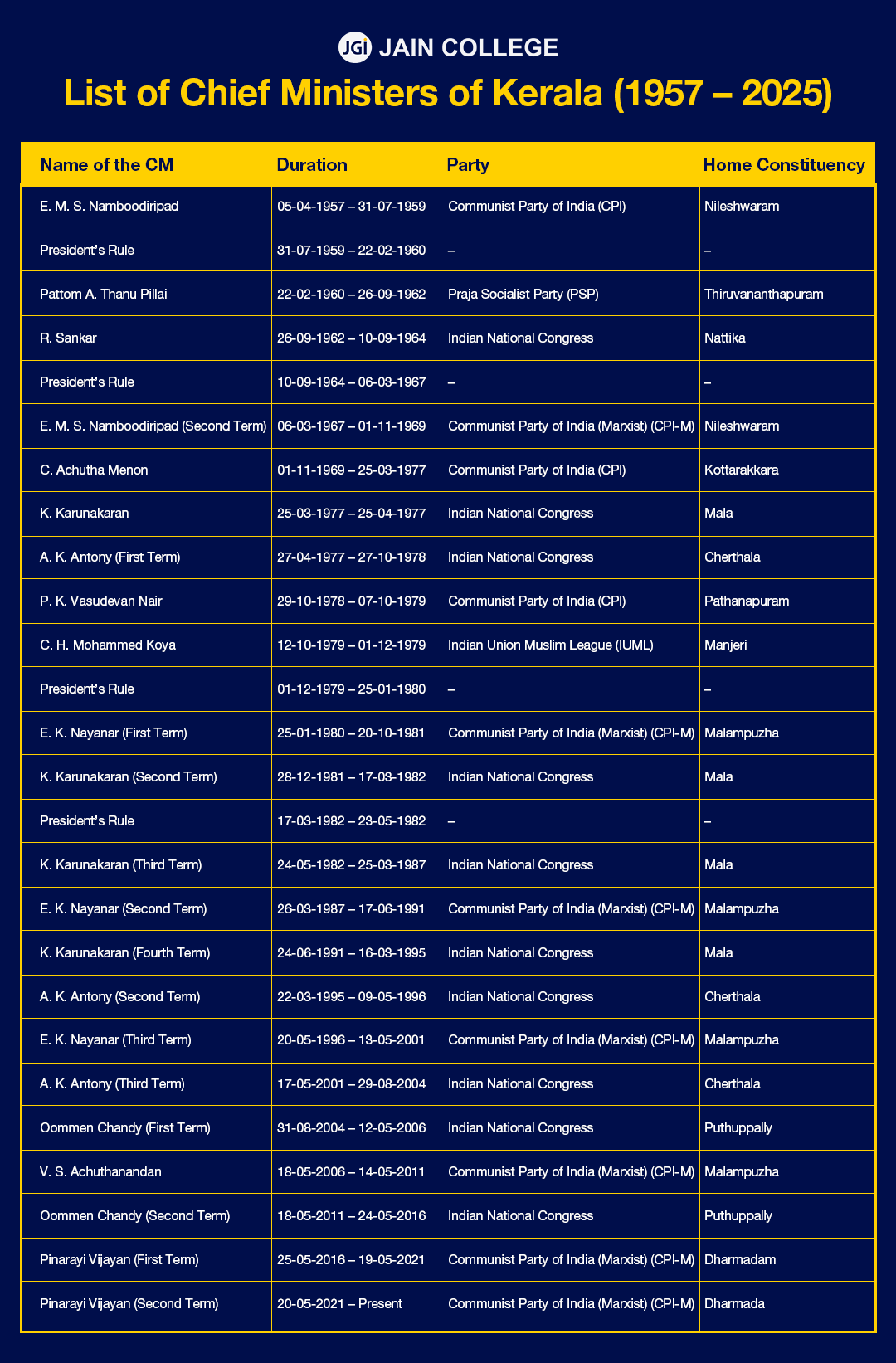
| Name | Duration | Party | Home Constituency |
|---|---|---|---|
| V. D. Satheesan | 18 May 2026 – Present | Indian National Congress (UDF) | Paravur |
| Pinarayi Vijayan (2nd Term) | 20 May 2021 – 18 May 2026 | Communist Party of India (Marxist) (CPI-M) | Dharmadam |
| Pinarayi Vijayan (1st Term) | 25 May 2016 – 19 May 2021 | CPI-M | Dharmadam |
| Oommen Chandy (2nd Term) | 18 May 2011 – 24 May 2016 | Indian National Congress | Puthuppally |
| V. S. Achuthanandan | 18 May 2006 – 14 May 2011 | CPI-M | Malampuzha |
| Oommen Chandy (1st Term) | 31 Aug 2004 – 12 May 2006 | Indian National Congress | Puthuppally |
| A. K. Antony (3rd Term) | 17 May 2001 – 29 Aug 2004 | Indian National Congress | Cherthala |
| E. K. Nayanar (3rd Term) | 20 May 1996 – 13 May 2001 | CPI-M | Malampuzha |
| A. K. Antony (2nd Term) | 22 Mar 1995 – 9 May 1996 | Indian National Congress | Cherthala |
| K. Karunakaran (4th Term) | 24 Jun 1991 – 16 Mar 1995 | Indian National Congress | Mala |
| E. K. Nayanar (2nd Term) | 26 Mar 1987 – 17 Jun 1991 | CPI-M | Malampuzha |
| K. Karunakaran (3rd Term) | 24 May 1982 – 25 Mar 1987 | Indian National Congress | Mala |
| K. Karunakaran (2nd Term) | 28 Dec 1981 – 17 Mar 1982 | Indian National Congress | Mala |
| E. K. Nayanar (1st Term) | 25 Jan 1980 – 20 Oct 1981 | CPI-M | Malampuzha |
| C. H. Mohammed Koya | 12 Oct 1979 – 1 Dec 1979 | Indian Union Muslim League (IUML) | Manjeri |
| P. K. Vasudevan Nair | 29 Oct 1978 – 7 Oct 1979 | Communist Party of India (CPI) | Pathanapuram |
| A. K. Antony (1st Term) | 27 Apr 1977 – 27 Oct 1978 | Indian National Congress | Cherthala |
| K. Karunakaran (1st Term) | 25 Mar 1977 – 25 Apr 1977 | Indian National Congress | Mala |
| C. Achutha Menon (2nd Term) | 4 Oct 1970 – 25 Mar 1977 | Communist Party of India (CPI) | Kottarakkara |
| C. Achutha Menon (1st Term) | 1 Nov 1969 – 3 Aug 1970 | Communist Party of India (CPI) | Kottarakkara |
| E. M. S. Namboodiripad (2nd Term) | 6 Mar 1967 – 1 Nov 1969 | CPI-M | Nileshwaram |
| R. Sankar | 26 Sep 1962 – 10 Sep 1964 | Indian National Congress | Nattika |
| Pattom A. Thanu Pillai | 22 Feb 1960 – 26 Sep 1962 | Praja Socialist Party | Thiruvananthapuram |
| E. M. S. Namboodiripad (1st Term) | 5 Apr 1957 – 31 Jul 1959 | Communist Party of India (CPI) | Nileshwaram |
Sri E. M. S. Namboodiripad, popularly known as EMS, was the first Chief Minister of Kerala and India’s first democratically elected Communist leader. A Marxist thinker and reformist, EMS introduced land reforms, education reforms, and measures to reduce caste inequalities. His government faced opposition from vested interests, leading to the dismissal of his first ministry in 1959 under Article 356. He returned in 1967, continuing his socialist agenda. EMS is remembered as a visionary leader who laid the foundations of Kerala’s progressive model.
Sri Pattom Thanu Pillai, leader of the Praja Socialist Party (PSP), became Kerala’s second CM. A veteran freedom fighter, his government emphasized education, administrative efficiency, and rural development. Though his tenure was short, he helped stabilize governance after EMS’s dismissal.
Sri R. Sankar, a Congress leader, became the first Christian Chief Minister of Kerala. His government focused on expanding education, improving infrastructure, and minority welfare. However, his tenure faced political instability, eventually leading to President’s Rule.
Sri C. Achutha Menon, from the Communist Party of India (CPI), is remembered as one of Kerala’s most efficient administrators. His government emphasized industrial development, cooperative movements, and poverty alleviation programs. He also laid the foundation for the state’s emphasis on science and technology, which later became a hallmark of Kerala’s growth.
Sri K. Karunakaran, a Congress stalwart, served four terms as CM. Known as Kerala’s “Leader of Development”, he oversaw major projects such as the Cochin International Airport and road infrastructure development. However, his first term was short-lived due to controversies. Karunakaran played a key role in shaping Kerala’s Congress politics and remained a dominant figure for decades.
Sri A. K. Antony, known for his clean image and simplicity, served three terms. As CM, he introduced education reforms, anti-corruption measures, and welfare schemes. His governance style earned him the reputation of being one of Kerala’s most respected Congress leaders. Later, he became India’s Defence Minister.
Sri P. K. Vasudevan Nair of the CPI became CM in 1978. His tenure was short but saw efforts to strengthen education, improve literacy rates, and expand social justice policies.
Sri C. H. Mohammed Koya, from the Indian Union Muslim League (IUML), became the first and only Muslim CM of Kerala so far. His government was short-lived but significant for minority representation. He emphasized education and social welfare.
Sri E. K. Nayanar, from the CPI(M), is Kerala’s longest-serving Chief Minister with three terms. A committed Marxist, his governments launched land reforms, literacy missions, poverty alleviation programs, and industrial projects. He is remembered as a mass leader who connected deeply with the working class.
Sri Oommen Chandy, representing the Congress, served two terms. He is best known for his people-centric governance, introducing schemes like Karunya Benevolent Fund, welfare pensions, and IT development. His Mass Contact Programme (direct interaction with citizens) earned him global recognition. He was deeply loved across party lines and remembered as one of Kerala’s most approachable leaders.
Sri V. S. Achuthanandan, a senior CPI(M) leader, became CM at the age of 82. His government focused on anti-corruption, environmental protection, housing for the poor, and IT development (Smart City project in Kochi). A strong advocate for the common man, VS is regarded as a symbol of integrity and honesty in Kerala politics.
Sri V. D. Satheesan of the Indian National Congress assumed office as the 13th Chief Minister of Kerala on 18 May 2026 after leading the United Democratic Front (UDF) to a decisive victory in the 2026 Assembly elections. He is known for his strong opposition leadership, grassroots connect, and focus on transparent governance. His government has prioritized welfare delivery, employment generation, education, infrastructure development, and improving public services. As a six-time MLA from Paravur, Satheesan is regarded as an articulate and reform-oriented leader who played a key role in bringing the UDF back to power after a decade in opposition
Sri Pinarayi Vijayan, current CM from CPI(M), became the first leader in Kerala to be re-elected consecutively (2016 and 2021). His government has focused on rebuilding Kerala after floods, strengthening healthcare (notably during COVID-19), infrastructure projects, and digital governance. He is a decisive leader known for strong administrative control and continues to play a central role in Kerala’s Left politics.

JAIN PU College, a part of the renowned JGI Group, is committed to empowering students with quality education.
Beyond academics, the college ensures its online content reflects the same standard of excellence. Every blog and article is meticulously vetted and proofread by subject matter experts to ensure accuracy, relevance, and clarity. From insightful educational topics to engaging discussions, JAIN PU College's content is crafted to inform, inspire, and add value to its readers, reflecting the institution's commitment to intellectual growth and innovation.
View all Blogs