






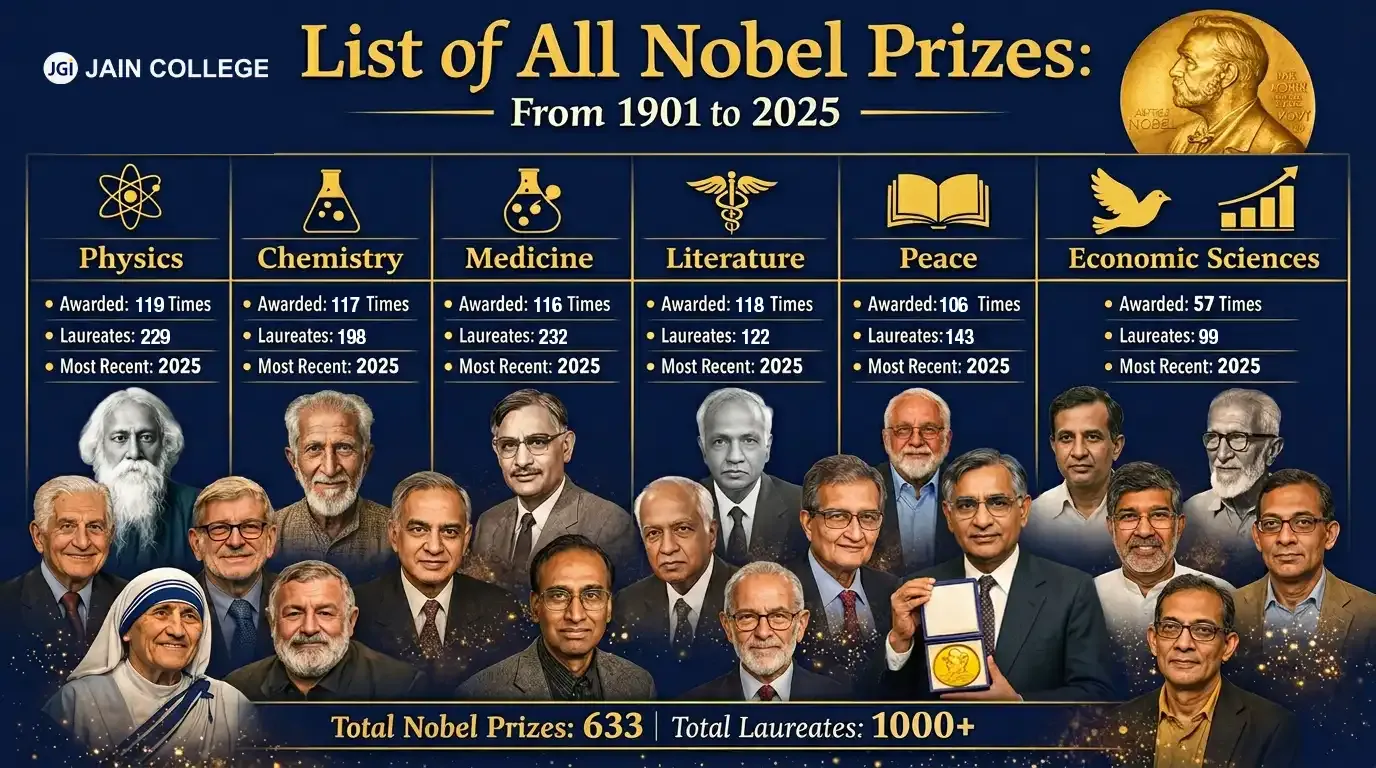
The Nobel Prize is an award that stands as a globally renowned symbol of excellence, honouring individuals and organisations whose work has significantly advanced the well-being of humanity.
Over the past 124 years (from 1901 to 2025), a total of 629 Nobel Prizes have been awarded, resulting in 1,018 winners (individuals and organisations). Here is the detailed list of Nobel Prizes and Nobel Prize laureates:
| Year | Categories | Nobel Laureates | Country | Prize Motivation |
| 1901 | Physics | Wilhelm Conrad Röntgen | Germany | In recognition of the extraordinary services he has rendered by the discovery of the remarkable rays subsequently named after him |
| 1901 | Chemistry | Jacobus H. van 't Hoff | Germany | In recognition of the extraordinary services he has rendered by the discovery of the laws of chemical dynamics and osmotic pressure in solutions |
| 1901 | Physiology or Medicine | Emil von Behring | Germany | For his work on serum therapy, particularly its application against diphtheria, has opened a new path in medical science and provided physicians with a powerful tool to combat illness and death. |
| 1901 | Literature | Sully Prudhomme | France | In special recognition of his poetic composition, which gives evidence of lofty idealism, artistic perfection and a rare combination of the qualities of both heart and intellect. |
1901 |
Peace |
Jean-Henry Dunant | Switzerland | For his humanitarian efforts to help wounded soldiers and create international understanding |
| Frédéric Passy | France | For his lifelong work for international peace conferences, diplomacy and arbitration |
| Year | Categories | Nobel Laureates | Country | Prize Motivation |
1902 |
Physics |
Hendrik A. Lorentz | Netherlands |
In recognition of the extraordinary service they rendered by their research into the influence of magnetism upon radiation phenomena. |
| Pieter Zeeman | ||||
| 1902 | Chemistry | Emil Fischer | Germany | In recognition of the extraordinary services he has rendered for his work on sugar and purine syntheses. |
| 1902 | Physiology or Medicine | Ronald Ross | U.K. | Renowned for his work on malaria, demonstrating how the disease enters the organism, thereby laying the foundation for successful research on this disease and methods of combating it. |
| 1902 | Literature | Theodor Mommsen | Germany | For the greatest living master of the art of historical writing, particularly for his monumental work, A History of Rome. |
1902 |
Peace |
Élie Ducommun | Switzerland |
For his untiring and skilful directorship of the Bern Peace Bureau |
| Albert Gobat | For his eminently practical administration of the Inter-Parliamentary Union |
| Year | Categories | Nobel Laureates | Country | Prize Motivation |
1903 |
Physics |
Henri Becquerel | France |
In recognition of the extraordinary services he has rendered by his discovery of spontaneous radioactivity. |
| Pierre Curie and Marie Curie | In recognition of the extraordinary services they have contributed by their joint research on the radiation phenomena discovered by Professor Henri Becquerel. | |||
| 1903 | Chemistry | Svante Arrhenius | Sweden | In recognition of the extraordinary services he has rendered to the advancement of chemistry by his electrolytic theory of dissociation. |
| 1903 | Physiology or Medicine | Niels Ryberg Finsen | Denmark | In recognition of his contribution to the treatment of diseases, particularly lupus vulgaris, with concentrated light radiation, he has opened a new avenue for medical science. |
| 1903 | Literature | Bjørnstjerne Bjørnson | Norway | As a tribute to his noble, magnificent and versatile poetry, which has always been distinguished by both the freshness of its inspiration and the rare purity of its spirit. |
| 1903 | Peace | Randal Cremer | U.K. | For his longstanding and devoted effort in favour of the ideas of peace and arbitration. |
| Year | Categories | Nobel Laureates | Country | Prize Motivation |
| 1904 | Physics | Lord Rayleigh | U.K. | For his research on the densities of the most important gases and for discovering argon in these studies. |
| 1904 | Chemistry | Sir William Ramsay | U.K. | In recognition of his services in the discovery of the inert gaseous elements in air and his determination of their place in the periodic system. |
| 1904 | Physiology or Medicine | Ivan Pavlov | Russia | In recognition of his work on the physiology of digestion, he has transformed and expanded knowledge about vital aspects of the subject. |
| 1904 | Literature | Frédéric Mistral | France | In recognition of the fresh originality and true inspiration of his poetic production, which faithfully reflects the natural scenery and native spirit of his people, as well as his significant work as a Provençal philologist. |
| José Echegaray | Spain | In recognition of the numerous and brilliant compositions that, in an individual and original manner, have revived the great traditions of the Spanish drama. | ||
| 1904 | Peace | Institute of International Law | Belgium | It strives in public law to develop peaceful ties between nations and to make the laws of war more humane. |
| Year | Categories | Nobel Laureates | Country | Prize Motivation |
| 1905 | Physics | Philipp Lenard | Germany | For his work on cathode rays. |
| 1905 | Chemistry | Adolf von Baeyer | Germany | In recognition of his services in advancing organic chemistry and the chemical industry through his work on organic dyes and hydroaromatic compounds. |
| 1905 | Physiology or Medicine | Robert Koch | Germany | He was renowned for his investigations and discoveries related to tuberculosis. |
| 1905 | Literature | Henryk Sienkiewicz | Poland | For his outstanding merits as an epic writer. |
| 1905 | Peace | Bertha von Suttner | Austria | For her audacity to oppose the horrors of war. |
| Year | Categories | Nobel Laureates | Country | Prize Motivation |
| 1906 | Physics | J.J. Thomson | U.K. | He was recognised for the great merits of his theoretical and experimental investigations on the conduction of electricity by gases. |
| 1906 | Chemistry | Henri Moissan | France | For his recognition of the great services rendered by him in his investigation and isolation of the element fluorine, and for the adoption in the service of science of the electric furnace called after him. |
| 1906 | Physiology or Medicine |
Camillo Golgi |
Italy |
For recognition of their work on the structure of the nervous system. |
| Santiago Ramón y Cajal | Spain | |||
| 1906 | Literature | Giosuè Carducci | Italy | As a tribute to the creative energy, freshness of style, and lyrical force which characterise his poetic masterpieces. |
| 1906 | Peace | Theodore Roosevelt | USA | He played a significant role in ending the recent bloody war between Japan and Russia, two of the world's great powers. |
| Year | Categories | Nobel Laureates | Country | Prize Motivation |
| 1907 | Physics | Albert A. Michelson | USA | Renowned for his optical precision instruments and the spectroscopic and metrological investigations he conducted with their assistance. |
| 1907 | Chemistry | Eduard Buchner | Germany | Renowned for his biochemical research and his discovery of cell-free fermentation. |
| 1907 | Physiology or Medicine | Alphonse Laveran | France | For his work on the role of protozoa in causing diseases. |
| 1907 | Literature | Rudyard Kipling | U.K. | The creations of this world-famous author are characterised by their power of observation, originality of imagination, virility of ideas, and remarkable talent for narration. |
1907 |
Peace |
Ernesto Teodoro Moneta | Italy | For his work in the press and in peace meetings, both public and private, for an understanding between France and Italy |
| Louis Renault | France | For his decisive influence upon the conduct and outcome of the Hague and Geneva Conferences |
| Year | Categories | Nobel Laureates | Country | Prize Motivation |
|---|---|---|---|---|
| 1908 | Physics | Gabriel Lippmann | France | For his method of reproducing colours photographically based on the phenomenon of interference. |
| 1908 | Chemistry | Ernest Rutherford | U.K. | For his investigations into the disintegration of the elements, and the chemistry of radioactive substances |
1908 |
Physiology or Medicine | Ilya Mechnikov | France | In recognition of their work on immunity |
| Paul Ehrlich | Germany | |||
| 1908 | Literature | Rudolf Eucken | Germany | In recognition of his earnest search for truth, his penetrating power of thought, his wide range of vision, and the warmth and strength in presentation with which in his numerous works he has vindicated and developed an idealistic philosophy of life |
1908 |
Peace |
Klas Pontus Arnoldson | Sweden | For their long-time work for the cause of peace as politicians, peace society leaders, orators and authors. |
| Fredrik Bajer | Denmark |
| Year | Categories | Nobel Laureates | Country | Prize Motivation |
1909 |
Physics |
Guglielmo Marconi | U.K. | For the significant contributions to the development of wireless telegraphy. |
| Ferdinand Braun | France | |||
| 1909 | Chemistry | Wilhelm Ostwald | Germany | For his work on catalysis and his investigations into the fundamental principles governing chemical equilibria and rates of reaction. |
| 1909 | Physiology or Medicine | Theodor Kocher | Switzerland | For his work on the physiology, pathology and surgery of the thyroid gland. |
| 1909 | Literature | Selma Lagerlöf | Sweden | Her writings are characterised by her lofty idealism, vivid imagination, and spiritual perception. |
1909 |
Peace |
Auguste Beernaert | Belgium | For the prominent position in the international movement for peace and arbitration. |
| Paul Henri d'Estournelles de Constant | France |
| Year | Categories | Nobel Laureates | Country | Prize Motivation |
| 1910 | Physics | Johannes Diderik van der Waals | Netherlands | Renowned for his contributions to the equation of state for gases and liquids. |
| 1910 | Chemistry | Otto Wallach | Germany | For his services to organic chemistry and the chemical industry through his pioneer work in the field of alicyclic compounds. |
| 1910 | Physiology or Medicine | Albrecht Kossel | Germany | Contributions to the knowledge of cell chemistry through his work on proteins, including the nucleic substances. |
| 1910 | Literature | Paul Heyse | Germany | A tribute to the consummate artistry, permeated with idealism, which he has demonstrated during his long, productive career as a lyric poet, dramatist, novelist, and writer of world-renowned short stories. |
| 1910 | Peace | Permanent International Peace Bureau | Switzerland | For establishing a connection between the peace societies of different countries and assisting them in organising global rallies for the international peace movement. |
| Year | Categories | Nobel Laureates | Country | Prize Motivation |
| 1911 | Physics | Wilhelm Wien | Germany | For his discoveries regarding the laws governing the radiation of heat. |
| 1911 | Chemistry | Marie Curie | France | In recognition of her contributions to the advancement of chemistry, including the discovery of the elements radium and polonium, the isolation of radium, and the study of its nature and compounds, Marie Curie received a medal. |
| 1911 | Physiology or Medicine | Allvar Gullstrand | Sweden | For his work on the dioptrics of the eye. |
| 1911 | Literature | Maurice Maeterlinck | Belgium | In appreciation of his many-sided literary activities, and especially of his dramatic works, which are distinguished by a wealth of imagination and by a poetic fancy, which reveals, sometimes in the guise of a fairy tale, a deep inspiration, while in a mysterious way they appeal to the readers' own feelings and stimulate their imaginations. |
1911 |
Peace |
Tobias Asser | Netherlands | For his role as co-founder of the Institut de droit international, initiator of the Conferences on International Private Law (Conférences de Droit international privé) at the Hague, and pioneer in the field of international legal relations. |
| Alfred Fried | Austria | For his effort to expose and fight what he considers to be the main cause of war, namely, the anarchy in international relations. |
| Year | Categories | Nobel Laureates | Country | Prize Motivation |
| 1912 | Physics | Gustaf Dalén | Sweden | For his invention of automatic regulators for use in conjunction with gas accumulators for illuminating lighthouses and buoys. |
1912 |
Chemistry |
Victor Grignard | France |
For the discovery of the so-called Grignard reagent, which in recent years has greatly advanced the progress of organic chemistry. |
Paul Sabatier |
For his method of hydrogenating organic compounds in the presence of finely disintegrated metals, whereby the progress of organic chemistry has been greatly advanced in recent years. | |||
1912 |
Physiology or Medicine |
Alexis Carrel |
France |
In recognition of his work on vascular suture and the transplantation of blood vessels and organs. |
1912 |
Literature |
Gerhart Hauptmann |
Germany |
In recognition of his fruitful, varied, and outstanding production in the realm of dramatic art. |
1912 |
Peace |
Elihu Root |
USA |
For bringing about better understanding between the countries of North and South America and initiating important arbitration agreements between the United States and other countries. |
| Year | Categories | Nobel Laureates | Country | Prize Motivation |
| 1913 | Physics | Heike Kamerlingh Onnes | Netherlands | For his investigations on the properties of matter at low temperatures, which led, inter alia, to the production of liquid helium. |
| 1913 | Chemistry | Alfred Werner | Switzerland | Recognised for his work on the linkage of atoms in molecules, which has shed new light on earlier investigations and opened up new fields of research, especially in inorganic chemistry. |
| 1913 | Physiology or Medicine | Charles Richet | France | In recognition of his work on anaphylaxis. |
| 1913 | Literature | Rabindranath Tagore | India | His profoundly sensitive, fresh, and beautiful verse has made his poetic thought, expressed in his own English words, a part of the literature of the West with consummate skill. |
| 1913 | Peace | Henri La Fontaine | Belgium | For his unparalleled contribution to the organisation of peaceful internationalism. |
| Year | Categories | Nobel Laureates | Country | Prize Motivation |
| 1914 | Physics | Max von Laue | Germany | For his discovery of the diffraction of X-rays by crystals. |
| 1914 | Chemistry | Theodore W. Richards | USA | In recognition of his accurate determinations of the atomic weight of a large number of chemical elements. |
| 1914 | Physiology or Medicine | Robert Bárány | Austria | For his work on the physiology and pathology of the vestibular apparatus. |
| 1914 | Literature | No Nobel Prize was awarded this year. | ||
| 1914 | Peace | No Nobel Prize was awarded this year. | ||
| Year | Categories | Nobel Laureates | Country | Prize Motivation |
1915 |
Physics |
William Bragg | U.K. |
Awarded jointly for their services in the analysis of crystal structure by means of X-rays. |
| Lawrence Bragg | ||||
| 1915 | Chemistry | Richard Willstätter | Germany | For his research on plant pigments, especially chlorophyll. |
| 1915 | Physiology or Medicine | No Nobel Prize was awarded this year. | ||
| 1915 | Literature | Romain Rolland |
France | A tribute to the lofty idealism of his literary production and to the sympathy and love of truth with which he has described different types of human beings. |
| 1915 | Peace | No Nobel Prize was awarded this year. | ||
| Year | Categories | Nobel Laureates | Country | Prize Motivation |
| 1916 | Physics | No Nobel Prize was awarded this year. | ||
| 1916 | Chemistry | No Nobel Prize was awarded this year. | ||
| 1916 | Physiology or Medicine | No Nobel Prize was awarded this year. | ||
| 1916 | Literature | Verner von Heidenstam | Sweden | In recognition of his significance as the leading representative of a new era in our literature. |
| 1916 | Peace | No Nobel Prize was awarded this year. | ||
| Year | Categories | Nobel Laureates | Country | Prize Motivation |
| 1917 | Physics | Charles Glover Barkla | U.K. | For his discovery of the characteristic Röntgen radiation of the elements. |
| 1917 | Chemistry | No Nobel Prize was awarded this year. | ||
| 1917 | Physiology or Medicine | No Nobel Prize was awarded this year. | ||
1917 |
Literature |
Karl Gjellerup | Denmark |
For his varied and rich poetry, which was inspired by lofty ideals |
| Henrik Pontoppidan | For his authentic descriptions of present-day life in Denmark | |||
| 1917 | Peace | International Committee of the Red Cross | Switzerland | The Red Cross was recognised for its efforts to care for wounded soldiers, prisoners of war, and their families. |
| Year | Categories | Nobel Laureates | Country | Prize Motivation |
| 1918 | Physics | Max Planck | Germany | In recognition of the services he rendered to the advancement of Physics through his discovery of energy quanta. |
| 1918 | Chemistry | Fritz Haber | Switzerland | For the synthesis of ammonia from its elements. |
| 1918 | Physiology or Medicine | No Nobel Prize was awarded this year. | ||
| 1918 | Literature | No Nobel Prize was awarded this year. | ||
| 1918 | Peace | No Nobel Prize was awarded this year. | ||
| Year | Categories | Nobel Laureates | Country | Prize Motivation |
| 1919 | Physics | Johannes Stark | Germany | For his discovery of the Doppler effect in canal rays and the splitting of spectral lines in electric fields. |
| 1919 | Chemistry | No Nobel Prize was awarded this year. | ||
| 1919 | Physiology or Medicine | Jules Bordet | Belgium | Renowned for his discoveries in the field of immunity. |
| 1919 | Literature | Carl Spitteler | Switzerland | For his epic, Olympian Spring. |
| 1919 | Peace | Woodrow Wilson | USA | Recognised for his contribution as a founding member of the League of Nations. |
| Year | Categories | Nobel Laureates | Country | Prize Motivation |
| 1920 | Physics | Charles Edouard Guillaume | France | In recognition of the service he has rendered to precision measurements in Physics by his discovery of anomalies in nickel steel alloys. |
| 1920 | Chemistry | Walther Nernst | Germany | He received recognition for his work in thermochemistry in 1920. |
| 1920 | Physiology or Medicine | August Krogh | Denmark | For his discovery of the capillary motor regulating mechanism. |
| 1920 | Literature | Knut Hamsun | Norway | For his monumental work, Growth of the Soil. |
| 1920 | Peace | Léon Bourgeois |
France | For his long-standing work for peace and justice and his key role in the League of Nations' founding. |
| Year | Categories | Nobel Laureates | Country | Prize Motivation |
| 1921 | Physics | Albert Einstein | USA | He was recognised for his contributions to Theoretical Physics, particularly for his discovery of the law of the photoelectric effect. |
| 1921 | Chemistry | Frederick Soddy |
U.K. | He made significant contributions to our understanding of the chemistry of radioactive substances and conducted investigations into the origin and nature of isotopes. |
| 1921 | Physiology or Medicine | No Nobel Prize was awarded this year. | ||
| 1921 | Literature | Anatole France |
France | He received recognition for his brilliant literary achievements, which are characterised by nobility of style, profound human sympathy and grace, and a true Gallic temperament. |
1921 |
Peace |
Hjalmar Branting | Sweden | For their lifelong contributions to the cause of peace and organised internationalism. |
| Christian Lange | Norway | For their lifelong contributions to the cause of peace and organised internationalism. | ||
| Year | Categories | Nobel Laureates | Country | Prize Motivation |
| 1922 | Physics | Niels Bohr | Denmark | He was recognised for his contributions to the study of the structure of atoms and the radiation they emit. |
| 1922 | Chemistry | Francis W. Aston | U.K. | Renowned for discovering isotopes in a large number of non-radioactive elements using his mass spectrograph and for his enunciation of the whole-number rule. |
1922 |
Physiology or Medicine |
Archibald V. Hill | U.K | For his discovery relating to the production of heat in the muscle. |
Otto Meyerhof |
Germany |
For his discovery of the fixed relationship between the consumption of oxygen and the metabolism of lactic acid in the muscle. | ||
| 1922 | Literature | Jacinto Benavente | Spain | For the happy manner in which he has continued the illustrious traditions of the Spanish drama. |
| 1922 | Peace | Fridtjof Nansen | Norway | For his leading role in the repatriation of prisoners of war, in international relief work and as the League of Nations' High Commissioner for refugees. |
| Year | Categories | Nobel Laureates | Country | Prize Motivation |
| 1923 | Physics | Robert A. Millikan | USA | For his work on the elementary charge of electricity and on the photoelectric effect. |
| 1923 | Chemistry | Fritz Pregl | Austria | For his invention of the method of microanalysis of organic substances. |
1923 |
Physiology or Medicine |
Frederick G. Banting | For the discovery of insulin. |
|
| John Macleod | Canada | |||
| 1923 | Literature | William Butler Yeats | Ireland | His always inspired poetry expresses the spirit of a whole nation in a highly artistic form. |
| 1923 | Peace | No Nobel Prize was awarded this year. | ||
| Year | Categories | Nobel Laureates | Country | Prize Motivation |
| 1924 | Physics | Manne Siegbahn | Sweden | For his discoveries and research in the field of X-ray spectroscopy. |
| 1924 | Chemistry | No Nobel Prize was awarded this year. | ||
| 1924 | Physiology or Medicine | Willem Einthoven | Netherlands | For his discovery of the mechanism of the electrocardiogram. |
| 1924 | Literature | Władysław Reymont | Poland | For his great national epic, The Peasants. |
| 1924 | Peace | No Nobel Prize was awarded this year. | ||
| Year | Categories | Nobel Laureates | Country | Prize Motivation |
| 1925 | Physics | James Franck &Gustav Hertz | Germany | For their discovery of the laws governing the impact of an electron upon an atom. |
| 1925 | Chemistry | Richard Zsigmondy |
Germany | For his demonstration of the heterogeneous nature of colloid solutions and for the methods he used, which have since become fundamental in modern colloid chemistry. |
| 1925 | Physiology or Medicine | No Nobel Prize was awarded this year. | ||
| 1925 | Literature | George Bernard Shaw | U.K. | For his work, which was marked by both idealism and humanity, its stimulating satire often infused with a singular poetic beauty. |
1925 |
Peace |
Sir Austen Chamberlain | U.K. | He played a crucial role in bringing about the Locarno Treaty. |
| Charles G. Dawes | USA | He was instrumental in the implementation of the Dawes Plan. | ||
| Year | Categories | Nobel Laureates | Country | Prize Motivation |
| 1926 | Physics | Jean Baptiste Perrin | France | For his work on the discontinuous structure of matter, and especially for his discovery of sedimentation equilibrium. |
| 1926 | Chemistry | The Svedberg | Sweden | For his work on disperse systems. |
| 1926 | Physiology or Medicine | Johannes Fibiger | Denmark | For his discovery of the Spiroptera carcinoma. |
| 1926 | Literature | Grazia Deledda | Italy | For her idealistically inspired writings which with plastic clarity picture the life on her native island and with depth and sympathy deal with human problems in general. |
1926 |
Peace |
Aristide Briand | France | For the crucial role in bringing about the Locarno Treaty. |
| Gustav Stresemann | Germany | He played a crucial role in the formation of the Locarno Treaty. |
| Year | Categories | Nobel Laureates | Country | Prize Motivation |
1927 |
Physics |
Arthur H. Compton | USA | For his discovery of the effect named after him. |
| C.T.R. Wilson | U.K. | For his method of making the paths of electrically charged particles visible by condensation of vapour. | ||
| 1927 | Chemistry | Heinrich Wieland | Germany | For his investigations of the constitution of the bile acids and related substances. |
| 1927 | Physiology or Medicine | Julius Wagner-Jauregg | Austria | For his discovery of the therapeutic value of malaria inoculation in the treatment of dementia paralytica. |
| 1927 | Literature | Henri Bergson | France | In recognition of his rich and vitalising ideas and the brilliant skill with which they have been presented. |
1927 |
Peace |
Ferdinand Buisson | France | He contributed to the emergence of a public opinion in France and Germany that favours peaceful international cooperation. |
| Ludwig Quidde | Germany | He contributed to the emergence of a public opinion in France and Germany that favours peaceful international cooperation. |
| Year | Categories | Nobel Laureates | Country | Prize Motivation |
| 1928 | Physics | Owen Willans Richardson | U.K. | For his work on the thermionic phenomenon and especially for the discovery of the law named after him. |
| 1928 | Chemistry | Adolf Windaus | Germany | He was recognised for the services he rendered through his research into the constitution of sterols and their connection with vitamins. |
| 1928 | Physiology or Medicine | Charles Nicolle | Tunisia | For his work on typhus. |
| 1928 | Literature | Sigrid Undset | Norway | For her powerful descriptions of Northern life during the Middle Ages. |
| 1928 | Peace | No Nobel Prize was awarded this year. | ||
| Year | Categories | Nobel Laureates | Country | Prize Motivation |
| 1929 | Physics | Louis de Broglie | France | For his discovery of the wave nature of electrons. |
1929 |
Chemistry |
Arthur Harden | U.K. | They were awarded the Nobel Prize for their research on sugar fermentation and fermentative enzymes. |
| Hans von Euler-Chelpin | Sweden | |||
1929 |
Physiology or Medicine |
Christiaan Eijkman | U.K. | Awarded for the discovery of the antineuritic vitamin. |
| Sir Frederick Hopkins | Netherlands | Received recognition for his discovery of the growth-stimulating vitamins in 1929. | ||
| 1929 | Literature | Thomas Mann | Germany | For the great novel, Buddenbrooks, which has won steadily increased recognition as one of the classic works of contemporary literature. |
| 1929 | Peace | Frank B. Kellogg | USA | He was renowned for his crucial role in bringing about the Briand-Kellogg Pact. |
| Year | Categories | Nobel Laureates | Country | Prize Motivation |
| 1930 | Physics | Sir Chandrasekhara Venkata Raman | India | He was famous for his work on light scattering and for discovering the effect named after him. |
| 1930 | Chemistry | Hans Fischer | Germany | For his research into the constitution of haemin and chlorophyll and especially for his synthesis of haemin. |
| 1930 | Physiology or Medicine | Karl Landsteiner | USA | For his discovery of human blood groups. |
| 1930 | Literature | Sinclair Lewis | USA | For his vigorous and graphic art of description and his ability to create, with wit and humour, new types of characters. |
| 1930 | Peace | Nathan Söderblom | Sweden | He was awarded the Nobel Peace Prize for his efforts in promoting Christian unity and fostering the mindset required for achieving peace among nations. |
| Year | Categories | Nobel Laureates | Country | Prize Motivation |
| 1931 | Physics | No Nobel Prize was awarded this year. | ||
1931 |
Chemistry |
Carl Bosch | Germany | In recognition of their contributions to the invention and development of chemical high-pressure methods. |
| Friedrich Bergius | ||||
| 1931 | Physiology or Medicine | Otto Warburg | Germany | For his discovery of the nature and mode of action of the respiratory enzyme. |
| 1931 | Literature | Erik Axel Karlfeldt | Sweden | The poetry of Erik Axel Karlfeldt. |
1931 |
Peace |
Jane Addams | USA |
For the assiduous effort to revive the ideal of peace and to rekindle the spirit of peace in their own nation and in the whole of mankind. |
| Nicholas Murray Butler | ||||
| Year | Categories | Nobel Laureates | Country | Prize Motivation |
| 1932 | Physics | Werner Heisenberg | Germany | For the creation of quantum mechanics, the application of which has, inter alia, led to the discovery of the allotropic forms of hydrogen. |
| 1932 | Chemistry | Irving Langmuir | USA | Renowned for his discoveries and investigations in the field of surface chemistry. |
| 1932 | Physiology or Medicine | Sir Charles Sherrington & Edgar Adrian | U.K. | They made significant discoveries about the functions of neurones. |
| 1932 | Literature | John Galsworthy | U.K. | For his distinguished art of narration, which takes its highest form in The Forsyte Saga. |
| 1932 | Peace | No Nobel Prize was awarded this year. | ||
| Year | Categories | Nobel Laureates | Country | Prize Motivation |
1933 |
Physics |
Erwin Schrödinger | Austria | For the discovery of new productive forms of atomic theory. |
| Paul A.M. Dirac | U.K. | |||
| 1933 | Chemistry | No Nobel Prize was awarded this year. | ||
| 1933 | Physiology or Medicine | Thomas H. Morgan |
USA | He received the award for his discoveries about the role of chromosomes in heredity. |
| 1933 | Literature | Ivan Bunin | Russia | for the strict artistry with which he has carried on the classical Russian traditions in prose writing |
| 1933 | Peace | Sir Norman Angell | U.K. | For having exposed by his pen the illusion of war and presented a convincing plea for international cooperation and peace |
| Year | Categories | Nobel Laureates | Country | Prize Motivation |
| 1934 | Physics | No Nobel Prize was awarded this year. | ||
| 1934 | Chemistry | Harold C. Urey | USA | For his discovery of heavy hydrogen. |
1934 |
Physiology or Medicine |
George H. Whipple | USA |
For their discoveries concerning liver therapy in cases of anaemia |
| George R. Minot | ||||
| William P. Murphy | ||||
| 1934 | Literature | Luigi Pirandello | Italy | For his bold and ingenious revival of dramatic and scenic art. |
| 1934 | Peace | Arthur Henderson | U.K. | For his untiring struggle and his courageous efforts as Chairman of the League of Nations Disarmament Conference 1931-34. |
| Year | Categories | Nobel Laureates | Country | Prize Motivation |
| 1935 | Physics | James Chadwick | U.K. | For the discovery of the neutron. |
1935 |
Chemistry |
Frédéric Joliot | France |
In recognition of their synthesis of new radioactive elements. |
| Irène Joliot-Curie | ||||
| 1935 | Physiology or Medicine | Hans Spemann | Germany | For his discovery of the organiSer effect in embryonic development. |
| 1935 | Literature | No Nobel Prize was awarded this year. | ||
1935 |
Peace |
Carl von Ossietzky |
Germany |
For his burning love for freedom of thought and expression and his valuable contribution to the cause of peace. |
| Year | Categories | Nobel Laureates | Country | Prize Motivation |
1936 |
Physics |
Victor F. Hess | Austria | For his discovery of cosmic radiation. |
| Carl D. Anderson | USA | For his discovery of the positron. | ||
| 1936 | Chemistry | Peter Debye | USA | He made significant contributions to our understanding of molecular structure by investigating dipole moments and the diffraction of X-rays and electrons in gases. |
1936 |
Physiology or Medicine | Sir Henry Dale | U.K. | For their discoveries relating to chemical transmission of nerve impulses |
| Otto Loewi | Germany | |||
| 1936 | Literature | Eugene O'Neill | USA | His dramatic works, which embody an original concept of tragedy, are renowned for their power, honesty, and deep-felt emotions. |
| 1936 | Peace | Carlos Saavedra Lamas | Argentina | He played a crucial role as the father of the Argentine Antiwar Pact of 1933, which he also utilised to mediate peace between Paraguay and Bolivia in 1935. |
| Year | Categories | Nobel Laureates | Country | Prize Motivation |
1937 |
Physics |
Clinton Davisson | USA | For their experimental discovery of the diffraction of electrons by crystals |
| George Paget Thomson | U.K. | |||
1937 |
Chemistry |
Norman Haworth | U.K. | For his investigations on carbohydrates and vitamin C. |
| Paul Karrer | Switzerland | He received the Nobel Prize in 1937 for his research on carotenoids, flavins, and vitamins A and B2. | ||
| 1937 | Physiology or Medicine | Albert Szent-Györgyi |
USA | He was awarded the Nobel Prize in 1937 for his discoveries related to biological combustion processes, particularly those involving vitamin C and the catalysis of fumaric acid. |
| 1937 | Literature | Roger Martin du GardFrance |
France | For the artistic power and truth with which he has depicted human conflict as well as some fundamental aspects of contemporary life in his novel cycle “Les Thibault”. |
| 1937 | Peace | Robert Cecil, Viscount Cecil of Chelwood | U.K. | In recognition of his tireless efforts in support of the League of Nations, disarmament, and peace. |
| Year | Categories | Nobel Laureates | Country | Prize Motivation |
| 1938 | Physics | Enrico Fermi |
Italy | For his demonstrations of the existence of new radioactive elements produced by neutron irradiation and for his related discovery of nuclear reactions brought about by slow neutrons. |
| 1938 | Chemistry | Richard Kuhn | Germany | For his work on carotenoids and vitamins. |
| 1938 | Physiology or Medicine | Corneille Heymans | Belgium | For the discovery of the role played by the sinus and aortic mechanisms in the regulation of respiration. |
| 1938 | Literature | Pearl Buck | USA | For her rich and truly epic descriptions of peasant life in China and for her biographical masterpieces. |
| 1938 | Peace | Nansen International Office for Refugees | Switzerland | The award was given for continuing Fridtjof Nansen's work to benefit refugees throughout Europe. |
| Year | Categories | Nobel Laureates | Country | Prize Motivation |
| 1939 | Physics | Ernest Lawrence | USA | He was awarded the Nobel Prize in Chemistry in 1939 for his invention and development of the cyclotron, as well as for the results obtained with it, particularly in relation to artificial radioactive elements. |
1939 |
Chemistry |
Adolf Butenandt | Germany | For his work on sex hormones. |
| Leopold Ruzicka | Switzerland | For his work on polymethylenes and higher terpenes. | ||
| 1939 | Physiology or Medicine | Gerhard Domagk | Germany | For the discovery of the antibacterial effects of prontosil. |
| 1939 | Literature | Frans Eemil Sillanpää |
Finland | He was awarded the Nobel Prize in Literature in 1939 for his profound comprehension of Finland's peasantry and the exceptional artistry with which he depicted their lifestyle and their connection with Nature. |
| 1939 | Peace | No Nobel Prize was awarded this year. | ||
| Year | Categories | Nobel Laureates | Country | Prize Motivation |
| 1940 | Physics | No Nobel Prize was awarded this year. | ||
| 1940 | Chemistry | No Nobel Prize was awarded this year. | ||
| 1940 | Physiology or Medicine | No Nobel Prize was awarded this year. | ||
| 1940 | Literature | No Nobel Prize was awarded this year. | ||
| 1940 | Peace | No Nobel Prize was awarded this year. | ||
| Year | Categories | Nobel Laureates | Country | Prize Motivation |
| 1941 | Physics | No Nobel Prize was awarded this year. | ||
| 1941 | Chemistry | No Nobel Prize was awarded this year. | ||
| 1941 | Physiology or Medicine | No Nobel Prize was awarded this year. | ||
| 1941 | Literature | No Nobel Prize was awarded this year. | ||
| 1941 | Peace | No Nobel Prize was awarded this year. | ||
| Year | Categories | Nobel Laureates | Country | Prize Motivation |
| 1942 | Physics | No Nobel Prize was awarded this year. | ||
| 1942 | Chemistry | No Nobel Prize was awarded this year. | ||
| 1942 | Physiology or Medicine | No Nobel Prize was awarded this year. | ||
| 1942 | Literature | No Nobel Prize was awarded this year. | ||
| 1942 | Peace | No Nobel Prize was awarded this year. | ||
| Year | Categories | Nobel Laureates | Country | Prize Motivation |
| 1943 | Physics | Otto Stern |
USA | For his contribution to the development of the molecular ray method and his discovery of the magnetic moment of the proton. |
| 1943 | Chemistry | George de Hevesy | Sweden | He received the award for his research on the application of isotopes as tracers in the investigation of chemical processes. |
1943 |
Physiology or Medicine |
Henrik Dam | Denmark | For his discovery of vitamin K. |
| Edward A. Doisy | USA | For his discovery of the chemical nature of vitamin K. | ||
| 1943 | Literature | No Nobel Prize was awarded this year. | ||
| 1943 | Peace | No Nobel Prize was awarded this year. | ||
| Year | Categories | Nobel Laureates | Country | Prize Motivation |
| 1944 | Physics | Isidor Isaac Rabi | USA | For his resonance method for recording the magnetic properties of atomic nuclei. |
| 1944 | Chemistry | Otto HahnGermany | Germany | For his discovery of the fission of heavy nuclei. |
| 1944 | Physiology or Medicine | Joseph Erlanger and Herbert S. Gasser | USA | They were awarded the Nobel Prize for their discoveries related to the highly differentiated functions of single nerve fibres. |
| 1944 | Literature | Johannes V. Jensen |
Denmark | For the rare strength and fertility of his poetic imagination, with which was combined an intellectual curiosity of wide scope and a bold, freshly creative style. |
| 1944 | Peace | International Committee of the Red Cross | Switzerland | For the great work it has performed during the war on behalf of humanity. |
| Year | Categories | Nobel Laureates | Country | Prize Motivation |
| 1945 | Physics | Wolfgang Pauli | USA | For the discovery of the Exclusion Principle, also called the Pauli Principle. |
| 1945 | Chemistry | Artturi Virtanen | Finland | For his research and inventions in agricultural and nutrition chemistry, especially for his fodder preservation method. |
1945 |
Physiology or Medicine |
Sir Alexander Fleming | U.K. |
For the discovery of penicillin and its curative effect in various infectious diseases. |
| Ernst B. Chain | ||||
| Sir Howard Florey | ||||
| 1945 | Literature | Gabriela Mistral |
Chile | For her lyric poetry, which, inspired by powerful emotions, has made her name a symbol of the idealistic aspirations of the entire Latin American world. |
| 1945 | Peace | Cordell Hull |
USA | For his indefatigable work for international understanding and his pivotal role in establishing the United Nations. |
| Year | Categories | Nobel Laureates | Country | Prize Motivation |
| 1946 | Physics | Percy W. Bridgman | USA | For the invention of an apparatus to produce extremely high pressures and for the discoveries he made therewith in the field of high-pressure physics. |
1946 |
Chemistry |
James B. Sumner | USA |
For his discovery that enzymes can be crystallised. |
| John H. Northrop and Wendell M. Stanley | They were awarded the Nobel Prize in Physiology or Medicine for their work in preparing enzymes and virus proteins in a pure form. | |||
| 1946 | Physiology or Medicine | Hermann J. Muller |
USA |
For the discovery of the production of mutations by means of X-ray irradiation. |
1946 |
Literature |
Hermann Hesse |
Germany |
Hermann Hesse's inspired writings, which grew bolder and more penetrating, exemplified the classical humanitarian ideals and high qualities of style. |
1946 |
Peace |
Emily Greene Balch | USA |
For her lifelong work for the cause of peace. |
| John R. Mott | For his contribution to the creation of a peace-promoting religious brotherhood across national boundaries. |
| Year | Categories | Nobel Laureates | Country | Prize Motivation |
| 1947 | Physics | Edward V. Appleton | U.K. | For his investigations of the physics of the upper atmosphere, especially for the discovery of the so-called Appleton layer. |
| 1947 | Chemistry | Sir Robert Robinson | U.K. |
For his investigations on plant products of biological importance, especially the alkaloids. |
1947 |
Physiology or Medicine |
Carl Cori and Gerty Cori | USA | For their discovery of the course of the catalytic conversion of glycogen. |
| Bernardo Houssay | Argentina | For his discovery of the part played by the hormone of the anterior pituitary lobe in the metabolism of sugar. | ||
| 1947 | Literature | André Gide |
France | His comprehensive and artistically significant writings present human problems and conditions with fearless love of truth and keen psychological insight. |
1947 |
Peace |
Friends Service Council | U.K. | For the pioneering work in the international peace movement and compassionate effort to relieve human suffering, thereby promoting fraternity between nations. |
1947 |
Peace |
American Friends Service Committee | USA | For the pioneering work in the international peace movement and compassionate effort to relieve human suffering, thereby promoting fraternity between nations. |
| Year | Categories | Nobel Laureates | Country | Prize Motivation |
| 1948 | Physics | Patrick M.S. Blackett | U.K. | For his development of the Wilson cloud chamber method and his discoveries therewith in the fields of nuclear physics and cosmic radiation. |
| 1948 | Chemistry | Arne Tiselius |
Sweden | For his research on electrophoresis and adsorption analysis, especially for his discoveries concerning the complex nature of the serum proteins. |
| 1948 | Physiology or Medicine | Paul MüllerSwitzerland | Switzerland | For his discovery of the high efficiency of DDT as a contact poison against several arthropods. |
| 1948 | Literature | T.S. Eliot | U.K. | For his outstanding, pioneer contribution to present-day poetry. |
| 1948 | Peace | No Nobel Prize was awarded this year. | ||
| Year | Categories | Nobel Laureates | Country | Prize Motivation |
| 1949 | Physics | Hideki Yukawa | Japan | For his prediction of the existence of mesons on the basis of theoretical work on nuclear forces. |
| 1949 | Chemistry | William F. Giauque | USA | For his contributions in the field of chemical thermodynamics, particularly concerning the behaviour of substances at extremely low temperatures. |
1949 |
Physiology or Medicine |
Walter Hess | Switzerland | For his discovery of the functional organisation of the interbrain as a coordinator of the activities of the internal organs. |
| Egas Moniz | Portugal | For his discovery of the therapeutic value of leucotomy in certain psychoses. | ||
| 1949 | Literature | William Faulkner | USA | For his powerful and artistically unique contribution to the modern American novel. |
| 1949 | Peace | Lord Boyd Orr |
U.K. | For his lifelong effort to conquer hunger and want, thereby helping to remove a major cause of military conflict and war. |
| Year | Categories | Nobel Laureates | Country | Prize Motivation |
| 1950 | Physics | Cecil Powell | U.K. | For his development of the photographic method of studying nuclear processes and his discoveries regarding mesons made with this method. |
| 1950 | Chemistry | Otto Diels and Kurt Alder | Germany | For their discovery and development of the diene synthesis. |
1950 |
Physiology or Medicine |
Edward C. Kendall | USA | For their discoveries relating to the hormones of the adrenal cortex, their structure and biological effects. |
| Tadeus Reichstein | Switzerland | |||
| Philip S. Hench | USA | |||
| 1950 | Literature | Bertrand Russell | U.K. | In recognition of his varied and significant writings in which he champions humanitarian ideals and freedom of thought. |
| 1950 | Peace | Ralph Bunche | USA | For his work as a mediator in Palestine in 1948-1949. |
| Year | Categories | Nobel Laureates | Country | Prize Motivation |
1951 |
Physics |
John Cockcroft | U.K. | For their pioneer work on the transmutation of atomic nuclei by artificially accelerated atomic particles. |
| Ernest T.S. Walton | Ireland | |||
| 1951 | Chemistry | Edwin M. McMillan and Glenn T. Seaborg | USA | For their discoveries in the chemistry of the transuranium elements. |
| 1951 | Physiology or Medicine | Max Theiler | USA | For his discoveries concerning yellow fever and how to combat it. |
| 1951 | Literature | Pär Lagerkvist | Sweden | For the artistic vigour and true independence of mind with which he endeavours in his poetry to find answers to the eternal questions confronting mankind. |
| 1951 | Peace | Léon Jouhaux | France | For having devoted his life to the fight against war through the promotion of social justice and brotherhood among men and nations. |
| Year | Categories | Nobel Laureates | Country | Prize Motivation |
1952 |
Physics |
Felix Bloch | Switzerland | For their development of new methods for nuclear magnetic precision measurements and discoveries in connection therewith. |
| E. M. Purcell | USA | |||
| 1952 | Chemistry | Archer J.P. Martin and Richard L.M. Synge | U.K. | For their invention of partition chromatography. |
| 1952 | Physiology or Medicine | Selman A. Waksman | USA | For his discovery of streptomycin, the first antibiotic effective against tuberculosis. |
| 1952 | Literature | François Mauriac | France | For the deep spiritual insight and the artistic intensity with which he has, in his novels, penetrated the drama of human life. |
| 1952 | Peace | Albert Schweitzer | France | For his altruism, reverence for life, and tireless humanitarian work which has helped make the idea of brotherhood between men and nations a living one. |
| Year | Categories | Nobel Laureates | Country | Prize Motivation |
| 1953 | Physics | Frits Zernike | Netherlands | For his demonstration of the phase contrast method, especially for his invention of the phase contrast microscope. |
| 1953 | Chemistry | Hermann Staudinger | Germany | For his discoveries in the field of macromolecular chemistry. |
1953 |
Physiology or Medicine |
Hans Krebs | U.K. | For his discovery of the citric acid cycle. |
| Fritz Lipmann | USA | He was awarded the Nobel Prize in Physiology or Medicine in 1953 for his discovery of coenzyme A and its significance in intermediary metabolism. | ||
| 1953 | Literature | Winston Churchill | U.K. | For his mastery of historical and biographical description and for hid brilliant oratory in defending exalted human values. |
| 1953 | Peace | George C. Marshall | USA | For proposing and supervising the plan for the economic recovery of Europe. |
| Year | Categories | Nobel Laureates | Country | Prize Motivation |
1954 |
Physics |
Max Born | U.K. | For his fundamental research in quantum mechanics, especially for his statistical interpretation of the wave function. |
| Walther Bothe | Germany | For the coincidence method and his discoveries made therewith. | ||
| 1954 | Chemistry | Linus Pauling | USA | For his research into the nature of the chemical bond and its application to the elucidation of the structure of complex substances. |
| 1954 | Physiology or Medicine | John F. Enders, Thomas H. Weller and Frederick C. Robbins | USA | For their discovery of the ability of poliomyelitis viruses to grow in cultures of various types of tissue. |
| 1954 | Literature | Ernest Hemingway | USA | For his mastery of the art of narrative, most recently demonstrated in The Old Man and the Sea, and for the influence that he has exerted on contemporary style. |
| 1954 | Peace | Office of the United Nations High Commissioner for Refugees | Switzerland | For its efforts to heal the wounds of war by providing help and protection to refugees all over the world. |
| Year | Categories | Nobel Laureates | Country | Prize Motivation |
1955 |
Physics |
Willis E. Lamb |
USA |
For his discoveries concerning the fine structure of the hydrogen spectrum. |
| Polykarp Kusch | For his precise determination of the magnetic moment of the electron. | |||
| 1955 | Chemistry | Vincent du Vigneaud | USA | For his work on biochemically important sulphur compounds, especially for the first synthesis of a polypeptide hormone. |
| 1955 | Physiology or Medicine | Hugo Theorell | Sweden | For his discoveries concerning the nature and mode of action of oxidation enzymes. |
| 1955 | Literature | Halldór Laxness | Iceland | For his vivid epic power which has renewed the great narrative art of Iceland. |
| 1955 | Peace | No Nobel Prize was awarded this year. | ||
| Year | Categories | Nobel Laureates | Country | Prize Motivation |
1956 |
Physics |
William B. Shockley | USA |
For their research on semiconductors and their discovery of the transistor effect. |
| John Bardeen | ||||
| Walter H. Brattain | ||||
1956 |
Chemistry |
Sir Cyril Hinshelwood | U.K. | For their research into the mechanism of chemical reactions. |
| Nikolay Semenov | Russia | |||
1956 |
Physiology or Medicine |
André F. Cournand | USA | For their discoveries concerning heart catheterisation and pathological changes in the circulatory system. |
| Werner Forssmann | Germany | |||
| Dickinson W. Richards | USA | |||
| 1956 | Literature | Juan Ramón Jiménez | Spain | For his lyrical poetry, which in the Spanish language constitutes an example of high spirit and artistical purity. |
| 1956 | Peace | No Nobel Prize was awarded this year. | ||
| Year | Categories | Nobel Laureates | Country | Prize Motivation |
1957 |
Physics |
Chen Ning Yang and Tsung-Dao Lee | USA |
Their penetrating investigation of the so-called parity laws has led to important discoveries regarding elementary particles. |
| 1957 | Chemistry | Lord Todd | U.K. | For his work on nucleotides and nucleotide coenzymes. |
1957 |
Physiology orMedicine |
Daniel Bovet |
Italy |
Daniel Bovet was awarded the Nobel Prize in Physiology or Medicine in 1957 for his discoveries related to synthetic compounds that inhibit the action of certain body substances, particularly their effect on the vascular system and skeletal muscles. |
| 1957 | Literature | Albert Camus | France | For his important literary production, which with clear-sighted earnestness illuminates the problems of the human conscience in our times. |
| 1957 | Peace | Lester Bowles Pearson | Canada | For his crucial contribution to the deployment of a United Nations Emergency Force in the wake of the Suez Crisis. |
| Year | Categories | Nobel Laureates | Country | Prize Motivation |
| 1958 | Physics | Pavel A. Cherenkov, Il´ja M. Frank and Igor Y. Tamm | Russia | They made significant contributions to the discovery and interpretation of the Cherenkov effect. |
| 1958 | Chemistry | Frederick Sanger | U.K. | For his work on the structure of proteins, especially that of insulin. |
1958 |
Physiology or Medicine |
George Beadle and Edward Tatum | USA | They discovered that genes act by regulating definite chemical events. |
Joshua Lederberg |
USA | For his discoveries concerning genetic recombination and the organisation of the genetic material of bacteria. | ||
| 1958 | Literature | Boris Pasternak | Russia | For his important achievement both in contemporary lyrical poetry and in the field of the great Russian epic tradition. |
| 1958 | Peace | Georges Pire | Belgium | For his efforts to help refugees to leave their camps and return to a life of freedom and dignity. |
| Year | Categories | Nobel Laureates | Country | Prize Motivation |
| 1959 | Physics | Emilio Segrè and Owen Chamberlain | USA | For their discovery of the antiproton. |
| 1959 | Chemistry | Jaroslav Heyrovsky | Czech Republic | For his discovery and development of the polarographic methods of analysis. |
1959 |
Physiology or Medicine |
Severo Ochoa | Spain | For their discovery of the mechanisms in the biological synthesis of ribonucleic acid and deoxyribonucleic acid. |
| Arthur Kornberg | USA | |||
| 1959 | Literature | Salvatore Quasimodo | Italy | For his lyrical poetry, which with classical fire expresses the tragic experience of life in our times. |
| 1959 | Peace | Philip Noel-Baker | U.K. | For his longstanding contribution to the cause of disarmament and peace. |
| Year | Categories | Nobel Laureates | Country | Prize Motivation |
| 1960 | Physics | Donald A. Glaser | USA | For the invention of the bubble chamber. |
| 1960 | Chemistry | Willard F. Libby | USA | For his method to use carbon-14 for age determination in archaeology, geology, geophysics, and other branches of science. |
1960 |
Physiology or Medicine | Sir Frank Macfarlane BurneT | Australia | For the discovery of acquired immunological tolerance. |
| Peter Medawar | U.K. | |||
| 1960 | Literature | Saint-John Perse | France | For the soaring flight and the evocative imagery of his poetry, Which, in a visionary fashion, reflects the conditions of our time. |
| 1960 | Peace | Albert Lutuli | South Africa | For his non-violent struggle against apartheid. |
| Year | Categories | Nobel Laureates | Country | Prize Motivation |
1961 |
Physics |
Robert Hofstadter | USA | For his pioneering studies of electron scattering in atomic nuclei and for his thereby achieved discoveries concerning the structure of the nucleons. |
| Rudolf Mössbauer | Germany | He received the Nobel Prize in Physics in 1961 for his research on the resonance absorption of gamma radiation and his discovery of the effect that bears his name. | ||
| 1961 | Chemistry | Melvin Calvin | USA | This research focuses on carbon dioxide assimilation in plants. |
| 1961 | Physiology or Medicine | Georg von Békésy | USA | For his discoveries of the physical mechanism of stimulation within the cochlea. |
| 1961 | Literature | Ivo Andrić | Yugoslavia | He has traced themes and depicted human destinies drawn from the history of his country with epic force. |
| 1961 | Peace | Dag Hammarskjöld | Sweden | For developing the UN into an effective and constructive international organisation, capable of giving life to the principles and aims expressed in the UN Charter. |
| Year | Categories | Nobel Laureates | Country | Prize Motivation |
| 1962 | Physics | Lev Landau | Russia | Renowned for his groundbreaking theories on condensed matter, particularly liquid helium. |
1962 |
Chemistry |
Max F. Perutz | Austria | For their studies of the structures of globular proteins. |
| John C. Kendrew | U.K. | |||
1962 |
Physiology or Medicine |
Francis Crick | U.K. | For their discoveries concerning the molecular structure of nucleic acids and its significance for information transfer in living material. |
| James Watson | USA | |||
| Maurice Wilkins | U.K. | |||
| 1962 | Literature | John Steinbeck | USA | For his realistic and imaginative writings, combining as they do sympathetic humour and keen social perception. |
| 1962 | Peace | Linus Pauling | USA | He was known for his efforts to combat the nuclear arms race between the East and West. |
| Year | Categories | Nobel Laureates | Country | Prize Motivation |
1963 |
Physics |
Eugene Wigner |
USA |
For his contributions to the theory of the atomic nucleus and the elementary particles, particularly through the discovery and application of fundamental symmetry principles. |
| J. Hans D. Jensen | Germany | For their discoveries concerning nuclear shell structure. | ||
| Maria Goeppert Mayer | USA | |||
1963 |
Chemistry |
Karl Ziegler | Germany | The Nobel Prize in Chemistry was awarded to Giulio Natta for his contributions to the field of high polymer chemistry and technology. |
| Giulio Natta | Italy | |||
1963 |
Physiology or Medicine |
Sir John Eccles | Switzerland | They are renowned for their discoveries regarding the ionic mechanisms involved in excitation and inhibition in the peripheral and central portions of the nerve cell membrane. |
| Alan Hodgkin | U.K. | |||
| Andrew Huxley | U.K. | |||
| 1963 | Literature | Giorgos Seferis | Greece | For his eminent lyrical writing, inspired by a deep feeling for the Hellenic world of culture. |
1963 |
Peace |
International Committee of the Red Cross | Switzerland | The organisation was dedicated to promoting the principles of the Geneva Convention and fostering cooperation with the UN. |
| League of Red Cross Societies | France |
| Year | Categories | Nobel Laureates | Country | Prize Motivation |
1964 |
Physics |
Charles H. Townes | USA | The fundamental work in the field of quantum electronics has led to the construction of oscillators and amplifiers based on the maser-laser principle. |
| Nicolay G. Basov | Russia | |||
| Aleksandr M. Prokhorov | Russia | |||
| 1964 | Chemistry | Dorothy Crowfoot Hodgkin | U.K. | For her determinations by X-ray techniques of the structures of important biochemical substances. |
| Physiology or Medicine | Konrad Bloch | USA | They are recognised for their groundbreaking discoveries regarding the mechanism and regulation of the metabolism of cholesterol and fatty acids. | |
| 1964 | Feodor Lynen |
Germany |
||
| 1964 | Literature | Jean-Paul Sartre | France | For his work, which was rich in ideas and filled with the spirit of freedom and the quest for truth, has exerted a far-reaching influence on our age. |
| 1964 | Peace | Martin Luther King Jr. | USA | For his non-violent struggle for civil rights for the Afro-American population. |
| Year | Categories | Nobel Laureates | Country | Prize Motivation |
1965 |
Physics |
Sin-Itiro Tomonaga | Japan | They received the award for their groundbreaking contributions to quantum electrodynamics, which have far-reaching implications for the study of elementary particles. |
| Julian Schwinger | USA | |||
| Richard P. Feynman | USA | |||
| 1965 | Chemistry | Robert B. Woodward | USA | For his outstanding achievements in the art of organic synthesis. |
1965 |
Physiology or Medicine | François Jacob, | France |
They are renowned for their discoveries concerning the genetic control of enzyme and virus synthesis. |
| André Lwoff | ||||
| Jacques Monod | ||||
| 1965 | Literature | Mikhail Sholokhov | Russia | For the artistic power and integrity with which, in his epic of the Don, he has given expression to a historic phase in the life of the Russian people. |
| 1965 | Peace | United Nations Children's Fund | USA | This effort aims to enhance solidarity between nations and reduce the gap between rich and poor states. |
| Year | Categories | Nobel Laureates | Country | Prize Motivation |
|---|---|---|---|---|
| 1966 | Physics | Alfred Kastler | France | For the discovery and development of optical methods for studying Hertzian resonances in atoms. |
| 1966 | Chemistry | Robert S. Mulliken | USA | For his fundamental work concerning chemical bonds and the electronic structure of molecules by the molecular orbital method. |
1966 |
Physiology or Medicine |
Peyton Rous | USA | For his discovery of tumour-inducing viruses |
| Charles B. Huggins | USA | For his discoveries concerning hormonal treatment of prostatic cancer | ||
1966 |
Literature |
Shmuel Agnon | Israel | For his profoundly characteristic narrative art with motifs from the life of the Jewish people |
| Nelly Sachs | Sweden | For her outstanding lyrical and dramatic writing, which interprets Israel's destiny with touching strength | ||
| 1966 | Peace | No Nobel Prize was awarded this year | ||
| Year | Categories | Nobel Laureates | Country | Prize Motivation |
| 1967 | Physics | Hans Bethe | USA | For his contributions to the theory of nuclear reactions, especially his discoveries concerning the energy production in stars. |
1967 |
Chemistry |
Manfred Eigen | Germany | They were known for their studies of extremely fast chemical reactions, which are effected by disturbing the equilibrium by means of very short pulses of energy. |
| Ronald G.W. Norrish | U.K. | |||
| George Porter | U.K. | |||
1967 |
Physiology or Medicine |
Ragnar Granit | Sweden | They were known for the discoveries concerning the primary physiological and chemical visual processes in the eye. |
| Keffer Hartline | USA | |||
| George Wald | USA | |||
| 1967 | Literature | Miguel Ángel Asturias | Guatemala | For his vivid literary achievement, deep-rooted in the national traits and traditions of Indian peoples of Latin America. |
| 1967 | Peace | No Nobel Prize was awarded this year | ||
| Year | Categories | Nobel Laureates | Country | Prize Motivation |
| 1968 | Physics | Luis Alvarez | USA | Renowned for his significant contributions to elementary particle physics, particularly the discovery of numerous resonance states, which he made possible through the development of a hydrogen bubble chamber technique and data analysis. |
| 1968 | Chemistry | Lars Onsager | USA | For the discovery of the reciprocal relations bearing his name, which are fundamental to the thermodynamics of irreversible processes. |
1968 |
Physiology or Medicine |
Robert W. Holley | USA |
For their interpretation of the genetic code and its function in protein synthesis. |
| H. Gobind Khorana | ||||
| Marshall W.Nirenberg | ||||
| 1968 | Literature | Yasunari Kawabata | Japan | For his narrative mastery, which with great sensibility expresses the essence of the Japanese mind. |
| 1968 | Peace | René Cassin | France | He fought to uphold the rights of man as outlined in the UN Declaration. |
| Year | Categories | Nobel Laureates | Country | Prize Motivation |
| 1969 | Physics | Murray Gell-Mann | USA | For his contributions and discoveries concerning the classification of elementary particles and their interactions. |
1969 |
Chemistry |
Derek Barton | USA | For their contributions to the development of the concept of conformation and its application in chemistry. |
| Odd Hassel | Norway | |||
1969 |
Physiology orMedicine | Max Delbrück | USA | They are renowned for their discoveries regarding the replication mechanism and the genetic structure of viruses. |
| Alfred D. Hershey | USA | |||
| Salvador E. Luria | USA | |||
| 1969 | Literature | Samuel Beckett | France | His writing, which takes on new forms in the novel and drama, elevates the destitution of modern man. |
| 1969 | Peace | International Labour Organisation | Switzerland | The organisation was responsible for creating international legislation that sets certain standards for working conditions in every country. |
1969 |
Economic Sciences |
Ragnar Frisch | Norway | For having developed and applied dynamic models for the analysis of economic processes. |
| Jan Tinbergen | Netherlands | He was recognised for his development and application of dynamic models in the analysis of economic processes. |
| Year | Categories | Nobel Laureates | Country | Prize Motivation |
1970 |
Physics |
Hannes Alfvén |
Sweden |
For fundamental work and discoveries in magneto hydro-dynamics with fruitful applications in different parts of plasma physics. |
| Louis Néel | France | For fundamental work and discoveries concerning antiferromagnetism and ferrimagnetism which have led to important applications in solid state physics. | ||
| 1970 | Chemistry | Luis Leloir | Argentina | For his discovery of sugar nucleotides and their role in the biosynthesis of carbohydrates. |
1970 |
Physiology or Medicine |
Sir Bernard Katz | U.K. | They made significant discoveries about the humoral transmitters present in nerve terminals, as well as the mechanisms involved in their storage, release, and inactivation. |
| Ulf von Euler | U.K. | |||
| Julius Axelrod | USA | |||
| 1970 | Literature | Aleksandr Solzhenitsyn | Russia | He has pursued the indispensable traditions of Russian literature with great ethical force. |
| 1970 | Peace | Norman Borlaug | USA | He was renowned for having given birth to a well-founded hope: the Green Revolution. |
| 1970 | Economic Sciences | Paul A. Samuelson | USA | Through his scientific work, he has developed static and dynamic economic theory and actively contributed to raising the level of analysis in economic science. |
| Year | Categories | Nobel Laureates | Country | Prize Motivation |
| 1971 | Physics | Dennis Gabor | U.K. | For his invention and development of the holographic method. |
| 1971 | Chemistry | Gerhard Herzberg | Canada | Recognised for his significant contributions to the understanding of the electronic structure and geometry of molecules, with a particular focus on free radicals. |
| 1971 | Physiology or Medicine | Earl W. Sutherland, Jr. | USA | For his discoveries concerning the mechanisms of the action of hormones. |
| 1971 | Literature | Pablo Neruda | Chile | For poetry that, with the action of an elemental force, brings alive a continent's destiny and dreams. |
| 1971 | Peace | Willy Brandt | Germany | For paving the way for a meaningful dialogue between East and West. |
| 1971 | Economic Sciences | Simon Kuznets | USA | Recognised for his empirically founded interpretation of economic growth, which has provided new and deeper insights into the economic and social structure and process of development. |
| Year | Categories | Nobel Laureates | Country | Prize Motivation |
| 1972 | Physics | John Bardeen | USA | For their jointly developed theory of superconductivity, usually called the BCS-theory. |
| Leon N. Cooper | USA | |||
| Robert Schrieffer | USA | |||
1972 |
Chemistry |
Christian Anfinsen |
USA | For his work on ribonuclease, especially concerning the connection between the amino acid sequence and the biologically active conformation. |
Stanford Moore and |
USA |
They have made significant contributions to the understanding of the relationship between the chemical structure and catalytic activity of the active centre of the ribonuclease molecule. | ||
William H. Stein |
||||
| 1972 | Physiology or Medicine | Gerald M. Edelman | USA | For their discoveries concerning the chemical structure of antibodies. |
| Rodney R. Porter | U.K. | |||
| 1972 | Literature | Heinrich Böll | Germany | His writing, which combines a broad perspective on his time with a sensitive skill in characterisation, has contributed to a renewal of German literature. |
| 1972 | Peace | No Nobel Prize was awarded this year | ||
1972 |
Economic Sciences | John R. Hicks | U.K. | For their pioneering contributions to general economic equilibrium theory and welfare theory. |
| Kenneth J. Arrow | USA | |||
| Year | Categories | Nobel Laureates | Country | Prize Motivation |
1973 |
Physics |
Leo Esaki |
USA |
They were awarded the Nobel Prize for their experimental discoveries related to tunnelling phenomena in semiconductors and superconductors, respectively. |
| Ivar Giaever | ||||
Brian D. Josephson |
U.K. |
For his theoretical predictions of the properties of a supercurrent through a tunnel barrier, in particular those phenomena which are generally known as the Josephson effects | ||
1973 |
Chemistry |
Ernst Otto Fischer | Germany | They are renowned for their independent pioneering work on the chemistry of organometallic compounds, also known as sandwich compounds. |
| Geoffrey Wilkinson | U.K. | |||
1973 |
Physiology or Medicine |
Karl von Frisch | Austria | For their discoveries concerning the organisation and elicitation of individual and social behaviour patterns |
| Konrad Lorenz | Austria | |||
| Nikolaas Tinbergen | Netherlands | |||
| 1973 | Literature | Patrick White | Australia | For an epic, psychological narrative art, he introduced a new continent into literature. |
1973 |
Peace |
Henry Kissinger | USA | For jointly having negotiated a ceasefire in Vietnam in 1973. |
| Le Duc Tho | Vietnam | |||
| 1973 | Economic Sciences | Wassily Leontief | Russia | For the development of the input-output method and for its application to important economic problems. |
| Year | Categories | Nobel Laureates | Country | Prize Motivation |
1974 |
Physics |
Martin Ryle |
U.K. |
For their pioneering research in radio astrophysics: Ryle for his This includes observations and inventions, particularly the aperture synthesis technique, and acknowledges Hewish for his decisive role in the discovery of pulsars. |
Antony Hewish |
U.K. | |||
| 1974 | Chemistry | Paul J. Flory | USA | For his fundamental achievements, both theoretical and experimental, in the physical chemistry of the macromolecules. |
1974 |
Physiology or Medicine |
Albert Claude | Belgium | They made significant discoveries regarding the structural and functional organisation of the cell. |
| Christian de Duve | USA | |||
| George E. Palade | USA | |||
1974 |
Literature |
Eyvind Johnson | Sweden | For narrative art, far-seeing in lands and ages, in the service of freedom. |
| Harry Martinson | Sweden | Harry Martinson's writings capture the dewdrop and mirror the cosmos. | ||
1974 |
Peace |
Seán MacBride | Ireland | For his efforts to secure and develop human rights throughout the world. |
Eisaku Satō |
Japan | He was awarded the Nobel Peace Prize in 1974 for his efforts to stabilise conditions in the Pacific rim area and for signing the Nuclear Non-Proliferation Treaty. | ||
1974 |
Economic Sciences |
Gunnar Myrdal | Sweden | For their pioneering work in the theory of money and economic fluctuations and for their penetrating analysis of the interdependence of economic, social and institutional phenomena. |
| Friedrich von Hayek | Germany |
| Year | Categories | Nobel Laureates | Country | Prize Motivation |
1975 |
Physics |
Aage N. Bohr | Denmark | For the discovery of the connection between collective motion and particle motion in atomic nuclei and the development of the theory of the structure of the atomic nucleus based on this connection. |
| Ben R. Mottelson | Denmark | |||
| James Rainwater | USA | |||
1975 |
Chemistry |
John Cornforth | Australia | For his work on the stereochemistry of enzyme-catalyzed reactions |
| Vladimir Prelog | Switzerland | For his research into the stereochemistry of organic molecules and reactions | ||
1975 |
Physiology or Medicine |
David Baltimore | USA | For their discoveries concerning the interaction between tumour viruses and the genetic material of the cell. |
| Renato Dulbecco | USA | |||
| Howard M. Temin | USA | |||
| 1975 | Literature | Eugenio Montale | Italy | For his distinctive poetry which, with great artistic sensitivity, has interpreted human values under the sign of an outlook on life with no illusions. |
| 1975 | Peace | Andrei Sakharov | Russia | For his struggle for human rights in the Soviet Union, for disarmament and cooperation between all nations. |
1975 |
Economic Sciences |
Leonid Vitaliyevich Kantorovich | Russia | For their contributions to the theory of optimum allocation of resources |
| Tjalling C. Koopmans | Netherlands |
| Year | Categories | Nobel Laureates | Country | Prize Motivation |
| 1976 | Physics | Burton Richter | USA | For their pioneering work in the discovery of a heavy elementary particle of a new kind |
| Samuel C.C. Ting | USA | |||
| 1976 | Chemistry | William Lipscomb | USA | For his studies on the structure of boranes, he illuminated problems of chemical bonding. |
1976 |
Physiology or Medicine |
Baruch S. Blumberg | USA | For their discoveries concerning new mechanisms for the origin and dissemination of infectious diseases |
| D. Carleton Gajdusek | USA | |||
| 1976 | Literature | Saul Bellow | USA | For the human understanding and subtle analysis of contemporary culture that are combined in his work |
1976 |
Peace |
Betty Williams | U.K. | For the courageous efforts in founding a movement to put an end to the violent conflict in Northern Ireland. |
| Mairead Corrigan | ||||
| 1976 | Economic Sciences | Milton Friedman | USA | For his achievements in the fields of consumption analysis, monetary history and theory and for his demonstration of the complexity of stabilisation policy. |
| Year | Categories | Nobel Laureates | Country | Prize Motivation |
1977 |
Physics |
Philip W. Anderson | USA | For their fundamental theoretical investigations of the electronic structure of magnetic and disordered systems. |
| Sir Nevill F. Mott | U.K. | |||
| John H. Van Vleck | USA | |||
1977 |
Chemistry |
Ilya Prigogine |
USA | For his contributions to non-equilibrium thermodynamics, particularly the theory of dissipative structures |
1977 |
Physiology or Medicine |
Roger Guillemin and Andrew V. Schally | USA | For their discoveries concerning the peptide hormone production of the brain |
| Rosalyn Yalow | USA | For the development of radioimmunoassays of peptide hormones | ||
| 1977 | Literature | Vicente Aleixandre | Spain | For a creative poetic writing which illuminates man's condition in the cosmos and in present-day society, at the same time representing the great renewal of the traditions of Spanish poetry between the wars |
| 1977 | Peace | Amnesty International | U.K. | For worldwide respect for human rights |
| 1977 | Economic Sciences | Bertil Ohlin | Sweden | For their pathbreaking contribution to the theory of international trade and international capital movements |
| James E. Meade | U.K. |
| Year | Categories | Nobel Laureates | Country | Prize Motivation |
| 1978 | Physics | Pyotr Kapitsa | Russia | For his basic inventions and discoveries in the area of low-temperature physics |
| Arno Penzias | Germany | For their discovery of cosmic microwave background radiation | ||
| Robert Woodrow Wilson | USA | |||
| 1978 | Chemistry | Peter Mitchell | U.K. | For his contribution to the understanding of biological energy transfer through the formulation of the chemiosmotic theory. |
1978 |
Physiology or Medicine |
Werner Arber | Switzerland | For the discovery of restriction enzymes and their application to problems of molecular genetics. |
| Daniel Nathans | USA | |||
| Hamilton O. Smith | USA | |||
| 1978 | Literature | Isaac Bashevis Singer | USA | For his impassioned narrative art, which, with roots in a Polish-Jewish cultural tradition, brings universal human conditions to life. |
1978 |
Peace |
Anwar al-Sadat | Egypt | They are renowned for their role in negotiating peace between Egypt and Israel in 1978. |
| Menachem Begin | Israel | |||
| 1978 | Economic Sciences | Herbert Simon | USA | For his pioneering research into the decision-making process within economic organisations. |
| Year | Categories | Nobel Laureates | Country | Prize Motivation |
1979 |
Physics |
Sheldon Glashow | USA | They were honoured for their work on the theory that combines the weak force and electromagnetic force between basic particles, which included predicting the weak neutral current. |
| Abdus Salam | U.K. | |||
| Steven Weinberg | USA | |||
1979 |
Chemistry |
Herbert C. Brown | USA | For their development of the use of boron- and phosphorus-containing compounds, respectively, into important reagents in organic synthesis. |
| Georg Wittig | Germany | |||
1979 |
Physiology or Medicine | Allan M. Cormack | USA | For the development of computer-assisted tomography |
| Godfrey N.Hounsfield | U.K. | |||
| 1979 | Literature | Odysseus Elytis | Greece | For his poetry, which, against the background of Greek tradition, depicts with sensuous strength and intellectual clear-sightedness modern man's struggle for freedom and creativeness. |
| 1979 | Peace | Mother Teresa | India | For her work for bringing help to suffering humanity |
| 1979 | Economic Sciences | Theodore W. Schultz | USA |
For their pioneering research into economic development research with particular consideration of the problems of developing countries. |
| Sir Arthur Lewis |
| Year | Categories | Nobel Laureates | Country | Prize Motivation |
1980 |
Physics |
James Cronin | USA |
For the discovery of violations of fundamental symmetry principles in the decay of neutral K-mesons |
| Val Fitch | ||||
1980 |
Chemistry |
Paul Berg | USA | He conducted fundamental studies on the biochemistry of nucleic acids, particularly recombinant DNA. |
| Walter Gilbert | USA | For their contributions concerning the determination of base sequences in nucleic acids. | ||
| Frederick Sanger | U.K. | |||
1980 |
Physiology orMedicine |
Baruj Benacerraf | USA | For their discoveries concerning genetically determined structures on the cell surface that regulate immunological reactions. |
| Jean Dausset | Spain | |||
| George D. Snell | USA | |||
| 1980 | Literature | Czesław Miłosz | USA | Who with uncompromising clear-sightedness voices man's exposed condition in a world of severe conflicts |
| 1980 | Peace | Adolfo Pérez Esquivel | Argentina | He served as a source of inspiration for repressed people, particularly in Latin America. |
| 1980 | Economic Sciences | Lawrence R. Klein | USA | He was awarded the Nobel Prize for his work in creating econometric models and applying them to the analysis of economic fluctuations and policies. |
| Year | Categories | Nobel Laureates | Country | Prize Motivation |
1981 |
Physics |
Nicolaas Bloembergen | USA | For their contribution to the development of laser spectroscopy. |
| Arthur L. Schawlow | ||||
Kai M. Siegbahn |
Sweden | For his contribution to the development of high-resolution electron spectroscopy. | ||
1981 |
Chemistry |
Kenichi Fukui and | Japan | For their theories, developed independently, concerning the course of chemical reactions. |
| Roald Hoffmann | USA | |||
1981 |
Physiology or Medicine |
Roger W. Sperry | USA | For his discoveries concerning the functional specialisation of the cerebral hemispheres. |
| David H. Hubel | USA | For their discoveries concerning information processing in the visual system. | ||
| Torsten N. Wiesel | USA | |||
| 1981 | Literature | Elias Canetti | U.K. | For writings marked by a broad outlook, a wealth of ideas and artistic power. |
| 1981 | Peace | Office of the United Nations High Commissioner for Refugees | Switzerland |
For promoting the fundamental rights of refugees. |
| 1981 | Economic Sciences | James Tobin | USA | He was recognised for his analysis of financial markets and their impact on expenditure decisions, employment, production, and prices. |
| Year | Categories | Nobel Laureates | Country | Prize Motivation |
| 1982 | Physics | Kenneth G. Wilson | USA | For his theory for critical phenomena in connection with phase transitions. |
| 1982 | Chemistry | Aaron Klug | U.K. | For his development of crystallographic electron microscopy and his structural elucidation of biologically important nucleic acid-protein complexes. |
| 1982 | Physiology or Medicine |
Sune K. Bergström | Sweden | They received recognition for their discoveries related to prostaglandins and other biologically active substances. |
| Bengt I. Samuelsson | Sweden | |||
| John R. Vane | U.K. | |||
| 1982 | Literature | Gabriel García Márquez | Mexico | His novels and short stories combine the fantastic and the realistic in a richly composed world of imagination that reflects a continent's life and conflicts. |
1982 |
Peace |
Alva Myrdal | Sweden | They are recognised for their efforts towards disarmament and the establishment of nuclear- and weapon-free zones. |
| Alfonso García Robles | Mexico | They are recognised for their efforts towards disarmament and the establishment of nuclear- and weapon-free zones. | ||
| 1982 | Economic Sciences | George J. Stigler | USA | For his seminal studies of industrial structures, the functioning of markets and the causes and effects of public regulation. |
| Year | Categories | Nobel Laureates | Country | Prize Motivation |
1983 |
Physics |
Subrahmanyan Chandrasekhar | USA | For his theoretical studies of the physical processes that are important to the structure and evolution of the stars. |
| William A. Fowler | USA | His theoretical and experimental studies of nuclear reactions hold significant importance in the formation of chemical elements in the universe. | ||
| 1983 | Chemistry | Henry Taube | USA | For his work on the mechanisms of electron transfer reactions, particularly in metal complexes. |
| 1983 | Physiology or Medicine | Barbara McClintock | USA | For her discovery of mobile genetic elements. |
| 1983 | Literature | William Golding | U.K. | For his novels which, with the perspicuity of realistic narrative art and the diversity and universality of myth, illuminate the human condition in the world of today. |
| 1983 | Peace | Lech Wałęsa | Poland | For the non-violent struggle for free trade unions and human rights in Poland. |
| 1983 | Economic Sciences | Gerard Debreu | France | Renowned for his incorporation of new analytical methods into economic theory and his rigorous reformulation of the theory of general equilibrium. |
| Year | Categories | Nobel Laureates | Country | Prize Motivation |
1984 |
Physics |
Carlo Rubbia and | Switzerland | For their decisive contributions to the large project, which led to the discovery of the field particles W and Z, communicators of weak interaction. |
| Simon van der Meer | Switzerland | |||
| 1984 | Chemistry | Bruce Merrifield | USA | For his development of methodology for chemical synthesis on a solid matrix. |
1984 |
Physiology or Medicine |
Niels K. Jerne, | France | Theories concerning the specificity in the development and control of the immune system, as well as the discovery of the principle for the production of monoclonal antibodies, have been studied extensively. |
| Georges J.F. Köhler | Germany | |||
| César Milstein | U.K. | |||
| 1984 | Literature | Jaroslav Seifert | Czech Republic | For his poetry, which was endowed with freshness, sensuality and rich inventiveness, provides a liberating image of the indomitable spirit and versatility of man. |
| 1984 | Peace | Desmond Tutu | South Africa | He played a crucial role as a unifying leader in the non-violent campaign to resolve the issue of apartheid in South Africa. |
| 1984 | Economic Sciences | Richard Stone | U.K. | For having made fundamental contributions to the development of systems of national accounts and hence greatly improved the basis for empirical economic analysis. |
| Year | Categories | Nobel Laureates | Country | Prize Motivation |
| 1985 | Physics | Klaus von Klitzing | Germany | For the discovery of the quantised Hall effect. |
1985 |
Chemistry |
Herbert A. Hauptman | USA | They received the award for their exceptional contributions to the advancement of direct methods for determining crystal structures. |
| Jerome Karle | USA | |||
| 1985 | Physiology or Medicine | Michael S. Brown | USA | For their discoveries concerning the regulation of cholesterol metabolism. |
| Joseph L. Goldstein | USA | |||
| 1985 | Literature |
Claude Simon |
France |
In his novel, he combines the poet's and the painter's creativeness with a deepened awareness of time in depicting the human condition. |
| 1985 | Peace | International Physicians for the Prevention of Nuclear War | USA | The organisation aims to spread authoritative information and raise awareness of the catastrophic consequences of nuclear war. |
| 1985 | Economic Sciences | Franco Modigliani | USA | For his pioneering analyses of saving and of financial markets. |
| Year | Categories | Nobel Laureates | Country | Prize Motivation |
1986 |
Physics |
Ernst Ruska |
Germany |
Recognised for his fundamental work in electron optics and for designing the first electron microscope. |
| Gerd Binnig | Switzerland | For their design of the scanning tunnelling microscope. | ||
| Heinrich Rohrer | Switzerland | |||
1986 |
Chemistry |
Dudley R. Herschbach, | USA | For their contributions concerning the dynamics of chemical elementary processes |
| Yuan T. Lee | USA | |||
| John C. Polanyi | Canada | |||
| 1986 | Physiology or Medicine | Stanley Cohen | USA | For their discoveries of growth factors |
| Rita Levi-Montalcini | Italy | |||
| 1986 | Literature | Wole Soyinka | Nigeria | Who, in a wide cultural perspective and with poetic overtones fashions the drama of existence |
| 1986 | Peace | Elie Wiesel | USA | For being a messenger to mankind: his message was one of peace, atonement and dignity |
| 1986 | Economic Sciences | James M. Buchanan Jr. | USA | For his development of the contractual and constitutional bases for the theory of economic and political decision-making. |
| Year | Categories | Nobel Laureates | Country | Prize Motivation |
| 1987 | Physics |
J. Georg Bednorz | Switzerland | They were awarded the Nobel Prize for their significant breakthrough in the discovery of superconductivity in ceramic materials. |
| K. Alex Müller | Switzerland | |||
1987 |
Chemistry |
Donald J. Cram | USA | Their development and use of molecules with structure-specific interactions exhibit high selectivity. |
| Jean-Marie Lehn | France | |||
| Charles J. Pedersen | USA | |||
| 1987 | Physiology or Medicine | Susumu Tonegawa | Japan | For his discovery of the genetic principle for the generation of antibody diversity. |
| 1987 | Literature | Joseph Brodsky | USA | For an all-embracing authorship, imbued with clarity of thought and poetic intensity. |
| 1987 | Peace | Oscar Arias Sánchez | Costa Rica | For his work for lasting peace in Central America. |
| 1987 | Economic Sciences | Robert M. Solow | USA | For his contributions to the theory of economic growth. |
| Year | Categories | Nobel Laureates | Country | Prize Motivation |
1988 |
Physics |
Leon M. Lederman | USA | For the neutrino beam method and the demonstration of the doublet structure of the leptons through the discovery of the muon neutrino. |
| Melvin Schwartz | USA | |||
| Jack Steinberger | Switzerland | |||
1988 |
Chemistry |
Johann Deisenhofer | Germany |
For the determination of the three-dimensional structure of a photosynthetic reaction centre |
| Robert Huber | ||||
| Hartmut Michel | ||||
1988 |
Physiology or Medicine |
Sir James W. Black | U.K. | For their discoveries of important principles for drug treatment. |
| Gertrude B. Elion | USA | |||
| George H. Hitchings | USA | |||
1988 |
Literature |
Naguib Mahfouz |
Egypt |
Who, through works rich in nuance – now clear-sightedly realistic, now evocatively ambiguous – has formed an Arabian narrative art that applies to all mankind. |
| 1988 | Peace | United Nations Peacekeeping Forces | USA | For preventing armed clashes and creating conditions for negotiations |
| 1988 | Economic Sciences | Maurice Allais | France | For his pioneering contributions to the theory of markets and efficient utilisation of resources |
| Year | Categories | Nobel Laureates | Country | Prize Motivation |
1989 |
Physics |
Norman F. Ramsey | USA | For the invention of the separated oscillatory fields method and its use in the hydrogen maser and other atomic clocks. |
| Hans G. Dehmelt | USA | For the development of the ion trap technique | ||
| Wolfgang Paul | Germany | |||
| 1989 | Chemistry | Sidney Altman | USA | For their discovery of catalytic properties of RNA |
| Thomas R. Cech | USA | |||
| 1989 | Physiology or Medicine | J. Michael Bishop | USA | For their discovery of the cellular origin of retroviral oncogenes |
| Harold E. Varmus | USA | |||
| 1989 | Literature | Camilo José Cela | Spain | For a rich and intensive prose, which with restrained compassion forms a challenging vision of man's vulnerability. |
| 1989 | Peace | The 14th Dalai Lama | India | For advocating peaceful solutions based upon tolerance and mutual respect in order to preserve the historical and cultural heritage of his people. |
| 1989 | Economic Sciences | Trygve Haavelmo | Norway | For his clarification of the probability theory foundations of econometrics and his analyses of simultaneous economic structures. |
| Year | Categories | Nobel Laureates | Country | Prize Motivation |
1990 |
Physics |
Jerome I. Friedman | USA | For their pioneering investigations concerning the deep inelastic scattering of electrons on protons and bound neutrons, which have been of essential importance for the development of the quark model in particle physics. |
| Henry W. Kendall | USA | |||
| Richard E. Taylor | USA | |||
| 1990 | Chemistry | Elias James Corey | USA | For his development of the theory and methodology of organic synthesis |
1990 |
Physiology or Medicine | Joseph E. Murray | USA | For their discoveries concerning organ and cell transplantation in the treatment of human disease |
| E. Donnall Thomas | USA | |||
1990 |
Literature |
Octavio Paz |
Mexico |
For impassioned writing with wide horizons, characterised by sensuous intelligence and humanistic integrity. |
1990 |
Peace |
Mikhail Gorbachev |
Russia |
He played a leading role in the radical changes in East-West relations. |
1990 |
Economic Sciences |
Harry M. Markowitz | USA |
They are renowned for their groundbreaking contributions to the field of financial economics. |
| Merton H. Miller | ||||
| William F. Sharpe |
| Year | Categories | Nobel Laureates | Country | Prize Motivation |
1991 |
Physics |
Pierre-Gilles de Gennes |
France |
For discovering that methods developed for studying order phenomena in simple systems can be generalised to more complex forms of matter, in particular to liquid crystals and polymers. |
1991 |
Chemistry |
Richard R. Ernst |
Switzerland |
For his contributions to the development of the methodology of high resolution nuclear magnetic resonance (NMR) spectroscopy. |
| 1991 | Physiology or Medicine | Erwin Neher | Germany |
For their discoveries concerning the function of single ion channels in cells. |
| Bert Sakmann | ||||
1991 |
Literature |
Nadine Gordimer |
South Africa |
Who through her magnificent epic writing, has – in the words of Alfred Nobel – been of very great benefit to humanity. |
| 1991 | Peace | Aung San Suu Kyi | Myanmar | For her non-violent struggle for democracy and human rights. |
1991 |
Economic Sciences |
Ronald H. Coase |
USA |
For his discovery and clarification of the significance of transaction costs and property rights for the institutional structure and functioning of the economy. |
| Year | Categories | Nobel Laureates | Country | Prize Motivation |
| 1992 | Physics | Georges Charpak | Switzerland | For his invention and development of particle detectors, in particular the multiwire proportional chamber. |
| 1992 | Chemistry | Rudolph A. Marcus | Switzerland | For his contributions to the theory of electron transfer reactions in chemical systems. |
1992 |
Physiology or Medicine | Edmond H. Fischer | USA | For their discoveries concerning reversible protein phosphorylation as a biological regulatory mechanism. |
| Edwin G. Krebs | USA | |||
| 1992 | Literature | Derek Walcott | Saint Lucia | For a poetic oeuvre of great luminosity, sustained by a historical vision, the outcome of a multicultural commitment. |
| 1992 | Peace | Rigoberta Menchú Tum | Guatemala | For her struggle for social justice and ethno-cultural reconciliation based on respect for the rights of indigenous peoples. |
| 1992 | Economic Sciences | Gary Becker | USA | For having extended the domain of microeconomic analysis to a wide range of human behaviour and interaction, including nonmarket behaviour. |
| Year | Categories | Nobel Laureates | Country | Prize Motivation |
1993 |
Physics |
Russell A. Hulse | USA | For the discovery of a new type of pulsar, a discovery that has opened up new possibilities for the study of gravitation. |
| Joseph H. Taylor Jr. | USA | |||
1993 |
Chemistry |
Kary B. Mullis | USA | For his invention of the polymerase chain reaction (PCR) method. |
| Michael Smith | Canada | For his fundamental contributions to the establishment of oligonucleotide-based, site-directed mutagenesis and its development for protein studies. | ||
1993 |
Physiology or Medicine | Richard J. Roberts | USA | For their discoveries of split genes |
| Phillip A. Sharp | USA | |||
1993 |
Literature |
Toni Morrison |
USA | Who, in novels characterised by visionary force and poetic import, gives life to an essential aspect of American reality. |
1993 |
Peace |
Nelson Mandela |
South Africa |
For the work for the peaceful termination of the apartheid regime and for laying the foundations for a new democratic South Africa. |
| F.W. de Klerk | ||||
1993 |
Economic Sciences |
Robert W. Fogel | USA | For having renewed research in economic history by applying economic theory and quantitative methods in order to explain economic and institutional change. |
| Douglass C. North | USA |
| Year | Categories | Nobel Laureates | Country | Prize Motivation |
1994 |
Physics |
Bertram N. Brockhouse | Canada | For the development of neutron spectroscopy. |
| Clifford G. Shull | USA | For the development of the neutron diffraction technique. | ||
| 1994 | Chemistry | George A. Olah | USA | For his contribution to carbocation chemistry. |
1994 |
Physiology or Medicine | Alfred G. Gilman | USA |
For their discovery of G-proteins and the role of these proteins in signal transduction in cells. |
| Martin Rodbell | ||||
1994 |
Literature |
Kenzaburo Oe |
Japan |
Who with poetic force creates an imagined world, where life and myth condense to form a disconcerting picture of the human predicament today. |
1994 |
Peace |
Yasser Arafat | Palestine | They were awarded the prize for their efforts to create peace in the Middle East |
| Shimon Peres | Israel |
|||
| Yitzhak Rabin | ||||
1994 |
Economic Sciences |
John C. Harsanyi | USA | They were awarded the prize for their groundbreaking analysis of equilibria in the theory of non-cooperative games. |
| John F. Nash Jr. | USA | |||
| Reinhard Selten | Poland |
| Year | Categories | Nobel Laureates | Country | Prize Motivation |
| 1995 | Physics | Martin L. Perl | USA |
For the discovery of the tau lepton. |
| Frederick Reines | For the detection of the neutrino. | |||
1995 |
Chemistry |
Paul J. Crutzen | Germany | For their work in atmospheric chemistry, particularly concerning the formation and decomposition of ozone. |
| Mario J. Molina | USA |
|||
| F. Sherwood Rowland | ||||
1995 |
Physiology or Medicine |
Edward B. Lewis | USA | For their discoveries concerning the genetic control of early embryonic development. |
| Christiane Nüsslein-Volhard | Germany | |||
| Eric F. Wieschaus | USA | |||
| 1995 | Literature | Seamus Heaney | Ireland | For works of lyrical beauty and ethical depth, which exalt everyday miracles and the living past. |
1995 |
Peace |
Joseph Rotblat | U.K. | In recognition of their efforts to diminish the role of nuclear arms in international politics and, in the longer run, to eliminate such arms. |
1995 |
Peace |
Pugwash Conferences on Science and World Affairs | Canada |
In recognition of their efforts to diminish the role of nuclear arms in international politics and, in the longer run, to eliminate such arms. |
| 1995 | Economic Sciences | Robert E. Lucas Jr. | USA | He developed and applied the hypothesis of rational expectations, transforming macroeconomic analysis and deepening our understanding of economic policy. |
| Year | Categories | Nobel Laureates | Country | Prize Motivation |
1996 |
Physics |
David M. Lee | USA |
They were awarded the prize for their discovery of superfluidity in helium-3. |
| Douglas D. Osheroff | ||||
| Robert C. Richardson | ||||
1996 |
Chemistry |
Robert F. Curl Jr. | USA | They were awarded the prize for their discovery of fullerenes. |
| Sir Harold Kroto | U.K. | |||
| Richard E. Smalley | USA | |||
| 1996 | Physiology or Medicine | Peter C. Doherty | USA | For their discoveries concerning the specificity of the cell-mediated immune defence. |
| Rolf M. Zinkernagel | Switzerland | |||
| 1996 | Literature | Wisława Szymborska | Poland | The poet's work, with its ironic precision, unveils the historical and biological context in fragments of human reality. |
1996 |
Peace |
Carlos Filipe Ximenes Belo | East Timor | They were recognised for their efforts in achieving a fair and peaceful resolution to the East Timor conflict. |
| José Ramos-Horta | East Timor | |||
1996 |
Economic Sciences |
James A. Mirrlees | U.K. | They were awarded the Nobel Prize for their significant contributions to the economic theory of incentives in situations of asymmetric information. |
| William Vickrey | USA |
| Year | Categories | Nobel Laureates | Country | Prize Motivation |
1997 |
Physics |
Steven ChuClaude | USA | For the development of methods to cool and trap atoms using laser light. |
| Cohen-Tannoudji | France | |||
| William D. Phillips | USA | |||
1997 |
Chemistry |
Paul D. Boyer | USA | They were awarded the Nobel Prize in Chemistry for their clarification of the enzymatic mechanism responsible for the production of adenosine triphosphate (ATP). |
| John E. Walker | U.K. | |||
Jens C. Skou |
DenmarK |
For the first discovery of an ion-transporting enzyme, Na+, K+ -ATPase. | ||
| 1997 | Physiology or Medicine | Stanley B. Prusiner | USA | For his discovery of Prions - a new biological principle of infection |
| 1997 | Literature | Dario Fo | Italy | Who emulates the jesters of the Middle Ages in scourging authority and upholding the dignity of the downtrodden. |
1997 |
Peace |
International Campaign to Ban Landmines and | USA |
For the work for the banning and clearing of anti-personnel mines. |
| Jody Williams | ||||
| 1997 | Economic Sciences | Robert C. Merton | USA |
For a new method to determine the value of derivatives. |
| Myron Scholes |
| Year | Categories | Nobel Laureates | Country | Prize Motivation |
1998 |
Physics |
Robert B. Laughlin | USA |
For their discovery of a new form of quantum fluid with fractionally charged excitations |
| Horst L. Störmer | ||||
| Daniel C. Tsui | ||||
1998 |
Chemistry |
Walter Kohn | USA |
For his development of the density-functional theory. |
| John Pople | For his development of computational methods in quantum chemistry. | |||
1998 |
Physiology or Medicine |
Robert F. Furchgott | USA |
They were awarded the Nobel Prize for their discoveries regarding nitric oxide's role as a signalling molecule in the cardiovascular system. |
| Louis J. Ignarro | ||||
| Ferid Murad | ||||
1998 |
Literature |
José Saramago |
Portugal |
Who with parables sustained by imagination, compassion and irony, continually enables us once again to apprehend an elusory reality. |
1998 |
Peace |
John Hume | U.K. |
For their efforts to find a peaceful solution to the conflict in Northern Ireland. |
| David Trimble | ||||
| 1998 | Economic Sciences | Amartya Sen | U.K. | For his contributions to welfare economics. |
| Year | Categories | Nobel Laureates | Country | Prize Motivation |
1999 |
Physics |
Gerardus 't Hooft | Netherlands |
For elucidating the quantum structure of electroweak interactions in physics. |
| Martinus J.G. Veltman | ||||
| 1999 | Chemistry | Ahmed Zewail | USA | For his studies of the transition states of chemical reactions using femtosecond spectroscopy. |
| 1999 | Physiology or Medicine | Günter Blobel | USA | He was awarded the Nobel Prize in Physiology or Medicine in 1999 for his discovery that proteins possess intrinsic signals that regulate their transport and localisation within the cell. |
| 1999 | Literature | Günter Grass | Germany | Whose frolicsome black fables portray the forgotten face of history. |
| 1999 | Peace | Doctors Without Borders | France | In recognition of the organisation's pioneering humanitarian work on several continents. |
| 1999 | Economic Sciences | Robert Mundell | USA | He received the award for his analysis of monetary and fiscal policy under various exchange rate regimes, as well as his examination of optimum currency areas. |
| Year | Categories | Nobel Laureates | Country | Prize Motivation |
2000 |
Physics |
Zhores Alferov | Russia | For developing semiconductor heterostructures used in high-speed and optoelectronics. |
| Herbert Kroemer | USA | |||
Jack Kilby |
USA |
He was recognised for his contribution to the invention of integrated circuits. | ||
2000 |
Chemistry |
Alan Heeger | USA | For their discovery and development of conductive polymers. |
| Alan MacDiarmid | USA | |||
| Hideki Shirakawa | Japan | |||
2000 |
Physiology or Medicine |
Arvid Carlsson | Sweden | For their discoveries concerning signal transduction in the nervous system. |
| Paul Greengard | USA | |||
| Eric Kandel | USA | |||
| 2000 | Literature | Gao Xingjian | France | For an oeuvre of universal validity, bitter insights and linguistic ingenuity, which have opened new paths for the Chinese novel and drama. |
| 2000 | Peace | Kim Dae-jung | South Korea | He was awarded the Nobel Peace Prize in 2000 for his efforts in promoting democracy and human rights in South Korea and East Asia, as well as for fostering peace and reconciliation with North Korea. |
2000 |
Economic Sciences |
James J. Heckman | USA | For his development of theory and methods for analysing selective samples. |
| Daniel L. McFadden | USA | He received the Nobel Prize for his work on the theory and methods of analysing discrete choice. |
| Year | Categories | Nobel Laureates | Country | Prize Motivation |
2001 |
Physics |
Eric Cornell | USA |
For the achievement of Bose-Einstein condensation in dilute gases of alkali atoms and for early fundamental studies of the properties of the condensates. |
| Wolfgang Ketterle | ||||
| Carl Wieman | ||||
| 2001 | Chemistry | William Knowles | USA | For their work on chirally catalysed hydrogenation reactions. |
| Ryoji Noyori | Japan | |||
| K. Barry Sharpless | USA | He was known for his work on chirally catalysed oxidation reactions. | ||
2001 |
Physiology or Medicine | Leland Hartwell | USA | Their discoveries of key regulators of the cell cycle have been widely recognised. |
| Tim Hunt | U.K. | |||
| Sir Paul Nurse | U.K. | |||
| 2001 | Literature | V. S. Naipaul | U.K. | For having united perceptive narrative and incorruptible scrutiny in works that compel us to see the presence of suppressed histories. |
| 2001 | Peace | United Nations | USA | For their work for a better organised and more peaceful world. |
| Kofi Annan | Ghana | |||
| 2001 | Economic Sciences | George A. Akerlof | USA |
For their analyses of markets with asymmetric information. |
| A. Michael Spence | ||||
| Joseph E. Stiglitz |
| Year | Categories | Nobel Laureates | Country | Prize Motivation |
2002 |
Physics |
Raymond Davis Jr. | USA | For pioneering contributions to astrophysics, in particular for the detection of cosmic neutrinos. |
| Masatoshi Koshiba | Japan | |||
| Riccardo Giacconi | USA | For pioneering contributions to astrophysics, which have led to the discovery of cosmic X-ray sources. | ||
2002 |
Chemistry |
John B. Fenn | USA | For their development of soft desorption ionisation methods for mass spectrometric analyses of biological macromolecules. |
| Koichi Tanaka | Japan | |||
| Kurt Wüthrich | USA | He developed nuclear magnetic resonance spectroscopy to determine the three-dimensional structure of biological macromolecules in solution. | ||
2002 |
Physiology or Medicine |
Sydney Brenner | USA | For their discoveries concerning genetic regulation of organ development and programmed cell death. |
| H. Robert Horvitz | USA | |||
| John E. Sulston | U.K. | |||
| 2002 | Literature | Imre Kertész | Hungary |
For writing that upholds the fragile experience of the individual against the barbaric arbitrariness of history. |
2002 |
Peace |
Jimmy Carter | USA |
For his decades of untiring effort to find peaceful solutions to international conflicts, to advance democracy and human rights, and to promote economic and social development. |
2002 |
Economic Sciences |
Daniel Kahneman | USA | For having integrated insights from psychological research into economic science, especially concerning human judgement and decision-making under uncertainty. |
| Vernon L. Smith | USA | For having established laboratory experiments as a tool in empirical economic analysis, especially in the study of alternative market mechanisms. |
| Year | Categories | Nobel Laureates | Country | Prize Motivation |
2003 |
Physics |
Alexei Abrikosov | USA | For pioneering contributions to the theory of superconductors and superfluids. |
| Vitaly L. Ginzburg | Russia | |||
| Anthony J. Leggett | USA | |||
2003 |
Chemistry |
Peter Agre | USA | For the discovery of water channels. |
| Roderick MacKinnon | USA | For structural and mechanistic studies of ion channels. | ||
2003 |
Physiology or Medicine | Paul C. Lauterbur | USA | For their discoveries concerning magnetic resonance imaging. |
| Sir Peter Mansfield | U.K. | |||
| 2003 | Literature | J. M. Coetzee | South Africa | Who in innumerable guises portrays the surprising involvement of the outsider |
| 2003 | Peace | Shirin Ebadi | Iran | For her efforts for democracy and human rights. She has focused especially on the struggle for the rights of women and children. |
| 2003 | Economic Sciences | Robert F. Engle III | USA | For methods of analysing economic time series with time-varying volatility (ARCH). |
| Clive W.J. Granger | USA | For methods of analysing economic time series with common trends (cointegration). |
| Year | Categories | Nobel Laureates | Country | Prize Motivation |
2004 |
Physics |
David J. Gross | USA | For the discovery of asymptotic freedom in the theory of the strong interaction. |
| H. David Politzer | USA | |||
| Frank Wilczek | USA | |||
2004 |
Chemistry |
Aaron Ciechanover | Israel | For the discovery of ubiquitin-mediated protein degradation. |
| Avram Hershko | Israel | |||
| Irwin Rose | USA | |||
2004 |
Physiology or Medicine | Richard Axel | USA | For their discoveries of odorant receptors and the organisation of the olfactory system. |
| Linda B. Buck | USA | |||
2004 |
Literature |
Elfriede Jelinek |
Austria |
For her musical flow of voices and counter-voices in novels and plays that, with extraordinary linguistic zeal, reveal the absurdity of society's clichés and their subjugating power. |
2004 |
Peace |
Wangari Maathai |
Kenya | For her contribution to sustainable development, democracy and peace. |
2004 |
Economic Sciences |
Finn E. Kydland | Norway | For their contributions to dynamic macroeconomics: the time consistency of economic policy and the driving forces behind business cycles. |
| Edward C. Prescott | USA |
| Year | Categories | Nobel Laureates | Country | Prize Motivation |
2005 |
Physics |
Roy J. Glauber | USA | For his contribution to the quantum theory of optical coherence. |
| John L. Hall | USA | For their contributions to the development of laser-based precision spectroscopy, including the optical frequency comb technique. | ||
| Theodor W. Hänsch | Germany | |||
2005 |
Chemistry |
Yves Chauvin | France | For the development of the metathesis method in organic synthesis. |
| Robert H. Grubbs | USA | |||
| Richard R. Schrock | USA | |||
2005 |
Physiology or Medicine | Barry J. Marshall | Australia | For their discovery of the bacterium Helicobacter pylori and its role in gastritis and peptic ulcer disease. |
| J. Robin Warren | Australia | |||
| 2005 | Literature | Harold Pinter | U.K. | Who in his plays uncovers the precipice under everyday prattle and forces entry into oppression's closed rooms. |
2005 |
Peace |
International Atomic Energy Agency | Austria | For their efforts to prevent nuclear energy from being used for military purposes and to ensure that nuclear energy for peaceful purposes was used in the safest possible way. |
Mohamed ElBaradei |
Egypt |
|||
| 2005 | Economic Sciences | Robert J. Aumann | Israel | For having enhanced our understanding of conflict and cooperation through game-theory analysis. |
| Thomas C. Schelling | USA |
| Year | Categories | Nobel Laureates | Country | Prize Motivation |
2006 |
Physics |
John C. Mather | USA | For their discovery of the blackbody form and anisotropy of the cosmic microwave background radiation. |
| George F. Smoot | USA | |||
| 2006 | Chemistry | Roger D. Kornberg | USA | For his studies of the molecular basis of eukaryotic transcription. |
2006 |
Physiology or Medicine | Andrew Z. Fire | USA | For their discovery of RNA interference – gene silencing by double-stranded RNA. |
| Craig C. Mello | USA | |||
2006 |
Literature |
Orhan Pamuk |
Turkey | Who in the quest for the melancholic soul of his native city, has discovered new symbols for the clash and interlacing of cultures. |
| 2006 | Peace | Muhammad Yunus | Bangladesh | For the efforts to create economic and social development from below. |
| 2006 | Peace | Grameen Bank | Bangladesh | For the efforts to create economic and social development from below. |
| 2006 | Economic Sciences | Edmund S. Phelps | USA | For his analysis of intertemporal tradeoffs in macroeconomic policy. |
| Year | Categories | Nobel Laureates | Country | Prize Motivation |
2007 |
Physics |
Albert Fert | France | For the discovery of Giant Magnetoresistance. |
| Peter Grünberg | Germany | |||
| 2007 | Chemistry | Gerhard Ertl | Germany | For his studies of chemical processes on solid surfaces. |
2007 |
Physiology or Medicine |
Mario R. Capecchi | USA | For their discoveries of principles for introducing specific gene modifications in mice by the use of embryonic stem cells. |
| Sir Martin J. Evans | U.K. | |||
| Oliver Smithies | USA | |||
2007 |
Literature |
Doris Lessing |
U.K. | That epicist of the female experience, who with scepticism, fire and visionary power has subjected a divided civilisation to scrutiny. |
2007 |
Peace |
Intergovernmental Panel on Climate Change and Al Gore |
USA | For their efforts to build up and disseminate greater knowledge about man-made climate change, and to lay the foundations for the measures that are needed to counteract such change. |
2007 |
Economic Sciences |
Leonid Hurwicz | USA |
For having laid the foundations of mechanism design theory |
| Eric S. Maskin | ||||
| Roger B. Myerson |
| Year | Categories | Nobel Laureates | Country | Prize Motivation |
2008 |
Physics |
Yoichiro Nambu |
USA | For the discovery of the mechanism of spontaneous broken symmetry in subatomic physics. |
| Makoto Kobayashi | Japan | For the discovery of the origin of the broken symmetry which predicts the existence of at least three families of quarks in nature. | ||
| Toshihide Maskawa | Japan | |||
2008 |
Chemistry |
Osamu Shimomura | Japan | For the discovery and development of the green fluorescent protein, GFP. |
| Martin Chalfie | USA | |||
| Roger Y. Tsien | USA | |||
2008 |
Physiology or Medicine |
Harald zur Hausen |
Germany | Renowned for his discovery of the human papillomavirus that causes cervical cancer. |
| Françoise Barré-Sinoussi | France | They are renowned for their discovery of the human immunodeficiency virus. | ||
| Luc Montagnier | France | |||
| 2008 | Literature | Jean-Marie Gustave Le Clézio | France | Author of new departures, poetic adventure and sensual ecstasy, explorer of a humanity beyond and below the reigning civilisation. |
| 2008 | Peace | Martti Ahtisaari | Finland | For his important efforts, on several continents and over more than three decades, to resolve international conflicts. |
| 2008 | Economic Sciences | Paul Krugman | USA | For his analysis of trade patterns and location of economic activity. |
| Year | Categories | Nobel Laureates | Country | Prize Motivation |
2009 |
Physics |
Charles K. Kao |
China |
For his groundbreaking achievements in the transmission of light through fibres for optical communication. |
| Willard S. Boyle | Canada | They received the Nobel Prize for their invention of an imaging semiconductor circuit, the CCD sensor. | ||
| George E. Smith | USA | |||
2009 |
Chemistry |
Venkatraman Ramakrishnan | India | For studies of the structure and function of the ribosome. |
| Thomas A. Steitz | USA | |||
| Ada E. Yonath | Israel | |||
2009 |
Physiology orMedicine |
Elizabeth H. Blackburn | USA |
For the discovery of how chromosomes are protected by telomeres and the enzyme telomerase. |
| Carol W. Greider | ||||
| Jack W. Szostak | ||||
| 2009 | Literature | Herta Müller | Germany | Who, with the concentration of poetry and the frankness of prose, depicts the landscape of the dispossessed. |
| 2009 | Peace |
Barack H. Obama |
USA |
For his extraordinary efforts to strengthen international diplomacy and cooperation between peoples. |
| 2009 | Economic Sciences |
Elinor Ostrom | USA |
For her analysis of economic governance, especially the commons. |
| Oliver E. Williamson | For his analysis of economic governance, especially the boundaries of the firm. |
| Year | Categories | Nobel Laureates | Country | Prize Motivation |
| 2010 | Physics |
Andre Geim | U.K. | For their groundbreaking experiments regarding the two-dimensional material graphene. |
| 2010 | Konstantin Novoselov | U.K. | ||
2010 |
Chemistry |
Richard F. Heck | USA | For palladium-catalysed cross couplings in organic synthesis. |
| Ei-ichi Negishi | USA | |||
| Akira Suzuki | Japan | |||
| 2010 | Physiology or Medicine | Robert G. Edwards | U.K. | For the development of in vitro fertilization |
| 2010 | Literature | Mario Vargas Llosa | Peru | For his cartography of structures of power and his trenchant images of the individual's resistance, revolt, and defeat. |
2010 |
Peace |
Liu Xiaobo |
China | For his long and non-violent struggle for fundamental human rights in China. |
2010 |
Economic Sciences |
Peter A. Diamond | USA | For their analysis of markets with search frictions. |
| Dale T. Mortensen | USA | |||
| Christopher A. Pissarides | U.K. |
| Year | Categories | Nobel Laureates | Country | Prize Motivation |
2011 |
Physics |
Saul Perlmutter | USA | For the discovery of the accelerating expansion of the Universe through observations of distant supernovae. |
| Brian P. Schmidt | Australia | |||
| Adam G. Riess | USA | |||
| 2011 | Chemistry | Dan Shechtman | Israel | For the discovery of quasicrystals. |
2011 |
Physiology or Medicine |
Bruce A. Beutler | USA | For their discoveries concerning the activation of innate immunity. |
| Jules A. Hoffmann | France | |||
| Ralph M. Steinman | USA | For his discovery of the dendritic cell and its role in adaptive immunity. | ||
2011 |
Literature |
Tomas Tranströmer |
Sweden |
Through his condensed, translucent images, he gives us fresh access to reality. |
2011 |
Peace |
Ellen Johnson Sirleaf | Liberia | For their non-violent struggle for the safety of women and for women's rights to full participation in peace-building work |
| Leymah Gbowee | Liberia | |||
| Tawakkol Karman | Yemen | |||
2011 |
Economic Sciences | Thomas J. Sargent | USA |
For their empirical research on cause and effect in the macroeconomy. |
| Christopher A. Sims |
| Year | Categories | Nobel Laureates | Country | Prize Motivation |
2012 |
Physics |
Serge Haroche | France | For groundbreaking experimental methods that enable measuring and manipulation of individual quantum systems. |
| David J. Wineland | USA | |||
2012 |
Chemistry |
Robert J. Lefkowitz | USA |
He was known for his research on G-protein-coupled receptors. |
| Brian Kobilka | ||||
| 2012 | Physiology or Medicine | Sir John B. Gurdon | U.K. | For the discovery that mature cells can be reprogrammed to become pluripotent. |
| Shinya Yamanaka | USA | |||
| 2012 | Literature |
Mo Yan |
China | With hallucinatory realism, he merges folk tales, history, and the contemporary. |
| 2012 | Peace |
European Union |
Norway |
For over six decades, it contributed to the advancement of peace and reconciliation, democracy and human rights in Europe. |
| 2012 | Economic Sciences | Alvin E. Roth | USA |
For the theory of stable allocations and the practice of market design. |
| Lloyd S. Shapley |
| Year | Categories | Nobel Laureates | Country | Prize Motivation |
2013 |
Physics |
François Englert | Belgium | For the theoretical discovery of a mechanism that contributes to our understanding of the origin of mass of subatomic particles, and which recently was confirmed through the discovery of the predicted fundamental particle by the ATLAS and CMS experiments at CERN's Large Hadron Collider. |
| Peter Higgs | U.K. | |||
2013 |
Chemistry |
Martin Karplus | USA | For the development of multiscale models for complex chemical systems. |
| Michael Levitt | USA | |||
| Arieh Warshel | USA | |||
2013 |
Physiology or Medicine | James E. Rothman | USA | They are renowned for their discoveries of machinery that regulates vesicle traffic, a major transport system in our cells. |
| Randy W. Schekman | USA | |||
| Thomas C. Südhof | USA | |||
| 2013 | Literature | Alice Munro | Canada | Master of the contemporary short story. |
| 2013 | Peace | Organisation for the Prohibition of Chemical Weapons | Netherlands | For its extensive efforts to eliminate chemical weapons. |
2013 |
Economic Sciences |
Eugene F. Fama | USA |
For their empirical analysis of asset prices. |
| Lars Peter Hansen | ||||
| Robert J. Shiller |
| Year | Categories | Nobel Laureates | Country | Prize Motivation |
2014 |
Physics |
Isamu Akasaki | Japan | This invention of efficient blue light-emitting diodes has enabled bright and energy-saving white light sources. |
| Hiroshi Amano | Japan | |||
| Shuji Nakamura | Japan | |||
2014 |
Chemistry |
Eric Betzig | USA | For the development of super-resolved fluorescence microscopy. |
| Stefan W. Hell | Germany | |||
| William E. Moerner | USA | |||
2014 |
Physiology or Medicine |
John O'Keefe | USA | For their discoveries of cells that constitute a positioning system in the brain. |
| May-Britt Moser | Norway | |||
| Edvard I. Moser | Norway | |||
2014 |
Literature |
Patrick Modiano |
France | For the art of memory, he has evoked the most ungraspable human destinies and uncovered the life-world of the occupation. |
2014 |
Peace |
Kailash Satyarthi | India | For their tireless efforts in combating the oppression of children and young people, as well as advocating for the universal right to education for all. |
| Malala Yousafzai | Pakistan | |||
| 2014 | Economic Sciences | Jean Tirole | France | For his analysis of market power and regulation. |
| Year | Categories | Nobel Laureates | Country | Prize Motivation |
2015 |
Physics |
Takaaki Kajita | Japan | Their discovery of neutrino oscillations shows that neutrinos have mass. |
| Arthur B. McDonald | Canada | |||
2015 |
Chemistry |
Tomas Lindahl | U.K. | For their study focused on the mechanisms of DNA repair. |
| Paul Modrich | USA | |||
| Aziz Sancar | USA | |||
2015 |
Physiology or Medicine |
William C. Campbell | USA | For their discoveries concerning a novel therapy against infections caused by roundworm parasites. |
| Satoshi Ōmura | Japan | |||
| Tu Youyou | China | For her discoveries concerning a novel therapy against malaria. | ||
2015 |
Literature |
Svetlana Alexievich |
Belarus | For her polyphonic writings, a monument to suffering and courage in our time. |
2015 |
Peace |
National Dialogue Quartet |
Tunisia | For its decisive contribution to the building of a pluralistic democracy in Tunisia in the wake of the Jasmine Revolution of 2011. |
| 2015 | Economic Sciences | Angus Deaton | USA | For his analysis of consumption, poverty, and welfare. |
| Year | Categories | Nobel Laureates | Country | Prize Motivation |
2016 |
Physics |
David J. Thouless | U.K. | For theoretical discoveries of topological phase transitions and topological phases of matter. |
| F. Duncan M. Haldane | USA | |||
| J. Michael Kosterlitz | USA | |||
2016 |
Chemistry |
Jean-Pierre Sauvage | France | They were awarded for the design and synthesis of molecular machines. |
| Sir J. Fraser Stoddart | USA | |||
| Bernard L. Feringa | Netherlands | |||
| 2016 | Physiology or Medicine | Yoshinori Ohsumi | Japan | For his discoveries of mechanisms for autophagy. |
| 2016 | Literature | Bob Dylan | USA | For having created new poetic expressions within the great American song tradition. |
| 2016 | Peace | Juan Manuel Santos | Colombia | He was awarded the Nobel Peace Prize for his firm dedication to ending the country's over 50-year-long civil war. |
2016 |
Economic Sciences |
Oliver Hart | USA |
They are recognised for their significant contributions to the field of contract theory. |
| Bengt Holmström |
| Year | Categories | Nobel Laureates | Country | Prize Motivation |
2017 |
Physics |
Rainer Weiss | USA |
For decisive contributions to the LIGO detector and the observation of gravitational waves. |
| Barry C. Barish | ||||
| Kip S. Thorne | ||||
2017 |
Chemistry |
Jacques Dubochet | Switzerland | For developing cryo-electron microscopy for the high-resolution structure determination of biomolecules in solution. |
| Joachim Frank | Germany | |||
| Richard Henderson | U.K. | |||
2017 |
Physiology or Medicine |
Jeffrey C. Hall | USA |
For their discoveries of molecular mechanisms controlling the circadian rhythm. |
| Michael Rosbash | ||||
| Michael W. Young | ||||
2017 |
Literature |
Kazuo Ishiguro |
Japan |
Kazuo Ishiguro, through his novels of immense emotional impact, has revealed the depths beneath our false sense of unity with the world. |
| 2017 | Peace | International Campaign to Abolish Nuclear Weapons | Australia | For its work to draw attention to the catastrophic humanitarian consequences of any use of nuclear weapons and for its ground-breaking efforts to achieve a treaty-based prohibition of such weapons. |
| 2017 | Economic Sciences | Richard H. Thaler | USA | For his contributions to behavioural economics. |
| Year | Categories | Nobel Laureates | Country | Prize Motivation |
| 2018 | Physics |
Arthur Ashkin | USA | For the optical tweezers and their application to biological systems. |
| 2018 | Gérard Mourou | France | They were awarded for their innovative technique of producing high-intensity, ultra-short optical pulses. | |
| 2018 | Donna Strickland | Canada | ||
2018 |
Chemistry |
Frances H. Arnold | USA | For the directed evolution of enzymes. |
| George P. Smith | USA | For the phage display of peptides and antibodies was the focus of this study. | ||
| Sir Gregory P. Winter | U.K. | |||
2018 |
Physiology or Medicine | James P. Allison | USA | For their discovery of cancer therapy by inhibiting negative immune regulation. |
| Tasuku Honjo | Japan | |||
| 2018 | Literature | Olga Tokarczuk | Poland | The narrative imagination of Olga Tokarczuk, with its encyclopedic passion, represents the crossing of boundaries as a form of life. |
2018 |
Peace |
Denis Mukwege | DRC | For their efforts to end the use of sexual violence as a weapon of war and armed conflict. |
| Nadia Murad | Iraq | |||
2018 |
Economic Sciences |
William D. Nordhaus | USA |
For integrating climate change into long-run macroeconomic analysis. |
| Paul M. Romer | For integrating technological innovations into long-run macroeconomic analysis. |
*DRC: Democratic Republic of the Congo.
| Year | Categories | Nobel Laureates | Country | Prize Motivation |
2019 |
Physics |
James Peebles | Canada | He received the award for theoretical discoveries in physical cosmology. |
| Michel Mayor | Switzerland | They received the award for discovering an exoplanet that orbits a solar-type star. | ||
| Didier Queloz | Switzerland | |||
2019 |
Chemistry |
John B. Goodenough | USA | For the development of lithium-ion batteries. |
| M. Stanley Whittingham | U.K. | |||
| Akira Yoshino | Japan | |||
2019 |
Physiology or Medicine |
William G. Kaelin Jr | USA | They were awarded the Nobel Prize for their discoveries regarding how cells perceive and adjust to the availability of oxygen. |
| Sir Peter J. Ratcliffe | U.K. | |||
| Gregg L. Semenza | USA | |||
| 2019 | Literature | Peter Handke | Austria | For an influential work that, with linguistic ingenuity, has explored the periphery and the specificity of human experience. |
| 2019 | Peace | Abiy Ahmed Ali | Ethiopia | He was awarded the Nobel Peace Prize in 2019 for his efforts to achieve peace and international cooperation, particularly for his decisive initiative to resolve the border conflict with neighbouring Eritrea. |
| 2019 | Economic Sciences |
Abhijit Banerjee | India | For an experimental approach to alleviating global poverty. |
| Esther Duflo | France | |||
| Michael Kremer | USA |
| Year | Categories | Nobel Laureates | Country | Prize Motivation |
2020 |
Physics |
Roger Penrose |
U.K. | Roger Penrose made a significant discovery, revealing that the formation of black holes was a strong prediction of the general theory of relativity. |
| Reinhard Genzel | Germany | For the discovery of a supermassive compact object at the centre of our galaxy. | ||
| Andrea Ghez | USA | |||
2020 |
Chemistry |
Emmanuelle Charpentier | Germany | For the development of a method for genome editing. |
| Jennifer A. Doudna | USA | |||
2020 |
Physiology or Medicine |
Harvey J. Alter | USA | For the discovery of the Hepatitis C virus. |
| Michael Houghton | Canada | |||
| Charles M. Rice | USA | |||
2020 |
Literature |
Louise Glück |
USA |
For her unmistakable poetic voice that, with austere beauty, makes individual existence universal. |
2020 |
Peace |
World Food Programme |
United Nations |
The World Food Programme was recognised for its efforts to combat hunger, its contribution to improving peace conditions in conflict-affected areas, and its role as a driving force in efforts to prevent the use of hunger as a weapon of war and conflict. |
2020 |
Economic Sciences |
Paul R. Milgrom | USA |
For their contributions to auction theory and the creation of innovative auction formats. |
| Robert B. Wilson |
| Year | Categories | Nobel Laureates | Country | Prize Motivation |
2021 |
Physics |
Syukuro Manabe | USA | For the physical modelling of Earth’s climate, it was essential to quantify variability and reliably predict global warming. |
| Klaus Hasselmann | Germany | |||
Giorgio Parisi |
Italy |
He was awarded the Nobel Prize for his discovery of the interplay of disorder and fluctuations in physical systems, ranging from atomic to planetary scales. | ||
2021 |
Chemistry |
Benjamin List | Germany | For the development of asymmetric organocatalysis. |
| David W.C. MacMillan | USA | |||
2021 |
Physiology or Medicine | David Julius | USA |
For their discoveries of receptors for temperature and touch. |
| Ardem Patapoutian | ||||
2021 |
Literature |
Abdulrazak Gurnah |
U.K. |
He won the Nobel Prize in Literature for his uncompromising and compassionate exploration of colonialism's effects and the fate of refugees in the gulf between cultures and continents. |
2021 |
Peace |
Maria Ressa | Philippines | For their efforts to safeguard freedom of expression, which was a precondition for democracy and lasting peace. |
| Dmitry Muratov | Russia | |||
2021 |
Economic Sciences |
David Card | USA |
For his empirical contributions to labour economics. |
| Joshua D. Angrist | For their methodological contributions to the analysis of causal relationships. | |||
| Guido W. Imbens |
| Year | Categories | Nobel Laureates | Country | Prize Motivation |
2022 |
Physics |
Alain Aspect | France | For experiments with entangled photons, establishing the violation of Bell inequalities and pioneering quantum information science. |
| John Clauser | USA | |||
| Anton Zeilinger | Austria | |||
2022 |
Chemistry |
Carolyn Bertozzi | USA | For the development of click chemistry and bioorthogonal Chemistry. |
| Morten Meldal | Denmark | |||
| K. Barry Sharpless | USA | |||
2022 |
Physiology or Medicine | Svante Pääbo |
Sweden |
For his discoveries concerning the genomes of extinct hominids and human evolution. |
2022 |
Literature |
Annie Ernaux |
France |
For the courage and clinical acuity with which she uncovers the roots, estrangements and collective restraints of personal memory. |
2022 |
Peace |
Ales Bialiatski | Belarus | It was jointly awarded for their efforts to defend civil society, document war crimes, and uphold human rights. |
| Memorial | Russia | |||
| Centre for Civil Liberties | Ukraine | |||
| 2022 | Economic Sciences |
Ben Bernanke | USA |
For the research on banks and financial crises. |
| Douglas Diamond | ||||
| Philip Dybvig |
| Year | Categories | Nobel Laureates | Country | Prize Motivation |
2023 |
Physics |
Pierre Agostini | France | For experimental methods that generate attosecond pulses of light for the study of electron dynamics in matter. |
| Ferenc Krausz | Hungary | |||
| Anne L’Huillier | France | |||
2023 |
Chemistry |
Moungi Bawendi | USA |
For the discovery and synthesis of quantum dots. |
| Louis Brus | ||||
| Aleksey Yekimov | ||||
| 2023 | Physiology or Medicine | Katalin Karikó | USA |
For their discoveries concerning nucleoside base modifications that enabled the development of effective mRNA vaccines against COVID-19. |
| Drew Weissman | ||||
| 2023 | Literature | Jon Fosse | Austria | For his innovative plays and prose, which give voice to the unsayable. |
| 2023 | Peace | Narges Mohammadi | Iran | For her fight against the oppression of women in Iran and her fight to promote human rights and freedom for all |
| 2023 | Economic Sciences | Claudia Goldin | USA | For having advanced our understanding of women’s labour market outcomes. |
| Year | Categories | Nobel Laureates | Country | Prize Motivation |
2024 |
Physics |
John J. Hopfield | USA | For foundational discoveries and inventions that enable machine learning with artificial neural networks. |
| Geoffrey Hinton | Canada | |||
2024 |
Chemistry |
David Baker | USA | For computational protein design |
| Demis Hassabis | U.K. | For protein structure prediction. |
||
| John Jumper | USA | |||
2024 |
Physiology or Medicine | Victor Ambros | USA | For the discovery of microRNA and its role in post-transcriptional gene regulation. |
| Gary Ruvkun | USA | |||
2024 |
Literature |
Han Kang |
South Korea | For her intense poetic prose that confronts historical traumas and exposes the fragility of human life. |
2024 |
Peace |
Nihon Hidankyo |
Japan |
For the efforts to achieve a world free of nuclear weapons and for demonstrating through witness testimony that nuclear weapons must never be used again. |
2024 |
Economic Sciences |
Daron Acemoglu | USA | For studies of how institutions are formed and affect prosperity |
| Simon Johnson | USA | |||
| James A. Robinson | USA |
| Year | Categories | Nobel Laureates | Country | Prize Motivation |
2025 |
Physics |
John Clarke | USA | For the discovery of macroscopic quantum mechanical tunnelling and energy quantisation in an electric circuit. |
| Michel H. Devoret | France | |||
| John M. Martinis | USA | |||
2025 |
Chemistry |
Susumu Kitagawa | Japan | For the development of metal–organic frameworks. |
| Richard Robson | Australia | |||
| Omar M. Yaghi | USA | |||
2025 |
Physiology or Medicine |
Mary E. Brunkow | USA | For their discoveries concerning peripheral immune tolerance. |
| Fred Ramsdell | USA | |||
| Shimon Sakaguchi | Japan | |||
2025 |
Literature |
László Krasznahorkai | Hungary | He was recognised for his compelling and visionary oeuvre that, amidst apocalyptic terror, reaffirms the power of art. |
2025 |
Peace |
María Corina Machado |
Venezuela |
For her tireless work promoting democratic rights for the people of Venezuela and for her struggle to achieve a just and peaceful transition from dictatorship to democracy. |
2025 |
Economic Sciences |
Joel Mokyr | Israel | He was credited with identifying the prerequisites for sustained growth through technological progress. |
| Philippe Aghion | U.K. | For the theory of sustained growth through creative destruction. | ||
| Peter Howitt | USA |
The list of Nobel Prizes goes beyond a list of names. These prizes serve as an inspiration that will motivate future generations to strive for discovery, peace, and human flourishing.
With the first Nobel Prize awarded in 1901 and the latest laureates in 2025, the Nobel Prizes have commemorated over a century of extraordinary human achievements. The Nobel Prizes have awarded more than 629 prizes to 1,018 winners (individuals and organisations) for their inventions, creative works, efforts, and other contributions to humanity.
For further information on the Legacy of the Nobel Prize and Nobel Award Winners for each category, read our blogs.
"Data Science" is a broad field that focuses on extracting valuable information from data.
Yes. A strong foundation in mathematics is required for a deep, functional understanding of Artificial intelligence (AI)
Data analysts are responsible for gathering and interpreting sets of data to find ways to solve problems. These professionals typically work with existing data to solve defined business problems.
Yes. PCMC is a good option for students who aspire to high-demand technical careers in Data Science and Artificial intelligence (AI).
The PCMC combination aspires to Data Science and AI professionals by providing students with strong analytical, coding, and problem-solving skills.
Some of the essential mathematics topics required for studying artificial intelligence (AI) are:

JAIN PU College, a part of the renowned JGI Group, is committed to empowering students with quality education.
Beyond academics, the college ensures its online content reflects the same standard of excellence. Every blog and article is meticulously vetted and proofread by subject matter experts to ensure accuracy, relevance, and clarity. From insightful educational topics to engaging discussions, JAIN PU College's content is crafted to inform, inspire, and add value to its readers, reflecting the institution's commitment to intellectual growth and innovation.
View all Blogs