





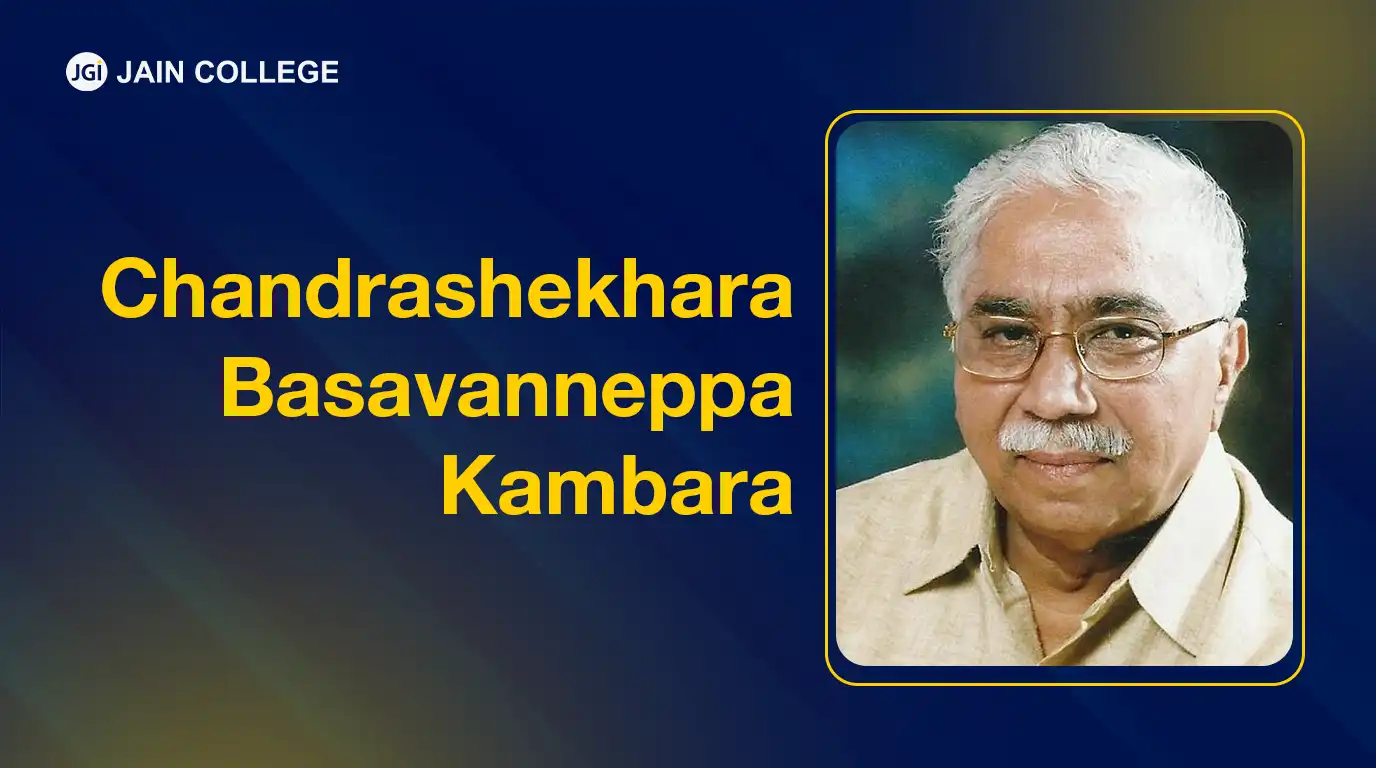
Chandrashekhara Kambara is a Jnanpith Award-winning Kannada poet, playwright, folklorist, and scholar known for integrating Indian folk theatre traditions into modern drama.
Among modern dramatists, Chandrashekhara Kambara stands out for his deep integration of folklore into his literary works. Few dramatists have used folk theatre traditions as expressively as Chandrashekhara Kambara in modern Kannada theatre.
Chandrashekhara Kambara is a renowned dramatist, poet, folklorist, novelist, and researcher.
Chandrashekhara Kambara was born on January 2, 1937, in Ghodageri, Belagavi, Karnataka, India. He belonged to a Kannada-speaking Kambara family and was the third and youngest son in the family.
He completed both his primary and higher schooling at the Municipal School in Gokak.
He later obtained a BA degree from Lingaraj College, Belgaum, followed by an MA in 1962.
At an early age, Chandrashekhara Kambara was interested in folk art, local culture, and rituals.
After completing his post-graduation, he pursued his PhD thesis on Uttara Karnatakada Janapad Rangabhumi ("The Folk Theatre of North Karnataka") from Karnataka University, Dharwad.
Chandrashekhara Kambara married Satyabhama in 1964; the couple had four sons.
Here is an overview of Chandrashekhara Kambara and a detailed timeline of his history.
| Chandrashekhara Kambara’s Chronology (January 2, 1937 - Present) | |
| Early Life | |
| Full Name | Chandrashekhara Basavanneppa Kambara |
| Birth Date | January 2, 1937 |
| Birthplace | Ghodageri, Belagavi, Karnataka, India |
| Nationality | Indian |
| Occupation | Poet, Playwright, Professor, Filmmaker, Folklorist, Academic administrator |
| Genre | Poetry, Drama, Folklore Studies, Literary Criticism |
| Family Details | |
| Parents | Basavanneppa Kambara and Chennamma |
| Siblings | Two Elder Brothers |
| Spouse | Satyabhama |
| Children | Four |
| Education & Career | |
| Primary and High school education at the Municipal High School, Gokak | |
| 1958 | B.A. degree from Lingaraj College, Belgaum |
| 1962 | M.A. degree from Karnataka University, Dharwad |
| 1970 | Ph.D. degree from Karnataka University |
| Literary Contributions | |
| Poetry | Mugulu Belli Meenu Helatena Kela Takararinavaru Ellide ShivapuraSamagra KavyaSaavirada NeraluAayda Kavanagalu Akkakku HaadugaleEevaregina Helatena Kela |
| Plays | JakkanaKharokhara Mathanthara Kittiya KathePushpa RaniBoleshankara Tirukana Kanasu Jokumaraswamy Bembattida Kannu Kambara Avara Natakagalu Sangya Balya Anabeko Naadolaga |
| Novels | Anna TangiShivana Dangura |
| Research and critical perceptions | Idu DesiSangya Balya Namma Janapada Kasigondu SeruBandire Nanna Jayolage Bannisi Hadavva Nana Balaga Bayalaatagalu and Matado LingaveKannada Folklore Dictionary (2 volumes)Uttara Janapada Karnatakada Rangabhumi. |
| Recognition and Awards | |
| 1975 | Kannada Sahitya Parishat |
| 1988 | Rajyotsava Award |
| 1991 | Sahitya Akademi Award (Siri Sampige) |
| 2001 | Padma Shri |
| 2010 | Jnanpith/Jnanapeeta Award |
| 2021 | Padma Bhushan |
| In addition to these honours, Chandrashekhara Kambara has received several state and national recognitions for his contributions to Kannada literature and theatre. | |
Chandrashekhara Kambara is a multifaceted individual who has been recognised as an illustrious scholar, filmmaker, and teacher. He later held high-level administrative positions, such as the
Chandrashekhara Kambara started his career after obtaining a master's degree.
He sought his future path under the guidance of Guru Bhayasanyaramath.
Chandrashekhara Kambara’s poetic sensibility reflects a deeply intuitive perception of the world.
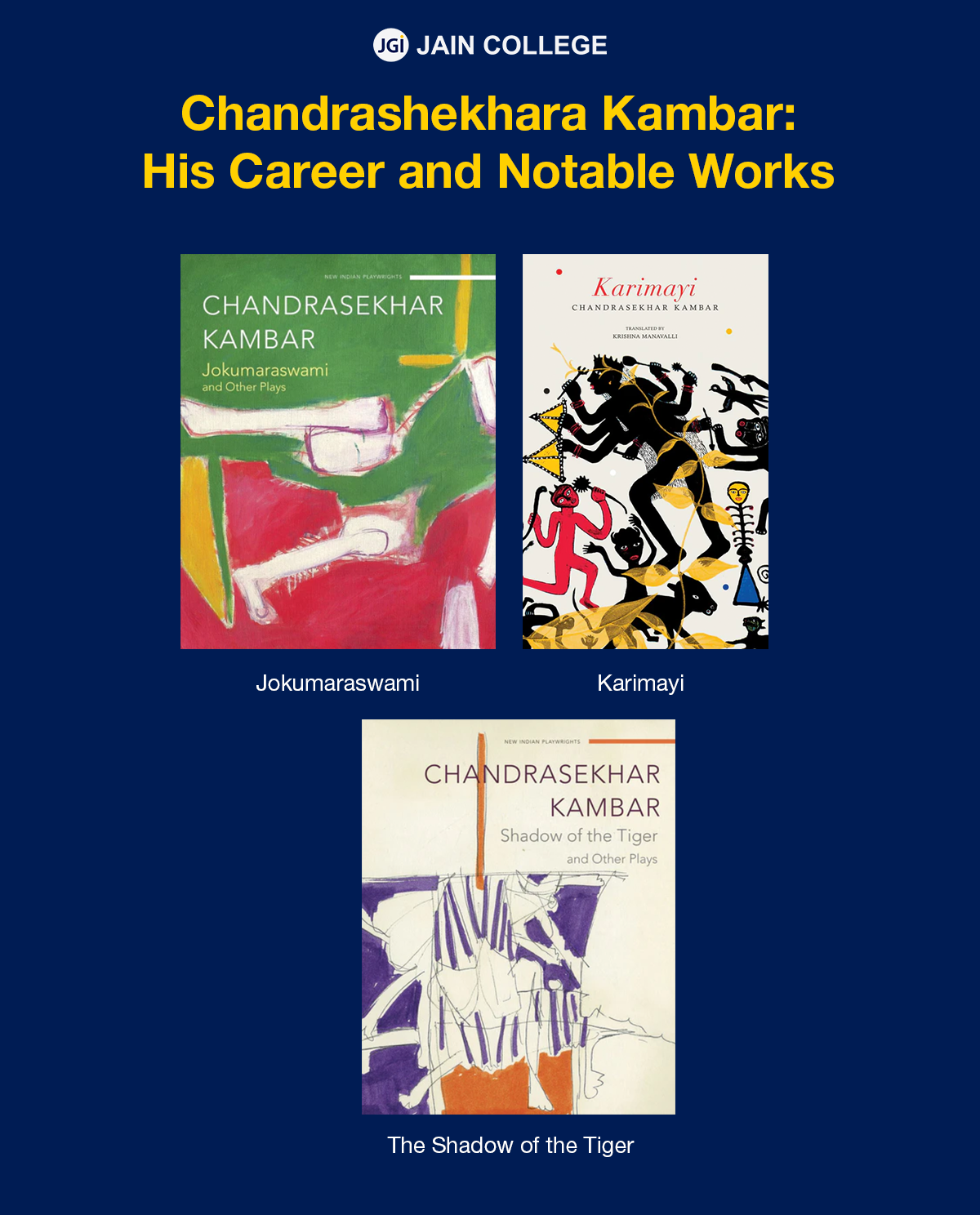
Chandrashekhara Kambara's notable works include:
A poet at heart, Kambara's corpus of literary achievements includes the following:
He has also authored several articles on topics such as folk theatre, literature, and education.
Kambara has made ten feature films along with fourteen documentaries. He has also composed music for six feature films, several documentaries and television series. Many of his works have been translated to English and several other Indian languages. Some of his plays and novels were adapted into film and also received a National Award.
To name a few:
Besides his voluminous research, Kambara has presented papers on Indian folklore and theatre at cultural organisations in India. He presented these papers at many universities and in different centers and organisations globally, including:
Here is a timeline highlighting the career milestones of the renowned Kannada poet, playwright, and folklorist Chandrashekhara Kambara:
| 1958 | Published his first poetry collection, Mugulu. |
| 1961 | Brought out his first play, Bembattida Kannu. |
| 1964 | Published his seminal long narrative poem, Helatena Kela. |
| 1965 | Published the Research work Uttara Janapada Karnatakada Rangabhumi. |
| 1968-1970 | Served as a visiting professor at the University of Chicago. |
| 1983-1987 | Chairman, Karnataka Nataka Sahitya Academy. |
| 1991-1998 | Vice-Chancellor, Kannada University, Hampi. |
| 1992-1996 | Member, Sangeet Natak Akademi. |
| 1996-2000 | Chairman, National School of Drama. |
| 1998 | Became a member of the Sahitya Akademi and the Sangeet Natak Akademi. |
Chandrashekhara Kambara is a renowned Indian poet, playwright, folklorist, film director, and academic who writes primarily in Kannada.
Karnataka's folk tradition, mythology, and rural life inspire his works. Throughout his extensive career, he received numerous prestigious awards and recognition for his contributions to literature, theatre, and education.
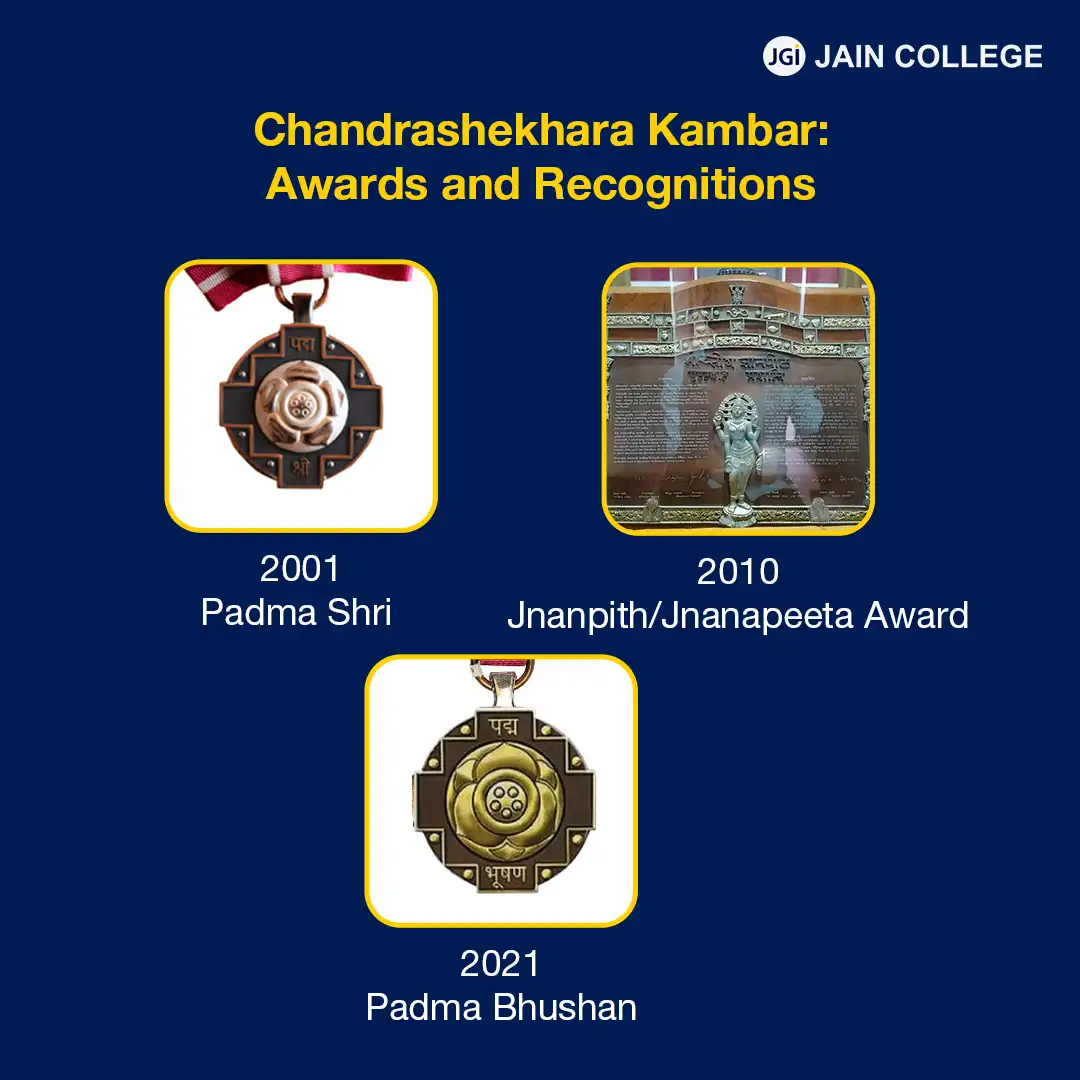
Here’s a summary of Chandrashekhara Kambara’s major awards and recognition:
| Central Awards: | |
| 1983 | Sangeet Natak Akademi Award |
| 1991 | Sahitya Akademi Award |
| 2001 | Padma Shri |
| 2010 | Jnanpith Award |
| 2011 | Sangeet Natak Akademi Fellowship |
| 2021 | Padma Bhushan |
| State Awards: | |
| 1971 | Kannada State Academy Award |
| 1975 | Kannada Sahitya Parishat |
| 1982 | Kumaran Ashan Award (Kerala) |
| 1987 | Karnataka Natak Academy |
| 1987 | Nandikar Award (Kolkata) |
| 1988 | Rajyotsava Award (Karnataka) |
| 1989 | Karnataka Sahitya Academy |
| 1991 | Sahitya Akademi Award for his play Siri Sampige |
| 1993 | Janapada and Yakshagana Academy Award |
| 1997 | Masti Award (Karnataka) |
| 2002 | Sant Kabir Award |
| 2004 | Pampa Award |
| 2004 | Nadoja Award |
| 2005 | Joshua Sahitya Puraskaram (Andhra Pradesh) |
| 2007 | Devaraj Urs Award (Karnataka) |
| 2011 | Sangeet Natak Akademi Fellowship (Akademy Ratna Award) |
| 2018 | Kadammanitta Ramakrishnan Award (Kerala) |
Chandrashekhara Kambara is a creative genius of Karnataka. He was a multi-talented Kannada poet, playwright, novelist, public figure, critic, singer, and director of drama and film.
Chandrashekhara Kambara has achieved enormous success in literature and languages. Through his innovative use of folklore and regional traditions, Kambara significantly contributed to modern Kannada literature and theatre.
Learn more about Karnataka's famous literary authors, poets and Kannada Jnanapeeta / Jnanpith winners. Visit the blogs on our website at JAIN PU College.
Which of Chandrashekhara Kambara’s plays or poems has inspired you the most, and why?
Share your thoughts in the comments below.
Chandrashekhara Kambara is an award-winning playwright. He is also a well-known writer of poetry, fiction, and literary and cultural criticism in Kannada. Chandrashekhara Kambara, a man with many interests, is also an illustrious scholar, filmmaker, and teacher. He is the recipient of the Jnanpith Award, the Padma Shri and many other awards and recognitions.
Bembattida Kannu was his first play to be published in 1961
Rocks of Hampi, written by Chandrashekhara Kambara, was translated into English by O. L. Nagabhushana Swamy in 2004.
Chandrashekhara Kambara's unique fusion of myth, folklore and modern themes distinguishes him from his literary peers.
Throughout his extensive career, Chandrashekhara Kambara has written more than 25 plays.
Kambara has written many books. Throughout his extensive career, he has written:
Kambara draws inspiration from folk myths and folk literature for his experiments.
Kambara has made 10 feature films and 14 documentaries, and he has composed music for 6 feature films, several documentaries, and teleserials.
Chandrashekhara Kambara's favourite Kannada writers include Kuvempu, Basava, Gopalakrishna Adiga, and Kumara Vyasa. His favourite English writers include Federico García Lorca, W.B. Yeats, and William Shakespeare.
Here are some of Kambara's plays, which were filmed and received Awards:
Other than these award-winning films, there are some other Kambara plays and novels that were also filmed, including:

JAIN PU College, a part of the renowned JGI Group, is committed to empowering students with quality education.
Beyond academics, the college ensures its online content reflects the same standard of excellence. Every blog and article is meticulously vetted and proofread by subject matter experts to ensure accuracy, relevance, and clarity. From insightful educational topics to engaging discussions, JAIN PU College's content is crafted to inform, inspire, and add value to its readers, reflecting the institution's commitment to intellectual growth and innovation.
View all Blogs