





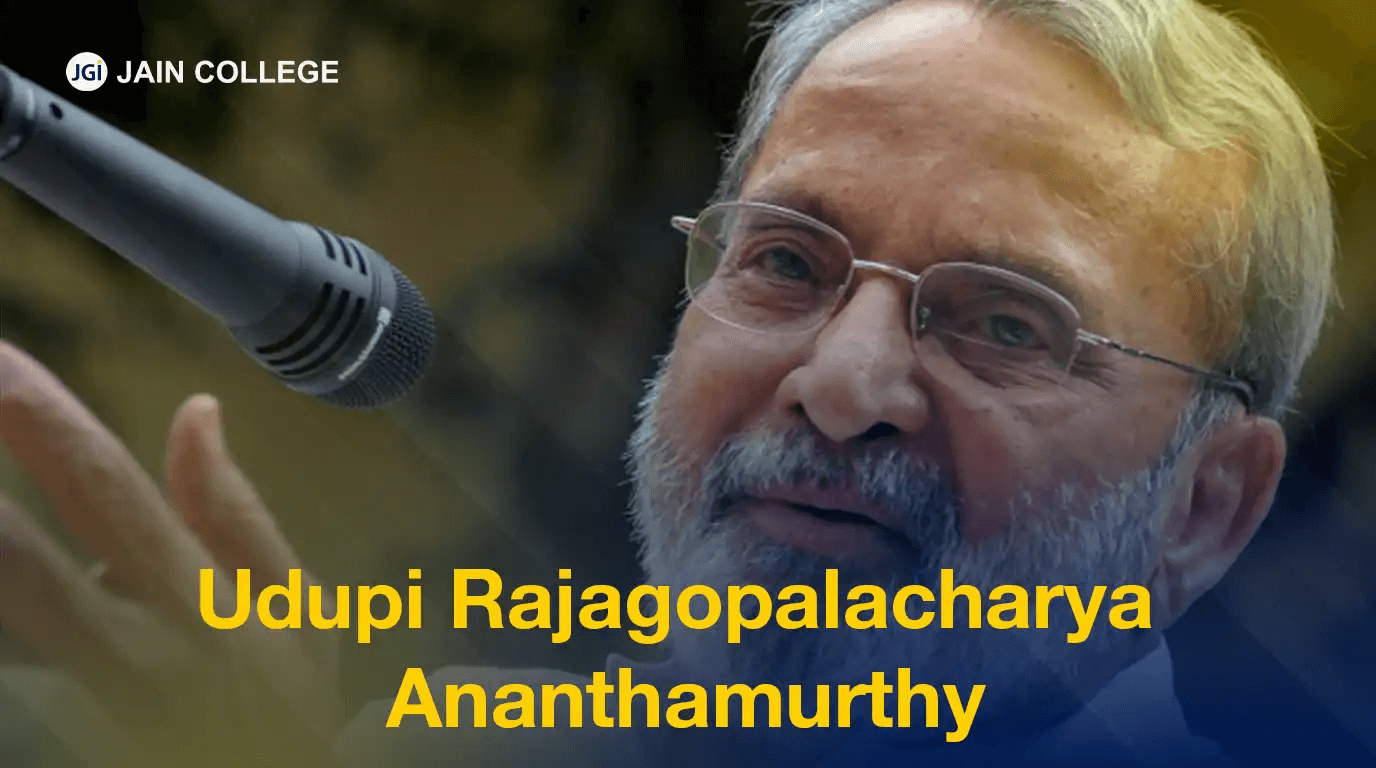
U.R. Ananthamurthy was a pioneering modernist Kannada writer, critic, and public intellectual, best known for leading the Navya movement and winning the Jnanpith Award in 1994.
Kannada Literature has greatly influenced other literary genres all over India.
Kannada Literature has produced several well-known poets and writers. In addition to housing several notable poets and authors, Kannada Literature has enriched the literary repertoire of our country. It has also contributed to the avant-garde movement and new-age literature.
Udupi Rajagopalacharya Ananthamurthy, popularly known as U.R. Ananthamurthy, was an Indian contemporary writer and critic in the Kannada language. He is well known among the Indian authors.

Ananthamurthy was born in Melige, a village near Tirthahalli in present-day Shivamogga district, Karnataka.
Professor Udupi Rajagopalacharya Ananthamurthy is one of the most eminent Indian writers. He presided over high modernism in Kannada Literature in a unique manner through his novels, short stories, poetry, and critical writing.
U.R. Ananthamurthy was born in a small village called Melige in Shimoga District, Karnataka, on December 21, 1932. He completed his primary schooling in a traditional Sanskrit school in his village. He obtained a master's degree in English from the University of Mysore, and later, in 1966, he earned a degree from the University of Birmingham in the U.K.
U.R. Ananthamurthy married Esther in 1956, and together they had two children.
During the later years of his life, R. Ananthamurthy and his family lived in Bangalore.
On August 22, 2014, the renowned Kannada writer and Jnanpith award winner U.R. Ananthamurthy died at the age of 81 at Manipal Hospital in Bangalore due to multiple organ failure following a prolonged illness.
This section provides an overview of U.R. Ananthamurthy and a detailed timeline of his history.
U.R. Ananthamurthy's literary works are well-known for their creative writing. As mentioned earlier, Ananthamurthy was born into an upper-caste orthodox Brahmin family and grew up witnessing the conservative structure of Indian society since his childhood.
The archaism and stagnancy of the system pushed him to question the norms and dogmas held by society. Most of his works address people's psychological aspects in different situations, times, and circumstances. In his writings, he offers an analysis of challenges, changes, and effects that befall Brahmin families in Karnataka, as well as bureaucrats dealing with politics.
Ananthamurthy's works have been awarded important literary prizes.
Ananthamurthy’s work often displayed a progressive perspective, which questioned the relevance of all medievalist ideologies. Some of the major themes of his
literary output were:
Ananthamurthy portrayed the lives of the common men and women of Karnataka with all their colours, dimensions, and sensibilities.
Ananthamurthy authored primarily in his native Kannada language. Many of these works
are also translated into English. Because of his complex engagement with the subject matter, these works have also received critical appreciation from English-language readers.
His major works include poems, plays, autobiographies, literary criticisms, essays, and more. Many of his works were translated into several Indian and European languages. Some of his significant contributions include:
| Plays: Aavaahane |

| Novels: Bhava Divya Avasthe Bharathipura Preeti Mrithyu Bhaya |

| Collection of Stories: Mouni Prashne Pachhe Resort Sooryana Kudure Aayda Kathegalu |

| Other Notable Works: |
| Collection of poems Abhava Mithuna 15 Padyagalu Samasta Kavya Ajjana Hegala Sukkugalu |
| Literary criticism and essays: Sannivesha Samakshama Poorvapara Yugapallata Prajne Mattu Parisara |
Most of his novels were made into films. Some of these include Samskara, Bara, Mouni, Sookha, Ghatashraddha, and Diksha.
The Jnanpith Award is considered the highest literary award in India.
U.R. Ananthamurthy was the sixth Kannada writer to receive this prestigious award, and he was honoured for his remarkable contributions to literature.

U.R. Ananthamurthy received many awards and honours for his versatile service. Here are some of them:
As a testament to his literary genius beyond Kannada readers, Ananthamurthy was shortlisted for the DSC Prize for South Asian literature in 2012 for his novel Bharatipura, originally written in Kannada.
One of India's most distinguished modernist writers and public intellectuals is
U.R. Ananthamurthy. His legacy lives on in Kannada Literature and in the ongoing debates about being modern, Indian, and humane.
Explore more about Karnataka's famous literary authors and poets at JAIN PU College Blogs.
Yes. U. R. Ananthamurthy was a leading voice of the Navya (Modernist) movement in Kannada literature. He shaped modern Kannada literature through novels, essays, and critical writing.
In 1994, U.R. Ananthamurthy received the Jnanpith Award, India's highest literary honour, for his contributions to Kannada and Indian literature.
In 1998, U.R. Ananthamurthy received the Padma Bhushan award for his contributions to Indian literature and his work in the Kannada language.
Yes. U.R. Ananthamurthy worked as a visiting professor at Shivaji University, Cornell University, the University of Iowa, and Tufts University.
Yes. U.R. Ananthamurthy worked at Mysore Radio (Akashvani) and had a successful stint as an interviewer there.

JAIN PU College, a part of the renowned JGI Group, is committed to empowering students with quality education.
Beyond academics, the college ensures its online content reflects the same standard of excellence. Every blog and article is meticulously vetted and proofread by subject matter experts to ensure accuracy, relevance, and clarity. From insightful educational topics to engaging discussions, JAIN PU College's content is crafted to inform, inspire, and add value to its readers, reflecting the institution's commitment to intellectual growth and innovation.
View all Blogs