







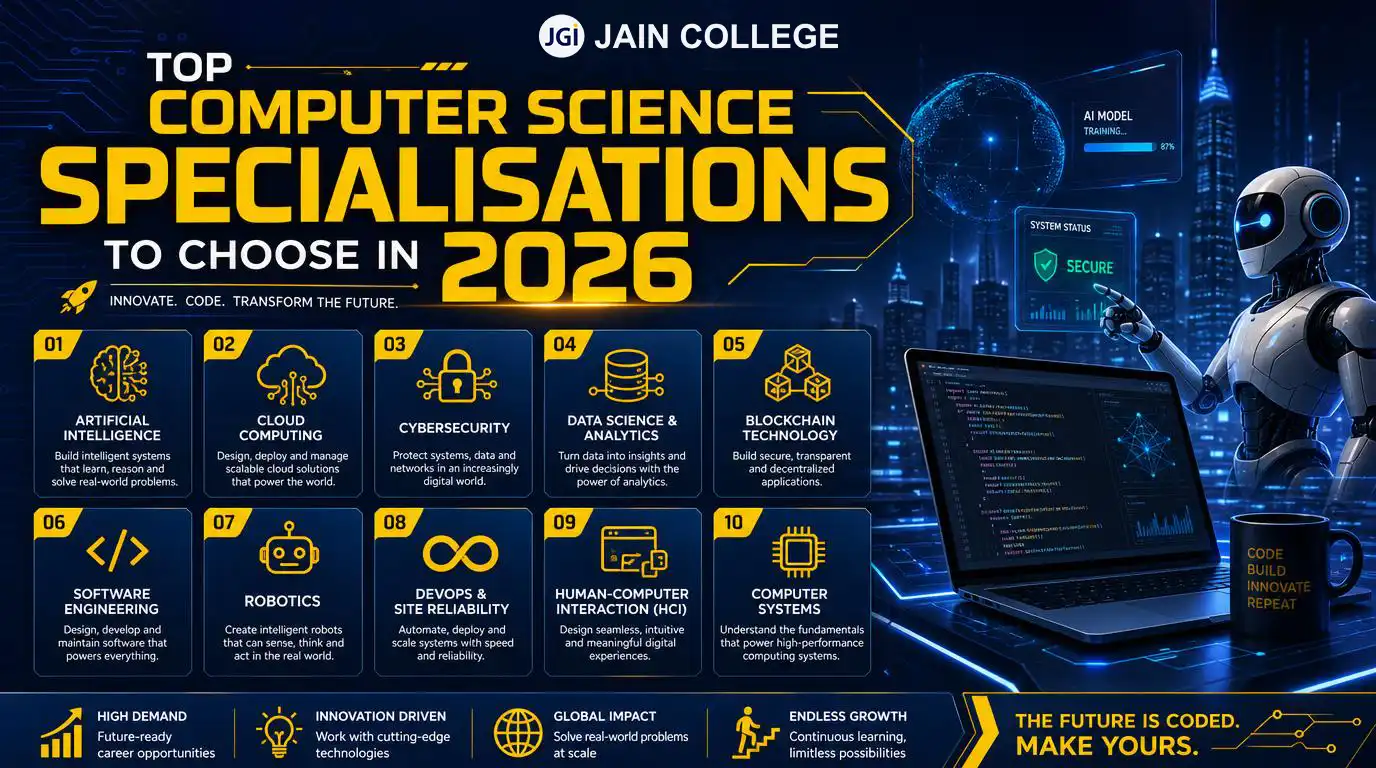
Choosing a Computer Science specialisation is a wise choice, and it really depends on what students prefer.
In today’s digital world, Computer Science doamain has many specialised fields like Artificial Intelligence, Data Science, Cybersecurity and Full-Stack Development. These fields are very popular because we use them in our daily lives.
So what is a Computer Science specialisation?
A Computer Science specialisation is the best option that matches students' interests and the kind of work they enjoy.
Therefore, the best way to figure out what students like is to choose a particular domain, build a few projects and evaluate how students might feel about Computer Science and the specialisation that they have chosen.
According to the U.S. Bureau of Labor Statistics, employment in computer and information technology occupations is projected to grow faster than the average for all occupations between 2023 and 2033, creating about 356,700 job openings each year.
A Computer Science specialisation is a focused area of study within Computer Science that develops expertise in a specific technology domain or computing discipline. These specialisations allow students to gain advanced knowledge and practical skills in areas such as:
Computer Science focuses on the theory of computation, software development, algorithms, data structures, computer systems, and programming languages. Specialisation enables students to apply foundational knowledge to industry-specific challenges
Choosing the right specialisation prepares students for careers that align with their interests and industry demand.
Computer Science provides the theoretical and practical foundation for many computing disciplines. Computer Science encompasses areas such as algorithm design, computer architecture, software development, and data management.
Software Engineering focuses on designing, developing, testing, and maintaining efficient software systems. Theoretical Computer Science involves developing mathematical models and algorithms to solve computational problems.
Computer scientists define the computational principles that are the basis of all software.
Computer Science combines theory, algorithms, and programming to design innovative computing solutions. It involves working with:
Computer scientists apply computational principles as the foundation of software development. A specialisation in a Computer Science master's programme gives students the opportunity to develop expertise in a specific area of computing.
By selecting the right specialisation, students can align their education with both their career goals and the demands of the industry. Furthermore, specialised knowledge enhances employability by equipping graduates with in-demand technical skills. Thus, a well-chosen specialisation contributes to long-term career growth and professional success.
Overall, employers prefer candidates with strong Computer Science basics. Practical experience in a specific area is also important. Thus, well-chosen specialisation contributes to
Each Computer Science specialisation develops a unique skill set. Thus, it is important for students to determine their career goals.
Computer Science offers a variety of specialisations that cater to different interests and career goals. Rapid technological advancements have expanded the applications of Computer Science across industries, which has increased the demand for specialised expertise.
Computer Science applies computing principles to design, develop, and optimise software, algorithms, and computing systems.
Artificial Intelligence (AI) is a branch of computer science that focuses on developing systems capable of performing tasks that typically require human intelligence, such as learning, reasoning, problem-solving, and decision-making.
Skills acquired:
Career opportunities:
Data science involves analysing large datasets to identify patterns, generate insights, and support data-driven decision-making. The growing use of data across industries has increased the demand for professionals with expertise in data science and analytics. This is because they assist businesses and organisations in making critical decisions by forecasting financial, business growth, and market trends.
Skills acquired:
Career opportunities:
Information security is the practice of protecting information and information systems through policies, processes, technologies, and controls to ensure their confidentiality, integrity, and availability. It safeguards data against unauthorised access, disclosure, alteration, disruption, and destruction.
Skills acquired:
Career opportunities:
Full-stack development has gained momentum within the field of Computer Science and engineering. This specialisation will remain in demand as organisations invest in software development and digital transformation.
Skills acquired:
Career opportunities
This specialisation focuses on designing user-centred systems by applying the principles of human-computer interaction (HCI) These mainly include virtual reality, websites, smartphones, and voice-enabled speakers. The effective and efficient development and deployment of Human-Computer interfaces call for the strategic application of standard libraries. This helps ensure that applications are usable, accessible, and compatible across different platforms and devices
Skills acquired:
Career opportunities:
Game design and development is a vast field that incorporates AI and machine learning technologies, which are key drivers of innovation across industries. This specialisation ensures coordination between back-end developers and front-end designers, delivering a seamless gaming experience.
Skills acquired:
Career opportunities:
This specialisation in the field of Computer Science deals with how different companies use wired and wireless networks for crucial information exchange with their stakeholders, both internal and external. Professionals specialising in computer networks design, implement, and maintain communication systems.
Skills acquired:
Career opportunities:
Computer graphics is a widely used specialisation in areas such as:
It deals with 2D and 3D images. Computer Graphics has wide-ranging applications in industries such as gaming, animation, film production, virtual reality, architecture, healthcare, and product design.
Skills acquired:
Creativity
Collaboration
Attention to visual and artistic detail
Career opportunities:
Computer Graphics is a Computer Science specialisation that focuses on creating, processing, and rendering visual content through computational techniques. It combines programming, mathematics, and design principles to develop realistic images, animations, simulations, and interactive digital experiences for applications across gaming, entertainment, healthcare, engineering, and virtual reality. Some of the career options available with this specilisation include:
| Specialisations | Focus on |
| Edge AI | Deploying AI models on edge devices for real-time data processing with minimal latency. |
| Generative AI | Developing AI systems that generate text, images, code, audio, and other digital content. |
| Quantum Computing | Designing algorithms and software for quantum computers to solve complex computational problems. |
| Blockchain Engineering | Building secure, decentralised applications and smart contract solutions using blockchain technology. |
| Augmented Reality (AR) and Virtual Reality (VR) | Creating immersive digital experiences for gaming, education, healthcare, and industrial applications. |
Each specialisation addresses distinct technological challenges and equips students with the knowledge and skills required for emerging areas of computing. By choosing a specialisation aligned with their interests and career goals, students can develop advanced expertise and prepare for evolving opportunities in the technology industry.
In general, specialising in these disciplines helps students:
Computer Science is a broad term that includes theory, analysis, design, and implementation of information systems. This field offers a wide range of specialisations.
Choosing a Computer Science specialisation is an important academic decision that shapes the knowledge, skills, and expertise students develop during their studies.
The right specialisation enhances technical capabilities and helps students develop their professional identity in the field. As they advance, this focus helps them distinguish themselves from others. The right specialisation can help students develop expertise that supports long-term professional growth and adaptability
When choosing a Computer Science specialisation, students should consider their interests, strengths, and career goals. Here are some key factors, which students should consider while making the right choice:
| Career Goals: Choose a specialisation that aligns with students' long-term professional aspirations. |
| Salary Potential: Expected earning opportunities in the chosen field |
| Work-Life Balance: Nature of workload, flexibility, and work environment |
| Skill Set Alignment: Compatibility with technical strengths and abilities |
| Interest and Passion: Genuine enthusiasm for the subject area |
| Global Opportunities: International demand and career mobility |
| Future Trends and Innovations: Growth potential of emerging technologies |
| Academic and Industry Support: Availability of learning resources, internships, and mentorship |
| Industry Demand and Job Prospects: Employment opportunities and market demand for the specialisation |
Choosing the right specialisation requires careful thought. By evaluating these factors, students can select a specialisation that aligns with their interests, strengths, and long-term career goals.
Computer Science offers a wide range of specialisations, enabling students to develop expertise in specific areas of the discipline. Students should choose a specialisation that aligns with their interests, strengths, and career aspirations.
Choosing the right Computer Science specialisation does not have to be an overwhelming task. Thus, start by thinking about students' passions, talents, and preferred job types.
Remember, there is no single “perfect” choice. Maintain a unique perspective consistently.
What matters most is choosing a path that aligns with students' interests, strengths, and career aspirations. With the right specialisation, students can develop the knowledge and skills they need for long-term career success.
Computer Science specialisation deals with the science of information. It is the practice of information processing and the engineering of information systems.
Computer Science is the study of the theoretical foundations of information and computation and of practical techniques for their implementation and application in computer systems.
Computer Science involves designing, developing, testing, and analysing software, algorithms, and computing systems to solve complex problems.
Some of the most important factors that need to be considered are:
Some of the most sought-after careers in Computer Science include:

JAIN PU College, a part of the renowned JGI Group, is committed to empowering students with quality education.
Beyond academics, the college ensures its online content reflects the same standard of excellence. Every blog and article is meticulously vetted and proofread by subject matter experts to ensure accuracy, relevance, and clarity. From insightful educational topics to engaging discussions, JAIN PU College's content is crafted to inform, inspire, and add value to its readers, reflecting the institution's commitment to intellectual growth and innovation.
View all Blogs
