








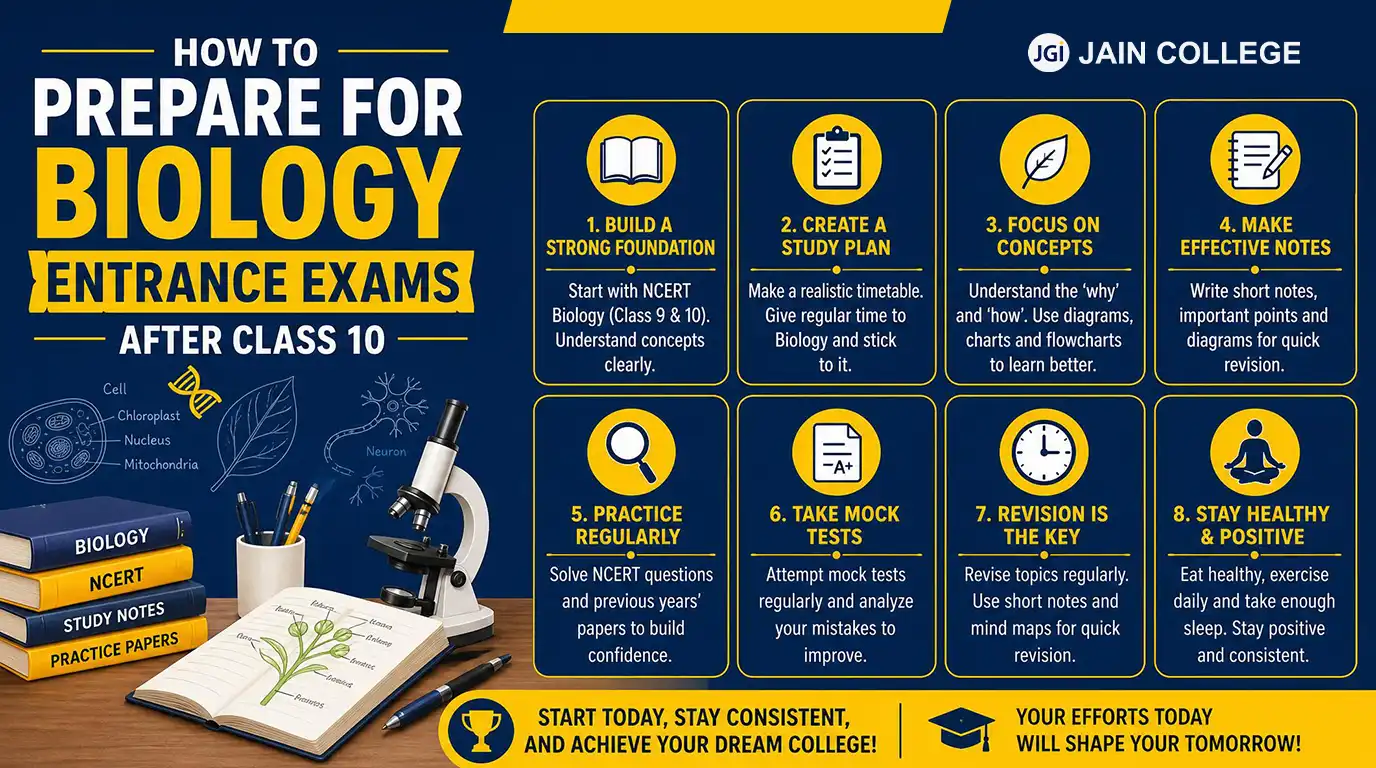
For students who want to take Biology entrance exams after Class 10, it is crucial to study smarter rather than harder.
With these preparation strategies, Biology concepts become clearer, revision becomes faster, and students' confidence in Biology exams grows naturally.
JAIN PU College is widely recognised as one of the best PU colleges in Bangalore, with well-established programmes in Biology, Chemistry and other Science streams.
Table of Contents
Biology is one of the most important subjects for students aspiring to pursue careers in medicine and life sciences. It focuses on the study of living organisms, their life processes, and their interactions with the environment. The subject forms the foundation for fields such as biotechnology, genetics, ecology, molecular biology, zoology, and botany, making it an essential part of the school curriculum.
Entrance exams are the gateway to getting admission into the desired college and
also help students strengthen their analytical skills, logical thinking, and problem-solving abilities.
Here is the list of top Biology entrance exams that students can take after Class 10.
| Entrance Exam | Purpose of the Exam |
| NSEB (National Standard Examination in Biology) | Pathway to the International Biology Olympiad (IBO). |
| Olympiads (Biology-related) | Builds strong concepts and valuable certifications |
| NEET Foundation Exams (coaching-level preparatory exams) | For future MBBS, BDS, Veterinary, AYUSH |
| Pharmacy and Healthcare Diplomas and Common Paramedical Courses | Admission to diploma-level healthcare and paramedical programmes such as DMLT, OTT, MPHW ,GDA and more (These courses may vary as per state eligibility.) |
Note:
JAIN PU college, recognised as one of the top PU colleges in Bangalore with NEET coaching, offers a rigorous and comprehensive NEET coaching programme, equipped with modern laboratories, well-furnished classrooms, and an extensive library, all contributing to a conducive atmosphere for NEET preparation.
Preparing for Biology entrance exams can be challenging, but the right mindset and consistent effort can help students stay focused and confident.
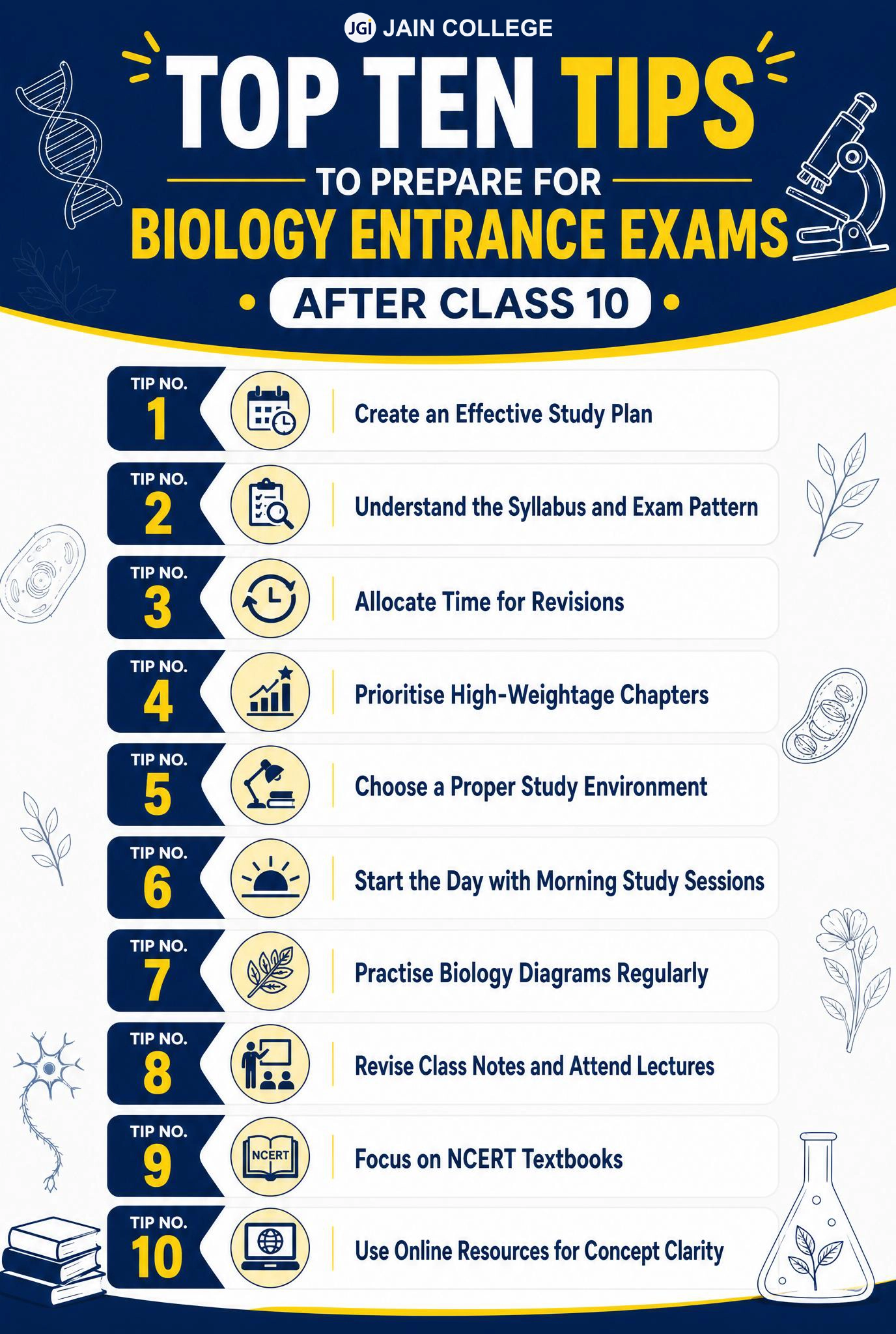
To help students with their exam preparations, here are some important tips for those preparing for their Biology entrance exams after Class 10.
A well-structured study plan helps students cover the syllabus systematically and avoid last-minute stress. Allocate dedicated time for learning new concepts, revising completed topics, and taking mock tests to track progress.
Tip No. 2: Understand the Syllabus and Exam Pattern
Begin by thoroughly reviewing the exam syllabus and pattern to understand the topics, marking scheme, and question types. Break the syllabus into smaller study units, prioritise challenging chapters first, and create a realistic timeline for completion.
Ensure there is enough time allocated for revision as well. Use techniques like spaced repetition (revisiting material at increasing intervals) to aid memory retention. Make sure to solve more model question papers and previous years' question papers to boost confidence.
High-weightage chapters are those that have appeared frequently across multiple entrance exam sessions over the years. Focusing more on these chapters will help students maximise their scoring potential and ensure they cover the entire syllabus.
Choosing the right study environment is key to academic success. Thus, select a study environment that is free from all sorts of disturbances, spacious, and has adequate ventilation and light to support better concentration and cognitive performance.
Tip No. 6: Start the Day with Morning Study Sessions
Always begin preparation early in the morning with a fresh mindset. Research suggests that cognitive functions such as memory and attention often perform better in the morning for many students. Thus, early morning preparation improves memory retention.
Biology is a subject where diagrams carry the highest weightage in examinations.
Diagrams assist students in grasping concepts and strengthening their memory.
Using well-labelled, clear diagrams from NCERT books will boost students' confidence and their marks. Overall, a neatly labelled diagram can help students earn full marks for their answers, and with regular practice, it can positively influence exam performance.
Consistent practice and dedication are essential for success. Always attend classes regularly and stay focused on the teacher’s lectures. Taking clearly organised notes in class is important, as it helps students improve their focus and understand key concepts.
NCERT textbooks form the foundation for the entrance exam preparations after Class 10. NCERT content forms a significant portion of many Biology entrance exam questions. Hence, practise using more concepts and diagrams from the NCERT books. Also, practise all the questions given at the end of each chapter.
To improve conceptual clarity, students can refer to reputable educational videos and online learning platforms.
For instance, watching educational videos can help students understand complex topics, such as photosynthesis, more effectively than through rote memorisation.
In addition to these ten tips for preparing for entrance exams, students should also prioritise their health and well-being by staying consistent and managing their stress effectively. This includes the following:
By following a structured study plan and focusing on key concepts, students can build confidence and improve their performance in Biology entrance examinations.
To complete the syllabus on time, study on a regular basis and create a weekly study schedule that allocates dedicated time to Biology concepts, revision, and mock tests to ensure steady progress.
JAIN PU College, recognised as one of the top PU colleges for PCMB Science in Bangalore, offers a strong academic foundation with integrated coaching programmes tailored for students aiming for professional careers. Students aspiring to study engineering, medicine, or management in college. JAIN PU College has structured programmes to help students prepare for the entrance tests.
All the Best!
These entrance exams are more than tests; they are stepping stones to prestigious careers and impactful futures.
Preparing for Biology entrance exams after Class 10 helps students stay focused on long-term academic and career goals. This entrance exam is crucial for students aiming to pursue careers in medicine, healthcare, life sciences, or biotechnology or continue with their higher studies. Starting the preparations early after Class 10 provides students with the clarity, confidence, and competence required to succeed.
Stay tuned to JAIN PU College blogs and explore more study plans, resources, and Biology entrance exam tips to ensure your success in the competitive landscape.
Shape Your Future with JAIN College's Integrated Programmes!
Which Biology entrance exam are you aiming for? Let us know your goals and preparation plans.
Share your thoughts in the comments below.
Yes, the ideal time to start preparation for NEET is immediately after Class 10.
This is because, for many students, early morning study sessions can support better focus, concentration, and memory retention.
Some of the disadvantages of studying late at night include:
Yes. Diagrams play an important role in all biology examinations. Examiners reward clear, neat, and well-labelled diagrams, sometimes even more than long written answers.
Because diagrams help students understand and remember the concepts easily.
Yes. The NCERT textbooks are crucial for NEET 2026 as they contain most exam topics. For Biology, Chemistry, and Physics, the NCERT textbooks are more necessary. At the same time, students are also advised to refer to other reference books, model question papers, and question papers from previous years for a more profound understanding.
Yes, preparing for Biology entrance exams after Class 10 helps students develop thinking, strengthens their core concepts and builds the strong foundation required for medical courses and entrance exams.
Revising frequently helps students understand the concepts better and remember them during exams.
Students can pursue careers in medicine, dentistry, nursing, pharmacy, physiotherapy, veterinary science, biotechnology, biomedical sciences, public health, nutrition, medical research and many other healthcare and life-science fields. Biology entrance exams can lead to a range of career options.
To succeed in academics, it is crucial to identify the mistakes students make during competitive exam preparation. Here are some of the common ones:
Students can remember Biology concepts better by:
Coaching can be helpful as it provides structure and guidance. It is not necessary for all students. Many students do well by studying on their own with the help of learning resources and regular practice.
Students can start preparing for Biology entrance exams soon after completing Class 10. This is a good time to build a strong foundation in Biology, Chemistry, and Physics, which form the core subjects for most medical entrance exams.
Students should focus mainly on high-weightage chapters including Cell Biology, Human Physiology, Genetics, Ecology, Reproduction, Plant Physiology and Biotechnology. Along with these chapters, students should also try to understand all the concepts instead of just focusing on a few chapters.
For foundation preparation students should study Biology for 1 to 2 hours every day. It is better for students to study regularly and try to understand the concepts of studying for a long time.
The best way for students to study for Biology entrance exams is to learn concepts by understanding them rather than just memorising. Other strategies include the following:

JAIN PU College, a part of the renowned JGI Group, is committed to empowering students with quality education.
Beyond academics, the college ensures its online content reflects the same standard of excellence. Every blog and article is meticulously vetted and proofread by subject matter experts to ensure accuracy, relevance, and clarity. From insightful educational topics to engaging discussions, JAIN PU College's content is crafted to inform, inspire, and add value to its readers, reflecting the institution's commitment to intellectual growth and innovation.
View all Blogs
