









After Class 10, students often find it difficult to decide between Biology and Computer Science.
Some students really like learning about the body, plants, animals and how to stay healthy. Others are more interested in computers, coding and new technology.
That is why there is no single correct answer. The better option depends on the student’s own interests and comfort level.
Biology is a science which all deals with the study of life, living things like plants and animals and the human body. Computer Science is all about computers and coding and technology. We use Computer Science to learn about computers, and Computer Science is very important for technology.
Thus, each subject requires different skills, ways of learning, and passions.
To choose the subject, students need to know the main differences between Biology and Computer Science. This helps them choose the subject that suits their strengths, interests, and future goals.
Let us explore the key differences between Biology and Computer Science.
| Biology focuses on the study of living organisms, while Computer Science focuses on computers, coding, and digital systems. |
Biology is the study of life.
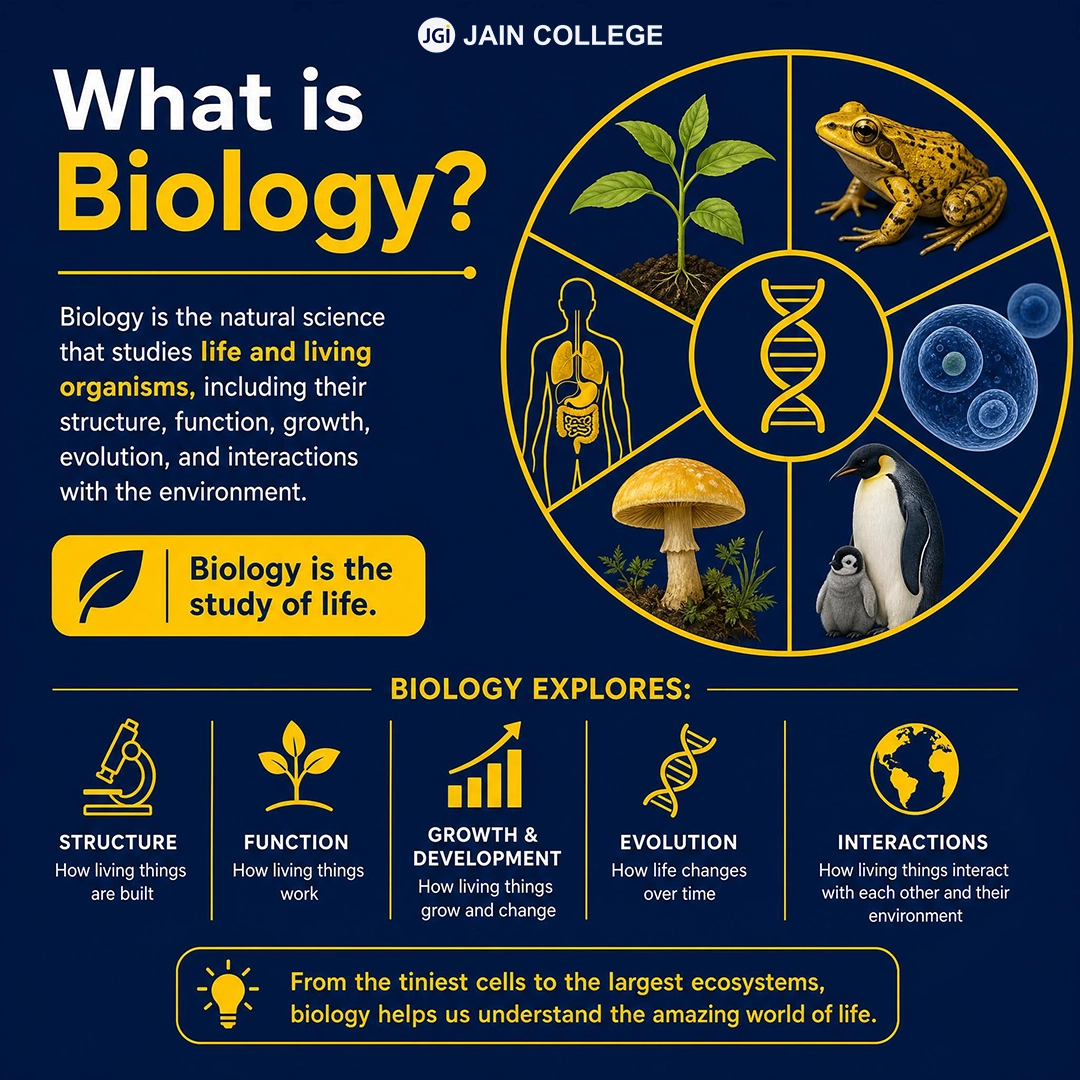
The word 'Biology' is derived from the greek words /bios/, meaning /life/, and /logos/, meaning /study/, and is defined as the science of life and living organisms. An organism is a living entity consisting of one cell, e.g., bacteria, or several cells, e.g., animals, plants and fungi.
Biology is a broad field which includes many sub-disciplines, such as Anatomy, Botany, Evolution, Genetics, Zoology and more. It explains to students about how living things breathe, eat, grow, move, and respond.
Biology is also about how living things have babies and interact with the world around them. It is about all living things, from small, minute, single-celled organisms to big multicellular organisms made up of many cells.
Biology is a subject that includes many smaller subjects like Anatomy, Botany, Evolution, Genetics and Zoology. The main parts of biology are:
Some other important areas of biology are anatomy, physiology, ecology, taxonomy, embryology and microbiology.
Biology helps students understand plants, animals and tiny living things. It teaches them how these things grow and survive. Students also learn about how these things change over time. Biology is about the scientists who made discoveries and what they learned. Biology is a subject that teaches us about living things and how they work. The subject includes plants, animals and tiny living things. Biology is important because it helps us learn about all living things.
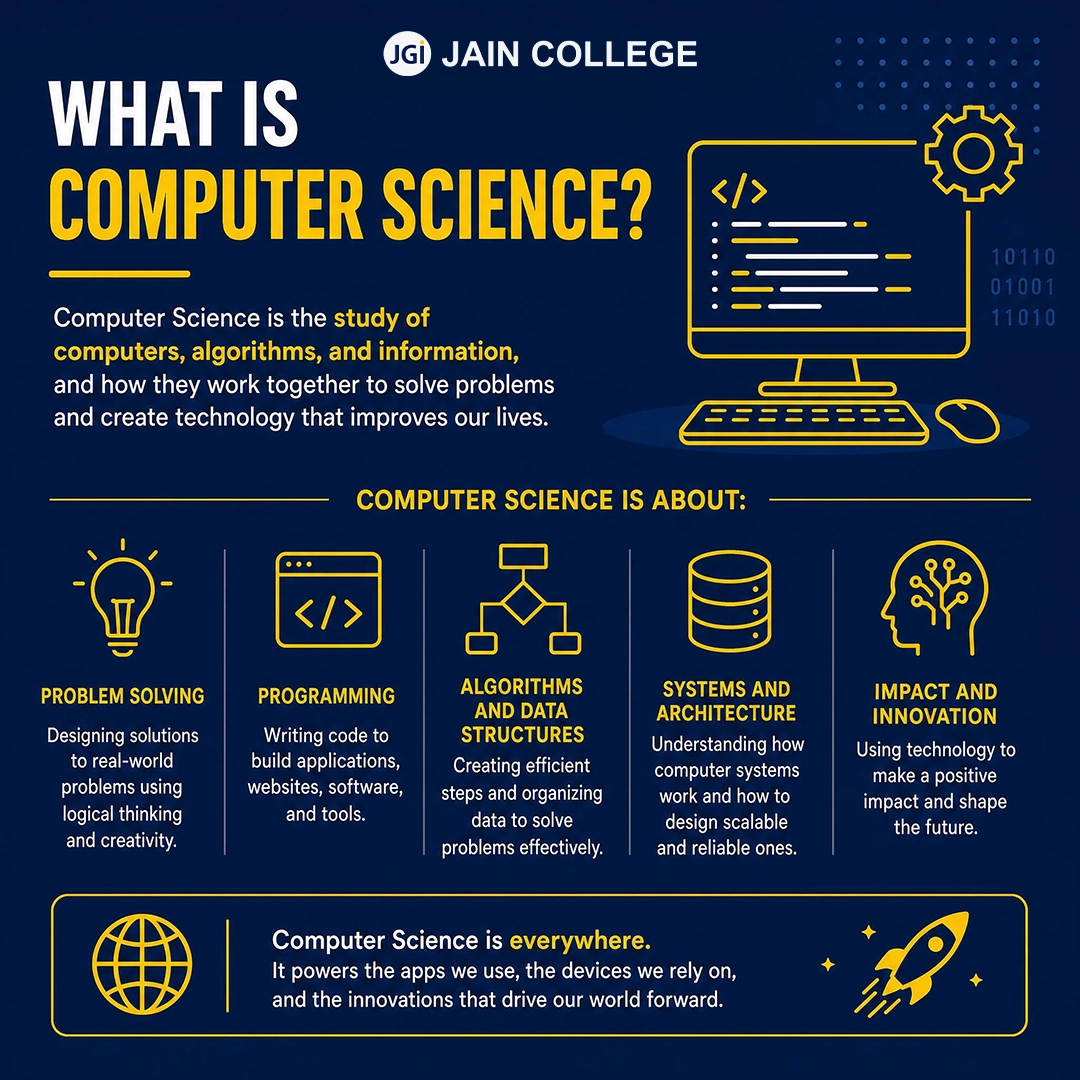
Computer Science is the study of the foundations of information and computation. This field takes a scientific and practical approach to computation and its applications.
Charles Babbage is known as the 'father of the modern computer' and is credited with describing the evolution from mechanical to modern computing.
A Computer System refers to the process of performing computations and making logical decisions.
The main advantage of Computer Science is that it is the fastest medium of communication. Arithmetic problems can be easily solved. Computers make it possible to receive, supply and process large volumes of data at very high speeds.
Computer Science is very different in terms of learning style. The subject focuses on computers, programming, and problem-solving. For high school students, computer science is an excellent option to build a foundation and improve their knowledge and skills in various computer-related fields.
Computer Science is a way to learn about computers and improve skills like programming.
Computer Science courses help students develop skills in:
Students also gain exposure to mathematical concepts, logic, and discrete structures, which help develop critical thinking and analytical abilities.
One common misconception is that one stream is easier than the other. The truth is, both Biology and Computer Science require a lot of effort.
Biology usually involves a lot of reading, while Computer Science needs regular practice and logical thinking. A student who enjoys coding may find Computer Science easier while another student who likes theory and science may feel more comfortable with Biology.
Here are major differences between Biology and Computer Science:
| Biology | Computer Science | |
| Content | Content-intensive | Logic-intensive |
| Type of Study | Life Sciences | Formal/Applied Science |
| Subject Focus | Study of living organisms and life processes | Study of computers, coding, and problem-solving |
| Strengths | Clear syllabus structure and predictable exam questions | Focus on algorithms, programming, and logical thinking |
| Memorisation | High: includes terms, processes, and classifications | Low: more understanding and practice than memorising |
| Challenges | Remembering many details (systems, processes, terms) | Regular coding practice and understanding algorithms |
| Type of Student | Good for students strong in memorisation and written answers | Good for logical thinkers who enjoy coding and technology |
| Workload Comparison | Heavy workload with large theory content and regular revisions | Balanced workload with coding practice and some theory |
| Career Considerations | Medicine, life sciences, research and more | Computer science, software engineering, data science, IT and more |
| Overall Difficulty (Perception) | Feels heavy due to large syllabus | Feels lighter if you enjoy logic and problem-solving |
As a whole, both the subjects have a lot to learn.
Choosing between Biology and Computer Science after Class 10 can impact a student's studies and career.
Students who are interested in medicine, healthcare, research, agriculture or environmental science often choose Biology. Many students later continue their higher studies in MBBS, BDS, Nursing, Biotechnology, Pharmacy or Veterinary Science. Students prefer Biology because it helps them understand living things and how to take care of people and the environment.
Here are the common career options available for students who choose the Biology course.
| Career Option | Course Required | Average Salary (?/month) |
| Biology Teacher/Lecturer | B.Ed., M.Sc | ?20,000 – ?60,000 |
| Pharmacist | B.Pharm, D.Pharm | ?20,000 – ?50,000 |
| Medical Lab Technician | DMLT, BMLT | ?15,000 – ?40,000 |
| Nutritionist/Dietitian | B.Sc. Nutrition and Dietetics | ?20,000 – ?60,000 |
| Microbiologist | B.Sc./M.Sc. Microbiology | ?30,000 – ?80,000 |
| Biotechnologist | B.Sc./B.Tech. Biotechnology | ?25,000 – ?70,000 |
| Research Scientist | MSc, PhD | ?35,000 – ?1 lakh |
| Dentist | BDS, MDS | ?40,000 – ?1 lakh |
| Doctor (MBBS) | MBBS, MD/MS | ?60,000 – ?1.5 lakh or more |
*Note: The average salaries mentioned here are approximate and may vary.
Computer Science leads to careers related to technology. Students can pursue careers in software development, artificial intelligence, cybersecurity, app development, data science, or web design. Since technology is growing rapidly, this field has become popular among students in recent years.
Here are the common career options available for students who choose the Computer Science course.
| Career Option | Course Required | Average Salary (?/month) |
| CS Teacher/Lecturer | BSc/MSc + BEd / UGC NET | ?25,000 – ?60,000 |
| Software Developer | BTech CSE / BCA / BSc CS | ?30,000 – ?80,000 |
| IT Support / System Admin | Diploma / BTech / IT Courses | ?20,000 – ?45,000 |
| Digital Marketing (Tech) | Digital Marketing Course | ?20,000 – ?60,000 |
| Game Developer | BTech / Game Design Course | ?30,000 – ?80,000 |
| Database Administrator | BTech / Database Courses | ?40,000 – ?90,000 |
| Cyber Security Analyst | BTech / Cyber Security Course | ?40,000 – ?1,00,000 |
| Ethical Hacker | CEH / Cyber Security Course | ?50,000 – ?1,10,000 |
| Cloud Engineer | BTech / Cloud Certification | ?50,000 – ?1,20,000 |
*Note: The average salaries mentioned here are approximate and may vary.
Interestingly, the two subjects—Biology and Computer Science— are no longer completely separate.
Fields like Bioinformatics combine Biology and Computer Science together.
Researchers today use computer technology in medical studies, genetics, and healthcare systems. This means students from both backgrounds may eventually work with technology in some way.
Ultimately, choosing a stream should not depend only on trends, marks, or pressure from others. Students usually perform better in subjects they genuinely enjoy studying.
A student interested in healthcare and life sciences may feel happier studying Biology, while someone who enjoys computers and problem-solving may naturally connect with Computer Science.
Stay tuned to JAIN PU College blogs for more articles on biology, computer science, and other related topics.
Enrol Now and Learn from the Best!
Biology is more of a research-orientated and theoretical subject, where the scientific findings can be of significant help for the human life span and other living species.
Biology helps us grasp how our bodies work, and earth science helps us understand how the planet works; computer science helps us understand how the digital systems around us work.
Bioinformatics is the application of computer to store, analyse and manipulate biological information
Computer Science is the study of the foundations of information and computation. The scientific and practical approach to computation and its applications is what it represents.
Choosing Computer Science in High School is a way to get a good job that pays well. Computers are used in every field, like engineering and business, and most jobs need you to know how to use a computer at least a little bit.
Computational Biology is a field that uses computers to help solve problems in biology and medicine. It is a mix of subjects including computer science and biology.
Biology and Computer Science are both sciences. Both fields require you to solve problems, analyse things, conduct research, and understand systems. Biology and Computer Science both involve figuring out how things work and finding ways to do things. Biology and Computer Science are pretty similar, in that way.
Biotechnology is the application of science which combines biology with technology for scientific advancements
Some of the core areas of study in Biology are:

JAIN PU College, a part of the renowned JGI Group, is committed to empowering students with quality education.
Beyond academics, the college ensures its online content reflects the same standard of excellence. Every blog and article is meticulously vetted and proofread by subject matter experts to ensure accuracy, relevance, and clarity. From insightful educational topics to engaging discussions, JAIN PU College's content is crafted to inform, inspire, and add value to its readers, reflecting the institution's commitment to intellectual growth and innovation.
View all Blogs
