









The list of best courses after PCMB (Physics, Chemistry, Math, and Biology) includes MBBS, BDS, or BAMS in the medical field and B.Tech or BE in core engineering subjects. Along with these options, courses aimed at AI or data science in the technical field can also be explored. Several other options after PCMB include courses specialising in biotechnology, pharmacy, bioinformatics, and Data Science. The best colleges for PCMB offer the right learning environment to explore your interests where you are not confined to either medicine or engineering alone. This guide includes PCMB courses after 12th, the entrance exams, and future roles, offering a clearer picture of where you want to head.
PCMB is said to be one of the toughest subject combinations in PUC, yet it is preferred because of the flexibility it offers. As opposed to choosing between Biology and Mathematics, those opting for PCMB get the benefit of venturing into careers involving medicine as well as engineering.
Such a combination of subjects develops strong analytical skills alongside knowledge in natural sciences. These skills are required for professions in bioinformatics, biomedical engineering, and environmental science.
It is observed at some of the best PCMB colleges in Bangalore that students with this background regularly branch into B.Tech, MBBS, BDS, pharmacy, data science, agriculture, and physiotherapy. And if you are drawn to pure sciences or research, those paths are accessible as well. Whether you opt for healthcare, technology, or research, you are well-versed in all the basic concepts necessary to excel.
Important benefits of PCMB:
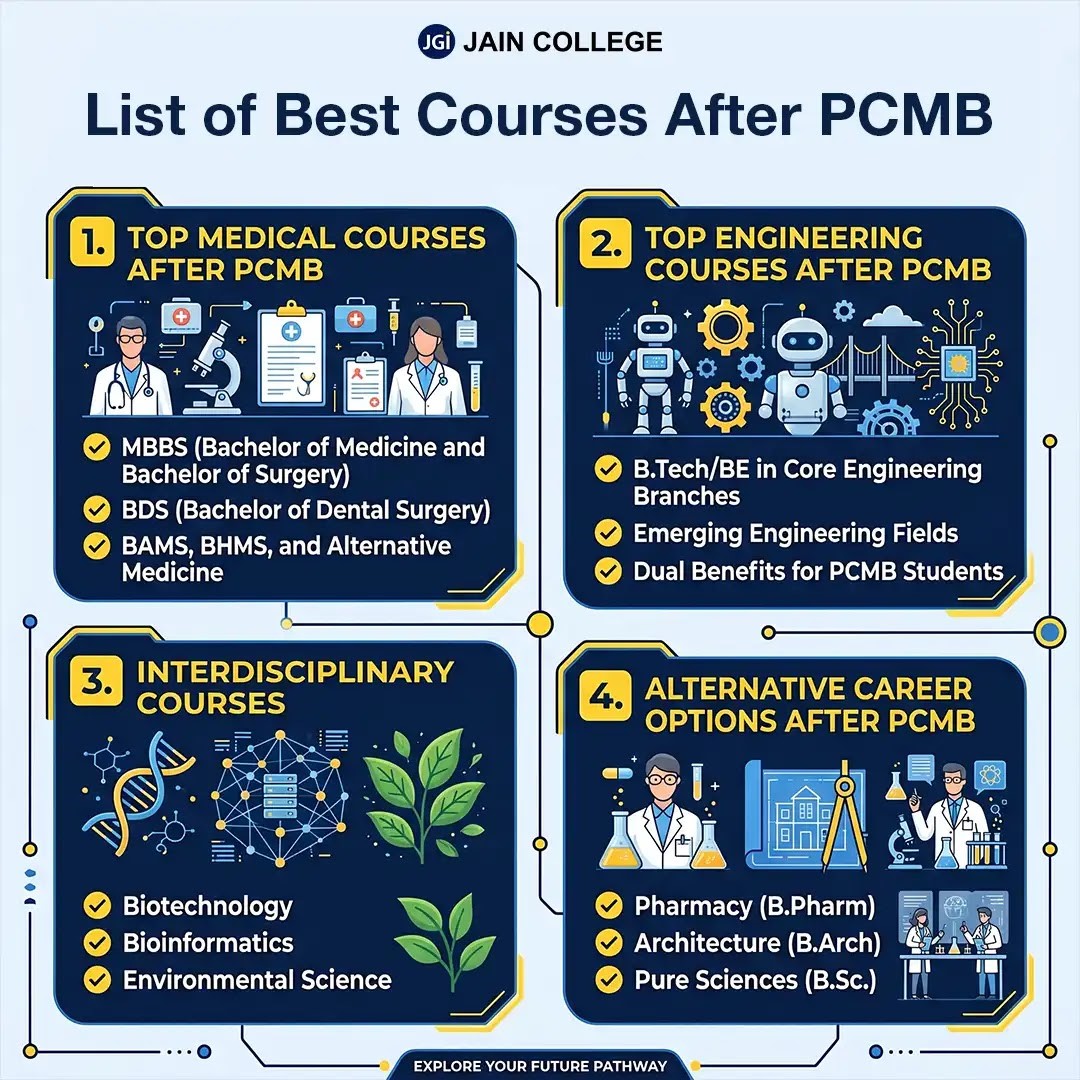
Core Medical Degrees via NEET: In case you prefer pursuing a career as a doctor, NEET-UG is your entry point. MBBS is a 5.5-year programme that trains you as a doctor and ensures you are ready for further specialisation, if wanted. BDS takes 5 years and covers dentistry.
AYUSH includes BAMS and BHMS for traditional medicine streams, whereas BVSc and AH cover veterinary work. Once you clear it and finish your internship, MBBS graduates generally take home ?8 to 15 LPA. BDS and BAMS roles start around ?4 to 10 LPA.
MBBS still tops among the popular courses for PCMB aspirants. This course involves detailed information about human anatomy, disorders, and medical procedures. It is an exhaustive process that promises a respectable career and great job security.
In case you are fascinated by dental healthcare, then the BDS course can be an alternative option to the MBBS course. It is a 5-year course that includes a 1-year rotating internship. The admission to BDS is based on NEET score.
The BDS curriculum is focused on dental anatomy, histology, oral pathology, preclinical prosthodontics, oral and maxillofacial surgeries, conservative dentistry & endodontics, and public health dentistry.
Alternative courses such as Ayurvedic medicine (BAMS) and homoeopathic medicine (BHMS) have become popular if you prefer holistic approaches to healthcare. These admissions are also based on the NEET UG score.
Why consider medical courses:
As Mathematics is one component of your subject combination, engineering becomes a highly feasible choice. Entrance exams like JEE Mains/Advanced, BITSAT, and various state-level CETs all accept the PCMB combination.
Branches like Mechanical, Civil, Electrical, and Computer Science Engineering are quite common and popular. These courses give you a robust technical base and lead to varied industrial opportunities.
The present-day industry requires knowledge in branches such as Artificial Intelligence, Robotics, and Data Science. These combine programming abilities with analysis, making them one of the rapidly growing professions worldwide.
PCMB students may even venture into specific streams such as biomedical engineering, which combines biological and engineering knowledge for the design of medical devices.
Key advantages of the engineering stream:
Interdisciplinary courses that integrate various areas of science make for an interesting field after PCMB. Interdisciplinary courses are suitable if you do not wish to confine yourself to one particular area. Here are some options to explore:
Biotechnology integrates biological studies and engineering technology to solve problems within health care, agriculture, and pharmaceuticals.
The discipline entails a blend of biological concepts, information technology, and mathematics. Bioinformatics is essential in genomic research and the development of new drugs.
With the current focus on climate change, you can find exciting opportunities in environmental science to promote sustainability. This will need a thorough understanding of biology and mathematics to understand the data.
Reasons for taking interdisciplinary courses:
Apart from conventional and multidisciplinary career options, there are other alternatives that one can opt for after PCMB.
Pharmacy is all about the development, production, and supply of drugs. You find job prospects in the pharmaceutical industry and research and development opportunities in laboratories.
Having a good blend of creativity and analysis skills, choosing architecture would prove to be an interesting decision. B.Arch is a 5-year course, and the admissions are conducted through the National Aptitude Test in Architecture (NATA).
Choosing a programme like B.Sc Physics, Chemistry, Mathematics, or Biology can pave the way towards a very successful career. With specialised education, it leads to roles like lab scientist, research associate, chemist, biotechnologist, and clinical research associate.
Other advantages of PCMB:
| Course | Duration | Career Scope | Ideal For |
| MBBS | 5.5 years | Doctor, Surgeon | Healthcare enthusiasts |
| B.Tech | 4 years | Engineer, Developer | Tech-oriented students |
| Biotechnology | 3-4 years | Research, Pharma | Science innovators |
| B.Pharm | 4 years | Pharmacist, Researcher | Clinical research |
| B.Sc | 3 years | Research, Teaching | Academic careers |
There is a simple way to choose the right course after PCMB. Ask yourself:
The selection of an appropriate path post-PCMB should not depend on trends but rather on your abilities and dreams. If you are good at Maths, engineering or data science will likely suit you better. If Biology comes more naturally, medicine or biotech is the smarter direction. There is no universally right answer. It comes down to what you are genuinely good at and what you can see yourself doing long-term.
Some of the top 10 PU colleges in Bangalore, like JAIN College, have built a strong reputation among PCMB students in Bangalore. The labs are well-equipped, coaching is structured, and students regularly go on to crack NEET and JEE from here. Visit the nearest campus to explore admissions.
Being a PCMB student, which field interests you more, medical or engineering? Which degree programme do you plan to pursue after PCMB?
After PCMB, MBBS is ideal for healthcare, while B.Tech or BE suits those interested in technology. There is no single best course after PCMB, as it depends on your interests and academic strengths.
Yes, PCMB students are eligible to appear for both NEET and JEE, giving them flexibility in career choices.
Yes, biotechnology is a good option after PCMB as it offers strong growth potential in research, healthcare, and pharmaceuticals.
There are several non-traditional courses after PCMB, including bioinformatics, environmental science, and data science, which combine sciences with Maths.

JAIN PU College, a part of the renowned JGI Group, is committed to empowering students with quality education.
Beyond academics, the college ensures its online content reflects the same standard of excellence. Every blog and article is meticulously vetted and proofread by subject matter experts to ensure accuracy, relevance, and clarity. From insightful educational topics to engaging discussions, JAIN PU College's content is crafted to inform, inspire, and add value to its readers, reflecting the institution's commitment to intellectual growth and innovation.
View all Blogs
