






Table of Contents
NCERT – National Council of Educational Research and Training is a government organisation established in the year 1961 with the main objective of improving school education in India.
This organisation produces textbooks, training programmes and other study materials for both students and teachers.
All schools affiliated with CBSE and other Kendriya Vidyalaya follow the NCERT curriculum. This is because they are considered reliable and aligned with national educational goals.
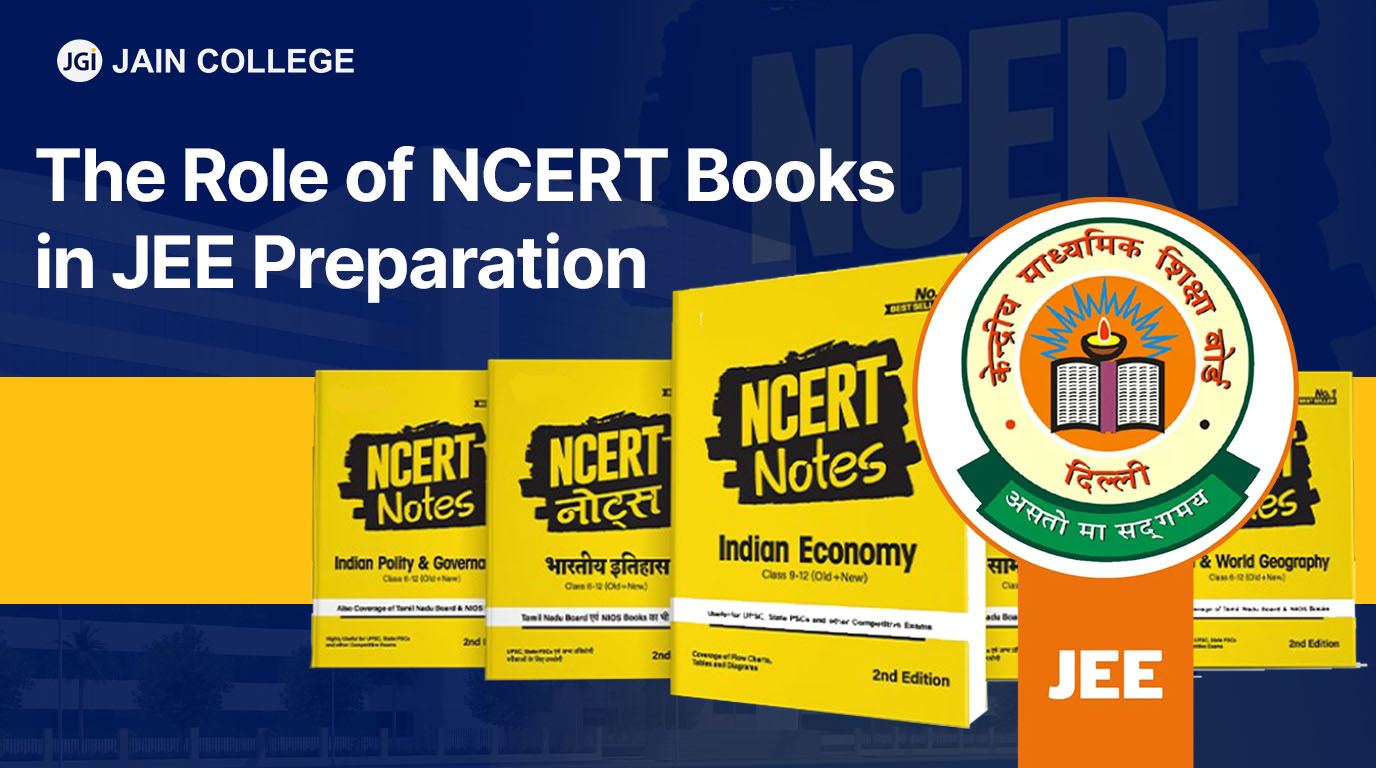
NCERT books are textbooks published by the National Council of Educational Research and Training.
These books are designed to create strong conceptual foundations for Classes 6 to 12
The NCERT books for Class 11 and 12, particularly in Physics, Chemistry, and Mathematics, are essential resources for students. are absolute must-haves.
Here is a subject-Wise Importance of NCERT books for JEE:
| NCERT Physics for JEE |
| NCERT books for Physics helps students by:Building strong theoretical understandingMastering definitions, laws, and derivationsWhile advanced numerical problems require reference books, many theory-based JEE questions are straight from NCERT explanations and examples. |
| NCERT Chemistry for JEE |
| This is where NCERT becomes non-negotiable. Inorganic Chemistry: Almost entirely NCERT-basedOrganic Chemistry: Reaction mechanisms and basic concepts come from NCERTPhysical Chemistry: Concepts and formulas form the base |
| NCERT Mathematics for JEE |
| NCERT Math helps students by:Understand definitions and theoremsLearn standard problem-solving approachesWhile higher-level practice is needed, NCERT exercises are perfect for concept-building. |
JEE – Joint Entrance Examination. It is one of the most prestigious competitive entrance exams in India. This engineering entrance examination is conducted for aspiring candidates for their B.Tech courses offered in NITs, IIITs, and other CFTIs.
JEE is a national-level test conducted for admission to top engineering colleges in India
Every year around 12–15 lakh students appear for JEE Main each year to gain admissions to IIT and other top engineering colleges in India.
The JEE Main and JEE Advanced are gateways to the country's most renowned engineering institutes, including the National Institute of Technology and the Indian Institutes of Technology (IITs).
The JEE Main and JEE Advanced differ significantly in structure, difficulty, and eligibility criteria.
Learning the differences is crucial for students who wish to proceed with their preparation efficiently and make informed decisions about their future.
JEE Main and JEE Advanced are different phases in the entrance exam process. These exams serve distinct purposes and pose unique challenges.
JEE Main is the first phase, while JEE Advanced is the next and the challenge phase.
The main purpose of JEE Main is admission to NITs, IITs, and other colleges; JEE Advanced is admission to IITs only.
Here are the key differences between JEE Main and JEE Advanced.
| Features | JEE Main | JEE Advanced |
| Competition | Very high | Extremely high (IIT level) |
| Difficulty Level | Moderate | High (Very Tough) |
| Who Can Appear? | Any eligible Class 12 student | Only top JEE Main rankers |
| Conducted By | NTA (National Testing Agency) | IITs (on a rotating basis) |
| Number of Attempts | Two times a year (Jan & Apr) | One time a year |
| Focus | Speed & accuracy | Concept clarity & problem-solving |
| Eligibility | Basic Class 12 eligibility | Must qualify JEE Main cutoff |
| Question Level | NCERT-based application | Deep concepts and tricky problems |
| Paper Style | Computer-based test (CBT) | Computer-based test (CBT) |
| Ranking Type | All India Rank (AIR) for Main | Separate AIR for Advanced |
| Admission into | NITs, IIITs, GFTIs & private colleges | IITs (Top engineering colleges) |
| Preparation Level | Strong NCERT practice | Advanced problem-solving & deep theory |
Read More: JEE Main vs JEE Advanced: Key Differences You Need to Know
NCERT books are highly useful for JEE preparation. This is mainly because these books primarily focus on:
and
NCERT books are well organised and prepared by subject experts to support effective JEE preparation.
NCERT books provide complete coverage of the exam syllabus. These books are popular because they are based on the latest exam pattern. These books are valued for their clarity, readability, and well-researched content.
Here are some key benefits of NCERT books for JEE preparation:
NCERT books define the standard in coursework. The entire learning process – from basic learning to that of board examination mastery – is covered in one-source assurance.
NCERT books hold a key position in preparing for JEE. These books provide concise concepts and accurate information, with simple explanations and strong exam relevance. Almost every competitive exam in India bases its questions on NCERT concepts.
Students seeking a dependable academic guide for exams such as JEE, KCET, COMEDK, or NEET will find these books helpful. NCERT books are ideal investments.
For more tips and guidance about the JEE preparations, students can visit our JEE related articles at JAIN PU College Blogs.
Yes. JEE is widely considered one of the toughest competitive exams in India.
The JEE – Joint Entrance Examination. It is a national-level entrance exam conducted annually for admission to top engineering institutions in India.
NCERT books are the primary reference material for JEE preparations. Along with the NCERT books, students should also refer to other resources to increase the chances of performing better.
Yes, the JEE curriculum aligns with NCERT books.
These books frequently include concepts tested in JEE Main and Advanced.
NCERT books provide step-by-step explanations that help students understand concepts clearly and perform better in exams.

JAIN PU College, a part of the renowned JGI Group, is committed to empowering students with quality education.
Beyond academics, the college ensures its online content reflects the same standard of excellence. Every blog and article is meticulously vetted and proofread by subject matter experts to ensure accuracy, relevance, and clarity. From insightful educational topics to engaging discussions, JAIN PU College's content is crafted to inform, inspire, and add value to its readers, reflecting the institution's commitment to intellectual growth and innovation.
View all Blogs
