








Early preparation for entrance examinations, including NEET, JEE, COMEDK, and any other state entrance exams, builds a strong foundation.
Understanding the wide array of entrance exams available after Class 10 allows students to set achievable goals, access better resources, and stay ahead of their peers.
Preparing for entrance exams after Class 10 requires:
JAIN PU College, recognised as one of the top PU colleges in Bengaluru, emphasises holistic development to help students achieve their full potential. Through a diverse range of educational programmes, it is a leading integrated PU college in Bangalore that offers coaching for entrance exams such as
Let’s explore key preparation strategies:
Students have access to several competitive exams after completing Class 10, which can lead to prestigious schools, scholarships, and career paths.
Here are a few top reasons to start preparing for competitive exams after Class 10:
There are many competitive examinations available after Class 10 that can place students on a special career track at an early stage.
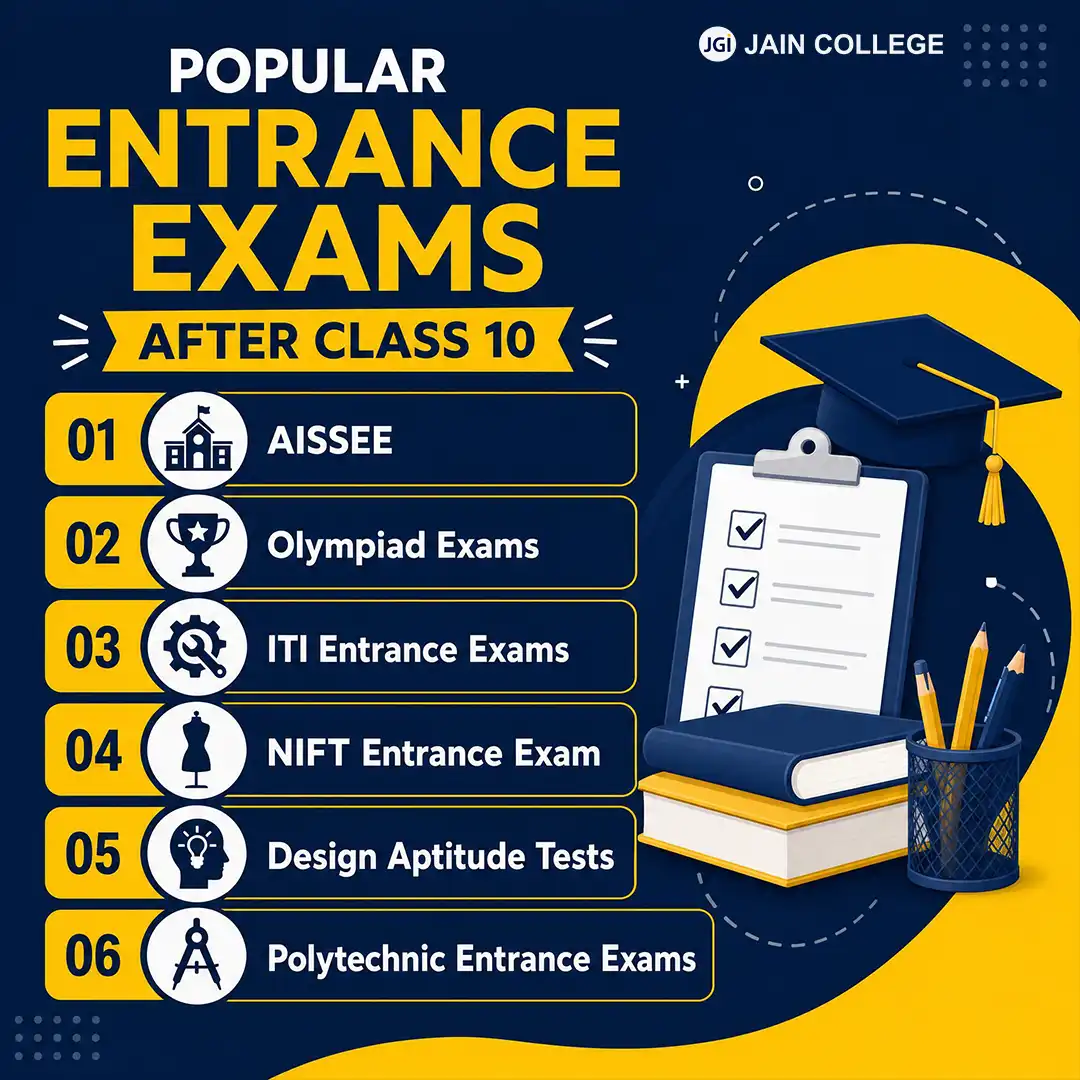
Here is a list of some entrance exams after Class 10:
| Entrance Exam | Purpose of the Exam |
| ITI Entrance Exams | Admission to Industrial Training Institutes (ITIs) for vocational education and skill training |
| AISSEE | AISSEE: All India Sainik School Entrance ExaminationAdmission to Sainik Schools for defence-oriented education |
| Polytechnic Entrance Exams | Admission to diploma courses in engineering and technical fields |
| Olympiad Exams (Science, Maths, English, Cyber, etc.) | To test subject knowledge, analytical ability, and academic excellence |
| NIFT Entrance Exam | For admission to foundation, diploma, and design-related programmes offered by the National Institute of Fashion Technology |
| NID DAT (National Institute of Design – Design Aptitude Test) | Conducted by the National Institute of Design for admission to design programmes |
| Design Aptitude Tests (Foundation / Diploma Level) | Admission to design and creative studies programmes |
*Note
These are some of the popular entrance exams after class 10 (2026). After Class 12, students take many other national-level engineering and medical entrance exams, such as JEE Main and NEET-UG.
Apart from these, there are many other entrance exams conducted by coaching institutions and other colleges and universities as preparatory programmes.
For example, JEE Foundation and NEET Foundation tests are not official national entrance examinations; they are preparatory programmes conducted by coaching institutes.
For many students, preparing for entrance examinations is one of the most stressful phases of academic life. Students, in particular, are under a great deal of stress because their futures depend on the results of entrance exams. The intense competition and significant stakes make the exam season a crucial moment for them.
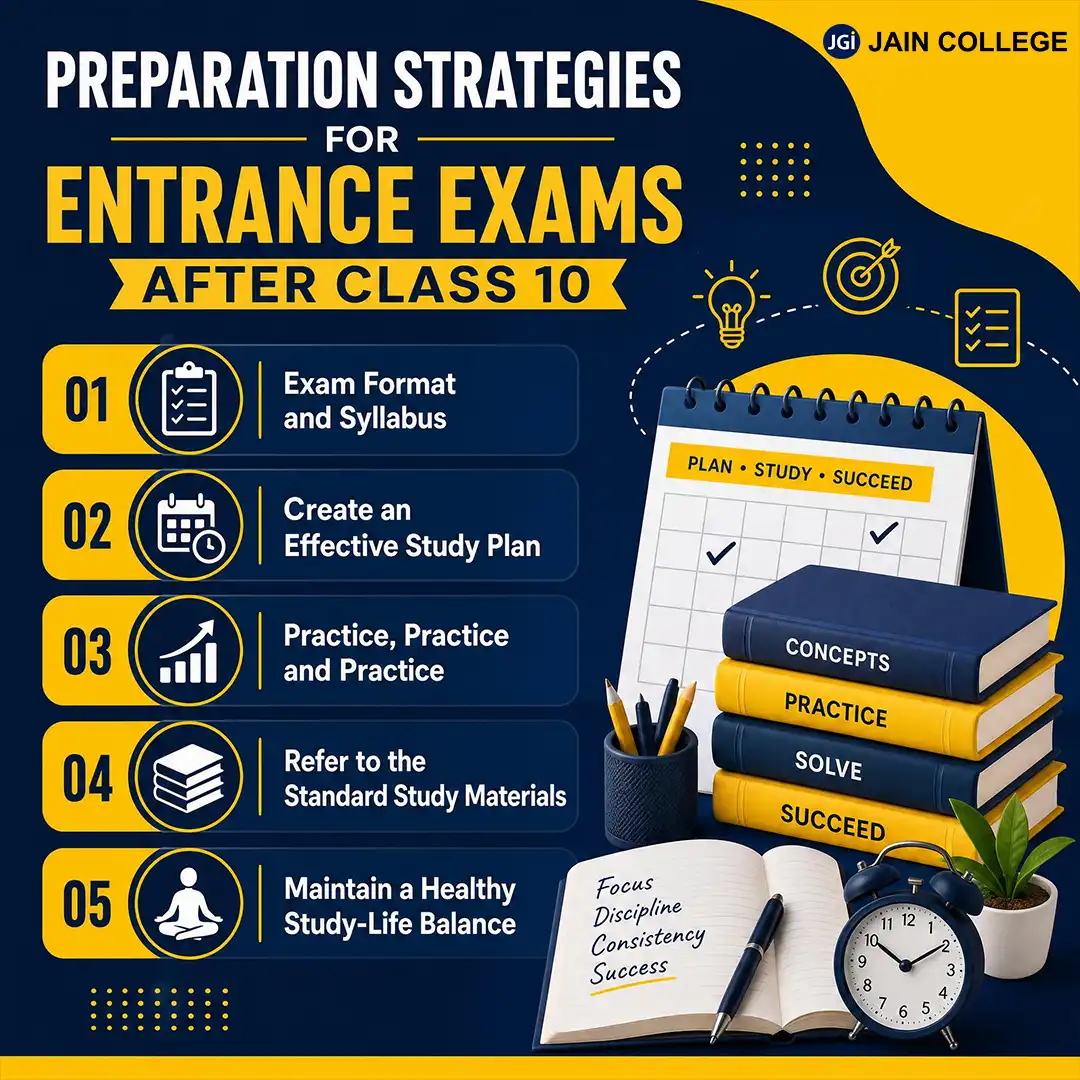
Here are some top five effective tips for those students who are preparing for entrance exams after the Class 10
Learning the exam format and its contents is a necessary initial stage of preparation. A better understanding of the question paper pattern and curriculum helps students prepare, plan, and execute strategies on time.
A study plan acts as a roadmap to guide students with their preparation. Students should create a thorough study plan by clearly specifying:
Overall, students should plan out their study timetable by the day, the week, and the month
| Chemistry by O.P. TandonUseful for conceptual understanding, but some sections may feel outdated for current competitive exam patterns |
| IIT Mathematics by M.L. KhannaStrong for advanced practice, though the presentation style may seem old-fashioned for today’s students |
| NCERT Biology (Class 11 & 12)Still relevant and essential for modern competitive exams like NEET |
| Concepts of Physics (Vol. I & II) by H.C. Verma Remains one of the most recommended books for building Physics concepts and problem-solving skills |
Along with the effective study plans, students should also take care of their physical and mental health by
Entrance exams have a major impact on students’ academic and professional futures.
More than simple assessments, these exams help students move toward rewarding careers and future opportunities.
Being aware and understanding the importance of entrance exams after Class 10 helps students align their efforts with long-term academic and career goals.
Whether students aim to pursue medical, engineering, design, legal, or defence services, starting early gives them clarity, confidence, and competence.
All the Best!
Stay tuned to https://www.jaincollege.ac.in/blogs and explore more effective tips and strategies required to prepare for entrance exams after Class 10.
What subject do you find most challenging while preparing for entrance exams?
Share your thoughts in the comments below.
Yes. There are several JEE pre-foundation exams and aptitude tests, which are mainly designed for class 10 students to assess readiness and award scholarships for foundational courses.
Olympiad exams are competitive tests organised by various governmental and non-governmental organisations to assess students' knowledge and skills in various subjects.
Yes. Some of the major institutes conduct their entrance tests to select students for special foundation batches.
According to the NEET eligibility criteria for 2026, students must have passed Class 12 or an equivalent exam with a PCB combination (Physics, Chemistry, and Biology as core subjects).
Preparing for competitive exams after Class 10 requires focus, planning, and the right strategy.
Here are some practical tips for students to prepare effectively:

JAIN PU College, a part of the renowned JGI Group, is committed to empowering students with quality education.
Beyond academics, the college ensures its online content reflects the same standard of excellence. Every blog and article is meticulously vetted and proofread by subject matter experts to ensure accuracy, relevance, and clarity. From insightful educational topics to engaging discussions, JAIN PU College's content is crafted to inform, inspire, and add value to its readers, reflecting the institution's commitment to intellectual growth and innovation.
View all Blogs
