





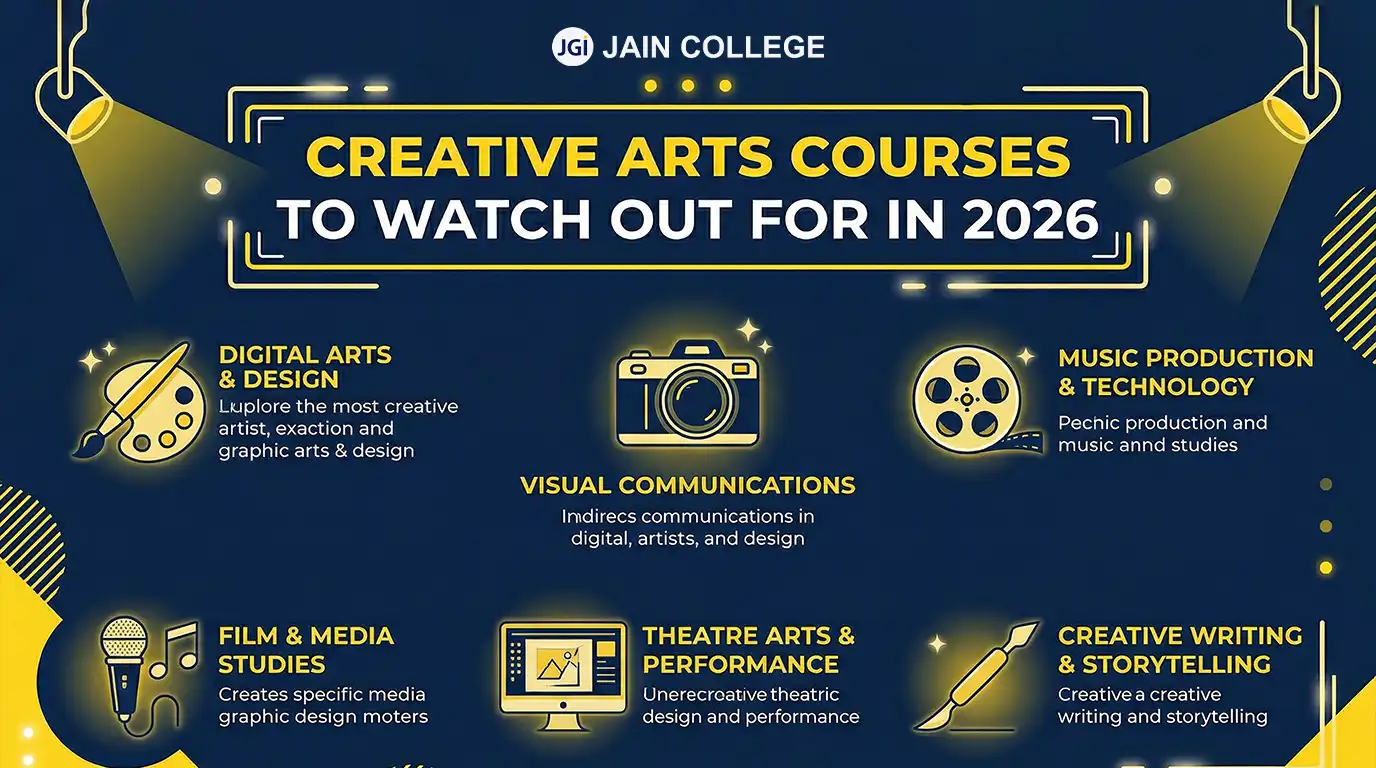
With the digitisation of industries and changing consumer habits, the creative industry is growing rapidly. Educational institutions have started modifying their courses according to these changes. This trend is creating a demand for Creative Arts courses that shape cross-functional talent: artists with an analytical edge, designers with coding expertise, and storytellers adept at navigating immersive technologies. Creative Arts courses to watch out for in 2026 are digital design, AI-integrated traditional arts, sustainable fashion design, and media.
You no longer have to enrol in creative education courses based only on your passion for the Creative Arts. Rather, you can now choose courses based on the requirements of the global market. Top PU Arts colleges in Bangalore offer diverse courses ideal for creative students. Take a look at the list of Creative Arts courses to shape your academic and professional journey.
From advertising and entertainment to digital marketing and gaming, the creative industry plays an important role in the world’s GDP. Even though automation is on the rise, this industry has managed to integrate it for the development of the creative field.
In spite of AI’s ability to produce different art forms, the need for human imagination and emotional depth in the arts has increased. This is how the curriculum for Creative Arts courses in 2026 highlight and addresses the need for imagination.
Digital media courses are changing rapidly, considering the changing landscape of modern communication. As of 2026, the main focus is on immersive design.
Virtual reality (VR) storytelling is an upcoming field where you learn the fundamentals of visual storytelling for an immersive experience. Simulations learnt and created during the course can be applicable in the fields of gaming, filmmaking, 3D modelling, and education.
Augmented reality (AR) is a field where brands apply AR for marketing. As a rapidly evolving field, AR is being widely integrated by advertising agencies to transform brand marketing. This shift enables brands to create highly immersive and personalised experiences for their audiences.
Sustainability is becoming an integral part of the fashion industry, as it is no longer a choice; it is a necessity.
Educational programmes related to fashion now focus on waste reduction, material recyclability, and product lifecycle assessments. Students are encouraged to design products with a low environmental footprint.
Eco-textile innovation is also an important part of the curriculum. This introduces you to eco-friendly fabric choices. Later on in your career, you can get a chance to work with environmental scientists to develop functional products with a low environmental footprint.
The gaming industry continues to grow, and the revenues are increasing. With this growth, new opportunities for creative professionals are emerging.
Game production is one of the top Creative Arts courses to watch out for in 2026. In the course, you can learn about game mechanics, character development, and monetisation techniques.
The demand for Esports content creation is increasing, and the courses are designed to cover live streaming, brand partnerships, and digital event production.
The rise of streaming platforms has changed the way people consume media.
The courses focused on screenwriting, especially the ones that cover streaming platforms, are in demand. Here, you learn about episodic storytelling and audience analytics. You also learn about script pitching. There are additional certifications about digital storytelling offered on online educational platforms.
With social media platforms preferring short-form content, there is a need to learn short-form storytelling. Some Creative Arts courses focus on short-form video strategy for the same reason.
Artificial Intelligence has a significant impact on the way art is created. AI-assisted illustrations are emerging as a new and significant way of creating art. Currently, artists use AI for faster prototyping and idea generation. There are courses available for the ethics of AI and IP Law.
The creative industries have never changed this fast. The Creative Arts courses to watch out for in 2026, however, show an understanding of this change by incorporating aspects of technology, sustainability, and entrepreneurship. If you decide to pursue these courses, you will have access to an interdisciplinary and future-proofed education. At its heart, creative education is no longer just about the creative individual. It is about strategic thinking, technological know-how, and living in an increasingly sustainable way. For those who get this, the future of the global marketplace looks bright.
Want to know which creative courses are offered at the top PU colleges for Arts in Bangalore? Institutes like JAIN College offer a variety of programmes that go beyond traditional subjects. Get in touch today to find out more.
Which courses did you find interesting enough to challenge your creative side? Let us know in the comments section.
Courses aimed at digital media design, UX/UI, sustainable fashion, AI-assisted art, and game design are some of the most in-demand Creative Arts programmes in 2026.
Yes, depending on your skills and portfolio, many sectors, such as gaming, digital marketing, and streaming media, offer competitive salaries and global opportunities.
Not always; however, a few creative courses have started integrating coding, analytics, and digital production tools.
Diploma programmes last one to two years, while bachelor’s degrees is usually for three to four years.

JAIN PU College, a part of the renowned JGI Group, is committed to empowering students with quality education.
Beyond academics, the college ensures its online content reflects the same standard of excellence. Every blog and article is meticulously vetted and proofread by subject matter experts to ensure accuracy, relevance, and clarity. From insightful educational topics to engaging discussions, JAIN PU College's content is crafted to inform, inspire, and add value to its readers, reflecting the institution's commitment to intellectual growth and innovation.
View all Blogs
