









Table of Contents
Computer Science can be challenging initially for biology students due to coding, mathematics, and logical thinking. However, with practice and structured learning, Biology students can successfully advance and thrive in Computer Science careers.
With the rapid expansion of technology, many students from diverse educational backgrounds are considering a career in computer science.
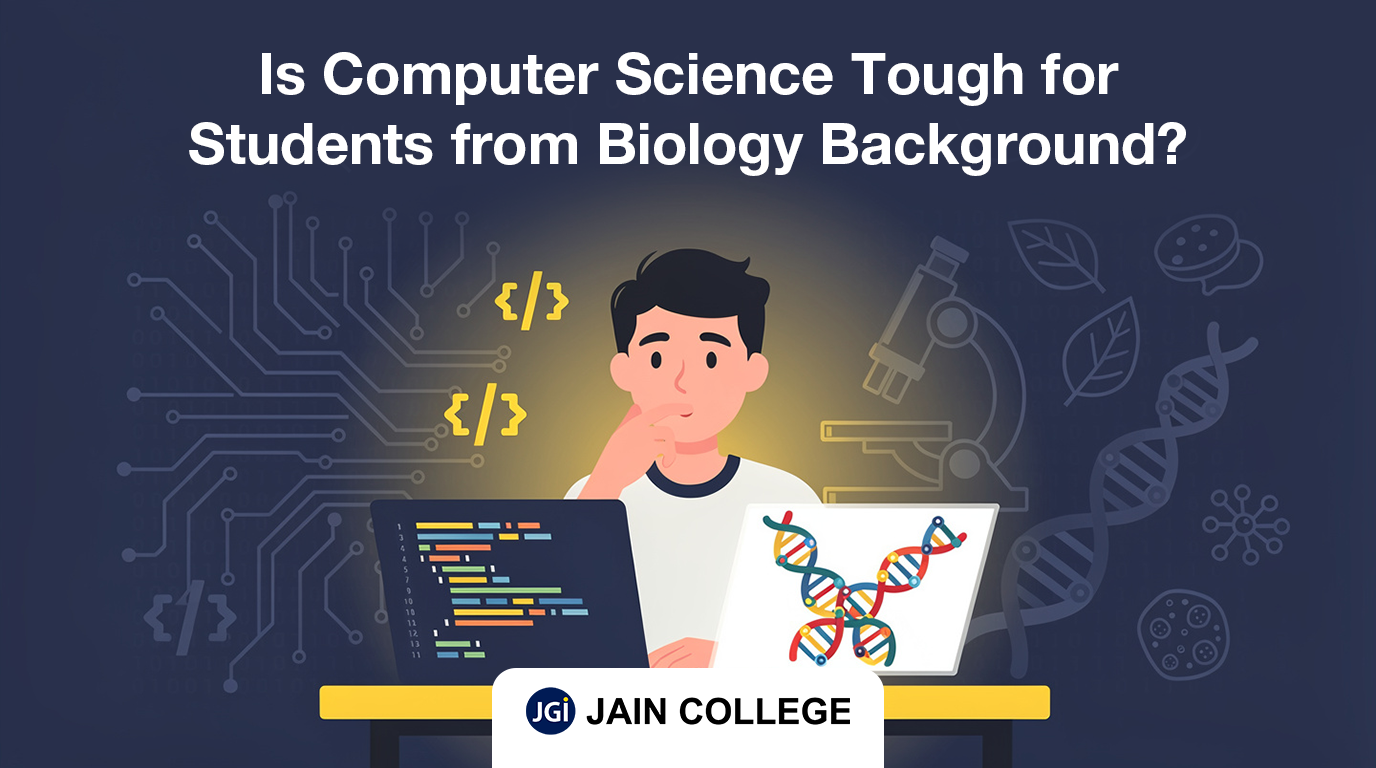
One of the most common questions is whether Computer Science is challenging for students who have studied Biology.
The simple response is no. Computer Science is not inherently more difficult for students from a Biology background. While the subjects demand different skills, motivated students can successfully transition into Computer Science with the right preparation and mindset.
After choosing Biology as a subject in Classes 10 and 11, students can pursue a bachelor's degree in Computer Science. Thus, they can choose a career path in technology, software development, and data-driven innovation.
Here is a detailed overview.
Both Computer Science and Biology are challenging subjects, but the skills required for each are entirely unique.
Computer Science requires coding, algorithms, and applied technology knowledge. On the other hand, the Biology course requires extensive memorisation of systems and processes.
Here is a further comparison between these two courses:
| Biology | Computer Science | |
| Syllabus | Content-heavy | Logic-heavy |
| Strengths | The syllabus is well-structured, and the exam questions are predictable. | The course primarily concentrates on algorithms, programming, and applied problem-solving. |
| Challenges | Requires memorising large amounts of concepts | This requires consistent practice in coding. |
| Suitable for | Students who are good at memorisation and descriptive writing | Students who excel in maths, logic, coding and problem-solving |
| Career Considerations | Medicine, life sciences, and environmental sciences. | Software engineering, data science, and technology-focused fields. |
Overall, Biology tends to suit students who are strong in memorisation and conceptual learning, while Computer Science is better suited for those who prefer logic-based thinking and practical problem-solving.
Biology is a natural science that studies living organisms and life processes, including plants, animals, microbes, ecosystems, and human biology. The subject involves extensive theory, diagrams, experiments, and practical work.
Biology requires:
Knowledge of Biology is widely applied in fields such as biotechnology, genetics, biochemistry, microbiology, pharmacy, and environmental sciences.
Biology is considered a demanding science subject because it requires hard work and regular study. It is based on understanding concepts, scientific terminology, biological structures, and practical experiments.
Computer science is an interdisciplinary field focused on computation and the use of computers and software. It involves designing software, solving problems through algorithms, and understanding how computational systems function.
Computer Science requires:
Several high-growth interdisciplinary fields intrinsically link Biology and Computer Science. These areas combine biological knowledge with computational tools and technology.
Some key intersecting fields include:
| Genomics and Data Science | Managing and interpreting large genetic datasets |
| Healthcare Analytics | Analysing medical data to improve patient care and decision-making |
| Computational Biology | Applying computer models to study biological systems and processes |
| Bioinformatics | Using algorithms and software to analyse biological data such as DNA and protein sequences |
| Biomedical Engineering | Developing medical devices and technologies using engineering and computing principles |
These fields show that Biology students do not have to abandon their subjects entirely to benefit from Computer Science. Instead, they can combine both disciplines to create unique and future-ready career paths.
Many biology students have started exploring Computer Science as a complementary or alternative career path. This shift is largely driven by the growing role of technology in healthcare, research, and life sciences.
The boundaries of modern biology have expanded higher than textbooks and laboratories. Fields such as medical imaging, genomics, drug discovery, and healthcare analytics rely heavily on data analysis, software tools, and computational models. As a result, students with backgrounds in Biology increasingly recognise the value of learning Computer Science to expand their career opportunities.
Additionally, Computer Science offers:
For biology students who enjoy problem-solving and are open to learning new skills, Computer Science provides a powerful way to stay relevant in a technology-driven world.
Biology and Computer Science are closely related. In some institutions, Computer Science courses may have a more intensive workload than Biology, depending on curriculum structure and student background. This distinction is because students must master fundamental concepts in Computer Science software, hardware, and theory.
Biology students may encounter the following challenges when studying Computer Science:
Since mathematics is the foundation of Computer Science, Biology students may have difficulty understanding some fundamental mathematical concepts, such as discrete mathematics, data structures, and algorithms.
Computer Science is an excellent way of cultivating logical thinking skills in students. As a core component of Computer Science, strong logical reasoning and analytical skills are essential. However, it may be challenging for students with a biological background to develop.
There is no doubt that pursuing an interdisciplinary education represents one of the best opportunities for career advancement.
From a student’s perspective, interest plays a key role in choosing a stream. Success ultimately depends on motivation and dedication, even though some students may find Computer Science more appealing than Biology.
With the right preparation, dedication, and mindset, biology students can successfully transition to Computer Science. While the shift may seem challenging at first, it is entirely achievable.
Here are some practical steps:
Thus, with consistent effort, curiosity, and guided learning, biology students can transition smoothly into Computer Science or successfully combine both fields for strong career prospects.
Students with the Biology background does not face any challenges or difficulties when studying Computer Science.It is a different course that focuses on coding, algorithms, and applied technology.
Choosing the right course depends on students' interests, strengths, and university goals.
Students who enjoy coding and problem-solving may find Computer Science easier and more rewarding than traditional sciences.
If you are looking for guided support, structured plans, and expert mentoring all in one place, JAIN PU College is the right path to choose.
Stay tuned for more articles related to Biology, Computer science and other relevant blogs from JAIN PU College.
Bioinformatics is a multidisciplinary field that combines biological knowledge with Computer Science, data analysis, and programming.
Biological computing explores how biological systems can perform computational tasks and often inspires new models of computing.
Choosing a Computer Science course supports career growth by offering exposure to cutting-edge technology, opportunities to work on innovative projects, professional networking, and strong personal and intellectual development.
Yes. Computer Science relies heavily on mathematical principles. While the level of mathematics varies by specialisation, core mathematical concepts are essential across all Computer Science courses.
Computer Science graduates with a Biology background can pursue careers in bioinformatics, data analysis, cybersecurity, software development, web development, and related interdisciplinary fields.

JAIN PU College, a part of the renowned JGI Group, is committed to empowering students with quality education.
Beyond academics, the college ensures its online content reflects the same standard of excellence. Every blog and article is meticulously vetted and proofread by subject matter experts to ensure accuracy, relevance, and clarity. From insightful educational topics to engaging discussions, JAIN PU College's content is crafted to inform, inspire, and add value to its readers, reflecting the institution's commitment to intellectual growth and innovation.
View all Blogs
