








Table of Contents
After completing the 2nd PUC science, students often consider careers in medicine or engineering. However, there are numerous other career options available.
Some of the most popular career fields after 2nd PUC science include IT, finance, research, engineering, healthcare, life sciences, environmental studies, and management.
These courses have their own unique career advantages, and they are associated with prestigious colleges for further education.
Here is a list of popular science-related courses after Class 12, some of which require entrance exams while others offer merit-based admission.
| Course | Admission based on |
| Pure Sciences: | |
| BSc Biology | Merit-based |
| BSc Physics | Merit-based |
| BSc Statistics | Merit-based |
| BSc Chemistry | Merit-based |
| BSc Mathematics | Merit-based |
| Life Sciences & Health: | |
| BSc Microbiology | Merit-based |
| BSc Biochemistry | Merit-based |
| BSc Biotechnology | Merit-based (some colleges may test) |
| BSc Forensic Science | Merit-based (some colleges may test) |
| BSc Nutrition & Dietetics | Merit-based |
| Healthcare & Paramedical: | |
| BSc Nursing (Private colleges) | Merit-based / College Test |
| Medical Lab Technology (BMLT) | Merit-based |
| Operation Theatre Technology | Merit-based or specific university-level entrance exam |
| Dialysis Technology | |
| Radiology Technician | |
| Engineering & Technology: | |
| BTech / BE (Engineering) | JEE KCET, COMEDK and more |
| Planning (BPlan) | JEE Main (Paper 2) |
| Architecture (BArch) | JEE Main (Paper 2), NATA |
| Medical (MBBS & Dental): | |
| MBBS (Doctor) | NEET-UG |
| BDS (Dental) | NEET-UG |
| Allied Health Sciences: | |
| BSc Nursing | NEET-UG / State-level Nursing Exams |
| Physiotherapy (BPT) | NEET-UG / College-level Exams |
| Radiology / Medical Imaging | NEET-UG / Institute Exams |
There are many science courses that are available after the second PUC. These Science courses required college-level or merit-based admission. Again, this criterion may vary by university, location, type of course, and college.
Some professional courses may require entrance tests or centralised counselling.
Many medical and paramedical courses are available after completing the 2nd PUC in the science stream that do not require entrance exams for admission.
Here are some of the course options available after the 2nd PUC in the science stream.
General BSc courses include:
| Course | Duration |
| BSc Botany | 3 years |
| BSc Zoology | 3 years |
| BSc Physics | 3 years |
| BSc Genetics | 3 years |
| BSc Chemistry | 3 years |
| BSc Microbiology | 3 years |
| BSc Biotechnology | 3 years |
There are many undergraduate programmes that focus on fundamental science skills and are directly applicable.
Note: The eligibility criteria may vary depending on the University or college
Choosing the best courses after 2nd PUC in the Science Stream is a critical decision for students.
With so many career options available after 2nd PUC Science, students should choose a course based on a combination of career goals, subject strengths, entrance exam requirements, and long-term opportunities in India and abroad.
Instead of choosing based only on marks or peer pressure, follow these practical steps:
|
Step 1: Learn about yourself Assess your academic and personal strengths honestly before choosing a course:
|
|
Step 2: Explore Course Options Relevant to Indian Education Research courses that are popular and recognised in India:
|
|
Step 3: Make an Informed Decision Once after shortlisting the course, think long-term:
|
|
Step 4: Implement it / Take Action (PUC-to-College Transition) Turn your decision into a clear plan:
|
These are some important factors to consider when choosing the right course after 2nd PUC science.
Why this Matters for PUC Science Students?
Choosing the right course after 2nd PUC Science is not just about getting into a college — it directly affects:
Thus, making a well-researched decision now can save years of confusion later.
Before making a choice, students should take time to understand themselves thoroughly, especially their likes and preferences. Parental support plays a determining factor in shaping students' career goals.
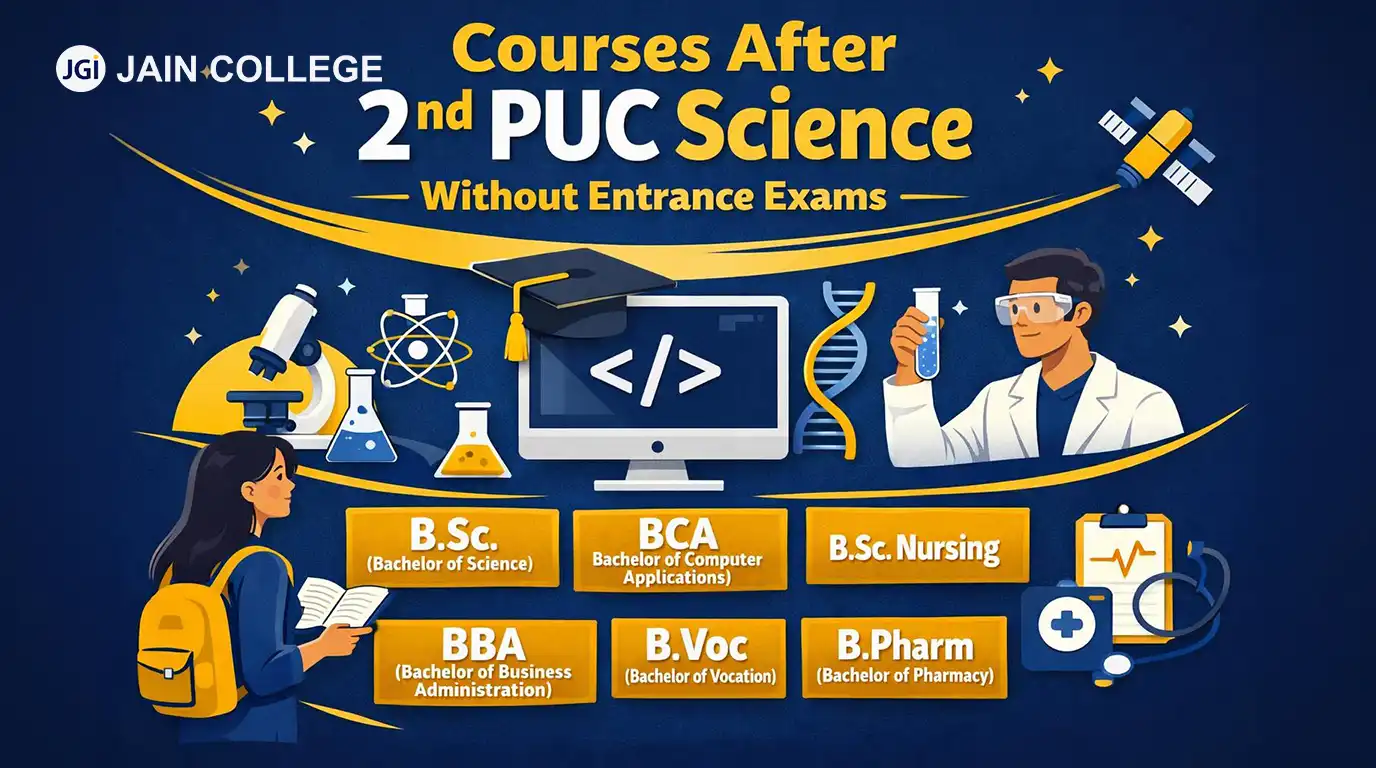
These are some of the top medical-related and undergraduate BSc courses that students can pursue after a 2nd PUC science without any entrance exams.
Choosing the right course after 2nd PUC science is a crucial decision that shapes a student’s career path. Thus, while choosing the perfect course after the 2nd PUC science, students should thoroughly research the course details, curriculum, and career prospects.
Along with research, it is important for students to consult an expert to make an informed choice.
Success depends on skill development, dedication, and continuous learning.
For more information on PUC students' career options, scope, and upcoming trends in science, as well as other relevant articles for class 11 students, stay tuned to the JAIN PU College blogs.
Medical courses focus on the study, prevention, and treatment of illnesses and health conditions. The specialisations in the medical course are expanding rapidly, and they aim to promote and maintain health and well-being.
The scope and career opportunities of Biotechnology include biotechnologists, bioinformaticists, research scientists, and more.
Yes. There are many courses after the 2nd PUC science course without entrance exams. Some of these courses include:
To pursue a career in medicine in India, the top entrance exams include NEET-UG and NEET-PG.
Here are certain factors that need to be considered while selecting a course after the 2nd PUC science:

JAIN PU College, a part of the renowned JGI Group, is committed to empowering students with quality education.
Beyond academics, the college ensures its online content reflects the same standard of excellence. Every blog and article is meticulously vetted and proofread by subject matter experts to ensure accuracy, relevance, and clarity. From insightful educational topics to engaging discussions, JAIN PU College's content is crafted to inform, inspire, and add value to its readers, reflecting the institution's commitment to intellectual growth and innovation.
View all Blogs
