






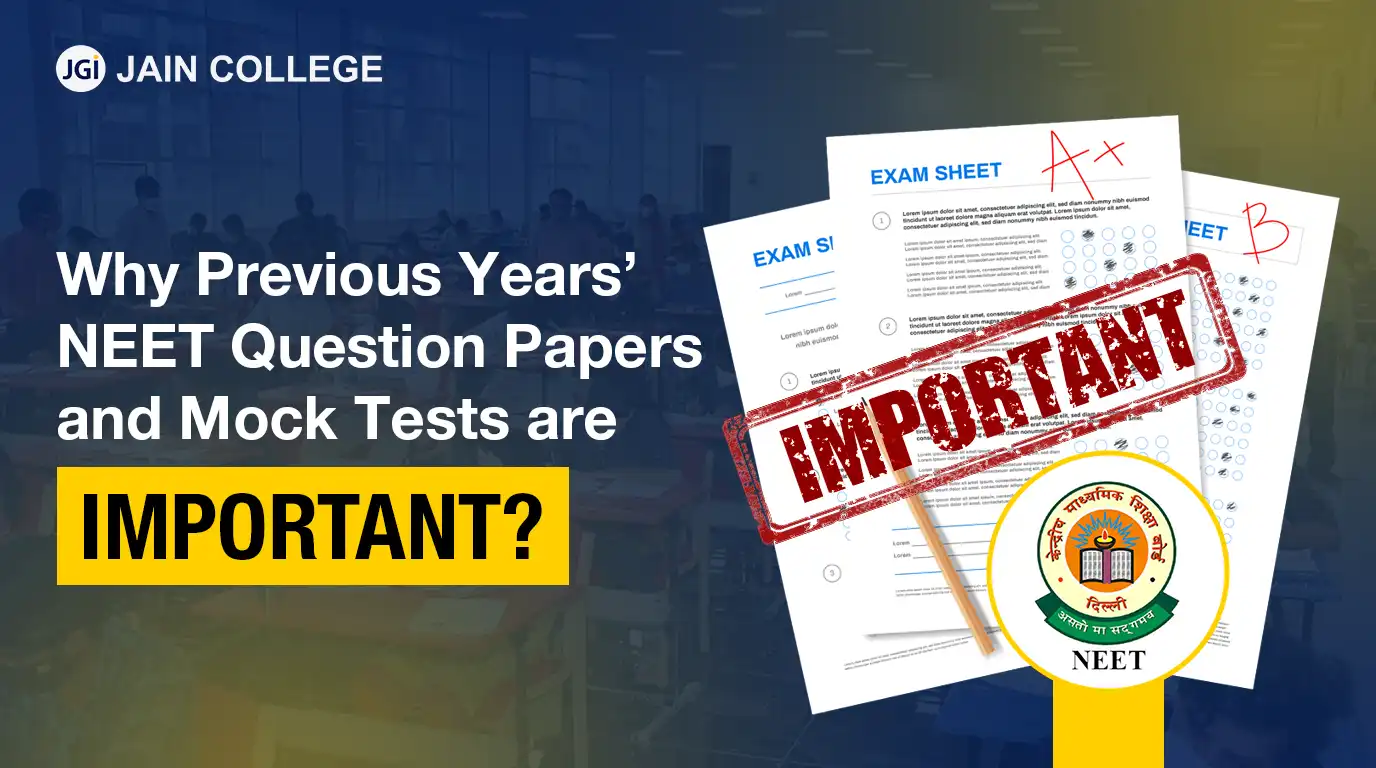
The National Eligibility cum Entrance Test, commonly known as NEET, is an Indian entrance examination for undergraduate medical programmes. To get ready for the NEET, you need to do more than just study hard. You also need to study strategically. The NEET is meant to see how well you can understand concepts in Physics, Chemistry, and Biology and apply them effectively to solve questions. Solving previous years’ NEET question papers and mock tests helps you become familiar with the exam pattern and chapter-wise weightage. It also helps you understand your strengths and weaknesses while mastering time management skills. Previous years’ NEET papers and mock tests are important to improve accuracy through practice. Some of the best PU colleges for science offer regular mock tests. Here are a few more benefits of focusing on PYQs and mock tests:
NEET is based on the NCERT syllabus for grades 11 and 12, covering Physics, Chemistry, and Biology. Instead of memorisation, NEET puts a lot of emphasis on making sure that you have understood concepts. A lot of the time, questions are set up to see how well you can link ideas from different topics. This is why practising real test questions is so important. Just memorising textbooks is not enough for moderately challenging questions.
Mock tests are another way to study that can help you get used to focusing for three hours and staying calm under pressure. This mental training is an important part of training for NEET. Solving previous years’ papers gives you a fair idea of which topics were repeated and the chapter-wise weightage. Then, mock tests help you strategically focus on the chapters.
| Aspect | Previous Years’ NEET Question Papers | NEET Mock Tests |
| Purpose | Help students understand real exam expectations | Help students practise in an exam-like environment |
| Source | Actual questions asked in past NEET exams | Expert-designed questions based on NEET pattern |
| Question Style | Reflects authentic framing and examiner intent | Mimics exam difficulty and structure |
| Concept Coverage | Highlights core concepts frequently tested | Ensures balanced coverage of the entire syllabus |
| Learning Benefit | Builds familiarity with recurring themes and logic | Improves application of concepts under time limits |
| Time Management | Helps estimate time spent per question type | Trains students to manage time across sections |
| Exam Confidence | Reduces fear by exposing students to real questions | Builds stamina and mental readiness for exam day |
| Performance Review | Identifies long-term conceptual strengths and gaps | Enables regular self-assessment and strategy refinement |
| Best Used When | After completing individual chapters or revisions | During full-length practice and final preparation phase |
NEET has a combination of conceptual and application-based questions. When you work on PYQs, you start to see how concepts are turned into questions and how to apply knowledge to find the answer. This helps close the gap between knowing the theory and being able to use it well on the test.
Question papers from previous years can give you an idea of which chapters have more weightage and how questions are usually framed. PYQs will give you a roadmap and show you the level of expected learning. This familiarity with the exam structure is essential when appearing for NEET.
NEET has a specific way of framing questions. Many a time, students choose wrong answers. It is not because they do not know the concept or the formula but because the questions are asked in a way that the wording is confusing. Solving PYQs helps you develop an understanding of subtle cues.
NEET requires you to make quick decisions in a limited time, as there are 180 minutes for 180 questions. NEET has 200 MCQs, out of which 180 are to be answered.Practice tests will help you divide time wisely between questions that need more attention and concise numericals. It is also useful in determining when to skip the challenging questions and avoid negative marking.
When you solve previous years’ NEET question papers, you can see which chapters were in focus. As you start understanding these patterns, it becomes easier to decide which chapters need more attention and which chapters require less time.
Create an error log to keep track of mistakes after each mock test. It will give you a fair idea of the common mistakes to avoid, like unit confusion or formula errors. You can also keep track of how much time is needed for each section and how you can improve time management. This is your chance for self-assessment to decide which topics need more focus.
When solving PYQs and mock tests, building a structured practice routine is necessary. You can start with past papers weekly, starting with one subject at a time, before full attempts. Always follow with detailed reviews to assess your strengths and weaknesses. When you are confident that you have conceptual clarity, schedule comprehensive mocks twice a week. Treat these as mini-exams where rest days are scheduled and enough time is given for analysis.
Even though focusing on NCERT creates a solid base and prepares you for the NEET syllabus, it is not enough to understand exam patterns. Solving previous years’ NEET question papers and mock tests is necessary to analyse your conceptual understanding. This is necessary to ensure your preparation is turned into a high-scoring performance.
When it comes to reliable guidance, many students look for PU colleges with NEET coaching to get the best attention. Weekly NEET tests and academic analysis that is done after each test ensure optimum results for each student. You can get in touch with us today to know how JAIN College is committed to providing quality education.
Solving previous years’ NEET question papers helps you understand exam patterns, question styles, and the level of conceptual clarity expected.
Yes, because mock tests train you to apply knowledge under exam-like conditions.
You can gradually incorporate mock tests into your routine once you have covered basic concepts.
Focus on understanding mistakes, time usage, and areas where concepts are unclear.

JAIN PU College, a part of the renowned JGI Group, is committed to empowering students with quality education.
Beyond academics, the college ensures its online content reflects the same standard of excellence. Every blog and article is meticulously vetted and proofread by subject matter experts to ensure accuracy, relevance, and clarity. From insightful educational topics to engaging discussions, JAIN PU College's content is crafted to inform, inspire, and add value to its readers, reflecting the institution's commitment to intellectual growth and innovation.
View all Blogs
