







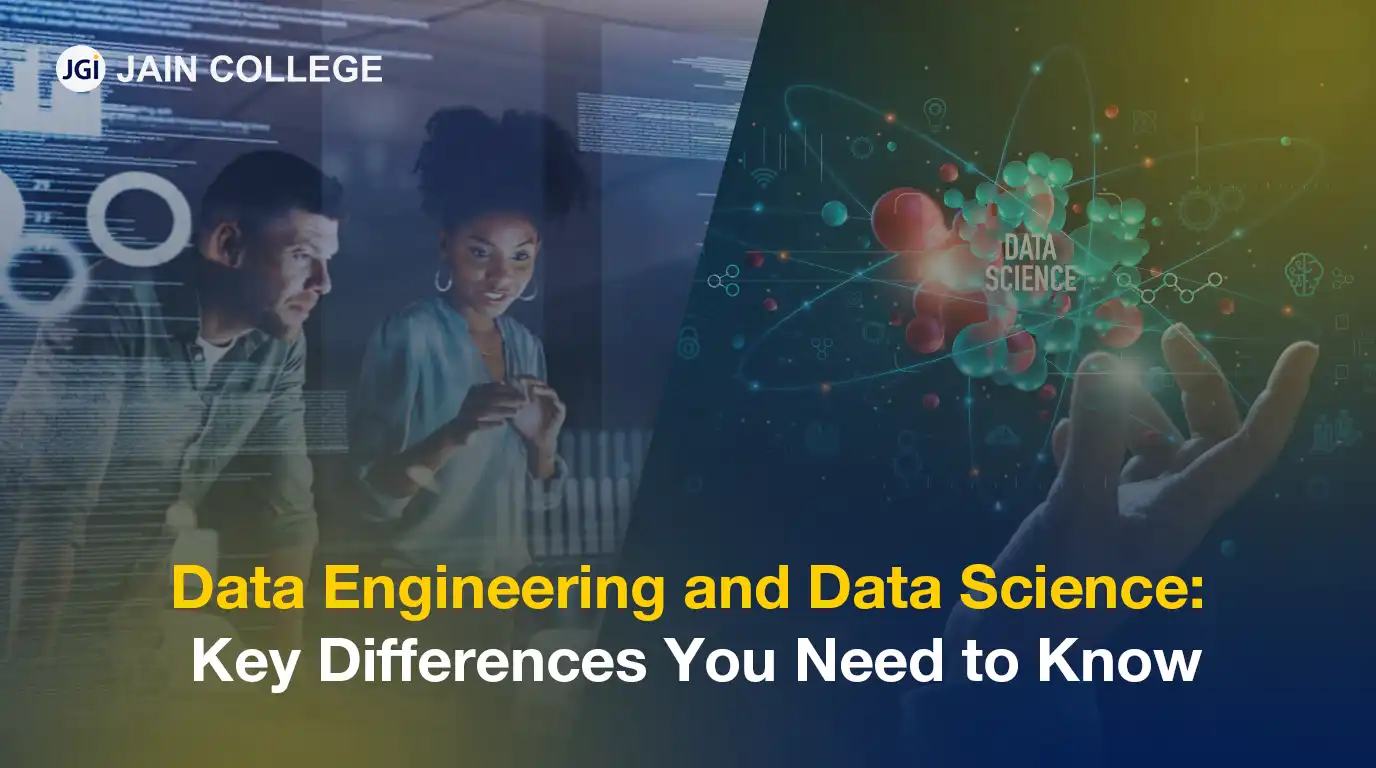
Data engineering and data science are often used interchangeably, where many treat the terms as the same. However, these are two very different fields. Data engineers build the reliable pipelines that make data accessible and usable. The commonly used tools here are Python, Java, Spark, and SQL. In contrast, data scientists are responsible for finding insights that can inform decision-making based on the data. This can be achieved based on strategies that use statistics and Machine Learning. It also includes tools like Tableau, R, Python, and TensorFlow. In simple words, data engineers are responsible for providing data, and data scientists turn it into actionable decisions or innovations. Knowing the differences between data engineering and data science will help you pick the right road after PUC science.
| Data Engineering | Data Science |
| Focuses on building and maintaining the infrastructure required to collect, store, and process large volumes of raw data from multiple sources. | Focuses on analysing clean and structured data to find insights, trends, and patterns that support business decisions. |
| Builds ETL (Extract, Transform, Load) pipelines to move data reliably across systems. | Uses statistical models and machine learning techniques to predict outcomes and uncover relationships in data. |
| Emphasises system reliability, performance optimisation, automation, and long-term efficiency. | Emphasises experimentation, analysis, interpretation, and storytelling with data. |
| Commonly uses programming languages such as Python, SQL, and Java. | Commonly uses Python, R, and SQL for analysis and modelling. |
| Uses big-data and infrastructure tools like Hadoop, Apache Spark, Kafka, Airflow, and dbt. | Uses data analysis and ML tools like Pandas, Scikit-learn, TensorFlow, Tableau, Matplotlib, and Power BI. |
| Focuses more on debugging systems and improving data pipeline efficiency. | Focuses more on communicating insights through reports, dashboards, and presentations. |
| Career growth often leads to roles such as Data Architect or Platform Lead. | Career growth often leads to roles such as ML Engineer, Analytics Director, or Chief Data Officer. |
| Average salary in India ranges from ?15–25 lakhs with experience, driven by high infrastructure demand. | Average salary in India ranges from ?12–22 lakhs, depending on experience and specialisation. |
| Best suited for students who enjoy building systems, solving scalability challenges, and working behind the scenes. | Best suited for students who enjoy working with numbers, analysing data, and turning insights into decisions. |
Data Engineering: The role of data engineers is to build scalable infrastructure to gather, store, and process raw data from many different sources. For later use, they ensure that the data is correct by managing databases and designing ETL (Extract, Transform, Load) processes.
Data Science: The role of data scientists, on the other hand, is to use statistical models, machine learning, and visualisation to look at clean data. It also helps to identify trends and predict what will happen.
Data scientists emphasise experimentation and analysis, while engineers place more emphasis on dependability and efficiency. To handle petabyte-scale data without causing bottlenecks, data engineers automate its flow. Data scientists ask business questions over and over again until the results fit the goals of the strategy. This makes the models better.
Data Engineering: You need to be good at software engineering to do data engineering. You need to know how to use Python, SQL, Java, and tools like Apache Spark, Kafka, and Airflow that work with streams. You need to know how to use cloud systems like AWS S3, Azure Data Lake, or Google BigQuery, as well as data storage and schema design, to do this job.
Data Science: Mathematics and statistics are important parts of any data science course. Not only do you need to know how to use R, but also Python libraries like Pandas, Scikit-learn, and TensorFlow, as well as visualisation tools like Tableau and Matplotlib.
To translate their analysis into business reports, data scientists need to be able to communicate well. Engineers, on the other hand, are great at finding bugs and making systems run more efficiently.
Data Engineers are required to use the Hadoop ecosystem for storage across multiple nodes, Spark for processing, and dbt for transformations. They implement data lakes for unstructured data, making it easier to access the data.
Data scientists explore with Jupyter Notebooks, keep track of experiments with MLflow, and use Power BI for dynamic charts and graphs. In Python/SQL, there is overlap, but engineers grow systems, and scientists make prototypes of models.
When it comes to choosing between data engineering and data science, you will first need to understand your interests. Choose data engineering if you enjoy coding, backend systems, and solving scalability problems. Opt for data science if you enjoy mathematics, statistics, data analysis, and pattern discovery.
Recommended degrees to pursue include BSc Computer Science, BCA, or BE/BTech in Computer Science or IT. You can also focus on internships, projects, and online certifications to refine your skills and improve job readiness.
If you are unsure, start with Computer Science + Python + SQL + Maths. You can determine your specialisation later.
A degree in computer science is often the first step towards becoming a data engineer. Next, you can get training in cloud servers like AWS Certified Data Analytics or big data, like Google Data Engineer. Advanced degrees in statistics and maths can be helpful foundations for data science careers. The ML courses available on Coursera and edX are very popular.
Data engineers, with a few years of experience, make an average of ?15 to 25 lakhs in India. It is more than data scientists, who make an average of ?12 to 22 lakhs.
After working for a few years and updating skills, data engineers can move up to jobs like data architect or platform lead. They are in charge of large systems in such jobs. A data scientist can become an ML engineer, an analytics director, or even a chief data officer, which means they have a say in strategy.
In small teams or organisations, it is possible to find hybrid routes, but specialisation leads to faster growth.
Consider your interests: do you like writing code for systems and figuring out scalability problems? Go into engineering. Enjoy telling stories with statistics and statistical findings? Choose to be a data scientist.
Many students who want to be a data engineer or a data scientist start their foundational journey at the best PU colleges in Bangalore. Get in touch with us to find out more and get expert advice.
Yes, with additional training in systems design, databases, and cloud computing, data scientists can take up engineering roles.
Yes, Python and SQL are essential for both fields, though many data engineers also use more system-level programming.
Salaries for data engineers and data scientists are comparable and depend on experience, specialisation, and location. However, in some markets, data engineers can earn more.
Yes, data science requires deeper knowledge of statistics and mathematical modelling compared to data engineering.

JAIN PU College, a part of the renowned JGI Group, is committed to empowering students with quality education.
Beyond academics, the college ensures its online content reflects the same standard of excellence. Every blog and article is meticulously vetted and proofread by subject matter experts to ensure accuracy, relevance, and clarity. From insightful educational topics to engaging discussions, JAIN PU College's content is crafted to inform, inspire, and add value to its readers, reflecting the institution's commitment to intellectual growth and innovation.
View all Blogs
